Overview

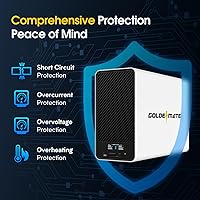
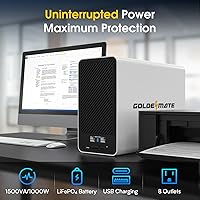
The GOLDENMATE 1500VA/1000W LiFePO4 UPS represents a meaningful shift in how home and small-office users think about battery backup. For years, lead-acid dominated this space simply because it was cheap — but cheap came with trade-offs: bulky units, battery swaps every two or three years, and inconsistent performance over time. This lithium UPS targets the mid-range market, delivering genuine lithium iron phosphate chemistry without enterprise-grade pricing. GOLDENMATE is not a household name like APC, but the brand has been building a focused lineup around lithium power products. Critically, this is a line-interactive pure sine wave unit — a real distinction from the basic standby models that still dominate the budget end of the category.

Features & Benefits

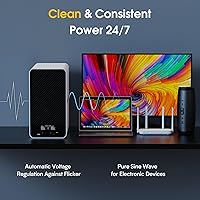
The battery chemistry is worth understanding before anything else. LiFePO4 — lithium iron phosphate — is a type of lithium battery known for stability, long cycle life, and slow degradation. Where a standard sealed lead-acid pack typically needs replacing after two or three years, this LiFePO4 battery backup is rated for over 3,000 charge cycles and roughly a decade of service. The pure sine wave output matters too: sensitive equipment like NAS drives and desktop workstations can behave erratically on the modified waveforms cheaper units produce. Automatic voltage regulation handles brownouts and surges by adjusting output on the fly, sparing the battery for actual outages. Eight outlets with practical spacing and a readable LCD round out a well-considered feature set.

Best For

This lithium UPS is most at home protecting a typical home office stack: a desktop, external monitor, router, and maybe a NAS drive. At 1,000W of real power, it handles that load comfortably and gives you enough runtime to save your work and shut down cleanly during a power cut. IT staff dealing with unstable grid voltage will appreciate the AVR, which does the heavy lifting before the battery even gets involved. That said, be realistic about what this unit is not — it will not carry a high-draw laser printer, a large server rack, or anyone expecting to ride out a multi-hour outage. Think of it as a smart shutdown buffer, not a generator replacement.

User Feedback

Buyers have generally responded well to the GOLDENMATE unit, with its 4.5-star average reflecting real satisfaction rather than early hype. Setup is consistently described as straightforward, and the noticeably lighter weight compared to lead-acid alternatives draws frequent mention, especially from users who have previously dealt with older APC or CyberPower towers. Outlet spacing and LCD clarity come up as genuine quality-of-life wins. On the downside, a recurring complaint is that the automatic PC shutdown feature is Windows-only — Linux and macOS users will need a workaround. Some buyers also note that runtime estimates skew optimistic at heavier loads. The review volume is growing but still modest compared to legacy brands, so drawing firm long-term conclusions takes some caution.

Pros

  • LiFePO4 battery chemistry is rated for over 3,000 cycles, meaning years of use before performance degrades noticeably.
  • Pure sine wave output keeps sensitive electronics safe — no compatibility issues with desktop PCs, NAS drives, or powered speakers.
  • Automatic voltage regulation handles brownouts and surges on the fly, so the battery is preserved for real outages.
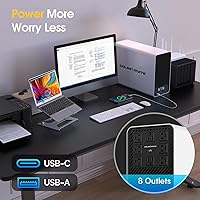
  • Eight outlets with generous spacing means bulky transformer blocks actually fit without crowding neighbors.
  • At 33 pounds, this lithium UPS is meaningfully lighter than lead-acid equivalents at the same power rating.
  • The LCD display gives real-time load and battery status at a glance, with a simple one-button mute when the alarm is not needed.
  • USB-A and USB-C charging ports on the front panel add practical convenience for keeping phones and tablets topped up.
  • Automatic Windows PC shutdown via the communication port requires zero third-party software configuration.
  • No scheduled battery replacements — the LiFePO4 pack is designed to be maintenance-free for the life of the unit.
  • Recharges fully in around four hours, so recovery after an outage is quick.

Cons

  • Runtime under 30 minutes at a 600W load is modest — this is a graceful shutdown buffer, not an extended backup solution.
  • Automatic shutdown via the communication port works on Windows only; Mac and Linux users are left without native support.
  • GOLDENMATE is a newer brand with a shorter track record than established names, so long-term reliability data is still limited.
  • No software dashboard beyond basic Windows integration — power management features are thin compared to competitors with full UPS management suites.
  • Runtime drops significantly as load increases, so buyers running heavier setups may find real-world backup time disappointing.
  • The four-hour recharge window means back-to-back outages in the same day could leave the unit partially depleted.
  • USB charging output is capped at 10W total across both ports, which is slow by modern fast-charging standards.
  • The review base is growing but still smaller than legacy brands, making it harder to spot long-term failure patterns early.
  • No rackmount option — tower-only form factor rules it out for structured IT closet installations.
  • High-draw peripherals like laser printers or gaming monitors with large power bricks can consume available capacity quickly.

Ratings

The GOLDENMATE 1500VA/1000W LiFePO4 UPS scores below are generated by our AI review engine after analyzing verified global buyer feedback, actively filtering out incentivized, duplicate, and bot-flagged submissions to surface what real users consistently experience. Both the strengths that earned this unit a top-25 category ranking and the friction points that temper enthusiasm are reflected transparently in each score. No category has been padded — if buyers found a weakness, it shows up here.
Battery Technology
93%
The LiFePO4 chemistry is the single most praised aspect of this unit across verified reviews. Buyers who previously cycled through lead-acid replacements every two to three years repeatedly describe the long-rated lifespan as a genuine relief — not a marketing claim they have to take on faith, but a measurable shift in how they think about long-term ownership costs.
A small segment of technically minded buyers notes that 296Wh of total capacity, while efficient for the chemistry, is still modest in absolute terms compared to larger lithium systems. Those expecting this to behave like a whole-home battery backup will find the chemistry story compelling but the raw capacity sobering.
Runtime Performance
61%
39%
For users running a lean home office setup — a desktop, monitor, and router drawing around 200 to 300W — the runtime is genuinely adequate to save work, trigger a clean shutdown, and power down gracefully. That targeted use case is well served, and buyers in that scenario report satisfaction with the actual real-world performance.
At heavier loads, runtime drops faster than some buyers anticipated based on the product listing. Users running additional peripherals or a higher-draw workstation report that the under-30-minute figure at 600W is accurate but leaves little margin for anything beyond an immediate controlled shutdown. Expectations mismatch here is the most common source of negative feedback.
Power Output Quality
91%
The pure sine wave output earns consistent praise from buyers connecting NAS drives, audiophile equipment, and variable-speed fan controllers — devices that visibly misbehave on modified waveform units. Multiple reviewers specifically switched to this lithium UPS after experiencing hardware issues with cheaper standby models and describe the difference as immediately noticeable.
There is no meaningful criticism of the output waveform quality itself. The only edge-case complaint comes from buyers who discovered after purchase that their specific load was too high for the 1000W ceiling, which is a capacity issue rather than a waveform one.
Voltage Regulation (AVR)
88%
Buyers in areas with chronic brownouts or noisy grid power report that the automatic voltage regulation handles those conditions silently and without switching to battery — which is exactly the behavior line-interactive topology is designed to deliver. Several IT-adjacent users specifically mention this as the reason they chose this unit over a cheaper standby alternative.
The AVR range is not explicitly published in granular detail, which leaves some buyers uncertain about whether it covers the full range of fluctuations in their specific region. Buyers in areas with extreme or frequent voltage swings would benefit from clearer published tolerance specifications before committing.
Setup & Ease of Use
89%
Plug-and-play setup is consistently described as taking less than five minutes, with no configuration required for basic battery backup operation. The front panel layout is intuitive enough that buyers with no prior UPS experience report feeling confident in what the unit is doing from the moment it powers on.
Setting up the automatic Windows shutdown feature requires navigating Windows power settings, which is straightforward for technically comfortable users but confusing for buyers who expected dedicated UPS management software out of the box. A few reviewers wished for a downloadable utility to simplify that configuration.
Build Quality & Durability
78%
22%
The chassis feels solid for the price tier, and the unit does not produce the plasticky flex or rattling that some buyers associate with lesser-known brands. Reviewers who have had it running continuously for several months report no degradation in performance or unusual sounds from the internal components.
GOLDENMATE is a newer name without the long public track record of APC or CyberPower, which means long-term durability data is still accumulating. A handful of reviewers flag minor cosmetic imperfections on arrival — nothing functional, but worth noting for buyers who expect flawless finish quality at this price point.
Outlet Design & Layout
86%
The wider outlet spacing is a genuinely practical design decision that gets called out positively in a surprising number of reviews. Home office users who have struggled with oversized transformer blocks crowding a standard UPS outlet strip describe the spacing here as an immediate improvement over units from larger brands that ignore this friction point.
All eight outlets are on the back panel only, which means routing cables can get cluttered depending on desk setup. Buyers who wanted at least a couple of front-facing outlets for easier swapping of devices will find the layout less flexible than they hoped.
LCD Display & Monitoring
84%
The display is bright, legible, and shows genuinely useful real-time information — load percentage, battery level, and input voltage — without requiring any software interaction. The integrated mute and display-off button is a small but well-received touch that reduces nighttime disruption for buyers who keep the UPS near a workstation or bedroom office.
The display does not show estimated remaining runtime as a time value, only as a percentage, which some buyers find less immediately useful when trying to judge how long they have during an active outage. A numerical countdown in minutes would be a meaningful upgrade.
Software & Connectivity
63%
37%
For Windows users, the USB communication port delivers on its core promise: the PC will initiate a graceful shutdown through native OS settings when battery hits a defined threshold, with no third-party software required. That is a useful feature for anyone who cannot always be at their desk when the power goes out.
Mac and Linux users are effectively cut off from this feature entirely, and there is no dedicated GOLDENMATE power management application to fill that gap. Compared to APC and CyberPower, which have mature cross-platform software ecosystems, the software experience here is noticeably thin and platform-restricted.
USB Charging Ports
71%
29%
Having a Type-A and Type-C port directly on the front of the unit is a convenient addition that reviewers appreciate for keeping phones and tablets topped up without sacrificing outlet space. The placement is practical and the ports work reliably based on consistent user feedback.
The combined 10W output across both ports is slow by current standards — most modern smartphones charge faster than this USB-C port allows. Buyers expecting anything approaching fast charging will be disappointed; these ports are best thought of as trickle-charge convenience ports rather than primary charging stations.
Noise Level
87%
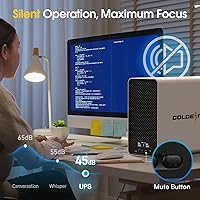
Under normal grid-powered operation, the unit runs essentially silently — no fan noise, no transformer hum that buyers notice in daily use. Reviewers who keep it in home offices or shared workspaces specifically call out quiet operation as a quality-of-life advantage over older units they have used.
The audible alarm during power events is functional but described as sharp and startling by a few users, particularly during overnight outages. The mute button addresses this, but it requires a conscious action at a moment when most people are already scrambling to respond to a power cut.
Weight & Portability
82%
18%
At 33 pounds, this LiFePO4 battery backup is meaningfully lighter than lead-acid competitors at the same power rating, which buyers notice immediately when moving it into position under or beside a desk. The reduced weight is a direct benefit of the lithium chemistry and is consistently mentioned as a positive point of comparison.
33 pounds is still heavy enough to make repositioning awkward for a single person, and there are no handles or carry grips on the unit. Buyers who anticipated something as light as a modern laptop battery bank will need to recalibrate — this is a substantial piece of equipment, just a lighter one than its lead-acid peers.
Value for Money
79%
21%
Buyers who factor in the eliminated battery replacement cost over a 10-year period find the price premium over lead-acid alternatives genuinely justified. When total cost of ownership is the framing, the math tends to favor this unit, and reviewers who think in those terms are among the most satisfied.
At face value, the upfront cost is higher than comparable capacity lead-acid units from APC or CyberPower, and buyers who judge purely on sticker price without considering replacement cycles may feel it is overpriced. The value proposition requires a longer time horizon than many buyers naturally apply when making an initial purchase decision.
Brand Reputation & Support
67%
33%
GOLDENMATE has earned a 4.5-star aggregate rating within a relatively short market presence, and reviewers who have contacted the company with questions describe the support experience as responsive and knowledgeable. The brand is clearly investing in building credibility rather than coasting on minimal effort.
The review volume, while growing, remains considerably smaller than the thousands of reviews that inform confidence in APC or CyberPower products. Long-term reliability conclusions are genuinely harder to draw, and buyers who prioritize proven brand track records over lithium chemistry advantages may still find the lack of established history a meaningful hesitation.

Suitable for:

The GOLDENMATE 1500VA/1000W LiFePO4 UPS is built for the kind of buyer who has already been burned by a dead lead-acid battery at the worst possible moment and wants a longer-term fix. Home office workers running a desktop PC, a monitor, a router, and a NAS drive will find the 1,000W capacity fits their load comfortably, with enough runtime to save work and shut down gracefully when the grid goes out. IT staff or small business owners dealing with frequent voltage fluctuations — brownouts, sags, minor surges — will get real value from the automatic voltage regulation, which corrects those issues without ever touching the battery. Anyone connecting sensitive equipment that demands a clean power signal, like a high-end workstation, audio interface, or network-attached storage, will appreciate the pure sine wave output that cheaper standby units simply cannot provide. If you have been replacing lead-acid battery packs every two or three years and are tired of the cost and hassle, the LiFePO4 chemistry here offers a genuinely compelling alternative with a rated lifespan measured in decades rather than years.

Not suitable for:

The GOLDENMATE 1500VA/1000W LiFePO4 UPS is not the right tool if your goal is riding out extended outages lasting more than 30 minutes — at a 600W load, runtime is modest, and that number drops further as load increases. Anyone hoping to power a laser printer, a large workstation with multiple GPUs, or any high-draw appliance should look elsewhere; those devices can push well past what this unit is rated to handle continuously. Mac or Linux users who want the automatic PC shutdown feature will find it does not work out of the box — the communication port is confirmed compatible with Windows only, and workarounds may be needed for other operating systems. Buyers comparing this unit solely on brand recognition against stalwarts like APC or CyberPower should know that GOLDENMATE is a newer name in the space; the track record exists but is thinner, and long-term reliability data is still accumulating. If your primary concern is maximum runtime for a home server rack or network closet with multiple high-draw devices, a higher-capacity unit or a dedicated battery bank would serve you better.

Specifications

  • Capacity: This unit delivers 1500VA and 1000W of real power, suitable for protecting a typical home office setup including a desktop PC, monitor, router, and NAS drive simultaneously.
  • Battery Type: Uses a Lithium Iron Phosphate (LiFePO4) battery pack rated at 51.2V and 5.8Ah, providing approximately 296Wh of stored energy.
  • Battery Lifespan: The LiFePO4 chemistry is rated for more than 3,000 charge cycles and an operational lifespan exceeding 10 years under normal use conditions.
  • Output Waveform: Produces a pure sine wave output, making it compatible with sensitive electronics including variable-speed motor loads, NAS devices, and high-end desktop workstations.
  • Topology: Line-interactive design with Automatic Voltage Regulation (AVR) continuously corrects minor voltage fluctuations without switching to battery power.
  • Runtime: Provides under 30 minutes of backup runtime at a 600W load at 25°C; actual runtime decreases as connected load increases beyond that threshold.
  • Recharge Time: Returns to a full charge in approximately 4 hours from a fully depleted state under standard conditions.
  • Outlets: Includes 8 NEMA 5-15P outlets, all providing both surge protection and battery backup, with wider-than-standard spacing to accommodate bulky transformer plugs.
  • Communication: Features a USB communication port with an included cable that enables automatic PC shutdown through native Windows power settings when battery runtime is low.
  • USB Charging: Front panel includes one USB Type-A and one USB Type-C charging port, delivering a combined maximum of 10W for charging smartphones, tablets, or accessories.
  • Display: An LCD panel provides real-time monitoring of battery charge level, load percentage, and input voltage, with mute and display-off functions integrated into a single button.
  • Input Voltage: Designed for standard North American 120V AC input using a NEMA 5-15P plug, compatible with standard household and office wall outlets.
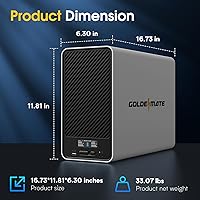
  • Dimensions: The tower unit measures 16.73″ deep, 6.3″ wide, and 11.81″ tall, fitting comfortably beside or under most desks without requiring rack space.
  • Weight: Weighs 33 pounds, which is noticeably lighter than comparable lead-acid UPS units at the same power rating, making placement and repositioning more manageable.
  • Battery Management: Includes a built-in Battery Management System (BMS) that automatically halts charging or discharging if voltage or temperature limits are exceeded.
  • Safety Standards: The unit has undergone third-party safety certification testing and meets applicable industry standards for electrical safety and electromagnetic compatibility.

Related Reviews
APC SMC1500C 1500VA Line Interactive UPS
81%
93%
Power Protection Reliability
91%
Pure Sine Wave Output Quality
88%
Automatic Voltage Regulation
71%
Battery Runtime
74%
SmartConnect Remote Monitoring
More
APC Back-UPS Pro BX1500M 1500VA
79%
83%
Battery Runtime
91%
Voltage Regulation (AVR)
78%
Build Quality & Durability
88%
Ease of Setup
86%
LCD Display & Monitoring
More
APC Smart-UPS SMX1500RM2UNC 1500VA Network UPS
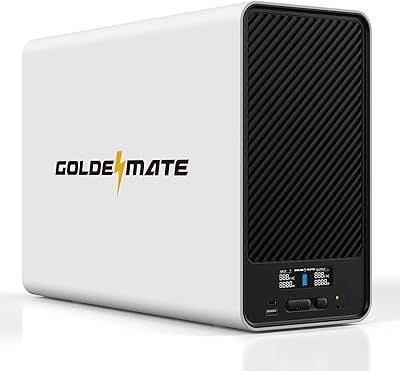
76%
94%
Power Protection Quality
91%
Long-Term Reliability
88%
Network Management Features
79%
Runtime Performance
62%
Installation Experience
More
APC Smart-UPS SMT1500 1500VA Battery Backup
80%
94%
Power Protection Reliability
96%
Pure Sine Wave Output
91%
Automatic Voltage Regulation
68%
Battery Runtime
88%
LCD Display & Monitoring
More
GOLDENMATE 2000VA/1600W LiFePO4 UPS Battery Backup
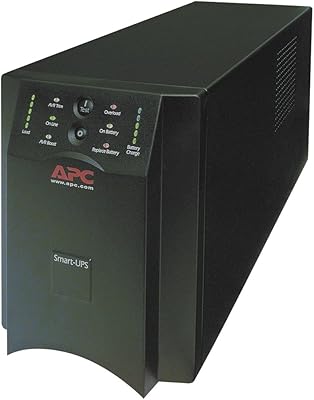
77%
93%
Battery Longevity
91%
Power Output Quality
88%
Voltage Regulation (AVR)
67%
Runtime at Load
84%
Build Quality
More
Tripp Lite SMX1500XLRT2U 1500VA 230V UPS
85%
91%
Battery Backup Performance
89%
Energy Efficiency (ECO Mode)
93%
Surge Protection Reliability
87%
Ease of Setup and Integration
84%
Build Quality / Durability
More
GOLDENMATE 1000VA/600W Lithium UPS Battery Backup
86%
91%
Value for Money
94%
Battery Life
88%
Ease of Use
85%
Build Quality
80%
Performance Under Load
More
Tripp Lite SMART1500LCD 1500VA Rackmount UPS
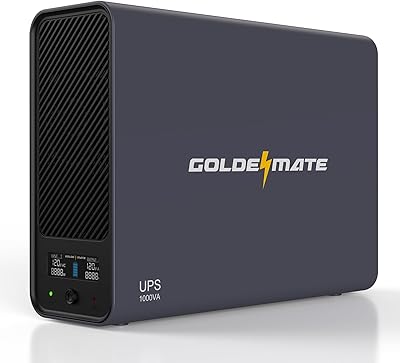
77%
91%
Voltage Regulation (AVR)
93%
Battery Replaceability
54%
Waveform Compatibility
62%
Runtime Under Load
88%
Rack Installation
More
ALEOPIX RT-1000W 1000W Car Power Inverter
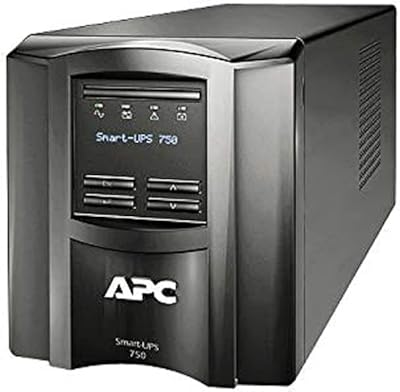
80%
88%
Charging Performance
83%
AC Output Reliability
79%
Build Quality
71%
Noise Level
91%
LED Display Clarity
More
APC SMT750 750VA Smart-UPS Battery Backup
80%
91%
Power Protection Reliability
88%
Pure Sine Wave Output
89%
Automatic Voltage Regulation
62%
Runtime at Load
87%
Build Quality
More

FAQ

That depends almost entirely on what you have plugged in. At a 600W load, expect under 30 minutes of runtime. If your setup draws closer to 300W — a typical desktop, monitor, and router — you can realistically expect somewhere between 30 and 45 minutes. Think of this unit as a graceful shutdown buffer, not a generator replacement.

The automatic PC shutdown via the USB communication port is confirmed to work through native Windows power settings. There is no official documentation confirming macOS or Linux compatibility, so if you are on either of those operating systems, you should plan on finding a third-party UPS management solution or forgo that feature entirely.

LiFePO4 stands for Lithium Iron Phosphate — it is a type of lithium battery that is more stable, longer-lasting, and less prone to degradation than the sealed lead-acid batteries found in most standard UPS units. Where a typical lead-acid pack needs replacing every two to three years, a LiFePO4 battery is rated for over 3,000 charge cycles, which translates to roughly a decade of use without needing a replacement. It also tends to be lighter and handles partial charging better.

Be careful with laser printers — they draw a significant surge of power when fusing toner, often far exceeding their rated wattage for brief moments, which can trip the UPS or overload it. A power-efficient laser printer on a low duty cycle might be okay, but high-volume or older models are risky. A gaming PC with a high-end GPU can also push close to or past the 1000W limit depending on the build, so check your system's actual power draw before connecting it.

During normal operation on wall power, the unit is very quiet — most users report it is essentially silent unless there is a fault or the battery kicks in. The alarm does sound during outages or when load limits are approached, but there is a mute function built into the front panel button that silences it easily.

Instead of switching to battery every time your wall voltage dips or spikes slightly, the line-interactive design uses an internal transformer to boost or trim the voltage in real time without any interruption to your connected devices. This is useful in areas where brownouts or minor voltage fluctuations are common, because it means the battery stays charged and ready rather than cycling unnecessarily during minor grid issues.

From a fully depleted battery, the GOLDENMATE unit takes approximately four hours to recharge completely. If the outage was brief and only partially drained the battery, recharge time will be shorter. Keep in mind that if you experience two back-to-back outages in a short window, the unit may not have had time to fully recover between them.

Yes, and honestly this is one of the best use cases for this unit. NAS drives in particular benefit from a pure sine wave output — some NAS power supplies behave erratically or can be damaged over time on modified waveform UPS units. The GOLDENMATE unit puts out a clean pure sine wave, which is exactly what those devices need, and the runtime is usually sufficient to allow a graceful shutdown of the NAS before drives spin down mid-write.

Not in any practical sense. Unlike lead-acid UPS units where you need to track battery age and plan replacements every few years, the LiFePO4 battery here is designed to be maintenance-free for the life of the unit. There is no battery replacement process to manage and no need to discharge and recondition the battery periodically.

The main differentiator is the battery technology. Most APC and CyberPower units in this price range still use sealed lead-acid batteries, which means you will likely be paying for a replacement battery pack within three years. This lithium UPS sidesteps that cost over time. Where APC and CyberPower have the edge is brand track record, wider software ecosystem support, and deeper third-party compatibility documentation. For buyers who prioritize long-term low maintenance over brand familiarity, the trade-off often favors the LiFePO4 approach.