Overview

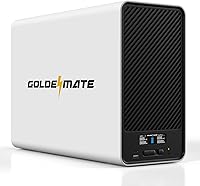
The GOLDENMATE 2000VA/1600W LiFePO4 UPS Battery Backup takes a different approach from the lead-acid units that have dominated this category for decades. By using Lithium Iron Phosphate chemistry, it sidesteps the most frustrating ownership cost of traditional UPS systems: the battery replacement cycle. Lead-acid packs typically need swapping every two to three years; this lithium UPS is rated for over 3,000 charge cycles and a decade of useful life. Runtime expectations matter here — at around 800W of load, you are looking at roughly 30 minutes, enough for a clean shutdown but not a prolonged outage. The all-white enclosure also stands out, looking far less like industrial equipment and more at home on a desk or open shelf.
Features & Benefits

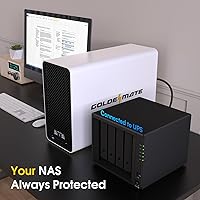
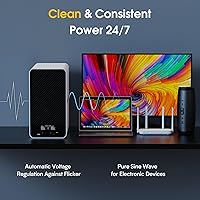
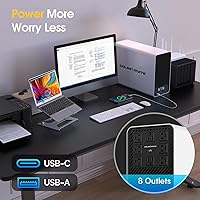
What separates this LiFePO4 battery backup from budget alternatives starts with the output waveform — it produces pure sine wave power, which matters if you are running a modern PC power supply, a NAS, or any device with an active PFC circuit. Many UPS units at this wattage cut corners with simulated sine wave, which can cause audible hum or even damage sensitive equipment. The built-in AVR handles voltage irregularities without touching the battery at all, which is exactly what you want in areas with frequent brownouts. Eight outlets with generously spaced plugs accommodate bulky adapters without forcing compromises, and the USB communication port allows Windows to trigger an automatic shutdown if the battery runs low while you are away from your desk.

Best For

The GOLDENMATE unit makes the most sense for home office users running a desktop workstation, monitor, router, and network-attached storage simultaneously — the 1600W ceiling gives comfortable headroom for that kind of setup. Small business network closets are another strong fit, particularly where VoIP phones and managed switches need both surge protection and ride-through power during brief grid interruptions. It also suits anyone dealing with unstable voltage, where AVR does more day-to-day work than the battery ever will. Where it falls short: this is not a backup generator substitute. If you need more than 30 minutes of runtime or are trying to power high-draw appliances, look elsewhere. It is built for graceful, protected shutdowns — not extended outages.

User Feedback

Early buyers — this LiFePO4 battery backup launched in May 2025, so the review pool is still growing — have responded positively, averaging 4.5 stars. Most praise centers on build quality that feels appropriate for the price tier, a clear and readable LCD panel, and a straightforward initial setup. The wider outlet spacing gets specific mentions as a practical improvement over older UPS designs. On the critical side, a few users note that configuring the Windows auto-shutdown feature requires more steps than expected, and the 10W USB charging output is modest for anyone hoping to top off a laptop. GOLDENMATE is not yet a household name in this space, so those weighing it against established brands should note that long-term reliability data is still accumulating.

Pros

  • LiFePO4 chemistry delivers an estimated 10-year battery lifespan, eliminating the routine replacement cost of lead-acid units.
  • Pure sine wave output protects modern power supplies, NAS drives, and devices with active PFC circuits that simulated sine wave can damage.
  • Automatic Voltage Regulation corrects brownouts and overvoltages on the fly, without draining the battery unnecessarily.
  • Eight outlets with wider-than-average spacing accommodate bulky wall adapters without blocking adjacent plugs.
  • USB communication port and bundled cable allow Windows to trigger automatic PC shutdown during prolonged outages.
  • The all-white enclosure looks far less industrial than typical black tower UPS units, fitting naturally on an open desk or shelf.
  • Real-time LCD display gives clear, at-a-glance status on load percentage and battery level without needing software.
  • Rated for over 3,000 charge cycles, compared to the 200 to 500 cycles typical of sealed lead-acid alternatives.
  • Front-panel Type-A and Type-C USB ports let you keep a phone or tablet charged during an outage without hunting for a separate adapter.

Cons

  • Runtime at heavier loads drops quickly — users running close to 1600W should expect well under 30 minutes of backup time.
  • Configuring the Windows auto-shutdown feature involves more manual steps than expected and lacks a polished setup experience.
  • At 38.5 pounds, this lithium UPS is still substantial enough that placement and repositioning require some effort.
  • The 10W combined USB charging output is too limited for anyone needing to charge a laptop or larger tablet during an outage.
  • GOLDENMATE is a newer brand in the UPS market, so long-term reliability data beyond the first year of ownership is still limited.
  • A five-hour recharge time means a deep discharge during a daytime outage could leave the unit undercharged heading into the evening.
  • No mobile app or network management card is available, which limits remote monitoring for small business or server room deployments.
  • The unit does not support runtime expansion via external battery packs, so the 460Wh capacity is a hard ceiling with no upgrade path.

Ratings

The scores below reflect an AI-driven analysis of verified global buyer reviews for the GOLDENMATE 2000VA/1600W LiFePO4 UPS Battery Backup, with spam, bot activity, and incentivized feedback actively filtered out before scoring. Each category was weighted against real usage patterns reported by home office workers, small business owners, and network equipment operators. Both the standout strengths and the friction points that came up repeatedly in honest buyer accounts are transparently represented here.

Battery Longevity
93%
The LiFePO4 chemistry is the single most praised aspect across all buyer segments. Owners who previously replaced lead-acid batteries every two to three years describe genuine relief at the prospect of a decade-long service life, and the 3,000-plus cycle rating gives technically minded buyers a concrete benchmark to trust.
Because the unit is a relatively new market entry, no buyer has yet confirmed real-world multi-year performance independently. The 10-year estimate remains a specification rather than a lived experience, which leaves some cautious buyers in a wait-and-see posture.
Power Output Quality
91%
Pure sine wave output at this wattage tier earns consistent praise from users running NAS drives, workstation power supplies, and networking gear that would behave unpredictably on simulated sine wave units. Several buyers specifically switched from cheaper UPS alternatives after experiencing equipment noise or instability, and report clean, quiet operation after switching to this lithium UPS.
A small number of users running mixed loads noted that the transition to battery during an outage, while fast, is not quite zero-transfer — extremely sensitive lab or audio equipment may register a brief flicker, though this is uncommon in typical home office environments.
Voltage Regulation (AVR)
88%
Buyers in regions with chronic voltage instability — rural areas, older building infrastructure, storm-prone zones — single out the AVR as the feature that justifies the purchase on its own. The ability to correct sags and surges without drawing on the battery keeps connected equipment stable throughout the day without depleting runtime reserves.
There is no granular feedback on what voltage range triggers AVR correction, and the LCD does not display real-time input voltage in a way that lets users monitor grid stability over time. Those wanting deeper diagnostics will find the reporting somewhat limited.
Runtime at Load
67%
33%
For users whose primary goal is a safe, controlled shutdown during an outage, the runtime is entirely adequate. Home office setups drawing 300 to 500W report comfortable margins — enough time to save work, close applications, and power down gracefully without any panic.
Users running heavier workstations or multiple high-draw peripherals find the 30-minute ceiling at 800W shrinks fast under real conditions. A few buyers expecting extended blackout coverage were disappointed, underscoring that this unit is optimized for shutdown protection rather than prolonged off-grid operation.
Build Quality
84%
The enclosure feels solid for the price tier, and the all-white finish is consistently described as a pleasant surprise — it looks more like modern office equipment than the utilitarian black towers that dominate this category. The outlet panel, in particular, gets specific praise for feeling sturdy and well-engineered.
A few buyers noted that the plastic casing, while visually appealing, shows minor flex under pressure near the ventilation areas. At 38.5 pounds, the unit also feels slightly front-heavy during repositioning, which suggests the internal weight distribution could be more balanced.
Outlet Design
86%
The wider-than-standard spacing between the eight NEMA outlets is a practical improvement that buyers notice immediately. Users running multiple devices with bulky wall adapters — routers, smart switches, external drives — report that all eight slots remain genuinely usable simultaneously without adapters blocking each other.
All eight outlets are battery-backed, which is generous, but the lack of any surge-only outlets means users cannot connect lower-priority devices without drawing on the battery budget. Some buyers would prefer a split configuration with a dedicated surge-only bank for peripherals like printers.
LCD Display
82%
18%
The display is praised for legibility and the practical usefulness of its real-time load percentage readout, which helps users figure out whether they are staying within safe capacity limits. Setup buyers particularly appreciate being able to see battery charge status at a glance without launching any software.
The LCD does not automatically stay on — it requires a button press to activate — which means you cannot passively monitor status without interacting with the unit. The display is also not visible from a distance in a bright room, limiting its utility as a wall-mounted status indicator.
PC Shutdown Integration
63%
37%
When it works, the Windows auto-shutdown feature is genuinely useful for users who leave workstations unattended — the unit communicates over USB and can trigger a graceful OS shutdown before the battery runs out, which is exactly the kind of protection an unmonitored server room needs.
The setup process is frustratingly underdocumented. Multiple buyers report spending significant time navigating Windows power settings to get the feature working correctly, and the included instructions do not walk through the process step by step. Mac and Linux users get no official support at all.
USB Charging Ports
58%
42%
Having a Type-A and Type-C port on the front panel is a thoughtful convenience feature for keeping a phone or small tablet charged during an outage, and the placement on the front face makes them easy to access without reaching around the unit.
The combined 10W output is the most commonly cited disappointment. In practice, 10W charges a modern smartphone slowly and cannot meaningfully charge any laptop. Buyers who anticipated using this for notebook backup during outages were let down, and the output feels undersized relative to the overall capability of the unit.
Setup & Ease of Use
81%
19%
Physical setup is straightforward — plug in, power on, connect devices. The plug-and-play hardware experience is consistently praised, and buyers report that the unit is operational within minutes of unboxing without needing to consult a manual for basic operation.
The experience diverges once buyers move beyond the hardware basics. Configuring communication features, interpreting alarm patterns, and understanding the mute-plus-LCD combined button behavior all require more patience than the documentation provides. The manual is functional but thin.
Noise Level
77%
23%
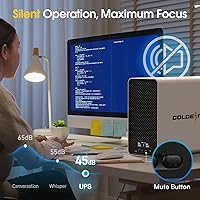
Under normal line-powered operation, the GOLDENMATE unit runs quietly — the fan is either off or barely audible in most home office environments, which buyers appreciate when the unit sits close to a desk. The mute function for the alarm also works reliably according to most owners.
When the fan spins up under heavy load or during recharging after an outage, it is noticeably audible in a quiet room. A handful of buyers in open-plan spaces or shared offices found the recharge fan cycle disruptive, particularly late at night after an evening power event.
Recharge Time
72%
28%
The approximately five-hour full recharge time is acceptable for most home and office scenarios where outages are infrequent. Buyers who experience one outage per month or less report no practical inconvenience from the recharge window.
In areas with repeated daily brownouts or short outages, a five-hour recharge cycle can become a real operational concern — the unit may not reach full charge before the next grid event. There is no fast-charge option, and the recharge rate is not adjustable.
Value for Money
79%
21%
Buyers who calculate total cost of ownership over five to ten years — factoring in zero battery replacements and reduced equipment damage risk — consistently rate this lithium UPS as strong value compared to lead-acid alternatives at similar wattage. The pure sine wave output at this price point is also seen as delivering features usually found in more expensive units.
The upfront cost is a genuine barrier compared to entry-level lead-acid UPS units, and buyers who only need occasional outage protection for a single PC may find it difficult to justify. GOLDENMATE is also a newer brand, which introduces some risk premium for buyers who associate reliability with established names.
Brand Confidence
61%
39%
Early adopters are largely satisfied with what they received, and the 4.5-star average from initial buyers reflects a product that delivers on its core promises out of the box. The hardware quality and feature set compare favorably against better-known competitors at this price range.
GOLDENMATE does not yet carry the decade-long service track record that brands like APC or CyberPower have built. Buyers making purchasing decisions for critical business infrastructure note the absence of long-term reliability data and established customer support infrastructure as meaningful concerns.

Suitable for:

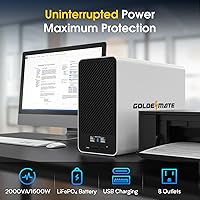
The GOLDENMATE 2000VA/1600W LiFePO4 UPS Battery Backup is built for people who have grown tired of the recurring cost and hassle of lead-acid battery replacements and want a UPS that genuinely lasts. Home office workers running a desktop PC, a monitor, a router, and a NAS drive will find the 1600W capacity comfortably handles that combined load, with AVR quietly managing voltage irregularities before the battery ever gets involved. It is also a strong fit for small business owners who need dependable clean power for network switches, VoIP equipment, or point-of-sale systems without dedicating someone to ongoing UPS maintenance. Users in regions with chronic brownouts or unstable utility power will benefit especially from the line-interactive topology, which corrects voltage sags and spikes continuously rather than just during full outages. Anyone prioritizing long-term ownership economics over the lowest upfront cost will find the lithium chemistry makes a compelling case over a multi-year horizon.
Not suitable for:

The GOLDENMATE 2000VA/1600W LiFePO4 UPS Battery Backup is not the right tool if your primary goal is surviving extended power outages. At a real-world load of 800W or more, runtime tops out around 30 minutes — enough for a safe shutdown, but not for riding out a two-hour blackout with a full workstation running. Users hoping to power high-draw appliances like space heaters, laser printers at full duty cycle, or large workstation GPUs under sustained load should carefully audit their wattage before purchasing, as running close to the 1600W ceiling will compress runtime significantly. Those who strongly prefer purchasing from long-established UPS brands with decades of field data may feel uncertain about a newer market entrant, which is a fair consideration even given the strong early reviews. It is also not a fit for anyone expecting the front-panel USB ports to charge a laptop — the combined 10W output is fine for phones but falls short of most notebook charging requirements.
Specifications

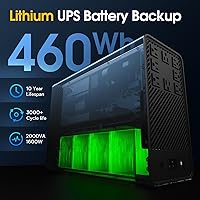
  • Capacity: This unit delivers a maximum continuous output of 2000VA and 1600W, suitable for powering a full home office workstation setup simultaneously.
  • Battery Type: The internal battery uses Lithium Iron Phosphate (LiFePO4) chemistry, which is more thermally stable and longer-lived than conventional sealed lead-acid alternatives.
  • Battery Pack: The integrated pack is rated at 51.2V and 9Ah, providing a total usable energy capacity of approximately 460.8Wh.
  • Cycle Life: The LiFePO4 cells are rated for more than 3,000 full charge-discharge cycles before meaningful capacity degradation, corresponding to an estimated service life of around 10 years under normal use.
  • Runtime: At a continuous load of approximately 800W, expected runtime is up to 30 minutes; actual runtime will be shorter at higher loads and longer at lighter loads.
  • Charge Time: A full recharge from a depleted state takes approximately 5 hours under standard conditions.
  • Output Waveform: The unit outputs a pure sine wave, making it compatible with active PFC power supplies, NAS devices, and other electronics that require clean AC waveform.
  • Topology: Line-interactive design with Automatic Voltage Regulation (AVR) continuously corrects input voltage sags and surges without switching to battery power.
  • Outlets: Eight NEMA 5-15P outlets are provided, all of which offer both battery backup and surge protection, with wider-than-standard spacing between ports.
  • Communication: A USB communication port and cable are included, enabling the UPS to interface with a Windows PC for automated graceful shutdown during extended outages.
  • USB Charging: Two front-panel USB charging ports are included — one Type-A and one Type-C — delivering a combined maximum of 10W for charging small personal devices.
  • Display: An integrated LCD panel provides real-time readouts of input voltage, output load percentage, battery charge level, and estimated runtime.
  • Input Voltage: Designed for North American 110V AC input; not compatible with 220–240V electrical systems without a separate step-down transformer.
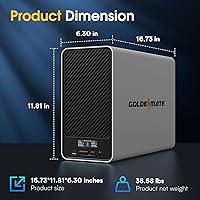
  • Dimensions: The physical footprint measures 16.73″ deep, 6.3″ wide, and 11.81″ tall, which is relatively compact for a 1600W-class UPS.
  • Weight: The unit weighs 38.5 pounds, which is lighter than a comparable lead-acid UPS of the same output rating but still requires care when repositioning.
  • Color: Available in white, distinguishing it visually from the all-black industrial aesthetic typical of most UPS units in this class.
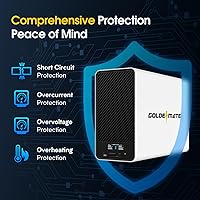
  • Safety Features: An integrated Battery Management System (BMS) monitors for overcharge, over-discharge, overcurrent, and thermal conditions, automatically halting operation if limits are exceeded.

Related Reviews
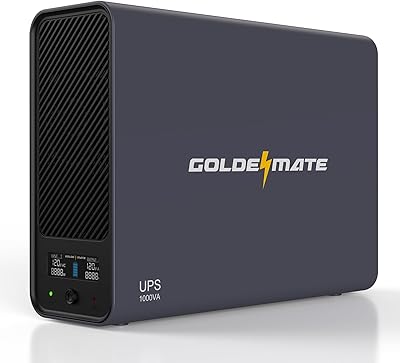
GOLDENMATE 1000VA/600W Lithium UPS Battery Backup
86%
91%
Value for Money
94%
Battery Life
88%
Ease of Use
85%
Build Quality
80%
Performance Under Load
More
APC SMT750 750VA Smart-UPS Battery Backup
80%
91%
Power Protection Reliability
88%
Pure Sine Wave Output
89%
Automatic Voltage Regulation
62%
Runtime at Load
87%
Build Quality
More
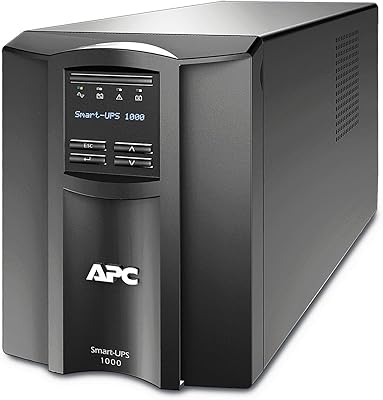
APC Smart-UPS SMT1000 1000VA Battery Backup
80%
93%
Build Quality
91%
Power Protection
89%
Voltage Regulation
82%
Runtime & Capacity
67%
Value for Money
More
APC Back-UPS Pro 1000VA UPS Battery Backup BX1000M
83%
92%
Reliability during Power Outages
88%
Ease of Setup
85%
Build Quality
90%
Surge Protection
80%
Energy Efficiency
More
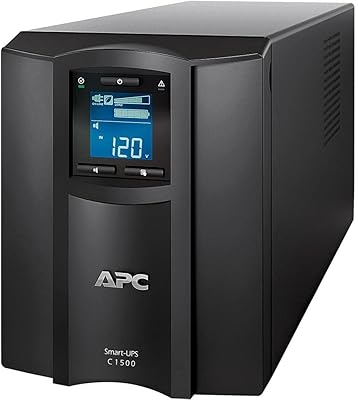
APC SMC1500C 1500VA Line Interactive UPS
81%
93%
Power Protection Reliability
91%
Pure Sine Wave Output Quality
88%
Automatic Voltage Regulation
71%
Battery Runtime
74%
SmartConnect Remote Monitoring
More
APC Back-UPS Pro BX1500M 1500VA
79%
83%
Battery Runtime
91%
Voltage Regulation (AVR)
78%
Build Quality & Durability
88%
Ease of Setup
86%
LCD Display & Monitoring
More
CyberPower BRG1500AVRLCD2 UPS Battery Backup
86%
88%
Overall Performance
90%
Reliability
68%
Battery Runtime
94%
Ease of Setup
92%
Surge Protection
More
CyberPower OR2200PFCRT2U 2000VA Sinewave UPS
76%
93%
Power Protection Quality
96%
Pure Sine Wave Output
67%
Battery Runtime
84%
Build & Physical Durability
58%
Installation & Setup
More
CyberPower CP900AVR UPS Battery Backup
78%
93%
Voltage Regulation (AVR)
91%
Power Protection Reliability
58%
Battery Runtime
84%
Outlet Layout & Flexibility
79%
Build Quality & Durability
More
Eaton 5S1500LCD 1500VA UPS Battery Backup
78%
91%
Voltage Regulation (AVR)
67%
Battery Runtime
83%
Noise Level
78%
Outlet Layout & Quantity
86%
LCD Display & Monitoring
More

FAQ

It depends on how much power your equipment draws. A typical home office setup — a mid-range desktop, a monitor, and a router — might pull 300 to 500W combined, which could give you anywhere from 45 minutes to over an hour of runtime. If your workstation is closer to 800W under load, expect roughly 30 minutes. The heavier the load, the shorter the runtime, so it pays to add up your connected device wattages before assuming best-case numbers.

Not for a very long time under normal use. The LiFePO4 cells are rated for more than 3,000 charge cycles and an estimated 10-year service life, which is a completely different ownership experience from lead-acid UPS batteries that typically need replacement every two to three years. That said, no battery lasts forever — if you are cycling it heavily during frequent outages, capacity will eventually decline, just much more slowly than with older chemistry.

Yes. The pure sine wave output makes this lithium UPS a safe choice for NAS devices, modern workstation power supplies, and any equipment with an active Power Factor Correction circuit. Simulated sine wave UPS units can cause problems with these devices — pure sine wave avoids that entirely.

You connect the included USB cable between the UPS and your Windows PC, then configure the shutdown behavior through Windows power settings — specifically the battery and power options in the Control Panel. A few buyers have noted this process is less intuitive than expected, so plan to spend 10 to 15 minutes working through it. It does not require third-party software on Windows, but the steps are not well-documented in the included materials.

The automatic shutdown feature via the communication port is officially designed for Windows. On macOS, you may be able to configure shutdown behavior using the built-in Energy Saver UPS settings if the unit is recognized as a USB UPS device. Linux users can explore compatibility with tools like NUT (Network UPS Tools), though this is not an officially supported configuration and results will vary.

Laser printers are notoriously power-hungry at startup — many draw 800W or more during the fusing cycle. While the 1600W output can technically handle most home laser printers, doing so will significantly reduce runtime for everything else connected. If your printer is used frequently during the day, it is worth considering whether it needs battery backup at all, or whether it would be better left on a surge-only strip while your core devices stay on this UPS.

The alarm is audible enough to get your attention in a quiet room, which is the point. The good news is that the mute function and LCD control are combined into a single accessible button, so silencing it is quick once you know the power is out and have decided how to respond. If you are using it in a bedroom or sleeping area at night, this is worth factoring into your placement decision.

Technically you can, but it is not recommended. Daisy-chaining power strips through a UPS outlet can create fire hazards and will void most warranties. More practically, you should not exceed the 1600W total output limit regardless of how many devices you connect. If eight outlets genuinely are not enough, consider which devices actually need battery backup versus surge protection only, and use a separate surge protector for the lower-priority items.

The GOLDENMATE unit is designed for 110V North American electrical systems, so it is not plug-compatible with 220–240V grids used across most of Europe, Asia, and other regions without an additional step-down transformer. The NEMA 5-15P outlet type is also North American standard. International buyers should verify compatibility carefully before purchasing.

Actually, this is one of its stronger use cases. The line-interactive AVR topology is specifically designed to handle voltage sags and overvoltages continuously, correcting them without switching to battery power at all. That means the battery stays in reserve for actual outages, while your equipment gets clean, stable voltage throughout the day. If brownouts are your primary concern rather than extended blackouts, the AVR feature alone justifies considering this LiFePO4 battery backup seriously.