





Overview
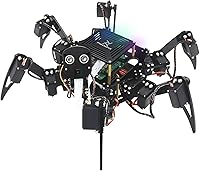
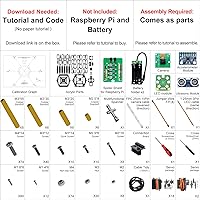
The Freenove Big Hexapod Robot Kit is one of the more ambitious Raspberry Pi robotics projects on the market, designed for hobbyists and STEM learners who want to build something that actually walks. Eighteen servo motors — three per leg — give the machine a fluid, multi-directional gait that's genuinely impressive to watch in motion. This hexapod kit supports a wide range of Raspberry Pi boards, from the latest Pi 5 down to the older 3B and even the Zero 2 W with some extra parts. One thing to be clear about upfront: assembly is required, and neither a Raspberry Pi nor a battery is included. That's completely standard in the maker world, but worth knowing before you order.
Features & Benefits
Each of the six legs is driven by three dedicated servo motors, giving the walking robot kit enough mechanical range to move in multiple directions and maintain balance on its own. The rotating head is one of the more practical design choices — it holds both a camera module and an ultrasonic distance sensor, so the robot can scan its environment while moving. Face recognition is built into the Python software stack, though performance varies depending on the Pi model and ambient lighting. Control is handled through the Freenove app, available on Android, iOS, and desktop operating systems. The entire codebase is open-source, which means programmers can dig in and customize behavior well beyond what the tutorial covers.
Best For
This six-legged build is a strong fit for Raspberry Pi users who've already gotten comfortable with GPIO projects and want a genuine mechanical challenge next. STEM educators and parents will find it works well as an extended project for older teens and adults — it's complex enough to be educational without being inaccessible. Python developers who want a real physical platform to experiment with computer vision or sensor integration will get a lot out of it. That said, if you've never worked with servo motors, written a line of Python, or assembled any electronics kit before, this probably isn't the right starting point. The learning curve is real, and that's not a knock — it's just honest.
User Feedback
Among the 372 ratings that have accumulated since 2020, the kit holds a solid 4.3-star average — and reading through the reviews, the praise tends to cluster around build quality and the depth of the downloadable tutorial. Assembly typically takes between four and eight hours, and most people who've finished it describe the process as genuinely satisfying rather than frustrating. The sticking points? Servo calibration trips up a fair number of builders the first time through, and figuring out the right battery setup is a recurring source of confusion — the tutorial covers it, but it's not prominently flagged. Face recognition and app responsiveness get mixed marks, with better results reported on the Pi 4 and Pi 5 than on older boards.
Pros
- All 18 servo motors are included in the kit, giving you everything needed for full six-legged movement out of the box.
- The downloadable tutorial is genuinely detailed, with step-by-step assembly instructions and complete Python code included.
- Wide Raspberry Pi compatibility means you can likely use a board you already own rather than buying something new.
- The open-source codebase makes it easy to customize behavior, add features, or use the kit as a learning sandbox.
- Wireless app control works across Android, iOS, and desktop operating systems without needing extra hardware.
- The rotating head with a built-in camera and ultrasonic sensor adds real functionality beyond just walking.
- Build quality is consistently praised by reviewers — the mechanical parts feel solid and well-manufactured.
- Self-balancing capability gives the walking robot kit a level of mechanical sophistication rarely seen at this price tier.
- The combination of physical assembly and Python programming makes it a genuinely educational project from start to finish.
Cons
- No Raspberry Pi or battery is included, so your total out-of-pocket cost is higher than the kit price alone suggests.
- Battery configuration is poorly explained upfront — many buyers have to dig into the tutorial before understanding what to buy.
- Assembly typically takes four to eight hours, which can feel overwhelming if you underestimate the commitment involved.
- Servo calibration is a fiddly, time-consuming step that catches many first-time builders off guard.
- Face recognition performance is inconsistent and noticeably weaker on older Raspberry Pi models or in low-light conditions.
- There is no printed manual in the box — if you lose the download link or have connectivity issues, getting started becomes harder.
- The app control experience has received mixed reviews, with some users reporting lag or connectivity hiccups depending on their device.
- Beginners without prior Python experience will struggle to get meaningful value from the customization features.
- At nearly six pounds packaged, the kit is bulkier than expected, which matters if you're buying it as a gift to ship.
Ratings
The scores below were generated by AI after analyzing verified buyer reviews for the Freenove Big Hexapod Robot Kit from across multiple global markets, with spam, bot-submitted, and incentivized feedback actively filtered out before any scoring was applied. Each category reflects the honest distribution of real user experiences — strengths are credited where they're earned, and friction points are reported without softening. The result is a transparent, balanced picture of where this six-legged build genuinely delivers and where it asks more of you than the product page implies.
Build Quality
Assembly Experience
Tutorial & Documentation
Value for Money
Ease of Use
Servo Performance
Camera & Sensor Integration
Face Recognition
App Control
Software & Customizability
Compatibility
Packaging & Unboxing
Educational Value
Suitable for:
The Freenove Big Hexapod Robot Kit is built for people who've already got some Raspberry Pi experience under their belt and are ready to tackle something genuinely complex. If you've wired up a few GPIO projects, written basic Python scripts, and want a mechanical challenge that produces something impressive at the end, this kit delivers exactly that. STEM educators will find it works particularly well as a multi-week classroom or after-school project for motivated teens and older students — the build process teaches servo control, sensor integration, and computer vision in a hands-on way that no textbook can replicate. Python developers who want a physical platform to experiment with real-time camera feeds, ultrasonic ranging, or wireless communication will find plenty to work with here, especially with the open-source codebase available to modify. Parents shopping for an ambitious holiday or birthday gift for a tech-minded teenager will also find this a rewarding choice, provided that teenager has the patience for a multi-hour assembly and some prior coding exposure.
Not suitable for:
If you're new to electronics, robotics, or Python programming, the Freenove Big Hexapod Robot Kit is likely to frustrate more than it teaches at this stage of your journey. This is not a kit you assemble in an afternoon and hand to a child to play with — it requires careful servo calibration, comfort reading technical documentation, and the ability to troubleshoot when things don't behave as expected. The absence of a Raspberry Pi and battery in the box means additional purchases are necessary before you can even power it on, and figuring out the right battery configuration has tripped up more than a few first-time buyers. Users hoping for polished, consumer-grade face recognition will likely be disappointed — the feature works, but its reliability depends heavily on which Pi model you use and the lighting conditions in your space. Anyone looking for a simple, ready-to-run robot toy should look elsewhere; this is fundamentally a builder's project, not a finished product.
Specifications
- Brand: This kit is manufactured and sold by Freenove, a brand focused on educational electronics and Raspberry Pi accessories.
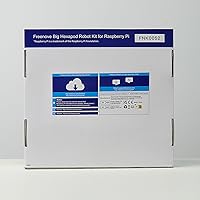
- Model Number: The official model designation is FNK0052, which can be used to identify compatible accessories and documentation.
- Compatibility: Fully supported Raspberry Pi models include the Pi 5, 4B, 3B+, 3B, and 3A+; the Zero 2 W, Zero W, and older boards are compatible but require additional parts not included in the kit.
- Servo Motors: The kit includes 18 servo motors in total, with three dedicated motors per leg enabling multi-directional movement and self-balancing capability.
- Head Unit: The rotating head assembly holds both a camera module and an ultrasonic distance sensor, allowing the robot to detect obstacles and capture video simultaneously.
- Control Methods: The robot can be controlled wirelessly via the Freenove app on Android, iOS, Windows, macOS, or Raspberry Pi OS.
- Programming Language: All provided example code and the downloadable tutorial are written in Python, making it accessible to anyone familiar with that language.
- Power Requirements: The kit operates at 5 Volts and requires a rechargeable battery pack, which is not included and must be purchased separately.
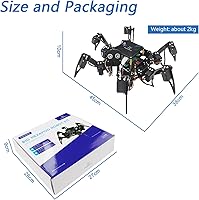
- Package Weight: The complete kit package weighs 5.85 pounds, reflecting the substantial number of mechanical and electronic components included.
- Package Dimensions: The box measures 10.91 x 10.12 x 3.54 inches, making it a moderately sized package suitable for gift wrapping or storage.
- Tutorial Format: The tutorial is provided as a downloadable PDF and Python code bundle accessed via a link printed on the product box; no printed manual is included.
- Wireless Type: Wireless communication relies on a combination of infrared and app-based control, depending on the control method selected.
- Assembly Required: Full assembly is required before the robot is operational, with the process typically taking between four and eight hours for most builders.
- Raspberry Pi: A Raspberry Pi board is not included in the kit and must be sourced separately before the robot can be powered or programmed.
- Date Available: This kit was first made available for purchase in October 2020 and has since accumulated over 370 customer ratings on Amazon.
Related Reviews
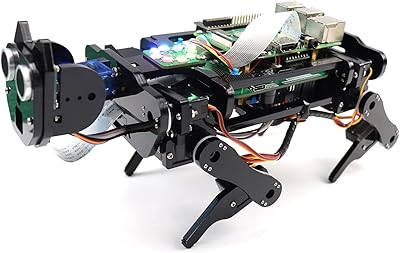
FREENOVE Robot Dog Kit FNK0050
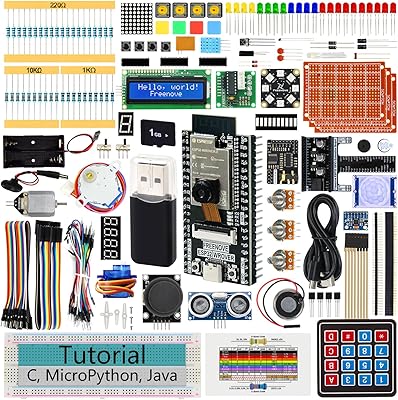
Freenove ESP32-WROVER CAM Board Ultimate Starter Kit (FNK0047B)
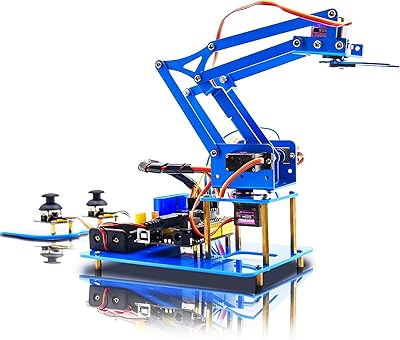
KEYESTUDIO 4DOF Robot Arm Arduino Kit
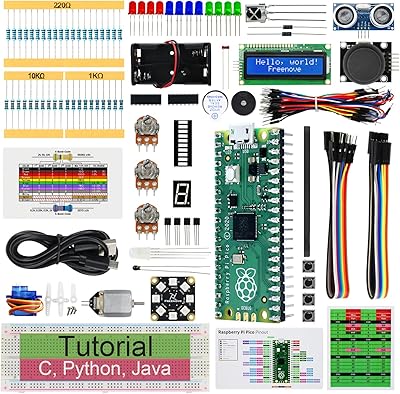
FREENOVE Super Starter Kit for Raspberry Pi Pico
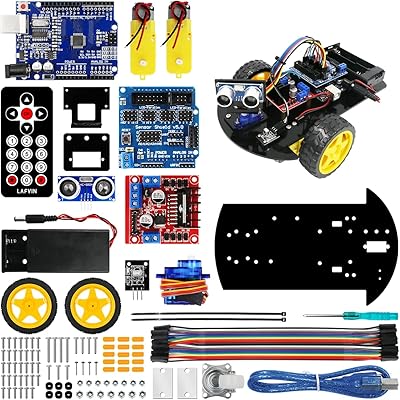
LAFVIN LA-018 2WD Smart Robot Car Kit

Convenience Kits International Men & Women Travel Toiletry Kit 2-Pack

DIY Gift Kits Bath Bomb Making Kit

TUBeauty Lash Lift Kit Eyelash Perming Kit

Proactiv ProactivMD Adapalene Gel Acne Kit