Overview

The FoMaKo FMK20SDI Gen 3 PTZ Camera sits firmly in the mid-to-high range of the PTZ market, targeting churches, educators, and live streaming operators who need reliable, unmanned coverage. The third-generation AI tracking is the headline upgrade over earlier models, and the switch to a gear-drive mechanism — rather than the belt-drive found in many rivals — is pitched as a meaningful durability and precision improvement, though that claim comes from the manufacturer rather than independent testing. Setup is notably straightforward: a built-in LCD screen displays the IP address and current resolution on boot, saving real guesswork on first install. One important caveat worth knowing before you buy: NDI support is technically present but locked behind an additional paid license key.
Features & Benefits

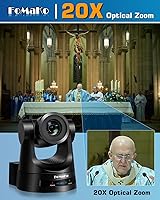
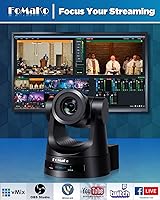
The 20x optical zoom is one of the first things you notice in practice — subjects stay crisp throughout a full zoom sweep, and the autofocus recovers quickly after a pan, which matters in live environments where a soft shot is not an option. Outputs are genuinely comprehensive: HDMI, 3G-SDI, USB 3.0, and IP streaming can all run simultaneously, covering broadcast switchers, recording rigs, and software like vMix or OBS without extra adapters. The Gen 3 tracking controls are unusually granular for this price tier — dial in sensitivity, limit movement to the horizontal axis, set a lost-target behavior, or click to switch subjects mid-stream. PoE support simplifies wiring significantly, especially in venues where running a separate power line to a ceiling mount would be costly or complicated.

Best For

This PTZ camera makes the most sense for small-to-medium churches that want capable, unmanned camera coverage without staffing a camera operator for every service. Educators broadcasting solo lectures or training sessions will also find it well-suited — the auto-tracking keeps the frame on the presenter throughout without any manual adjustment needed. Esports venues and live event operators will appreciate the fast, accurate preset recall that the gear-drive system enables. On the software side, the FoMaKo PTZ unit integrates cleanly with vMix and OBS over USB or IP, and organizations already running PoE infrastructure can drop this into an existing network with minimal extra cabling or installation cost.

User Feedback

Buyers consistently mention tracking responsiveness and color accuracy as standout positives, particularly in worship settings where skin tones under mixed lighting can be tricky to render faithfully. Users who have owned belt-drive competitors offer favorable comparisons on preset positioning precision. On the critical side, the NDI paywall is the most repeated complaint — at this price point, many buyers assume NDI is included outright, and discovering otherwise after purchase tends to sting. The remote control has a real learning curve; first-time PTZ users often need a session or two to get comfortable with speed zones and preset controls. After-sales support, however, earns consistent praise, with most reviewers reporting helpful, timely responses from the FoMaKo team.

Pros

  • Gen 3 AI tracking offers unusually fine-grained controls, including sensitivity adjustment, horizontal-only mode, and customizable lost-target behavior.
  • PoE support simplifies permanent installations dramatically, eliminating the need to run separate power cables to ceiling or wall mounts.
  • Simultaneous HDMI, 3G-SDI, USB 3.0, and IP outputs cover virtually every live production workflow without extra adapters or splitters.
  • The built-in LCD screen displays the IP address and resolution on startup, cutting setup time significantly for non-technical users.
  • 20x optical zoom with fast autofocus keeps subjects sharp even during active panning and zoom transitions in live environments.
  • H.264 and H.265 encoding keeps streams smooth and manageable even on venues with constrained or shared network bandwidth.
  • The gravity sensor automatically flips the image when ceiling-mounted, removing a common configuration headache.
  • A 3-year limited warranty and responsive after-sales support give buyers meaningful peace of mind for a fixed installation investment.
  • Gear-drive mechanics, per the manufacturer, deliver more accurate and repeatable preset positioning than belt-drive alternatives.
  • Default DHCP configuration means the camera is discoverable on most networks immediately, with no manual IP setup required to get started.

Cons

  • NDI is not included in the base purchase; unlocking it requires buying a separate license key, which feels like a hidden cost at this price tier.
  • The remote control has a genuine learning curve, and first-time PTZ users may need several sessions before the speed and preset controls feel intuitive.
  • Maximum resolution is capped at 1080p60, which is a real limitation for productions that require 4K output.
  • The gear-drive durability advantage is a manufacturer claim and has not been independently verified, so long-term reliability data remains limited.
  • At over three pounds and nearly seven inches tall, this PTZ camera is strictly a fixed-install unit and not practical for mobile or travel use.
  • Web interface controls, while functional, feel dated compared to some competitors and may frustrate operators managing multiple cameras remotely.
  • The included power adapter and cabling are basic, and buyers running longer cable runs or more demanding setups may need to source better components separately.
  • No onboard recording to SD card is mentioned as a functional feature in current configurations, limiting standalone operation options.

Ratings

The scores below for the FoMaKo FMK20SDI Gen 3 PTZ Camera were generated by AI after analyzing verified purchase reviews from buyers worldwide, with spam, bot-submitted, and incentivized feedback actively filtered out. Ratings reflect the full picture — where this auto-tracking camera genuinely delivers and where real users have run into friction. Both the strengths and the legitimate pain points are weighted honestly.
AI Auto-Tracking
83%
In church and classroom settings, the Gen 3 tracking handles a single moving presenter reliably, keeping the subject well-framed without operator intervention. The ability to fine-tune sensitivity, restrict movement to horizontal only, and define what the camera does when it loses a subject gives operators meaningful control over live output.
Tracking can struggle when multiple people move through the frame simultaneously or when a subject moves very quickly toward the edges. In high-contrast lighting environments, the system occasionally latches onto the wrong person before self-correcting, which is disruptive during a live broadcast.
Image Quality
79%
21%
Color accuracy is a recurring highlight in user feedback, particularly in worship venues with mixed stage lighting where skin tones are notoriously difficult to render faithfully. The 1080p60 output is clean and motion remains sharp during panning and zoom transitions, which is where many competing cameras at this tier show visible softness.
The 1080p ceiling is a real limitation for buyers who anticipated a higher-resolution output given the price point. Dynamic range in very high-contrast scenes — a bright window behind a speaker, for example — can result in clipped highlights or lifted shadows that require post-processing to correct.
Zoom Performance
86%
The 20x optical zoom reaches comfortably across a mid-to-large sanctuary or lecture hall while the autofocus recovery after zooming is noticeably fast compared to many competitors in this class. Subjects remain sharp throughout the zoom range, which matters significantly in live scenarios where a soft shot cannot be retaken.
At the far end of the 20x zoom range, minor focus hunting can appear momentarily in low-light conditions before the system locks. The digital zoom extension beyond optical range produces the expected quality drop and is best avoided in any broadcast-quality application.
Connectivity & Outputs
91%
Simultaneous HDMI, 3G-SDI, USB 3.0, and IP output is genuinely rare at this price tier and eliminates the need for signal splitters or additional capture devices in multi-destination workflows. OBS and vMix users consistently report clean, stable signal recognition over both USB and IP without needing additional drivers or configuration.
The IP streaming interface, while functional, feels dated in its web UI implementation compared to newer competitors. Some users on managed networks have encountered VLAN and firewall configuration challenges that the documentation does not address in enough detail for non-technical installers.
PoE Implementation
88%
Single-cable power and data delivery is a practical advantage in permanent installations, particularly for ceiling mounts in older buildings where running additional power lines is expensive. Buyers on existing PoE network infrastructure report that installation time drops significantly compared to cameras requiring separate power runs.
The camera's PoE power draw sits toward the higher end of the 802.3af standard, and a handful of users with older or budget PoE switches have experienced instability or failure to power on reliably. Verifying switch compatibility before installation is worth doing.
Build & Mechanical Durability
74%
26%
The gear-drive transmission system gives the pan and tilt movement a smooth, solid feel, and users who have switched from belt-drive cameras report noticeably more accurate preset recall over extended daily use. The chassis feels dense and well-assembled for a camera in this range.
The durability advantage of the gear-drive mechanism is a manufacturer claim and has not been independently verified over multi-year use cycles at scale, so long-term reliability data is still limited. A small number of users have also reported motor noise during fast pan movements that was not present in initial use but developed over months.
Preset Accuracy
81%
19%
For churches and event venues that rely on calling up predefined camera positions quickly during a live production, preset recall is reliable and consistent under normal operating conditions. Most users report that tightly framed shots return accurately enough for broadcast use without needing manual correction after recall.
Very tight close-up presets can show slight positional variance over thousands of recall cycles, which becomes noticeable in demanding broadcast contexts. Users managing many presets across complex multi-camera setups have also found the preset management interface on the remote control fiddly and slow to navigate.
Ease of Setup
77%
23%
The LCD screen displaying the IP address and current resolution on startup is a genuinely useful touch that saves non-technical users from having to dig through router logs or run network scanning tools to locate the camera. Default DHCP and a straightforward web browser interface mean basic operation is accessible to volunteers and educators without an IT background.
The depth of the tracking configuration menu and the remote control logic create a real learning curve for first-time PTZ users. Documentation is functional but thin on practical examples, and configuring advanced tracking modes or integrating with a hardware controller is likely to require FoMaKo support assistance for most users.
NDI & Streaming Protocol Support
52%
48%
The camera does support NDI protocol, and buyers who are already planning to purchase a license key will find the integration works as expected once activated. For productions running SRT or RTSP alongside NDI, the multi-protocol flexibility is a reasonable foundation.
NDI being a paid add-on is the single most common criticism in user reviews, and it is a legitimate frustration at this price tier where buyers reasonably expect it included. The lack of upfront clarity in product listings about this cost has caused multiple buyers to feel misled after purchase, which has a visible impact on overall satisfaction scores.
Remote Control Usability
61%
39%
The IR remote covers the full range of camera functions including tracking toggle, preset save and recall, speed adjustment, and tracking target switching, which means it is a capable standalone controller for a basic one-camera setup. Response time is snappy and there are no reported lag or dropout issues with the IR signal under normal conditions.
The button layout is dense and the labeling is small, making it genuinely challenging for new users to operate confidently in a live setting. Several buyers describe needing to print supplementary cheat sheets for volunteers because the learning curve on F-button functions and speed zone controls is steeper than it should be.
Value for Money
71%
29%
For buyers who need simultaneous multi-output capability, Gen 3 AI tracking, and PoE in a single fixed-install camera, the pricing is competitive relative to established broadcast brands offering equivalent output flexibility. The 3-year warranty and responsive support team add genuine reassurance to the investment for organizations operating on tight AV budgets.
The hidden cost of the NDI license key erodes the perceived value significantly for buyers who assumed it was included. When that add-on is factored in, the effective cost of a fully-featured unit lands noticeably higher than the listed price, which shifts the value calculation for budget-conscious buyers.
After-Sales Support
82%
18%
FoMaKo's customer support receives consistent praise across reviews, with users highlighting fast response times and willingness to provide remote setup assistance for configuration issues. For organizations without dedicated IT support, the availability of free online training and hands-on troubleshooting help is a meaningful differentiator.
Support quality is strong for standard setup and configuration questions but some users with more advanced integration scenarios — hardware controller protocols, complex network environments — have found the support team less equipped to help beyond the basics. Response times on tickets submitted outside business hours can also stretch past the stated 24-hour window.
Mounting Flexibility
84%
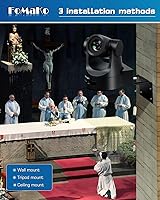
Support for desktop, tripod, wall, and ceiling configurations makes this PTZ unit adaptable to a wide range of venue layouts without sourcing third-party brackets. The gravity sensor that auto-flips the image for ceiling-mounted installations removes a common and annoying configuration step that trips up first-time PTZ installers.
The included wall mount and ceiling bracket are functional but basic, and buyers doing a more finished permanent installation in a church or conference room often end up replacing them with heavier-duty third-party hardware. The camera body size also limits placement options in tight or shallow ceiling cavities.
Low-Light Performance
67%
33%
Under controlled indoor lighting conditions typical of a church sanctuary or lecture hall, the CMOS sensor produces acceptable results with manageable noise levels and reasonable color consistency. For the majority of fixed-installation use cases this camera is designed for, low-light output is workable without supplementary lighting.
In genuinely dim environments or venues with poorly designed stage lighting, noise becomes visible at 1080p and the autofocus can hunt before locking, both of which are problematic in a live broadcast context. Users expecting strong performance in candlelit or minimally lit environments will be disappointed.

Suitable for:

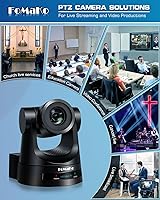
The FoMaKo FMK20SDI Gen 3 PTZ Camera is purpose-built for organizations that need dependable, unmanned video coverage in fixed installation environments. Small and mid-sized churches are arguably the sweet spot — volunteer-run AV teams benefit enormously from auto-tracking that keeps a presenter or pastor in frame without a dedicated operator on the camera. Solo educators, corporate trainers, and lecturers broadcasting to remote audiences will find similar value, since the Gen 3 tracking handles the framing work automatically and frees the presenter to focus on delivery. Esports venues and live event producers will appreciate how quickly preset positions can be recalled and how accurately the gear-drive mechanism returns to them repeatedly. On the technical side, organizations already running PoE network infrastructure get a clean, single-cable install, and production teams using vMix or OBS can pull a reliable signal over IP or USB without additional capture hardware.
Not suitable for:

Buyers expecting a fully-loaded NDI workflow out of the box should look elsewhere or budget for the extra license fee, because the FoMaKo FMK20SDI Gen 3 PTZ Camera does not include NDI as a standard feature despite advertising compatibility — that distinction frustrates buyers who only discover it after purchase. If your production pipeline is built entirely around NDI and adding cost post-purchase is not an option, a competitor with native NDI included may be a smarter fit at a similar price. This camera also tops out at 1080p60, so anyone requiring 4K output for broadcast or high-end production work will hit a hard ceiling. First-time PTZ users without any technical background may find the initial setup and remote control logic more involved than expected, particularly when configuring tracking modes and network settings. Finally, buyers who need a truly portable, run-and-gun camera will find the size and fixed-installation design of this PTZ unit a poor match for that workflow.
Specifications

  • Optical Zoom: The camera provides 20x optical zoom, allowing subjects to be framed tightly from a significant distance without degrading image sharpness.
  • Sensor: A 1/2.8-inch CMOS sensor captures video with accurate color reproduction across a range of indoor lighting conditions.
  • Max Resolution: Video output tops out at 1080p60, with additional format support for 1080p50, 1080p30, 720p60, and 720p30.
  • Video Encoding: Both H.264 and H.265 encoding are supported, with H.265 delivering comparable quality at lower bitrates on bandwidth-constrained networks.
  • Outputs: The camera simultaneously outputs via HDMI, 3G-SDI, USB 3.0, and IP streaming, covering broadcast, recording, and software-based workflows without additional hardware.
  • PoE Support: Power over Ethernet (802.3af/at) is supported, enabling a single network cable to carry both data and power to the camera installation point.
  • AI Tracking: Third-generation AI tracking includes adjustable sensitivity, figure size control, horizontal-only tracking mode, click-to-switch target, and configurable lost-target behavior.
  • Mechanical Drive: The pan and tilt mechanism uses a gear transmission system, which the manufacturer claims delivers more precise preset positioning than belt-drive alternatives.
  • LCD Screen: A 2-inch LCD on the camera body displays the current IP address and video resolution immediately on power-up, simplifying network setup.
  • NDI Support: NDI protocol compatibility is available but requires the purchase of a separate NDI license key; it is not included in the base unit price.
  • Mounting Options: The camera supports desktop, tripod, wall, and ceiling mounting configurations, with a built-in gravity sensor that automatically flips the image when inverted.
  • Dimensions: The unit measures 6.93 x 5.63 x 6.69 inches, making it a compact but substantial fixed-installation camera body.
  • Weight: The camera weighs 3.08 pounds, which is within a typical range for PTZ units intended for permanent bracket or ceiling mounting.
  • Network Default: DHCP is enabled by default, so the camera is immediately discoverable on most standard networks without any manual IP configuration.
  • Audio Formats: Supported audio encoding formats include AAC, MP3, and G.711A for use in IP streaming configurations.
  • Storage: An SD card slot is present for local storage, with MP4 as the supported video capture format.
  • Warranty: FoMaKo provides a 3-year limited warranty on the unit, along with a 30-day no-questions-asked return window from the purchase date.
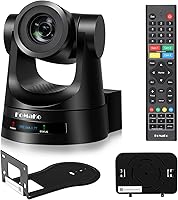
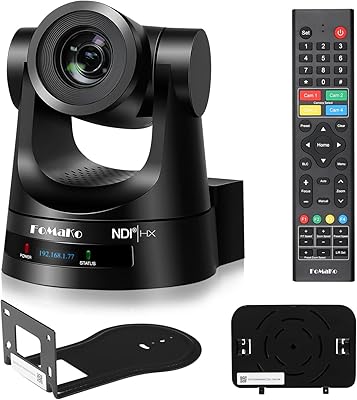
  • In the Box: Package contents include the camera, IR remote controller, wall mount, ceiling bracket, USB cable, 12V 2A power adapter, and a printed user manual.

Related Reviews
FoMaKo KN30A Pro NDI PTZ Camera
86%
94%
Video Quality
92%
AI Auto-Tracking Accuracy
89%
Low-Light Performance
90%
Build Quality
88%
PTZ Mechanism Precision
More
AVKANS AV-E20-NDI PTZ Camera

79%
88%
Image Quality
91%
NDI Integration
93%
Connectivity & Output Options
82%
Low-Light Performance
74%
PTZ Motor & Movement Smoothness
More
myFirst Camera 3 Kids Digital Camera
72%
76%
Image Quality (Daylight)
51%
Low-Light Performance
74%
Video Quality
83%
Macro Lens
81%
Ease of Use
More
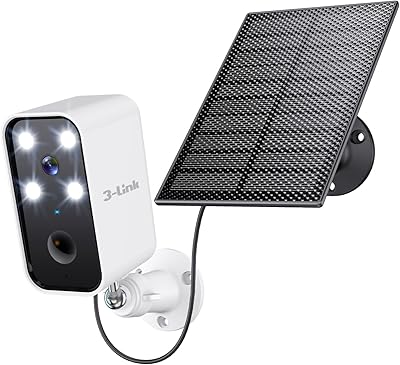
3-Link Battery Camera TB1 S Solar Security Camera
84%
91%
Setup & Installation
89%
Motion Detection Reliability
88%
Solar Charging Efficiency
83%
Night Vision Performance
85%
Weather Resistance
More
ZEROXCLUB B3C 3-Camera Wireless Backup Camera System
76%
84%
Video Signal Reliability
83%
Image Quality
76%
Night Vision Performance
71%
Installation Experience
88%
Weather & Build Durability
More
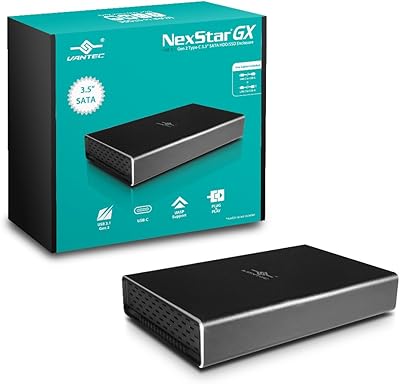
Vantec NST-371C31-BK NexStar Gx USB 3.1 Gen 2 Type-C 3.5″ SATA HDD/SSD Enclosure
84%
89%
Performance
94%
Ease of Setup
85%
Build Quality
92%
Compatibility with Systems
88%
Data Transfer Speed
More
Vantec NexStar JX 3.5″ HDD Enclosure
76%
93%
Ease of Setup
78%
Transfer Speed — USB
86%
Transfer Speed — eSATA
74%
Thermal Management
67%
Build Quality
More
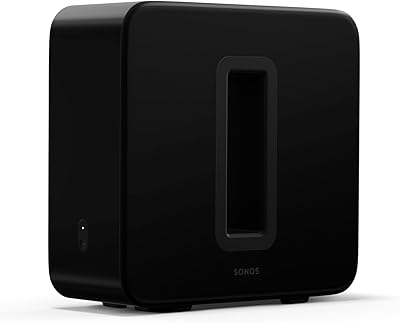
Sonos Sub (Gen 3)
Sonos Sub (Gen 3)
85%
91%
Sound Quality
88%
Ease of Setup
93%
Build Quality
95%
Bass Performance
92%
Compatibility with Sonos Systems
More
Tenveo VL12U 4K PTZ Camera
74%
88%
Image Quality
79%
AI Auto-Tracking
84%
Zoom Performance
83%
PoE & Connectivity
71%
Ease of Setup
More
TONGVEO 20X PTZ Conference Camera
78%
88%
Zoom Clarity & Optical Performance
93%
Setup & Ease of Use
79%
PTZ Movement & Preset Recall
86%
Video Quality at 1080p 60fps
71%
Remote Control Reliability
More

FAQ

Yes, it integrates with both OBS and vMix either over USB 3.0 as a UVC device or via IP streaming using RTSP. Most users have it recognized and outputting in OBS or vMix within a few minutes of connecting it to the network or USB port.

NDI is not included in the standard purchase. The camera is NDI-upgradeable, but you will need to buy a separate NDI license key to unlock that functionality. If your production workflow depends on NDI, make sure to factor that additional cost into your budget before buying.

Yes. The camera ships with a 12V 2A power adapter so you can power it from a standard wall outlet. PoE is a convenient option if you already have the network infrastructure, but it is not required to use the camera.

Most users in worship settings report solid tracking performance, particularly for a single presenter moving on a stage. The Gen 3 tracking lets you adjust sensitivity and limit movement to the horizontal axis, which helps avoid the camera over-correcting when a speaker makes small gestures. Color accuracy under mixed stage lighting also draws frequent praise in user reviews.

There is a real learning curve, especially around the remote control. The speed zone buttons and preset save and recall functions are not immediately intuitive, and the tracking configuration menu has a lot of options. Most first-time users report feeling comfortable after two or three setup sessions, and FoMaKo offers free online training and remote setup assistance if you get stuck.

Yes. A built-in gravity sensor detects the orientation and automatically flips the image, so a ceiling-mounted installation produces a correctly oriented output without any manual setting changes in the menu.

Yes, and this is one of its stronger practical advantages. HDMI, 3G-SDI, USB 3.0, and IP streaming can all run at the same time, so you could feed a projector via HDMI, a broadcast switcher via SDI, and a streaming encoder via IP simultaneously without any signal splitting hardware.

Preset accuracy is generally very good for this class of camera. The gear-drive mechanism is designed for more repeatable positioning than belt-drive systems, and user feedback from event and church installations tends to confirm that presets are reliable in day-to-day use. That said, no PTZ camera achieves perfect repeatability, and very tight close-up shots may show slight variance over thousands of recalls.

The Gen 3 tracking system includes a configurable lost-target action, so you can set the camera to return to a home preset, hold its last position, or continue panning in the last known direction when it loses the subject. You configure this behavior through the camera menu, which gives you real control over how the system recovers during a live broadcast.

You have several control options. The included IR remote handles basic operation and tracking toggles. The camera also has a web browser interface accessible from its IP address for configuration and control. For more advanced integration, it supports standard PTZ control protocols over IP, which means hardware controllers and production software that support those protocols can operate it as well.