Overview

The Facmogu 298A Bluetooth Stereo Amplifier is a compact, no-frills receiver aimed at budget-conscious listeners who want real speaker output without spending serious money. It delivers 40W RMS per channel — enough to fill a bedroom or small office without strain — while keeping its footprint small enough to tuck into a bookshelf or cabinet. This isn't a device for picky audiophiles chasing flat frequency curves or low distortion floors. It's an honest entry point: practical in what it offers and clear about what it isn't. With over 1,800 Amazon ratings averaging 4.2 stars since its 2020 launch, it has earned a solid reputation in its lane.

Features & Benefits

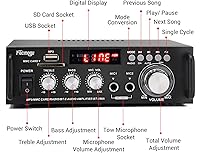
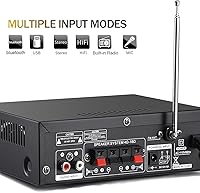
What makes the 298A receiver genuinely useful at its price is the range of ways you can feed it a signal. Bluetooth 5.0 handles wireless streaming reliably from a phone or laptop, while RCA inputs cover turntables and televisions, and a USB port or SD card slot lets you play audio directly without any streaming service involved. There's even a built-in FM tuner, which some users genuinely appreciate. Two physical knobs handle bass and treble adjustment — no app, no menu diving. A remote control comes included, and the LED display makes it easy to confirm your active input from across the room without walking over.

Best For

This budget stereo amplifier fits naturally into small-room setups — bedroom bookshelf speakers, a garage workshop, a basement hangout, or a home office that needs something better than a portable Bluetooth speaker. Beginners assembling their first passive speaker system will appreciate that it requires zero technical configuration to get running. The dual microphone inputs also make it a surprisingly capable option for casual karaoke without buying dedicated hardware. If you live in a larger home expecting wide coverage, this isn't the right tool — but for contained spaces and listeners who just want music on without overthinking it, the 298A receiver hits a comfortable, practical sweet spot.

User Feedback

Buyers consistently praise how quickly this compact amp gets up and running, and many are genuinely surprised by how full it sounds relative to its price in small rooms. That said, real limitations do surface. The Bluetooth range is short — a single wall between you and the unit can noticeably degrade the connection. Condenser microphone users frequently report audible hiss through the mic inputs; switching to a dynamic mic typically resolves it, but it's worth knowing before you buy. A handful of reviewers also called out the peak wattage labeling on the packaging as misleading — those large numbers reflect theoretical peaks, not the actual output you'll hear day to day.

Pros

  • Gets up and running in minutes — no complicated setup or configuration required.
  • Bluetooth 5.0 pairs reliably and holds a stable connection at close range.
  • The range of inputs — RCA, USB, SD card, FM radio, and dual mic jacks — covers most everyday source needs.
  • 40W RMS per channel delivers satisfying volume for bedrooms, small offices, and workshops.
  • Built-in FM tuner works well and is a genuinely handy bonus for listeners who still use radio.
  • The included remote makes switching inputs and adjusting volume easy without leaving your seat.
  • Compact enough to fit almost anywhere — on a shelf, in a cabinet, or on a cluttered desk.
  • Dual microphone inputs make it a capable casual karaoke solution without extra hardware.
  • Bass and treble controls give basic tonal shaping without needing an app or external equalizer.
  • Represents strong overall value for a first passive speaker setup on a tight budget.

Cons

  • Bluetooth range drops noticeably through walls — unreliable beyond a single room.
  • Condenser microphones trigger audible hiss through the mic inputs; dynamic mics are needed to avoid it.
  • The power supply is not included in the box, which is an easy-to-miss extra cost at checkout.
  • Peak wattage figures printed on the unit are inflated marketing numbers, not real-world output.
  • Bass and treble controls are basic — no mid-range adjustment or graphic EQ of any kind.
  • Not built for loud, sustained listening sessions; it can run warm under prolonged high-volume use.
  • Sound quality in the upper frequency range can feel slightly flat compared to mid-range receivers.
  • No optical or digital audio input, limiting compatibility with modern TVs and soundbar-style setups.

Ratings

The scores below were generated by AI after analyzing thousands of verified buyer reviews for the Facmogu 298A Bluetooth Stereo Amplifier from global marketplaces, with spam, incentivized feedback, and bot activity actively filtered out. Every category reflects the honest spread of real user experiences — strengths are credited where earned, and recurring pain points are represented without softening.

Value for Money
91%
This is where the 298A receiver consistently earns its strongest praise. Buyers who set up a small bedroom or garage speaker system report feeling like they got far more than they paid for, particularly when comparing it to similar-priced competitors that offer fewer inputs. For first-time amp buyers especially, the perceived value is high.
The missing power adapter stings a little at this price tier — it is a small but real hidden cost that some buyers only discover after unboxing. A handful of reviewers also felt that the inflated peak wattage figures on the packaging undermined the otherwise honest value proposition.
Sound Quality
74%
26%
In a small, acoustically forgiving room, this compact amp produces clean, clear audio that genuinely surprises listeners at its price point. Volume headroom is adequate for casual listening, and the bass and treble knobs allow enough tonal shaping to compensate for basic speaker deficiencies.
Upper-frequency detail feels compressed compared to even modestly priced dedicated amplifiers, and some listeners notice a slight muddiness when bass is pushed above the midpoint. At high volume levels, the sound begins to lose composure — best kept at moderate listening levels for the cleanest output.
Bluetooth Performance
67%
33%
Pairing is quick and reliable under ideal conditions — most users connect within seconds and experience stable playback when their source device stays in the same open room as the unit. Bluetooth 5.0 brings noticeably improved stability compared to the 4.x versions commonly found in competing budget amps.
The real-world range is a significant limitation. A single interior wall between phone and amp is often enough to cause dropout or signal degradation, making multi-room usage essentially impractical. Several buyers who assumed typical modern Bluetooth range were caught off guard by how proximity-dependent this connection really is.
Ease of Setup
93%
Setup time is almost universally described as under ten minutes, even by buyers who had never connected a wired speaker system before. The physical controls are intuitive, the LED display confirms your active input clearly, and there is no software, app, or account required to get audio playing.
The lack of a power adapter means first-time buyers sometimes need a second trip or order before they can even start. The included documentation is minimal, and a few users found the input-switching sequence slightly unintuitive until they figured out the remote control button mapping.
Microphone Performance
52%
48%
Having dual mic inputs on a unit at this price is a genuine differentiator, and for users running casual karaoke nights at home with dynamic microphones, the performance is more than adequate. Voice comes through clearly and loud enough to sing over most music without additional hardware.
Condenser microphone users consistently encounter hissing and interference through the mic inputs, a well-documented hardware limitation that the manufacturer itself acknowledges. This is not a subtle issue — it can render the mic function unusable with the wrong microphone type, which is a meaningful problem for buyers who own condensers.
Build Quality
63%
37%
The chassis feels solid enough for a static desktop or shelf installation, and the knobs turn with reasonable resistance. Most buyers who treat it as a set-and-forget bedroom amp report no structural issues after months of regular use.
The enclosure is clearly plastic rather than metal, and the overall material quality reflects the budget price tier. A few users noted that the knobs feel slightly cheap to the touch, and the unit does not inspire confidence if it were to be moved or bumped frequently.
Input Versatility
88%
The range of available inputs is one of the most compelling aspects of this budget stereo amplifier. Being able to switch between Bluetooth, RCA, USB drive, SD card, and FM radio from a single small unit gives casual listeners flexibility that was previously only found in much more expensive receivers.
There is no optical or HDMI ARC input, which limits direct integration with modern televisions that have moved away from analog audio outputs. Users hoping to use this as a TV speaker amplifier may need an additional DAC or adapter, adding cost and complexity.
Remote Control
79%
21%
The included IR remote handles the core functions — volume, input switching, and playback control for USB and SD sources — well enough for everyday use. Being able to adjust the amp from a couch or bed without getting up is a comfort feature buyers genuinely appreciate.
IR remotes require line-of-sight, so placement of the unit matters. A few buyers reported the remote feeling flimsy and plasticky, and response sensitivity is inconsistent at wider angles. There is no backlight, which makes button identification difficult in darker rooms.
FM Radio
76%
24%
The FM tuner performs well in areas with decent broadcast signal strength, locking onto local stations cleanly with minimal interference. Users in suburban and urban areas who still enjoy radio as a background listening format find it a satisfying bonus feature.
In rural areas or locations with weak FM signals, reception quality drops considerably and static becomes noticeable. There is no built-in antenna included, and performance depends heavily on wire placement or an external antenna solution that buyers need to source themselves.
Thermal Management
61%
39%
Under typical moderate-volume use — background music during work hours or casual evening listening — the unit runs at an acceptable temperature without concern. Most buyers who use it within its intended small-room context never encounter heat-related issues.
Extended high-volume sessions cause the unit to run noticeably warm, and the passive cooling design offers no fan or venting system to manage heat proactively. A few buyers reported automatic shutoff during prolonged loud use, which points to thermal limiting kicking in under sustained load.
Size & Portability
86%
At roughly 4 x 4 x 2.76 inches and under three pounds, this compact amp fits almost anywhere. Users who move between spaces — say, from a home office to a garage workshop — appreciate being able to carry it without effort or planning.
The compact size means speaker terminals are tightly spaced, making simultaneous cable management slightly fiddly, especially with thicker gauge speaker wire. The small form factor also contributes to the thermal limitations noted elsewhere, as there is limited internal space for heat dissipation.
Display Readability
81%
19%
The LED display is bright and clearly visible from across a typical bedroom or office, making it easy to confirm the active input or volume level without walking up to the unit. Buyers who use it in moderate ambient light find it informative and practical.
In very bright rooms or under direct sunlight, the display can wash out and become harder to read. The character size is small enough that some older buyers or users with vision sensitivities mentioned having difficulty reading it from farther distances.
Long-Term Reliability
69%
31%
A reasonable number of buyers report using the 298A receiver consistently for one to two years without hardware failure, which is respectable for a budget device in this category. For low-intensity regular use — a few hours per day in a stable environment — longevity appears satisfactory.
There is a subset of reviews describing unit failure after several months of heavier use, and the brand's warranty support process has been described as inconsistent. Buyers relying on this as a primary daily driver should factor in the risk of a shorter lifespan compared to mid-range alternatives.

Suitable for:

The Facmogu 298A Bluetooth Stereo Amplifier is a genuinely smart pick for anyone setting up a simple speaker system in a small, contained space without wanting to spend heavily. Bedroom listeners, home office workers, garage tinkerers, and basement hangout enthusiasts will find it punches well above its price bracket in those settings. Beginners who have never owned a wired speaker setup will appreciate how little configuration it demands — plug in your speakers, pair your phone, and you're done in minutes. It also works surprisingly well for casual karaoke nights at home, since the dual microphone inputs eliminate the need to buy a separate karaoke amp. Anyone who wants the option to play music offline from a USB drive or SD card without relying on a streaming service will find that flexibility genuinely useful here.

Not suitable for:

The Facmogu 298A Bluetooth Stereo Amplifier is not the right tool for larger rooms, open-plan living spaces, or anyone expecting wall-to-wall coverage from a single unit. The real-world output is 40W per channel — useful for small rooms, but it will run out of headroom fast if you push it in a bigger space. Buyers who care about audio fidelity, low noise floors, or flat frequency response should look at a step-up receiver, because this budget stereo amplifier is built for convenience, not precision. If you plan to use it with condenser microphones for recording or professional karaoke setups, the mic input hiss is a recurring and well-documented issue that is unlikely to disappear without switching to dynamic mics. And if your speakers or source devices are located more than a room away, the Bluetooth range limitations will become a frustration quickly.

Specifications

  • RMS Power: Delivers 40W per channel into a 2-channel stereo configuration, representing the actual continuous output you can expect during normal listening.
  • Peak Power: The packaging references a 300W x 2 peak figure, which reflects a theoretical maximum under ideal burst conditions and not sustained real-world output.
  • Bluetooth: Uses Bluetooth 5.0 for wireless audio streaming, offering improved connection stability compared to older Bluetooth versions at close range.
  • Wired Inputs: Accepts audio via RCA stereo input, USB port, and SD/TF card slot, giving users multiple wired source options beyond wireless streaming.
  • Microphone Inputs: Features two 6.35mm (quarter-inch) microphone jacks suited for dynamic microphones, with individual volume control for each mic channel.
  • FM Tuner: Built-in FM radio tuner covers a frequency range of 87.5 to 108 MHz with station presets accessible via the front panel or remote.
  • Signal-to-Noise Ratio: Rated at 80dB or higher SNR, which is adequate for casual listening in small rooms but may show background noise at high gain levels.
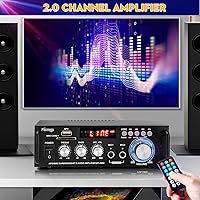
  • Channels: Operates as a 2.0 stereo amplifier with no subwoofer or surround processing — purely two-channel left and right output.
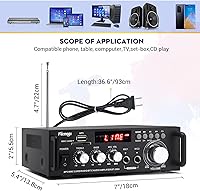
  • Dimensions: Measures 3.94 x 3.94 x 2.76 inches, making it compact enough to sit on a shelf, desk, or inside most A/V cabinets without issue.
  • Weight: Weighs 2.64 pounds, light enough to reposition or relocate easily without tools or mounting hardware.
  • Tone Controls: Provides dedicated physical knobs for bass and treble adjustment, allowing basic tonal shaping without any app or external device.
  • Display: Equipped with a bright LED digital readout that shows the active input source and current settings such as volume level and FM frequency.
  • Remote Control: Ships with an IR remote control that handles volume adjustment and input switching from a distance without needing to approach the unit.
  • Bluetooth Range: Effective wireless range is approximately 16.4 feet (5 meters) in open space; walls and obstructions significantly reduce this distance in practice.
  • Power Supply: A power adapter is required to operate the unit but is not included in the box, so buyers should confirm they have a compatible supply before first use.
  • Model Number: Officially designated as the 298A, manufactured by Mo-gu and sold under the Facmogu brand on major retail platforms.
  • Speaker Terminals: Uses spring-clip speaker terminals compatible with standard bare wire connections, accepting most common speaker wire gauges used in home setups.
  • Output Impedance: Designed to work with speakers in the 4 to 8 ohm impedance range, covering the majority of standard bookshelf and floor-standing home speakers.

Related Reviews
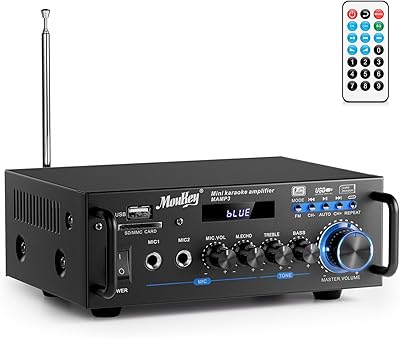
Moukey MK0153 Karaoke Amplifier
73%
88%
Value for Money
91%
Ease of Setup
72%
Microphone Performance
78%
Bluetooth Connectivity
58%
Audio Output Power
More
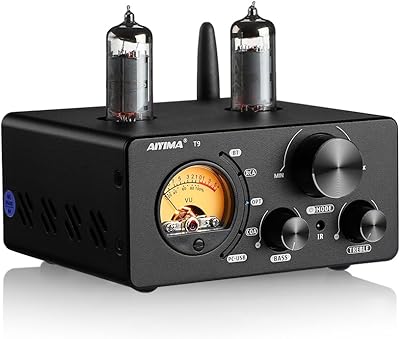
AIYIMA T9
AIYIMA T9
77%
83%
Sound Quality
88%
Value for Money
91%
Connectivity & Input Variety
67%
Bluetooth Performance
74%
Build Quality & Materials
More
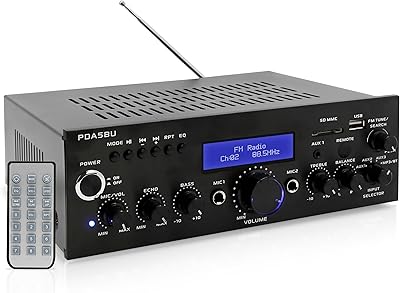
Pyle PDA5BU Bluetooth Stereo Amplifier
82%
88%
Audio Performance
82%
Bluetooth Connectivity
71%
Build Quality
85%
Ease of Setup
90%
Input Versatility
More
Pyle PDA69BU Stereo Amplifier Receiver
75%
83%
Bluetooth Connectivity
74%
Sound Quality
79%
Build Quality
86%
Value for Money
88%
Input Versatility
More
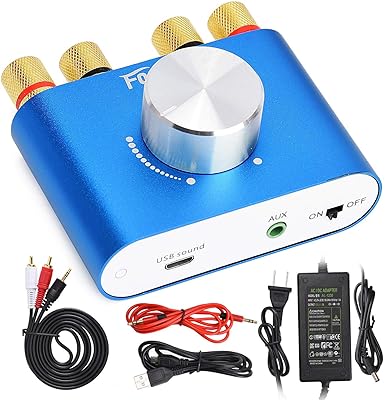
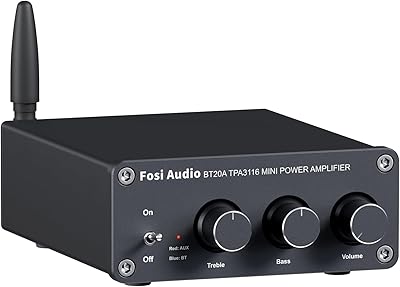
Fosi Audio BT20A
Fosi Audio BT20A
80%
93%
Value for Money
84%
Sound Quality
81%
Build Quality
96%
Ease of Setup
72%
Bluetooth Performance
More
Saiyin PA300H Stereo Bluetooth Power Amplifier
74%
76%
Sound Quality
79%
Bluetooth Performance
58%
Build Quality
83%
Value for Money
91%
Ease of Setup
More
Facmogu F900S Mini Bluetooth Amplifier
76%
83%
Sound Clarity
91%
Value for Money
77%
Build Quality
92%
Ease of Setup
84%
Bluetooth Connectivity
More
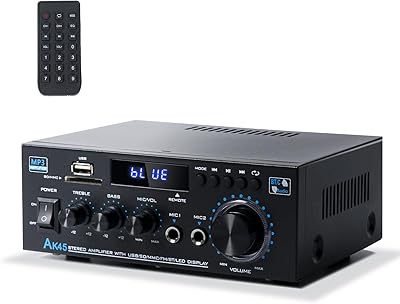
NEOHIPO AK45 Bluetooth Stereo Receiver Amplifier
73%
83%
Value for Money
91%
Ease of Setup
71%
Sound Quality
88%
Input Versatility
67%
Bluetooth Stability
More
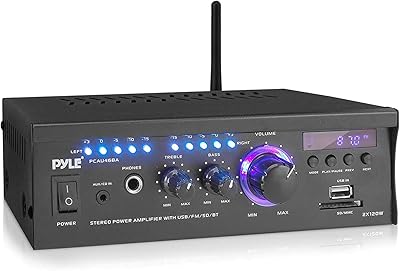
Pyle PCAU46BA Bluetooth Stereo Amplifier
73%
83%
Value for Money
67%
Sound Quality
91%
Ease of Setup
68%
Bluetooth Performance
54%
Build Quality
More
Rockville RXM8BTB 8-Channel Bluetooth Car Amplifier
77%
78%
Value for Money
82%
Build Quality
74%
Power Output
59%
Bluetooth Performance
87%
Channel Flexibility
More

FAQ

The power supply is not included in the box, which catches a lot of buyers off guard. You will need to source a compatible DC adapter separately before you can use it. Check the product listing or manufacturer details for the correct voltage and connector specs before ordering one.

For a typical bedroom, it gets plenty loud — most users report hitting satisfying volume levels well before reaching the halfway point on the dial. The 40W RMS per channel is real and usable output, not a padded marketing number. You should have no trouble filling a room up to roughly 150 to 200 square feet without pushing the amp hard.

It depends on your turntable. If your turntable has a built-in phono preamp (most modern and budget turntables do), you can connect it directly using the RCA input. If your turntable outputs a raw phono-level signal with no built-in preamp, you will need an external phono preamp between the turntable and this compact amp, otherwise the volume will be extremely low.

This is a well-documented issue specifically with condenser microphones, which require phantom power that this unit does not supply — the mismatch creates interference and audible hiss. Switching to a dynamic microphone almost always resolves it completely. If you need to use a condenser mic, a ferrite choke or magnetic interference block on the cable can reduce but may not fully eliminate the noise.

No, the 298A receiver is a standard 2-channel stereo amp — the two output channels are left and right for a single listening position, not separate zones. Running speakers in two separate rooms simultaneously is not a supported use case for this unit.

In open space with no walls between you and the unit, around 16 feet is a reasonable working range. The moment a wall or door comes between your phone and the amp, that range drops noticeably — sometimes to just a few feet. If your phone will be in a different room than the amp, Bluetooth connectivity is likely to be unreliable.

Yes, the unit is designed to handle speakers in the 4 to 8 ohm range, so 4-ohm speakers are compatible. Just keep in mind that lower impedance speakers draw more current, so avoid pushing the volume to maximum for extended periods as it can cause the amp to run warm.

Yes, if your TV has RCA audio outputs (often labeled Audio Out), you can connect them directly to the RCA input on this budget stereo amplifier. Most modern TVs have phased out RCA outputs in favor of optical or HDMI ARC, so you may need an adapter or a DAC with optical input to bridge the connection if your TV lacks RCA.

User feedback on the FM tuner is generally positive for casual listening. It locks onto strong local stations cleanly and holds them well with a decent antenna or in areas with good signal. In locations with weak FM reception or lots of interference, results vary — but it is a functional feature, not just a checkbox.

The speaker terminals are spring-clip style, which accept bare wire ends without the need for banana plugs or spade connectors. Standard 16 to 18 AWG speaker wire works well for typical bookshelf speaker setups at this power level. Just strip about half an inch of insulation from each wire end, press the spring clip, insert the wire, and release — it takes about two minutes per speaker.