Overview

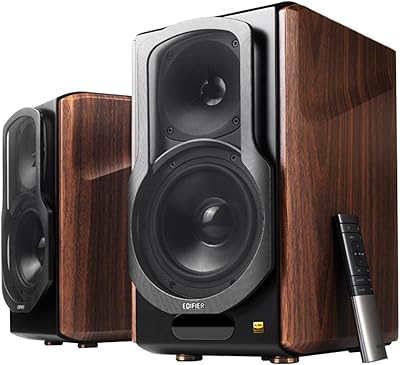
The Edifier S1000MKII is a serious powered bookshelf speaker aimed at listeners who want genuine hi-fi performance without assembling a stack of separate components. The MK2 designation is not just marketing — compared to the original S1000, it brings refined drivers and expanded connectivity options. Size-wise, do not mistake these for compact desktop monitors; each cabinet is substantial, and they need real space to breathe. The built-in Class D amplifier means you simply plug in a source and listen, skipping the receiver entirely. At this price tier, you are stepping into audiophile territory without committing to full separates.

Features & Benefits

Each speaker houses a 5.5-inch aluminum alloy mid-bass woofer alongside a 1-inch titanium dome tweeter — a pairing that handles midrange warmth and high-frequency crispness without audible compression at moderate volumes. The Class D amplifier delivers 60 watts per channel, running cool and clean. Connectivity is genuinely comprehensive: dual RCA inputs, optical, and coaxial cover virtually every source you own. Bluetooth 5.0 with aptX HD raises the wireless ceiling, though you will only hear the difference if your source device supports that codec. The included remote handles volume, bass, and treble adjustments from across the room without touching the speakers.

Best For

These powered monitors make the most sense for a few specific listener types. Desktop audiophiles who want real sound quality without routing cables through a separate amplifier will find the all-in-one setup genuinely convenient. Anyone connecting a modern TV or Blu-ray player will appreciate the optical input for a clean digital signal. Vinyl and CD listeners benefit from the dual analog RCA inputs. That said, these Edifier bookshelf speakers need adequate placement space — they are not suited for a cramped shelf or tiny desk. In a small or medium room where they can be positioned properly, they can challenge pricier passive speaker-and-amp combinations.

User Feedback

Buyers of these Edifier bookshelf speakers consistently highlight soundstage and separation as the strongest arguments for choosing them — the sense of space between instruments on a well-recorded track genuinely impresses. The wood-veneer cabinet finish also draws praise; they do not look like budget gear. On the other side, listeners in larger rooms report bass feeling thin without an added subwoofer — worth knowing before committing. A handful of TV users mention slight Bluetooth latency during video playback, which matters if lip-sync accuracy is a priority. Remote control convenience earns near-universal appreciation, and long-term owners rarely feel the urge to move on to a pricier passive setup.

Pros

  • Soundstage width and instrument separation outperform most active speakers in this price range.
  • Built-in Class D amplifier means zero need for a separate receiver or stereo amp.
  • Wood-veneer cabinet finish looks and feels far more premium than the price suggests.
  • Optical, coaxial, dual RCA, and Bluetooth inputs cover virtually every source device in one system.
  • Wireless remote allows volume, bass, and treble adjustments from across the room without any app.
  • Bluetooth 5.0 with aptX HD delivers genuinely improved wireless quality for compatible Android and PC sources.
  • Titanium dome tweeter handles high-frequency detail cleanly without introducing harsh edge or listener fatigue on good recordings.
  • Long-term owners report consistent performance with no noticeable degradation after years of regular use.
  • Universal 100–240V power supply removes any compatibility concern for international buyers.
  • All-in-one design simplifies setup dramatically — unboxing to first sound takes under ten minutes.

Cons

  • Bass thins out noticeably in medium-to-large rooms without an added subwoofer.
  • Inter-speaker cable has a fixed length, limiting how far apart the two speakers can be placed.
  • aptX HD advantage is lost entirely on iPhones and other Apple devices due to codec incompatibility.
  • Bluetooth latency during video playback makes wireless connection unreliable for TV lip-sync accuracy.
  • No USB audio input, which is a frustrating omission for PC users wanting a direct digital connection.
  • Input source switching produces a brief audio muting gap that disrupts quick back-and-forth between sources.
  • Passive speaker uses push-pin terminals rather than binding posts, which feels inconsistent with the overall build quality.
  • The neutral-to-bright tuning exposes harshness in poorly mastered or heavily compressed streaming audio.
  • Cabinet footprint is large enough to dominate or simply not fit on compact desks and standard bookshelves.
  • A small share of long-term users report gradual channel imbalance at very low volume levels over time.

Ratings

Our AI scoring for the Edifier S1000MKII was built by analyzing thousands of verified purchase reviews from global buyers, with spam, incentivized posts, and bot-generated feedback actively filtered out before any score was calculated. The result is an honest, granular breakdown that reflects what real listeners experienced over weeks and months of use — not just first impressions. Both the standout strengths and the legitimate frustrations are weighted into every number you see below.

Sound Quality
91%
Listeners across multiple setups consistently describe the soundstage as surprisingly wide for a bookshelf form factor, with instruments sitting in distinct, well-defined positions. On well-recorded jazz or acoustic tracks, the titanium dome tweeter renders high-frequency detail without harshness, while the aluminum mid-bass driver keeps the midrange natural and uncolored.
At very high volumes, some users note a slight compression in the upper midrange that pulls the sound slightly forward and fatiguing. These powered monitors also lean toward a neutral-to-bright tuning, which suits critical listening but may feel lean to buyers expecting a warm, bass-heavy signature.
Bass Performance
68%
32%
In near-field desktop configurations or small rooms, the 5.5-inch woofer delivers solid, controlled bass with decent extension down to its 45 Hz floor. Buyers using them close to a wall or in a corner report improved low-end fullness, which suggests the cabinet design responds well to boundary reinforcement.
In medium to large rooms, the bass thins out noticeably and the overall presentation can feel lightweight without a subwoofer in the chain. This is probably the most recurring complaint from buyers who placed these Edifier bookshelf speakers in open living rooms expecting floor-standing-level low end.
Build Quality
88%
The wood-veneer cabinet finish elevates these powered monitors well above what most buyers expect at this tier — they look like proper hi-fi furniture rather than powered computer speakers. The grilles, drivers, and binding posts all feel substantial, and long-term owners rarely report any physical degradation after years of use.
A small number of buyers noted minor cosmetic inconsistencies in the veneer finish on corners, suggesting quality control is not perfectly uniform across production batches. The passive speaker's connection terminal — a push-pin type rather than binding posts — feels slightly less premium than the rest of the build.
Bluetooth Performance
74%
26%
Bluetooth 5.0 with Qualcomm aptX HD gives these Edifier bookshelf speakers a clear advantage for wireless listeners with compatible Android or PC sources, producing noticeably cleaner highs and better dynamic range than standard SBC streaming. Pairing is quick and the connection holds stably within a typical room.
The aptX HD advantage only materializes if your phone or laptop actually supports that codec — iPhone users, for example, are limited to SBC. A subset of TV users also reported occasional audio-to-video sync lag when streaming wirelessly, which is enough to make Bluetooth a secondary input for video-heavy use cases.
Connectivity & Inputs
93%
The input lineup here is genuinely comprehensive for an active speaker at any price: optical, coaxial, two sets of RCA, and Bluetooth cover essentially every source a home listener is likely to own. Buyers frequently highlight being able to connect a TV via optical and a turntable via RCA simultaneously, then switch between them with the remote.
There is no USB audio input, which some PC users who prefer a direct digital connection find frustrating. Input switching is functional but not instant — there is a brief muting gap when changing sources that a few users found annoying during quick back-and-forth switching.
Amplifier Performance
87%
The onboard Class D amplifier runs cool even after extended listening sessions, which matters for speakers that may be left powered on throughout the workday. At 60 watts per channel, there is enough headroom to fill a medium room without audible distortion or strain at realistic listening levels.
Audiophiles accustomed to high-current linear amplifiers may find the Class D presentation slightly clinical on complex orchestral passages. The integrated nature also means if the amp section ever fails, the entire unit requires service rather than a simple component swap.
Remote Control & Usability
82%
18%
The wireless remote is one of the more appreciated practical features — being able to adjust volume, bass, and treble from the couch without app dependency or touchscreen fussiness is a genuine convenience that many buyers mention explicitly. Response is reliable within a normal listening distance.
The remote is IR-based, which means it requires line-of-sight and will not work reliably if the speakers are placed inside a cabinet or angled away. A few users also reported the remote feeling lightweight and plasticky relative to the premium feel of the speakers themselves.
Value for Money
83%
When buyers factor in the cost of a comparable passive speaker pair plus a decent stereo amplifier, the S1000MKII often comes out equal or cheaper while taking up less space and fewer cables. Long-term owners in particular express high satisfaction, suggesting the speakers hold up their end of the bargain over time.
At the asking price, buyers are right to expect near-flawless performance, and the bass limitation in larger rooms is a sting that feels disproportionate for the investment. Competitors from brands like KEF and Q Acoustics at similar prices offer passive options with more low-end authority, though they require separate amplification.
Imaging & Soundstage
89%
Instrument separation is repeatedly cited as a highlight by experienced listeners who have owned multiple speaker systems — these powered monitors cast a surprisingly wide and deep stereo image when positioned with a modest toe-in angle. Vocalists sit centered and naturally sized rather than diffuse or pinched.
The soundstage is more impressive in near-field listening positions than at distance. Buyers who sit more than eight feet away report that the stereo separation narrows and the imaging loses some precision, which limits how well these Edifier bookshelf speakers scale to larger listening arrangements.
High-Frequency Detail
86%
The titanium dome tweeter handles cymbal decay, string overtones, and vocal sibilance with good refinement — there is clear detail retrieval without the etch or glare that cheaper metal dome tweeters can introduce. Buyers who listen to acoustic, classical, or well-produced electronic music tend to be especially positive about this aspect.
On poorly mastered or heavily compressed source material, the tweeter's resolution works against it by making harshness more audible rather than masking it. A handful of users described extended listening on certain playlists as tiring, suggesting a slight upper-frequency forwardness that is source-dependent.
Setup & Installation
78%
22%
The all-in-one active design removes the most intimidating part of speaker ownership — choosing and connecting an external amplifier. Unboxing to first sound takes under ten minutes for most buyers, and the universal 100–240V power supply means no transformer concerns for international buyers.
The inter-speaker cable that connects the active unit to the passive one is a fixed length, which limits placement flexibility if buyers want to spread the speakers wider than the cable allows. There is no wall-mount provision, so placement is strictly tabletop or stand-based.
Size & Placement Flexibility
61%
39%
For listeners who have the space, the cabinet size translates into better cabinet resonance control and driver excursion than most competing bookshelf designs. Buyers in dedicated listening rooms or on large desks report that the physical presence of the speakers feels appropriate for the performance level.
At roughly 14.5 inches deep and over 16 inches tall per cabinet, these are substantially larger than most buyers anticipate from the photos. Users with compact desks or small shelves frequently mention that the speakers dominate the surface area or physically cannot fit where intended.
TV & Video Use
71%
29%
The optical input makes connection to a modern television clean and reliable, and the audio quality improvement over built-in TV speakers is dramatic enough that buyers consistently describe it as the most immediately noticeable upgrade in their setup. Dialogue clarity in particular earns strong praise.
Bluetooth latency for TV use is the main friction point — enough users mentioned sync issues over wireless that it is clearly a consistent limitation rather than an isolated defect. For TV use, optical is the recommended connection, which adds a cable but eliminates the latency problem entirely.
Long-Term Reliability
84%
Buyers who have owned these powered monitors for two or more years rarely report hardware failures or degradation in sound quality, suggesting the build is durable under normal use conditions. The brand has a generally positive service reputation for handling warranty claims without excessive friction.
A small proportion of longer-term owners noted a gradual increase in channel imbalance at very low volumes, which is a known behavioral trait of certain Class D implementations rather than a product defect per se. This is unlikely to affect most listeners but can bother those with very low reference listening habits.

Suitable for:

The Edifier S1000MKII is a strong match for listeners who want a meaningful step up in audio quality without the complexity and cost of assembling separate amplifier and speaker components. If you have a dedicated desk setup, a small home office, or a medium-sized listening room and want speakers that handle everything from a vinyl turntable to a smart TV to a laptop over Bluetooth, the input variety here covers nearly every scenario without adapters or workarounds. Desktop audiophiles in particular will appreciate getting genuine soundstage and detail retrieval at a level that most powered speakers in this category simply do not deliver. The optical input makes these Edifier bookshelf speakers an easy upgrade path for TV listeners who are tired of thin built-in sound, especially in a bedroom or a second living space where a full AV receiver would be overkill. Buyers who stream wirelessly from Android devices or modern laptops that support aptX HD will also get a noticeably cleaner wireless signal than standard Bluetooth speakers provide, though it helps to verify codec compatibility before buying.

Not suitable for:

The Edifier S1000MKII is not the right call if your listening room is large or open-plan — the bass output that feels satisfying in a smaller, well-damped space thins out considerably when the speakers have to work harder to fill a bigger volume, and you would likely need a subwoofer to compensate, which adds cost and complexity. Buyers hoping to place these powered monitors in a tight bookshelf slot or on a compact desk should measure carefully first; at over 16 inches tall and nearly 15 inches deep per cabinet, they physically overwhelm smaller surfaces in a way that photos do not always make obvious. If your primary use case is watching video over Bluetooth — streaming from a TV or a media player wirelessly — the intermittent latency some users experience with lip-sync is a real friction point that the optical input solves but Bluetooth does not. iPhone users who were drawn in by the aptX HD marketing should know that Apple devices do not support that codec, so wireless performance will default to standard Bluetooth quality. Finally, buyers who prefer a warm, full-bodied sonic character over a neutral or slightly bright presentation may find these Edifier bookshelf speakers less satisfying on casual listening, particularly with compressed streaming audio.

Specifications

  • Total Power: The system delivers 120W of total output, split as 60W per channel across the active and passive speaker units.
  • Amplifier Type: A built-in Class D amplifier powers both speakers, running efficiently with minimal heat generation during extended listening sessions.
  • Woofer Driver: Each cabinet houses a 5.5″ aluminum alloy mid-bass driver, chosen for its stiffness-to-weight ratio and resistance to cone flex at higher output levels.
  • Tweeter Driver: A 1″ titanium dome tweeter handles high-frequency reproduction in each speaker, providing extended detail up to 40 kHz.
  • Frequency Response: The system is rated to reproduce frequencies from 45 Hz at the low end up to 40 kHz at the top of its range.
  • Bluetooth: Bluetooth 5.0 with Qualcomm aptX HD decoding enables high-resolution wireless streaming from compatible source devices.
  • Wireless Range: The Bluetooth connection maintains stable operation at distances of approximately 32.8 feet (10 meters) in open conditions.
  • Wired Inputs: Wired connectivity includes one optical (Toslink) input, one coaxial digital input, and two sets of analog RCA line inputs.
  • Speaker Config: The system operates as a 2.0 stereo pair, consisting of one active (amplified) unit and one passive unit connected via a speaker cable.
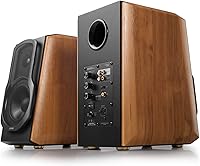
  • Cabinet Finish: Both cabinets are finished in a real wood veneer, giving the speakers a traditional hi-fi appearance rather than a painted or plastic exterior.
  • Dimensions: Each speaker cabinet measures approximately 14.5″ deep, 20.5″ wide, and 16″ tall, making these among the larger bookshelf-category speakers available.
  • Total Weight: The combined weight of both speaker units is approximately 36.7 lbs (16.7 kg), so a sturdy surface or dedicated speaker stands are advisable.
  • Control Method: A wireless infrared remote is included for adjusting volume, bass, and treble from a distance, with manual controls also accessible on the active speaker.
  • Power Supply: The speakers accept a universal 100–240V AC input, making them compatible with wall outlets in most countries without a voltage converter.
  • Inter-Speaker Cable: The active unit connects to the passive speaker via a proprietary speaker cable included in the box, with a fixed length that determines maximum speaker separation distance.
  • Usage Environment: These speakers are designed exclusively for indoor use and carry no weather resistance or waterproofing rating of any kind.
  • Warranty: Edifier covers the speakers under a limited manufacturer warranty; buyers should confirm current warranty terms and duration directly with Edifier or the point of purchase.
  • Included Items: The package includes the active speaker, passive speaker, wireless remote, inter-speaker cable, and a user manual.

Related Reviews
Edifier S3000MKII
Edifier S3000MKII
88%
94%
Sound Accuracy
91%
Bass Performance
93%
Treble Clarity
88%
Wireless Connectivity
90%
Build Quality
More
Edifier H650 Headphones
83%
87%
Sound Quality
91%
Portability
79%
Comfort
85%
Build Quality
73%
Durability
More
Edifier TWS NB2
Edifier TWS NB2
85%
87%
Noise Cancellation Effectiveness
90%
Sound Quality
85%
Call Clarity
88%
Battery Life
82%
Comfort and Fit
More
Edifier NeoBuds Pro
Edifier NeoBuds Pro
86%
94%
Sound Quality
91%
Noise Cancellation
89%
Battery Life
87%
Comfort & Fit
78%
Bluetooth Connectivity
More
Edifier S2000MKIII Bookshelf Speakers
86%
92%
Sound Quality
89%
Bluetooth Performance
88%
Build Quality
85%
Ease of Use
91%
Connectivity Options
More
Edifier W80 Over-Ear Headphones
86%
88%
Sound Quality
91%
Noise Cancelling Effectiveness
94%
Battery Life
85%
Comfort & Fit
89%
Call Clarity
More
Edifier P841 Over-Ear Headphones
83%
85%
Sound Quality
90%
Comfort & Fit
70%
Build Quality
82%
Noise Isolation
88%
Ease of Use (In-Line Controls)
More
Edifier M60 Multimedia Speaker
88%
94%
Sound Quality
91%
Bass Performance
88%
Connectivity Options
87%
Design & Aesthetics
89%
Setup & Installation
More
Edifier G2000
Edifier G2000
78%
78%
Sound Quality
71%
Bass Performance
86%
Build Quality
73%
EQ Modes
83%
Connectivity & Inputs
More
Edifier T5 Powered Subwoofer
86%
94%
Bass Performance
88%
Build Quality
85%
Ease of Setup
89%
Energy Efficiency
91%
Sound Clarity
More

FAQ

No, the Edifier S1000MKII has a fully integrated Class D amplifier built into the active speaker unit. You connect your source directly — whether that is a turntable with a preamp, a TV via optical, or a laptop over Bluetooth — and you are ready to go. No external amp or receiver is required.

Yes, they will pair and play audio from an iPhone without any issue over standard Bluetooth. However, the aptX HD codec that these Edifier bookshelf speakers support is not compatible with Apple devices, so your iPhone will default to the standard SBC codec instead. The audio will still sound good, but you will not get the higher-resolution wireless stream that an aptX HD-capable Android phone or laptop would provide.

Only if your turntable has a built-in phono preamp — meaning it outputs a standard line-level signal rather than a raw phono signal. The RCA inputs on these powered monitors are line-level inputs, not phono inputs. If your turntable does not have a built-in preamp, you will need an inexpensive external phono stage between the turntable and the speakers.

That depends on the length of the inter-speaker cable included in the box, which connects the active unit to the passive one. The cable has a fixed length, so if you need a wider separation than it allows, you would need to source a compatible replacement or extension. It is worth measuring your intended setup before assuming you can spread them as wide as you like.

A portion of users have reported mild lip-sync lag when streaming audio wirelessly to these powered monitors while watching video. It is not universal, and it depends on the source device and how it handles Bluetooth audio buffering. If you plan to use them primarily with a TV, connecting via the optical input is the more reliable solution and eliminates latency concerns entirely.

In a small to medium room, yes — they perform very well. In an open-plan or larger living space, some buyers find the bass output feels thin and the overall volume ceiling less convincing than expected. If you have a large room, budgeting for a subwoofer alongside these Edifier bookshelf speakers is worth considering from the start rather than as an afterthought.

Yes. The multiple input options — optical, coaxial, and two RCA inputs — mean you can have several sources plugged in simultaneously. You switch between them using the remote or the input selector on the active speaker. There is a brief muting gap during input switching, but that is a minor inconvenience in everyday use.

Each cabinet is approximately 14.5 inches deep, over 16 inches tall, and about 20.5 inches wide. That is genuinely large for a bookshelf speaker — they are closer to the footprint of a floor-standing speaker in terms of depth and height. Many buyers are surprised by the size when they arrive, so measuring your shelf or desk space before ordering is strongly recommended.

It is a physical infrared remote included in the box — no app, no Bluetooth pairing, no smartphone required. It controls volume, bass, and treble. The trade-off is that IR remotes require a clear line of sight to the active speaker, so if the speaker is tucked into a cabinet or at a sharp angle, the remote may not respond reliably.

It is a genuine trade-off rather than a clear winner either way. These powered monitors bundle everything into one tidy package with less cable clutter, and long-term owners often express high satisfaction when comparing value to a separates setup at a similar combined cost. The advantage of separates is upgradeability — you can swap the amp or speakers independently down the road. If you want a capable, self-contained system without the research overhead of matching separate components, these Edifier bookshelf speakers are a well-considered choice. If future upgradeability matters to you, passive separates give more flexibility.