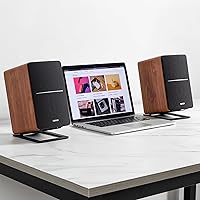
Overview

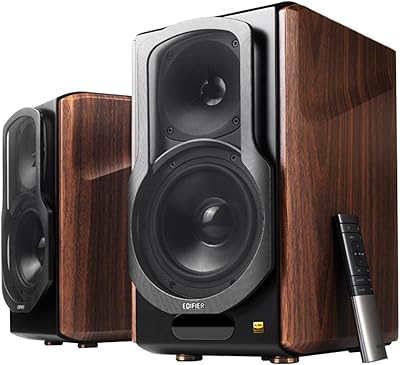
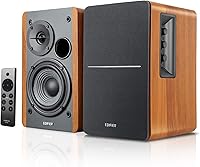
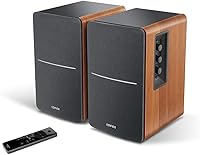
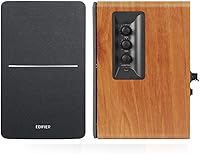
The Edifier R1280DBs sits comfortably in the mid-range active bookshelf category — a sweet spot for listeners who want real versatility without spending serious money on separates. The wood grain enclosure is more than a style choice; it gives the cabinet a denser, more acoustically stable feel compared to the plastic shells that dominate this price range. These are 2.0 stereo speakers with a subwoofer line-out, so there is room to grow your setup later. Edifier has quietly built a reputation for delivering quality that outpaces its pricing, and this powered speaker pair fits that pattern well. Just keep expectations realistic — this is consumer-friendly tuning, not studio-reference accuracy.

Features & Benefits

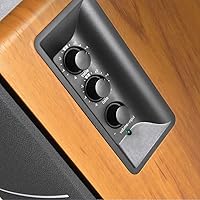
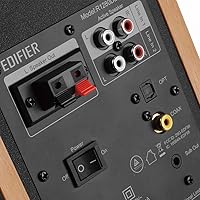
What makes these Edifier bookshelf speakers worth a closer look is how many inputs they pack into a compact cabinet. You get Bluetooth 5.0 for wireless listening from your phone or laptop, plus optical, coaxial, and dual RCA inputs — meaning a TV, turntable, and gaming console can all stay connected simultaneously. At 42W RMS total, there is enough power to fill a small-to-medium room without pushing the drivers into distortion. The subwoofer line-out includes a built-in crossover, so expanding to a dedicated sub later is simple and does not require a separate receiver. Physical bass and treble knobs on the side panel, combined with a wireless remote, make daily adjustments easy — something many rivals in this tier skip entirely.

Best For

This powered speaker pair makes the most sense for home office setups, where one system needs to handle background music, video calls, and TV or monitor audio without constant cable swapping. Vinyl fans will appreciate the dual RCA inputs and the option to add a subwoofer when the mood calls for it. Gamers and streamers who run optical out from a console while keeping Bluetooth free for a phone will find the input switching practical. That said, apartment living is the natural habitat here — these speakers perform best at moderate volumes in smaller spaces. Anyone expecting to fill a large, open living room may find the 4-inch woofer hits a ceiling sooner than expected.

User Feedback

With a 4.5-star rating across more than 4,000 reviews, the general verdict on these Edifier bookshelf speakers is solidly positive — though that crowd skews toward mainstream listeners rather than audiophiles, which is worth keeping in mind. Many buyers praise the warm, rich sound straight out of the box and find the remote control a genuine convenience over alternatives that require walking to the speaker. On the critical side, Bluetooth range can get spotty beyond roughly 20 to 25 feet, and some report a faint hiss at high volume with no active signal. The bigger practical issue: if you connect via optical to a TV, the volume control loop is not always recognized, meaning your TV remote may not adjust speaker volume directly.

Pros

  • Bluetooth 5.0, optical, coaxial, and dual RCA inputs let you keep multiple devices connected at once without unplugging anything.
  • The wood grain enclosure looks and feels significantly more premium than plastic alternatives at this price tier.
  • A subwoofer line-out with built-in crossover means you can expand your setup later without buying a separate amplifier.
  • Physical bass and treble knobs on the side panel make quick EQ adjustments easy and intuitive.
  • The included wireless remote handles volume, mute, and input switching — a convenience many rivals skip entirely.
  • Warm, smooth sound out of the box suits casual listening for hours without ear fatigue.
  • Setup takes under ten minutes for most buyers, with no drivers, apps, or complex configuration required.
  • 42W RMS output is more than enough to fill a small-to-medium room at comfortable listening levels.
  • Many buyers report the R1280DBs holds its own against pricier competitors from Klipsch and Polk in real-world listening tests.
  • The 2.0 stereo imaging at near-field distances is convincing and well-defined for the category.

Cons

  • The optical input does not support TV remote volume control, which is a daily frustration for TV-connected setups.
  • Bluetooth range degrades noticeably past 20 to 25 feet, limiting wireless usefulness beyond a single room.
  • A faint background hiss is audible at high volume with no active input signal, particularly noticeable in quiet rooms at night.
  • The wood grain finish is a vinyl wrap over MDF, not solid wood — fine acoustically, but worth knowing before purchase.
  • The crossover frequency on the subwoofer output is fixed, which limits precise blending with higher-end subs.
  • The infrared remote requires line-of-sight to the active speaker, which can be awkward depending on desk or shelf layout.
  • Bass-heavy music genres feel thin without an external subwoofer — the 4-inch driver has a clear low-end ceiling.
  • Input switching is not instantaneous, and some buyers report a brief lag when cycling between sources.
  • No USB audio input means laptop users wanting plug-and-play digital connection will need an adapter or workaround.
  • Speaker grilles are included but feel flimsy and do not clip onto the cabinet with much confidence.

Ratings

Our score for the Edifier R1280DBs was produced by AI after analyzing thousands of verified buyer reviews from global markets, with spam, bot-generated, and incentivized feedback actively filtered out. The result is a balanced breakdown that reflects what real listeners consistently praise and where genuine frustrations tend to surface. Both the strengths and the sticking points are represented transparently, so you can judge whether this powered speaker pair fits your specific setup.

Sound Quality
83%
Many buyers describe the sound as warm and full-bodied straight out of the box, with smooth highs that avoid the harshness common in budget desktop speakers. For casual listening at a desk or in a bedroom, the tonal balance feels polished and easy to live with for hours.
The 4-inch woofer runs out of low-end extension fairly quickly — bass below 60Hz thins out noticeably without a subwoofer attached. Listeners coming from dedicated hi-fi setups may find the overall tuning a touch colored rather than neutral.
Bass Performance
67%
33%
For a compact 2.0 system, the R1280DBs produces a respectable amount of mid-bass warmth that works well for pop, jazz, and spoken-word content. The subwoofer line-out with a built-in crossover means buyers can bring in a dedicated sub without needing extra equipment.
The 4-inch driver simply cannot move enough air for satisfying low-end on bass-heavy genres like hip-hop or electronic music at moderate-to-loud volumes. Without an external subwoofer, this powered speaker pair will leave bass-focused listeners wanting more below 60Hz.
Build Quality
79%
21%
The wood grain enclosure gives these Edifier bookshelf speakers a noticeably more substantial feel than the plastic-shelled competition at this price tier. Buttons and knobs feel solid, and the cabinet shows no signs of flex or cheap assembly even after prolonged use.
A closer look reveals that the wood grain finish is a vinyl wrap over MDF, not solid wood, which is fine acoustically but something to know upfront. A few buyers note that the rear input panel feels slightly less refined than the front-facing presentation suggests.
Connectivity & Input Options
91%
The input lineup here is genuinely one of the strongest selling points: Bluetooth 5.0, optical, coaxial, and dual RCA all on one powered speaker. That means a TV, a turntable, and a gaming console can stay plugged in simultaneously, with switching handled via the remote.
There is no USB audio input, which some laptop users expecting plug-and-play digital connection may miss. Input switching is not instantaneous, and a small number of buyers report occasional lag when cycling between sources.
Bluetooth Performance
72%
28%
Within typical desktop or bedroom distances — roughly 15 feet or less — Bluetooth 5.0 holds up reliably with phones, tablets, and laptops. Pairing is quick, and many buyers appreciate having the wireless option available without sacrificing wired inputs.
Range starts to degrade noticeably past 20 to 25 feet, particularly through walls or with interference from other devices. A meaningful number of buyers report occasional dropouts in larger rooms, which limits the usefulness of Bluetooth in open-plan spaces.
Optical Input & TV Integration
61%
39%
The optical input does deliver a lossless digital connection and works well when a TV or computer sound card is the source. Audio quality over optical is consistently clean, and the input is recognized reliably on most modern TVs during initial setup.
The most commonly flagged issue is that the optical input does not support volume control passthrough, meaning your TV remote may be unable to raise or lower speaker volume directly. Buyers expecting the kind of integrated control they get from a soundbar will likely find this workflow frustrating day-to-day.
Remote Control
84%
The included wireless remote covers volume, mute, input switching, and mode selection — a notably complete feature set for a speaker at this price point. Many buyers cite it as a daily convenience that keeps them from reaching behind the desk constantly.
The remote is infrared, so it requires line-of-sight to the active speaker, which can be awkward depending on desk or shelf placement. A small number of buyers report the remote feeling lightweight and plasticky relative to the speakers themselves.
Side-Panel EQ Controls
78%
22%
Having physical bass and treble knobs on the side panel is a practical advantage over speakers that rely entirely on app control or fixed EQ settings. Most buyers find a comfortable balance within a few minutes and rarely need to revisit the adjustment.
The EQ range is relatively modest — you can warm up or brighten the sound, but you cannot dramatically reshape the frequency response. Buyers wanting graphic EQ or room correction capabilities will need to pair these with an external solution.
Value for Money
86%
Relative to what competing brands offer at a similar price, the R1280DBs delivers an unusually complete package: multiple inputs, Bluetooth, a remote, and a subwoofer output all in one. Many buyers switching from soundbars or basic desktop speakers describe the improvement as immediately obvious.
Buyers comparing directly to the Klipsch R-51PM or Polk Audio T15 note that some competitors offer a more revealing, higher-fidelity sound at a similar outlay. The value case is strongest for versatility-focused buyers rather than those prioritizing pure audio performance.
Setup & Ease of Use
89%
Unboxing to listening takes most buyers under ten minutes — cables are included, the active and passive speakers connect with a single wire, and Bluetooth pairing is self-explanatory. The manual is clear enough that even first-time powered speaker buyers rarely report confusion.
The optical volume control limitation can cause confusion during TV setup, and troubleshooting it is not well documented in the included materials. A handful of buyers also report that input priority defaults are not always intuitive when multiple sources are connected.
Soundstage & Imaging
74%
26%
At near-field listening distances of two to four feet, the stereo imaging is surprisingly convincing for a 2.0 system without room correction. Instruments and vocals have decent placement, and the sound does not collapse to a narrow center at moderate volumes.
The soundstage narrows considerably when listening from across a room or at off-axis angles, which limits how well the speakers perform outside a dedicated desktop setup. Buyers expecting a wide, room-filling stereo spread will likely be underwhelmed.
Noise Floor & Background Hiss
63%
37%
Under normal listening conditions with an active signal feeding the speakers, the noise floor is inoffensive and most buyers never notice any issues. The 85dB signal-to-noise ratio is reasonable for the category and holds up well at typical listening volumes.
A recurring complaint involves a faint but audible hiss when the speakers are at high volume with no active input signal. In quiet rooms, particularly late at night, this can be distracting — it is not a dealbreaker, but it is consistent enough across reviews to be worth flagging.
Design & Aesthetics
81%
19%
The wood grain finish and clean front baffle give these Edifier bookshelf speakers a restrained, classic look that suits both home office desks and living room shelves. Most buyers appreciate that they do not look out of place next to a monitor or TV stand.
The design is deliberately understated, which means buyers looking for a modern all-black or bold aesthetic may find them a little plain. The speaker grilles, while included, feel slightly flimsy and are not the most secure fit on the cabinet.
Volume & Room Coverage
71%
29%
At 42W RMS combined, there is enough output for a home office, bedroom, or small living room to be filled with comfortable listening levels. Many buyers report they rarely push the volume past the midpoint even in moderately sized rooms.
Larger or open-plan rooms expose the limits of both power and the 4-inch driver fairly quickly — sound can thin out and lose body at high volumes in bigger spaces. These are fundamentally near-field speakers, and expecting them to perform otherwise will lead to disappointment.
Subwoofer Line-Out Usability
77%
23%
The automatic detection and built-in crossover make adding a subwoofer as simple as plugging in a cable — no receiver or additional configuration required. This future-proofing feature is something buyers rarely find at this price point and adds real long-term flexibility.
The crossover frequency is fixed and not adjustable, which limits how precisely a subwoofer can be blended with the main drivers. Buyers with a higher-end subwoofer may prefer to bypass it entirely and use the sub's own crossover controls instead.

Suitable for:

The Edifier R1280DBs is a strong match for home office workers who want one speaker system to handle everything — background music over Bluetooth, a monitor's audio via optical, and a turntable through RCA — without juggling multiple setups. Casual listeners upgrading from a TV's built-in speakers or a basic soundbar will notice an immediate and meaningful improvement in clarity and stereo separation. Vinyl enthusiasts who want a powered speaker with dual RCA inputs and the option to bolt on a subwoofer later will find the expandability here genuinely useful. Gamers and streamers who run optical out from a console while keeping Bluetooth available for a phone or tablet will appreciate the input flexibility without needing a separate amplifier or receiver. Apartment dwellers and anyone listening in a bedroom or small study are the natural home for this powered speaker pair — the 42W output and near-field tuning are well matched to those environments.

Not suitable for:

The Edifier R1280DBs is not the right call for listeners who care deeply about low-end extension and have no intention of adding a subwoofer — the 4-inch woofer runs out of meaningful bass below 60Hz, and bass-heavy genres will feel thin at higher volumes. Anyone planning to connect these to a TV and control volume exclusively through their TV remote should be aware that the optical input does not support volume passthrough, which turns a routine daily task into a minor but persistent annoyance. Buyers furnishing a large open-plan living room should also look elsewhere — this powered speaker pair is tuned and sized for near-field, moderate-volume listening, and it loses body and presence when pushed to fill bigger spaces. Audiophiles or recording musicians expecting studio-flat frequency response will find the consumer-friendly tuning too colored for critical listening or mixing work. Finally, anyone prioritizing wireless range — say, controlling audio from another room — should know that Bluetooth reliability drops off noticeably past 20 to 25 feet.

Specifications

  • Total Power: The system delivers 42W RMS combined output, split evenly at 21W per channel for left and right drivers.
  • Tweeter: A 13mm silk dome tweeter handles high-frequency reproduction, producing smooth and non-fatiguing treble across the listening range.
  • Woofer: A 4-inch (116mm) dynamic driver handles mid-bass and low-midrange frequencies in each speaker cabinet.
  • Frequency Response: The system reproduces audio from 51Hz to 20kHz, with meaningful low-end extension beginning around 60Hz under typical conditions.
  • Signal-to-Noise: The signal-to-noise ratio is rated at 85dB, which is adequate for casual and home office listening at normal volumes.
  • Inputs: Available inputs include Bluetooth 5.0, optical (TosLink), coaxial (S/PDIF), and two sets of RCA stereo line inputs.
  • Subwoofer Out: A dedicated subwoofer line-out with automatic detection and a built-in crossover allows direct connection to a passive or powered subwoofer.
  • Bluetooth Version: Bluetooth 5.0 is used for wireless pairing with phones, tablets, laptops, and other compatible devices.
  • Bluetooth Range: The rated wireless range is up to 30 feet under ideal, unobstructed conditions.
  • Remote Control: An infrared wireless remote is included and supports volume adjustment, mute, and input source switching.
  • EQ Controls: Side-panel rotary knobs on the active speaker allow independent adjustment of bass and treble levels.
  • Enclosure: The cabinet uses a wood grain vinyl wrap over an MDF enclosure, providing both aesthetic appeal and acoustic density.
  • Speaker Dimensions: Each speaker measures 5.7 x 7.7 x 9.2 inches (width x depth x height), suitable for desktop or bookshelf placement.
  • System Weight: The combined weight of both speakers is approximately 10.8 pounds (approximately 4,900 grams).
  • Configuration: The system is a 2.0 stereo active/passive pair, with all amplification housed in the right (active) speaker.
  • Input Sensitivity: Line input sensitivity is rated at 500mV for RCA Line In 1 and 600mV for RCA Line In 2, with Bluetooth sensitivity at 700mV.
  • Included Items: The package includes both bookshelf speakers, a wireless remote, a connecting cable between active and passive units, and power cable.
  • Mounting Type: These speakers are designed for tabletop placement and are not supplied with wall-mount hardware or dedicated stands.
  • Usage Environment: The speakers are rated for indoor use only and are not water resistant or suitable for outdoor placement.
  • Wireless Protocol: Wireless connectivity uses Bluetooth 5.0 exclusively; there is no Wi-Fi, AirPlay, or Chromecast support.

Related Reviews
Edifier S3000MKII
Edifier S3000MKII
88%
94%
Sound Accuracy
91%
Bass Performance
93%
Treble Clarity
88%
Wireless Connectivity
90%
Build Quality
More
Edifier NeoBuds Pro
Edifier NeoBuds Pro
86%
94%
Sound Quality
91%
Noise Cancellation
89%
Battery Life
87%
Comfort & Fit
78%
Bluetooth Connectivity
More
Edifier TWS NB2
Edifier TWS NB2
85%
87%
Noise Cancellation Effectiveness
90%
Sound Quality
85%
Call Clarity
88%
Battery Life
82%
Comfort and Fit
More
Edifier H650 Headphones
83%
87%
Sound Quality
91%
Portability
79%
Comfort
85%
Build Quality
73%
Durability
More
Edifier M60 Multimedia Speaker
88%
94%
Sound Quality
91%
Bass Performance
88%
Connectivity Options
87%
Design & Aesthetics
89%
Setup & Installation
More
Edifier S2000MKIII Bookshelf Speakers
86%
92%
Sound Quality
89%
Bluetooth Performance
88%
Build Quality
85%
Ease of Use
91%
Connectivity Options
More
Edifier W80 Over-Ear Headphones
86%
88%
Sound Quality
91%
Noise Cancelling Effectiveness
94%
Battery Life
85%
Comfort & Fit
89%
Call Clarity
More
Edifier W855BT Bluetooth Headphones
85%
87%
Sound Quality
93%
Battery Life
89%
Comfort and Fit
84%
Build Quality
91%
Ease of Use
More
Edifier T5 Powered Subwoofer
86%
94%
Bass Performance
88%
Build Quality
85%
Ease of Setup
89%
Energy Efficiency
91%
Sound Clarity
More
Edifier P841 Over-Ear Headphones
83%
85%
Sound Quality
90%
Comfort & Fit
70%
Build Quality
82%
Noise Isolation
88%
Ease of Use (In-Line Controls)
More

FAQ

Unfortunately, this is one of the more common frustrations with the Edifier R1280DBs. The optical input does not support volume control passthrough, which means your TV remote will not be able to raise or lower the speaker volume directly. You will need to use the included infrared remote or the side-panel knob on the active speaker to adjust levels. It is worth factoring this into your daily workflow before buying, especially if you plan to use these as your main TV speakers.

No — these are fully active (powered) speakers, meaning all the amplification is built into the right speaker cabinet. You just plug them into a wall outlet and connect your source, and you are ready to listen. No receiver, amplifier, or external processing is required.

It depends on your turntable. If your turntable has a built-in phono preamp — which many modern entry-level decks do — you can connect it directly via the RCA inputs and it will work fine. If your turntable outputs a raw phono-level signal, you will need a separate phono preamp between the turntable and the speakers, as these Edifier bookshelf speakers do not have one built in.

You can keep several devices plugged in simultaneously across the different inputs: one via Bluetooth, one via optical, one via coaxial, and up to two via the dual RCA inputs. Switching between them is handled through the remote or the side-panel controls, though the switching is not instantaneous and may take a second or two between sources.

For most casual listening — pop, jazz, podcasts, classical, or background music at moderate volumes — the bass from the 4-inch woofer is satisfying enough. However, if you listen to bass-heavy music like hip-hop, EDM, or film soundtracks and you want real low-end impact, you will eventually feel the limit of the driver. The good news is that the subwoofer line-out with a built-in crossover makes it easy to add a dedicated sub later without needing a receiver.

The rated range is about 30 feet in open space, but real-world performance tends to be more conservative. Most buyers find the connection stays solid within 15 to 20 feet in a typical room. Walls, interference from other wireless devices, and building materials can all reduce that range, so if you are planning to stream audio from another room, results may be inconsistent.

A low-level background hiss is a known characteristic of this powered speaker pair, most noticeable at higher volume settings with no active audio signal feeding the input. It is not unusual for active speakers in this price range to exhibit some noise floor, and most buyers only notice it in very quiet rooms late at night. If it becomes bothersome, plugging in a source and setting the volume to a moderate level typically masks it completely during normal use.

Yes, and this is actually one of the better use cases for these speakers. If your console has an optical audio output, you can run a TosLink cable directly to the optical input for a clean, low-latency wired connection. Alternatively, Bluetooth pairing works with consoles that support it natively, though optical is the more reliable route for gaming audio.

The R1280T is a stripped-back version without Bluetooth, optical, or coaxial inputs — it only has RCA. If you only need a simple pair of speakers for a computer or turntable with no wireless needs, the R1280T is a reasonable saving. But if you want Bluetooth, the ability to connect a TV via optical, or the subwoofer line-out, the upgrade to this powered speaker pair is worth it. The core sound character is similar between both models.

Only the right speaker is active — meaning it contains the amplifier, all the input connections, the EQ controls, and the remote sensor. The left speaker is passive and connects to the right one through a speaker cable that is included in the box. All your source connections and control adjustments happen through the right speaker.