
Overview

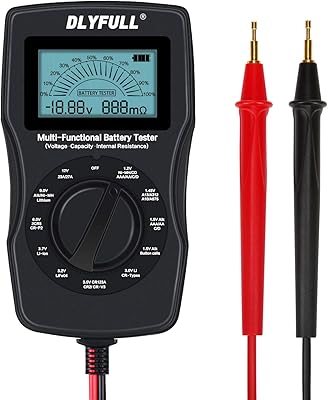
The Dlyfull B4 Universal Battery Tester sits in an interesting middle ground — it's more capable than the cheap LED testers that only flash red or green, yet it makes no pretense of being a professional instrument. What sets it apart at this price point is genuinely broad compatibility: 12 battery types in one compact device is not something you see often. The LCD dual-readout showing both voltage and remaining charge percentage puts real information in your hands rather than a vague indicator. It arrives ready to use, batteries included, and fits easily in a drawer. Just don't expect lab-grade precision — this is built for home and hobby use.

Features & Benefits

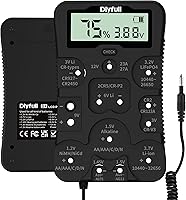
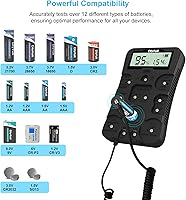
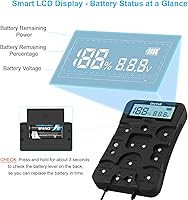
The LCD readout is where this battery checker earns its keep. Instead of guessing whether a AA is dead or just weak, you get an actual voltage number and a percentage bar — which makes the difference between tossing a half-charged battery and squeezing another few months out of it. Compatibility is impressively wide: cylindrical cells from AAA to D-size, specialty formats like CR123A and 18650, button cells, 9V, and even 12V packs all work here. One thing worth knowing: the self-test requires a 3-second button hold to activate — skip that step and the display shows an error, which is not a malfunction, just how the design works.

Best For

This battery checker makes the most sense for households that accumulate a true mix of battery types — remotes, smoke detectors, flashlights, kids' toys, cameras, and rechargeable packs all sharing the same junk drawer. It's a genuine upgrade for anyone still relying on a basic LED tester who wants actual voltage numbers rather than a binary pass/fail light. Hobbyists running 18650 or LiFePO4 cells in flashlights or DIY projects will appreciate the chemistry-specific support. It also suits people who maintain emergency kits and need to verify battery shelf life periodically without replacing an entire stock on a guess.

User Feedback

Buyers rate this LCD battery tester at 4.2 out of 5, and the praise is fairly consistent: display clarity and wide battery range get mentioned repeatedly, with most people feeling the value holds up for everyday home use. The most common stumbling block in critical reviews is the self-test requirement — users who don't hold the button a full three seconds see an error message and assume the unit is defective. A smaller group questions reading accuracy across all supported chemistries. Worth stating plainly: the Dlyfull tester has no load-testing and won't report mAh capacity, so anyone needing deeper diagnostics should look elsewhere.

Pros

  • Shows both voltage and charge percentage on a clear LCD, so you get real data instead of a vague pass/fail light.
  • Covers 12 battery chemistries and formats in a single compact unit, which is rare at this price tier.
  • Works with 18650 and LiFePO4 cells, making it genuinely useful for hobbyists beyond basic household batteries.
  • Arrives ready to use with two AAA batteries already included — no first-day frustration.
  • Compact and light enough to slip into a tool bag or kitchen drawer without taking up noticeable space.
  • Self-test function checks the tester's own battery level, which helps avoid misleading readings from a dying internal cell.
  • The 12-month warranty and lifetime support contact add a layer of confidence for a mid-range purchase.
  • Supports button cells like CR2032 alongside full-size cylindrical formats, so one device covers the whole household.

Cons

  • No load-testing capability means readings may not reflect real-world battery performance under high-current devices.
  • Cannot report milliamp-hour capacity, so you cannot gauge how much total runtime a rechargeable cell actually has left.
  • The 3-second self-test hold trips up new users who see an error message and assume the unit is broken.
  • Reading accuracy may vary slightly across different battery chemistries, which matters if precision is important to you.
  • Powered by AAA batteries rather than USB or a built-in rechargeable cell, so you will eventually need replacements.
  • No backlight on the LCD, which can make readings harder to see in dim lighting conditions.
  • The relatively modest build quality reflects the price point and may feel lightweight compared to professional-grade testers.

Ratings

The scores below for the Dlyfull B4 Universal Battery Tester were generated by our AI after systematically analyzing verified global buyer reviews, actively filtering out incentivized, bot-generated, and outlier feedback to surface genuine user sentiment. Both the strengths that drive repeat purchases and the friction points that frustrate real buyers are transparently reflected in every category score.

Battery Compatibility
92%
Buyers consistently highlight how liberating it is to own one device that handles everything from a coin cell CR2032 to an 18650 Li-ion pack. Hobbyists in particular appreciate not needing separate tools when switching between alkaline remotes, rechargeable flashlight cells, and specialty camera batteries in the same sitting.
A small number of users report that a few niche formats, particularly older alkaline packs and certain industrial cell sizes, produced inconsistent slot fits. The compatibility list is wide, but edge cases exist where physical contact quality introduces doubt about the reading.
Display Clarity
86%
The dual readout showing voltage alongside a percentage bar is the feature buyers mention most in positive reviews. Moving from a basic LED tester to an LCD that shows 3.85V at 74% makes battery triage much faster — no more guessing whether a cell is worth keeping or tossing.
The absence of a backlight is a recurring complaint, especially among users who store the tester in dim garages or utility closets. Several buyers noted that reading the LCD under anything less than direct light requires either moving to a brighter spot or squinting, which undercuts the convenience factor.
Ease of Use
74%
26%
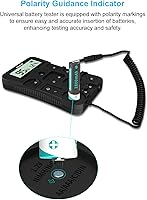
Placing cylindrical batteries against the pin contacts and dropping button cells into their slots is genuinely straightforward once you have done it a couple of times. Most buyers report getting useful readings within seconds, which is exactly what you want from a grab-and-check household tool.
The 3-second button hold for the self-test is the single biggest usability complaint across the review base. Users who skip or shorten this step see an error message and frequently assume the unit is defective, leading to returns that were likely avoidable with clearer out-of-box instructions.
Reading Accuracy
71%
29%
For alkaline and standard Ni-MH cells, buyers report readings that feel consistent and trustworthy enough for practical household decisions. The voltage display gives enough granularity to distinguish a strong cell from a weak one, which is all most people actually need day to day.
Accuracy concerns surface more often with less common chemistries like LiFePO4 and zinc air, where a handful of users noted readings that seemed optimistic compared to their multimeter. This is a consumer-grade device, and buyers expecting calibrated precision across all 12 supported chemistries may come away disappointed.
Build Quality
67%
33%
The housing is compact and feels solid enough for a device that lives in a drawer or toolkit. The contact pins and battery slots show no obvious wobble or misalignment out of the box, and most buyers report no structural issues after months of regular use.
The plastic construction reads clearly as mid-range — it does not feel cheap, but it does not inspire confidence either. A few buyers mentioned that the contact pin felt stiffer than expected on certain cylindrical cell sizes, requiring a bit of force to seat the battery properly.
Value for Money
78%
22%
Buyers who previously owned LED-only testers overwhelmingly feel the step up to actual voltage and percentage data justifies the price difference. The included AAA batteries and 12-month warranty sweeten the package enough that most reviewers consider it a fair deal for what it delivers.
A vocal minority questions whether the price is justified when multimeters offering similar voltage readings are available at comparable cost. Those buyers tend to want load-testing or mAh readout, features the Dlyfull tester simply does not offer, which makes the value calculation very use-case dependent.
Portability
88%
At under 0.34 lb and roughly the footprint of a TV remote, this battery checker travels well. Users who carry it in a field kit, camping bag, or car glove box appreciate that it adds virtually no bulk while covering a wide range of battery types they might encounter away from home.
There is no carrying case or protective pouch included, so the LCD screen and contact pins are exposed during transport. A few buyers noted minor scuffing on the display after loose storage in a tool bag, suggesting a simple sleeve or case would have been a welcome addition.
Self-Test Function
63%
37%
The idea behind the self-test is genuinely practical — knowing that the tester itself has sufficient battery power before you run a test prevents falsely low readings that could lead you to discard a perfectly good cell. Users who understand the feature appreciate the logical safeguard it provides.
The execution creates more confusion than confidence in practice. The requirement to hold a button for exactly 3 seconds before each session is not intuitive, and the error display that results from skipping it is not descriptive enough to guide inexperienced users toward the correct fix without consulting documentation.
Setup & Out-of-Box Experience
81%
19%
Including two AAA alkaline batteries means the tester is usable straight from the package, which buyers consistently mention as a small but appreciated touch. The compact form and clearly labeled slots make physical setup require no tools and almost no learning curve for the basics.
The welcome guide, while present, does not do enough to walk first-time users through the self-test step in plain language. Several negative reviews trace back directly to this documentation gap rather than any actual hardware failure, which suggests a missed opportunity in the onboarding experience.
Rechargeable Cell Support
83%
Hobbyists managing 18650 Li-ion cells for flashlights or vaping hardware report that the voltage readout is specific enough to make meaningful charge decisions without pulling out a separate dedicated charger with a display. LiFePO4 support for solar and DIY battery projects is also a differentiator at this price.
The tester cannot perform a load test or estimate actual remaining runtime on rechargeable cells, which limits its usefulness for anything beyond a quick charge-state snapshot. Power users managing battery packs for more demanding applications will hit this ceiling fairly quickly.
Customer Support
77%
23%
The promise of lifetime 24-hour customer service is a credible differentiator for a product in this category, and buyers who have reached out report reasonably prompt responses. The 12-month warranty adds a meaningful safety net for a device people tend to use repeatedly over years.
Support quality appears to vary — a portion of reviewers mention generic responses that did not fully address their specific compatibility question. Whether the lifetime support claim holds up over the long term is something that newer buyers simply cannot verify yet.
Button Cell Testing
84%
Having dedicated slots for coin and button cells removes the awkward balancing act that plagues basic testers with spring-clip designs. Buyers who regularly swap CR2032 batteries in watches, key fobs, and small electronics find this a practical convenience that saves time during routine replacements.
The range of supported button cell formats, while solid, does not cover every variant a collector or watchmaker might encounter. A few specialty button cell sizes sit outside the labeled slots, and users are left guessing whether an unlabeled slot will work or risk a poor contact reading.
Instruction Clarity
58%
42%
For confident, technically minded buyers the physical layout of slots and labels is intuitive enough that the manual becomes mostly redundant after one or two test runs. The LCD interface is simple enough that experienced users rarely need to reference documentation after initial setup.
The included welcome guide is the weakest link in the overall package. It does not adequately explain the self-test process, the meaning of the error display, or the chemistry-specific voltage ranges — gaps that are directly traceable to a meaningful share of the one- and two-star reviews left by otherwise salvageable buyers.

Suitable for:

The Dlyfull B4 Universal Battery Tester was clearly designed with the mixed-battery household in mind, and that is exactly where it shines. If your home runs on a rotating cast of AAA remotes, D-cell flashlights, CR2032 watch batteries, and 18650 rechargeable packs, having one device that handles all of them without swapping adapters is a genuine convenience. It makes particular sense for hobbyists managing rechargeable cells — being able to see an actual voltage reading rather than a vague indicator light helps you decide whether a battery needs charging or is simply at end of life. Emergency kit maintainers and light preppers will also find it useful for periodically verifying stored battery stocks without replacing everything on gut instinct. Anyone stepping up from a basic LED tester will immediately notice the difference that real percentage and voltage data makes in day-to-day battery decisions.

Not suitable for:

If your work demands diagnostic-grade accuracy or load-tested capacity measurements, the Dlyfull B4 Universal Battery Tester will leave you wanting more. It does not perform load testing, which means it cannot simulate how a battery behaves under actual device draw — a reading of 80% charge may still mean the cell struggles under high-current demand. There is no milliamp-hour capacity readout, so it cannot tell you how much total energy remains in a rechargeable pack. Technicians, battery recyclers, or anyone evaluating cells for resale or safety-critical applications should invest in a more specialized instrument. Similarly, buyers hoping for a one-touch experience may find the mandatory 3-second self-test button hold unintuitive at first, particularly if they are less comfortable with multi-step electronic devices.

Specifications

  • Brand & Model: Manufactured by Dlyfull under the model designation B4.
  • Dimensions: The unit measures 6.14 x 3.66 x 0.96 inches, making it slim enough to store in a standard drawer.
  • Weight: Weighs approximately 4.8 oz (0.34 lb), light enough to carry in a tool bag without added bulk.
  • Display: Features an LCD screen that simultaneously shows voltage reading and remaining charge as a percentage with a bar indicator.
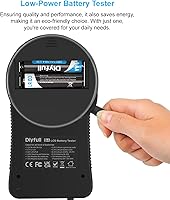
  • Power Source: Requires 2 x AAA 1.5V alkaline batteries to operate; two batteries are included in the box.
  • Chemistry Support: Compatible with Ni-MH, Ni-CD, Li-ion, LiFePO4, Alkaline, Zinc Air, and Lithium Manganese battery chemistries.
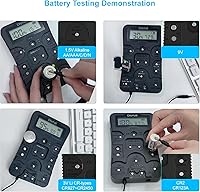
  • Voltage Ranges: Reads batteries across voltage levels of 1.2V, 1.45V, 1.5V, 3.0V, 3.2V, 3.7V, 6V, 9V, and 12V.
  • Supported Formats: Tests cylindrical cells (AAA, AA, C, SC, D, N), button cells (including CR2032), and specialty types such as CR123A, CR-V3, 2CR5, 23A, 27A, and 18650.
  • Battery Type Count: Officially supports 12 distinct battery types across sizes and chemistries in a single device.
  • Self-Test Function: Holding the check button for 3 seconds triggers a self-diagnostic that verifies the tester's own internal battery level.
  • Color & Finish: Available in a matte black finish with no secondary color options listed.
  • Warranty: Covered by a 12-month manufacturer warranty against defects.
  • Customer Support: Dlyfull provides lifetime 24-hour customer service access for product questions and troubleshooting.
  • Load Testing: This tester does not perform load testing; it measures open-circuit voltage and charge state only.
  • Capacity Readout: Does not display milliamp-hour (mAh) capacity; charge level is shown as a percentage and bar graph only.
  • BSR Ranking: Ranked #23,684 in Tools & Home Improvement and #3,562 in Electrical Equipment on Amazon at the time of listing.

Related Reviews
X-cosrack Universal Battery Tester
84%
91%
Ease of Use
88%
Battery Compatibility
92%
Display Clarity
89%
Portability
90%
Accuracy for Small Batteries
More
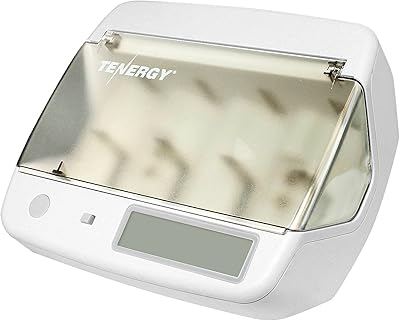
Tenergy TN299 Universal Battery Charger
87%
87%
Charging Performance
91%
Ease of Use
85%
Display Clarity
90%
Portability
92%
Versatility (Battery Types)
More
KKEANIC SL-049 Battery Tester
87%
91%
Ease of Use
94%
Compatibility with Battery Types
90%
Portability and Size
88%
Accuracy of Testing
74%
Display Quality
More
Intelligence 8 Bay Universal Battery Charger
86%
90%
Charging Speed
88%
Usability
93%
Safety Features
85%
Display Clarity
87%
Build Quality
More
ZTS Mini-MBT Multi-Battery Load Tester
82%
93%
Testing Accuracy
96%
Ease of Use
88%
Battery Type Coverage
84%
Build Quality
91%
Portability
More
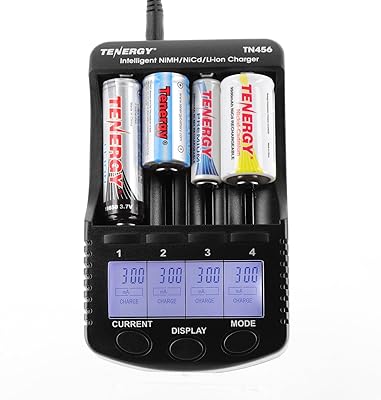
Tenergy TN456 Universal Battery Charger
82%
93%
Battery Chemistry Compatibility
91%
Independent Slot Operation
88%
LCD Display & Data Readouts
86%
Capacity TEST Mode
79%
Charging Speed & Current Control
More
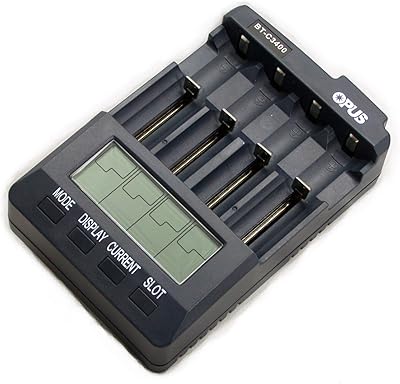
Opus C3400 4-Channel Battery Charger Analyzer
79%
93%
Measurement Accuracy
91%
Multi-Channel Independence
89%
Chemistry Compatibility
88%
Capacity Test Reliability
82%
Internal Resistance Testing
More
Xuerdon Battery Organizer Storage Case with Tester
86%
93%
Storage Capacity
89%
Battery Tester Effectiveness
85%
Build Quality and Durability
87%
Portability and Ease of Use
91%
Design and Organization
More
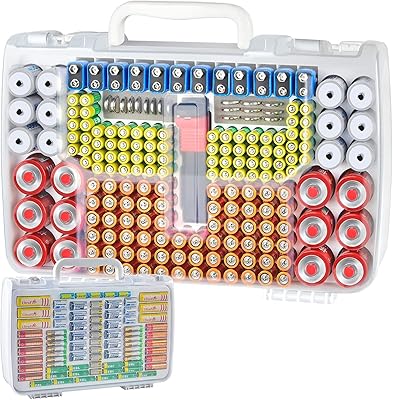
The Battery Organizer TBO2699 180-Battery Storage Case
78%
93%
Storage Capacity
78%
Build Quality
91%
Lid Design & Transparency
82%
Wall-Mount Usability
67%
Slot Fit & Battery Compatibility
More
Bee Neat Battery Organizer and Storage Case with Tester
83%
92%
Storage Capacity
88%
Ease of Use
85%
Design and Build Quality
90%
Battery Tester Functionality
76%
Compactness and Space Efficiency
More

FAQ

That error message almost certainly means you pressed the check button too quickly. The Dlyfull B4 Universal Battery Tester requires you to hold the check button for a full 3 seconds to complete its self-test before use. It is a built-in design step, not a sign that anything is wrong — just hold the button a little longer and the display will initialize properly.

Yes, the Dlyfull tester explicitly supports 18650 Li-ion cells. You place the cell in the corresponding cylindrical slot and the LCD will show both the voltage and estimated charge percentage. Keep in mind this is an open-circuit reading, so it will not tell you how the cell performs under actual load.

Absolutely. Button cells including CR2032 have dedicated slots on the tester, so there is no need to balance or hold anything in place. Just set it in the slot and the reading appears on the LCD within a second or two.

For a household tool, the readings are reasonably consistent and useful for everyday decisions like sorting dead batteries from usable ones. That said, this is a consumer-grade device and should not be treated as a calibrated instrument. If you need accuracy within a few millivolts for technical work, a proper bench multimeter would serve you better.

No, it does not report mAh capacity. The battery checker shows charge as a percentage alongside the voltage, which is practical for everyday use but does not give you a precise energy-remaining figure. If mAh readout is important to your workflow, you would need a dedicated battery capacity analyzer.

The tester runs on two AAA 1.5V alkaline batteries, which are included in the box. Longevity depends on how frequently you use it, but because each test only takes a few seconds, a pair of quality alkaline AAAs should last a long time with typical household use. The built-in self-test function will alert you when the internal batteries need replacing.

Dlyfull specifically recommends using 1.5V alkaline AAA batteries to power the unit. Rechargeable Ni-MH cells typically output around 1.2V, which can affect the tester's accuracy and may cause unreliable readings for some battery types. Stick with standard alkaline cells for the power source.

The LCD does not have a backlight, which is one of the practical limitations of this battery checker. In dim lighting — a garage, a closet, or under a kitchen counter — you may need to move closer to a light source to read the display clearly.

No tester is safe to use with a damaged, leaking, or visibly swollen battery. You should handle those cells with care, wear gloves, and dispose of them according to your local battery recycling guidelines rather than attempting to test them.

The tester comes with a 12-month manufacturer warranty covering defects in materials and workmanship. Dlyfull also offers lifetime customer service access, which you can reach through the contact information included in the welcome guide that ships with the unit. For most common issues like error messages or unexpected readings, their support team can usually walk you through a resolution quickly.