Overview

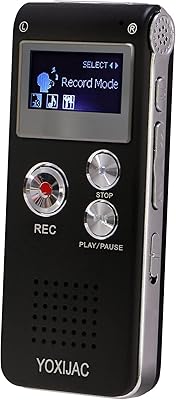
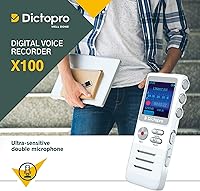
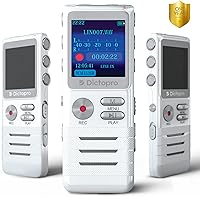
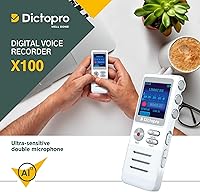
The DictoPro X100 8GB is a compact, aluminum-bodied voice recorder that sits comfortably between throwaway budget options and more expensive prosumer gear. It has been on the market since 2015 and has accumulated over 2,300 ratings — enough real-world feedback to draw some honest conclusions. The core pitch is simple: drop it in your pocket, set it to voice-activated mode, and let it run. No fumbling with a phone app, no draining your main battery. The shell feels solid without adding bulk, and the dual built-in microphones are designed to capture sound from a meaningful distance across a room.

Features & Benefits

The X100's voice activation is the feature that earns it the most consistent praise. Rather than recording silence between speakers, it kicks in when sound crosses a threshold and pauses when the room goes quiet — practical for long lectures or drawn-out meetings. The 8GB internal storage is roomy enough that you can record daily for months without worrying about space. Files save in MP3 or WAV, and moving them to a computer is just a matter of plugging in via USB. The noise reduction does a decent job softening background hum, though it is not a studio-grade fix. At under 3 ounces, this dictation device is genuinely pocketable.

Best For

This voice recorder makes the most sense for people who want a dedicated device — not another app competing for phone battery and attention. Students in long lecture halls will appreciate the hands-off recording style; set it on a desk and forget about it. It also works well for professionals who conduct interviews or sit through lengthy meetings and need reliable audio without managing a phone. Doctors and field workers doing hands-free dictation will find the slim form factor convenient. If you are still relying on a smartphone for recording, the X100 is a straightforward step up — more focused, less fuss.

User Feedback

With a 4.0-star average across more than 2,300 reviews, the overall picture is positive but not without caveats. Most buyers are satisfied with audio clarity in office settings, classrooms, and quieter environments. The voice activation sensitivity does come up as a friction point — a few users mention it occasionally clips the first syllable of a sentence in very soft-spoken rooms, which is worth knowing before you buy. Battery life holds up well for a full workday, though heavy users pushing across multi-day sessions have noted it falls short. The built-in speaker is functional but quiet, and headphones improve playback quality noticeably in any noisy setting.

Pros

  • Voice-activated recording means no dead-air files and no manual babysitting during long sessions.
  • Dual microphones capture group conversations from across a standard meeting room with solid clarity.
  • The aluminum body feels noticeably more durable than plastic rivals at a similar price point.
  • Storage is generous enough that most students can record an entire semester without running out of space.
  • Plug-in-and-transfer USB setup works on both Mac and Windows without any extra software.
  • Lightweight and slim enough to slip into a shirt pocket without bulk or discomfort.
  • Supports both MP3 and WAV recording, giving users a choice between file size and audio quality.
  • The X100 handles playback of FLAC and APE files too, useful for reviewing high-quality source recordings.
  • Voice activation conserves battery during pauses, stretching usable recording time across a full workday.
  • Setup is minimal — charged and ready to record within minutes of opening the box.

Cons

  • Voice activation can clip the opening syllable of a sentence in very quiet or soft-spoken environments.
  • The built-in speaker lacks volume for any setting with ambient noise — headphones become effectively mandatory.
  • No memory card slot means storage cannot be expanded beyond the built-in 8GB.
  • USB 2.0 connectivity feels dated compared to newer recorders with faster transfer or wireless options.
  • Battery life of around 10 hours leaves little room for multi-day use without access to a charger.
  • Voice activation sensitivity is not user-adjustable in any meaningful way, limiting fine-tuning options.
  • The small display makes browsing through a large archive of saved files more tedious than it should be.
  • No companion app or cloud integration means file organization is entirely manual on the user side.
  • Noise reduction softens consistent hum but struggles with louder or unpredictable background sounds.
  • The product design has not been significantly updated since its 2015 launch, and newer rivals are closing the gap.

Ratings

The DictoPro X100 8GB has been put through its paces by thousands of buyers worldwide — students, healthcare professionals, journalists, and everyday note-takers — and our AI-driven scoring model has analyzed that verified feedback to filter out incentivized reviews and bot patterns. What follows reflects an honest cross-section of real experiences, with both the genuine strengths and the recurring frustrations weighted transparently into each score.

Audio Clarity
83%
In quiet classrooms, small meeting rooms, and one-on-one interviews, most users report that recorded speech comes back crisp and easy to transcribe. The dual microphone setup captures voices from across a typical conference table without any noticeable drop in intelligibility.
Clarity takes a hit in larger, echo-prone spaces or rooms with steady ambient noise like HVAC systems. A handful of reviewers found distant speakers — say, a professor pacing at the front of a large lecture hall — harder to capture cleanly.
Voice Activation Accuracy
71%
29%
When it works as intended, the voice-activated mode is genuinely convenient — set it on a desk and it captures every exchange without recording long stretches of silence. For most users in office or classroom settings, this feature works reliably.
Soft-spoken environments trip it up more often than they should. Some buyers report the recorder clips the first syllable when someone starts talking quietly, and very low-volume rooms can occasionally cause it to miss short exchanges altogether.
Build Quality
86%
The aluminum shell gives the X100 a noticeably sturdier feel than similarly priced plastic competitors. It survives regular pocket and bag carry without showing scuffs or creaks, and the button layout feels intentional rather than cheaply afterthought.
The body is slightly thicker than some rivals at this price, which a few users with slim pockets found mildly inconvenient. The clip, where present, has drawn occasional complaints about tension strength over extended daily use.
Battery Life
68%
32%
For a standard single workday — a full day of classes, a series of back-to-back client meetings — the built-in battery holds up without issue. Most users who plug it in overnight report no mid-session failures.
Push it into multi-day field use or forget to charge between heavy sessions and you will run into trouble. The roughly 10-hour operational window is adequate for typical use but leaves little buffer for demanding schedules.
Storage & Capacity
91%
Eight gigabytes translates to a remarkable amount of real recording time, particularly in the default MP3 format. Students who record every lecture across a full semester rarely find themselves running out of space before exams.
There is no option to expand storage via a memory card, so once you hit the ceiling, file management becomes your responsibility. Power users archiving everything without regular offloads will eventually need to transfer files more often than they might prefer.
Noise Reduction
67%
33%
The noise reduction processing does soften consistent background hum — air conditioning, light traffic, office chatter in an adjacent room — enough to make transcription noticeably easier in moderately noisy environments.
It is not a surgical tool. Loud or unpredictable ambient sounds push past the filtering with ease, and some users feel the processing occasionally adds a faint processed texture to voices recorded in already-quiet spaces.
Ease of Use
88%
The control layout is minimal and logical — new users typically figure out the core recording and playback functions within a few minutes without consulting a manual. That simplicity is a real asset for older users or anyone who just wants to press record and go.
The display is small, which makes navigating multiple saved files slightly tedious. Users managing a large archive across dozens of recordings occasionally wish the file browsing interface had more depth.
Portability
93%
At under 3 ounces and slim enough to forget in a shirt pocket, this dictation device earns consistent praise for how little presence it has during a long day. Doctors moving between patient rooms and students rushing between classes both cite the size as a genuine plus.
The aluminum body, while durable, is not rubberized or grippy, so it can feel slightly slippery when pulled quickly from a pocket. A few users would have preferred a softer-touch finish for one-handed operation.
Playback Experience
62%
38%
The built-in speaker lets you do a quick spot-check on a recording without any accessories, which is handy when you just need to confirm the device captured something important. Headphone playback via the 3.5mm jack is genuinely clear.
The speaker volume is modest — fine for a quiet office but barely usable in a coffee shop or anywhere with ambient noise. This is probably the most consistently mentioned disappointment among buyers who expected more from on-device playback.
File Transfer & Compatibility
84%
Plug it into a laptop via USB and it mounts as a standard drive — no proprietary software required. Both Mac and Windows users report straightforward drag-and-drop transfers without driver headaches.
USB 2.0 transfer speeds are fine for audio files but feel slightly dated compared to some newer competitors. There is no wireless transfer option, which is a minor inconvenience for users who prefer to keep cables out of their workflow.
Recording Format Flexibility
78%
22%
Support for both MP3 and WAV gives users a practical choice between compact file sizes and lossless quality. The playback side also handles FLAC and APE, which is a nice bonus for audiophile-leaning users reviewing their own recordings.
The selection, while solid, does not extend to more modern compressed formats. Users feeding recordings directly into transcription software occasionally have to run a quick format conversion first, depending on their tool of choice.
Value for Money
81%
19%
Relative to cheaper single-mic recorders that struggle in group settings, the X100 justifies its mid-range positioning with noticeably better dual-mic capture and a more durable body. For students and professionals who need something reliable without spending heavily, it hits a reasonable sweet spot.
A few buyers feel the price has crept up since the product launched without meaningful hardware updates. At its current cost, some competing newer models offer wireless features or improved voice activation that make the value calculus closer than it once was.
Setup & Out-of-Box Experience
87%
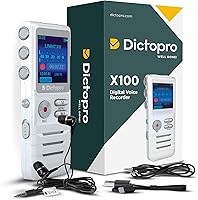
The battery comes pre-installed and partially charged, so most users are recording within minutes of opening the box. The included USB cable and reasonably clear quick-start guide lower the barrier for less tech-savvy buyers.
The manual covers the basics adequately but does not go deep on configuring voice activation sensitivity, which is exactly what new users struggling with clipping issues need most. A more thorough setup guide would reduce early frustration noticeably.

Suitable for:

The DictoPro X100 8GB is a strong fit for anyone who needs a reliable, dedicated recording device without the distraction or battery drain of a smartphone. College and university students will get the most immediate value — drop it on a desk at the start of a lecture, let voice activation handle the rest, and walk out with a clean, organized audio file. Professionals who sit through lengthy client meetings, conduct field interviews, or need discreet dictation will also find the slim aluminum body and hands-off operation genuinely practical. Medical practitioners and field workers who dictate notes throughout a busy shift benefit from the pocketable form factor and the fact that it does not compete for attention with other devices. If your recording environments are mostly indoors — classrooms, offices, consultation rooms, small conference spaces — this dictation device is well-matched to exactly those conditions.

Not suitable for:

The DictoPro X100 8GB is not the right tool for every situation, and being clear about that upfront saves real frustration. Buyers who need to record in loud, unpredictable outdoor settings — construction sites, street interviews, crowded events — will find the noise reduction insufficient and the voice activation unreliable when background sound is constantly fluctuating. Journalists or researchers who need extended multi-day field recording without access to a charger may find the roughly 10-hour battery window too tight for peace of mind. The built-in speaker is genuinely quiet, so if you plan to play recordings back in a group setting or a noisy room, you will be reaching for headphones every time. Anyone who expects wireless syncing, app integration, or modern connectivity features should look elsewhere — this voice recorder keeps things wired and straightforward, which is either a feature or a limitation depending on your workflow.

Specifications

  • Storage: The device includes 8GB of internal flash memory with no option for external expansion via memory card.
  • Recording Capacity: Internal storage supports up to 700 hours of audio recorded in the default MP3 format.
  • Recording Formats: Audio can be saved in either MP3 or WAV format, selectable depending on whether file size or audio fidelity is the priority.
  • Playback Formats: On-device playback supports MP3, APE, and FLAC files in addition to recordings made on the device itself.
  • Microphone: Two built-in microphones are positioned to capture directional stereo audio with a stated pickup range of up to 40 feet.
  • Noise Reduction: Onboard digital noise reduction processing is applied during recording to attenuate steady background noise such as ventilation hum or room ambience.
  • Voice Activation: A voice-activated control mode starts recording automatically when sound exceeds a set threshold and pauses during silence to conserve battery and storage.
  • Battery: A built-in lithium-ion rechargeable battery is included and provides approximately 10 hours of continuous operation on a full charge.
  • Connectivity: Files are transferred to a computer via a USB 2.0 connection; the device mounts as a standard removable drive requiring no proprietary software.
  • Headphone Output: A 3.5mm headphone jack allows private playback through standard earphones or headphones for clearer audio review.
  • Built-In Speaker: An integrated speaker enables on-device playback without accessories, though output volume is modest and best suited to quiet environments.
  • Body Material: The outer shell is constructed from aluminum, providing a rigid, scratch-resistant enclosure that holds up well to daily pocket and bag carry.
  • Dimensions: The unit measures 1.46″ deep by 1.26″ wide by 3.66″ tall, making it small enough to fit in a standard shirt pocket.
  • Weight: At 2.72 ounces, the recorder adds negligible bulk to a bag or coat pocket during all-day use.
  • Operating Time: Under typical mixed-use conditions combining recording and standby, the battery sustains approximately 10 hours before requiring a recharge via USB.
  • Model Number: The official model designation is X100, manufactured by Productech under the Dictopro brand.
  • First Available: The product was first listed for sale in November 2015 and remains an active, non-discontinued item in the manufacturer's lineup.
  • Compatibility: The recorder is compatible with Windows and macOS laptops and desktops that support standard USB mass storage devices.

Related Reviews
Orange Pi 5 8GB
Orange Pi 5 8GB
83%
94%
Processing Performance
91%
Graphics Capability
89%
Memory & Multitasking
87%
Video Output Quality
72%
Connectivity Options
More
DATO DDR4 8GB 3200MHz Memory
86%
89%
Performance
91%
Energy Efficiency
94%
Ease of Installation
87%
Compatibility with Desktop Systems
92%
Value for Money
More
YOXIJAC LYB-101 8GB
YOXIJAC LYB-101 8GB
75%
91%
Ease of Use
78%
Audio Quality — Quiet Environments
47%
Audio Quality — Noisy Environments
63%
Voice Activation Accuracy
69%
Battery Life
More
idoooz U2 MP3 Player 8GB
85%
91%
Value for Money
95%
Portability
88%
Battery Life
82%
Sound Quality
90%
Ease of Use
More
RasTech Raspberry Pi 5 8GB Kit
84%
93%
CPU Performance
91%
Power Supply Compatibility
72%
Thermal Management
84%
Value for Money
88%
PCIe Expandability
More
AGPTEK K1 8GB MP3 Player
88%
88%
Build Quality
94%
Portability
90%
Battery Life
92%
Audio Format Support
91%
Ease of Use
More
Crucial 8GB DDR4-2666 DIMM
84%
91%
Value for Money
88%
Performance Boost
94%
Ease of Installation
87%
Power Efficiency
82%
Compatibility
More
AGPTEK G02 8GB MP3 Player
79%
88%
Value for Money
93%
Portability & Design
75%
Battery Life
80%
Sound Quality
85%
FM Radio Functionality
More
Crucial 8GB DDR4-2400 SODIMM RAM
88%
91%
Performance
94%
Installation Ease
93%
Energy Efficiency
85%
Compatibility
88%
Multitasking Performance
More
Hynix 8GB DDR4-2666MHz RAM Module
86%
88%
Performance
94%
Compatibility
91%
Ease of Installation
90%
Value for Money
85%
Energy Efficiency
More

FAQ

It works reliably in most classroom settings, but large halls with a distant speaker can occasionally challenge the sensitivity threshold. The X100 picks up sound reasonably well up to around 40 feet, but if a professor tends to speak softly or turns away from the device, you may notice the occasional clipped word at the start of a sentence. Placing the recorder on a desk near the front of the room helps considerably.

No — there is no memory card slot, so the 8GB of internal storage is what you have to work with. That said, 8GB translates to a very large number of recorded hours in MP3 format, so most users recording lectures or meetings daily will go weeks or months before needing to offload files to a computer.

Connect the recorder to your laptop using the included USB cable and it will appear as a removable drive — no software installation needed. From there you can drag and drop files just like you would with a USB flash drive. Both Windows and macOS handle this without any compatibility issues.

It helps with steady, low-level background noise like air conditioning or distant chatter, but it is not a professional-grade filter. In a genuinely busy open office or a noisy cafe, some ambient sound will still bleed into the recording. For quieter environments it does a noticeably cleaner job.

Expect around 10 hours of active use, which covers a full workday or a long series of lectures without issue. If you are doing multi-day field work without access to a USB charger, you will want to plan around that limit. Charging is done via the USB connection, so any standard laptop port or USB wall adapter works.

Yes, it mounts as a standard USB storage device on macOS without any drivers or additional software. File management is done directly through Finder, just like any external drive.

The sensitivity is fixed at the factory setting and cannot be adjusted through the device menu. For most typical recording environments this works fine, but buyers who need fine-tuned control over activation thresholds may find this limiting compared to more advanced recorders in higher price brackets.

Not really — it is useful for personal spot-checking in a quiet room, but it will struggle to fill any space with ambient noise. For reviewing recordings with others, plug in a pair of standard earphones via the 3.5mm jack or transfer the files to a computer where you can use better speakers.

This voice recorder saves in either MP3 or WAV. MP3 keeps files smaller and is perfectly adequate for speech and dictation, while WAV is lossless and produces larger files more suitable if audio fidelity is important for your use case. For everyday note-taking and lecture recording, MP3 is what most users stick with.

The aluminum body holds up well to the kind of wear that comes with being tossed into a bag or pocket every day. It does not feel fragile or hollow the way some budget plastic recorders do. A few long-term users have owned theirs for years without any structural issues, though the finish can show light surface marks over time with heavy use.