
Overview

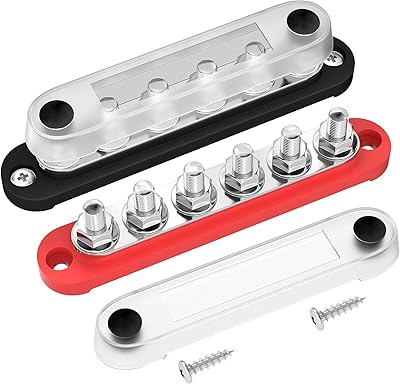
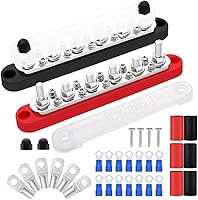
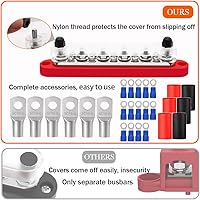
The Dianrui 250A Marine Bus Bar comes as a color-coded pair — one red positive, one black negative — giving you a clean foundation for organizing multiple circuits without the rats-nest wiring that plagues so many DIY electrical builds. At its mid-range price it punches well above what you might expect from a budget option, yet it stops short of industrial-grade territory, so keep your expectations calibrated accordingly. It works across marine, automotive, RV, and solar applications, and Dianrui even includes 14 insulated ring terminals and six copper lugs, which means you can often get straight to work without an extra hardware store run.

Features & Benefits

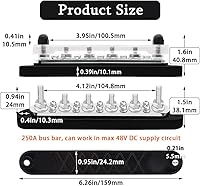
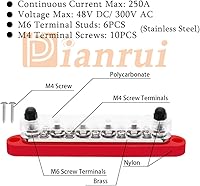
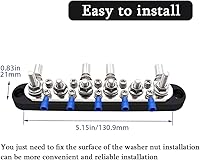
Each bar in this distribution block offers six 1/4-inch M6 studs, giving you enough termination points to handle a typical spread of accessories on a mid-sized boat or RV without daisy-chaining. The nickel-plated copper contact plates keep resistance low and hold up well against moisture and salt air — noticeably better than bare copper in corrosive environments. A transparent polycarbonate cover locks down via screw rotation, protecting live terminals from accidental contact and light splash. The nylon base isolates the bar electrically while keeping the whole assembly lightweight. The system is rated for up to 48V DC and 250A, though real-world loads should stay comfortably below that ceiling.

Best For

This terminal block pair is an obvious fit for boat owners trying to bring order to a growing list of 12V accessories — think bilge pumps, navigation lights, depth finders, and VHF radios all pulling from one organized source. RV builders and overlanders will find it equally useful when a solar charge controller and multiple loads need a clean distribution hub. Custom car audio builds benefit too, since the color-coded bars eliminate the guesswork that comes with unmarked wire taps. Anyone running a modest off-grid solar system on 12V or 24V will appreciate the six-position layout and the clear view through the protective cover during troubleshooting.

User Feedback

Buyers consistently highlight two things: how easy the installation is and how solid the block feels at this price. Build quality draws repeated praise, with many noting the cover fits snugly and the studs feel secure once torqued down. That said, a handful of users flagged that the included ring terminals are functional but not premium — treat them as a starter kit. Marine buyers have been largely positive about corrosion resistance in coastal conditions, though long-term saltwater data is limited given the product's relatively short market history. A few noted that stud spacing could be slightly wider to accommodate bulkier cable lugs comfortably.

Pros

  • Sold as a matched positive-and-negative pair, which simplifies planning and cuts down on extra orders.
  • Six M6 stud positions per bar give ample room for the typical spread of marine or RV accessories.
  • Nickel-plated copper contact plates resist corrosion noticeably better than bare copper in salt air.
  • The transparent cover lets you visually inspect connections without removing any hardware.
  • Screw-rotation cover lock keeps the protective cap secure even with vibration from engines or rough water.
  • Included ring terminals and copper lugs are a genuine convenience, especially for first-time installers.
  • Lightweight nylon base makes panel mounting straightforward without adding meaningful weight to the build.
  • Color-coded red and black bars make polarity clear at a glance, reducing wiring mistakes during installation.
  • Rated up to 48V DC, so it works equally well on both 12V and 24V battery systems.
  • Strong buyer ratings reflect consistent satisfaction with build quality relative to the asking price.

Cons

  • No integrated fusing means each branch circuit depends entirely on upstream overcurrent protection being correctly sized.
  • The included ring terminals are functional but basic — serious builders will likely swap them for higher-quality crimps.
  • Stud spacing may be too tight to comfortably seat large-gauge lugs used in high-amperage runs.
  • Long-term saltwater corrosion resistance is still relatively unproven given the product's short market history.
  • The polycarbonate cover offers splash resistance only — it carries no IP rating for wet or submerged environments.
  • 250A is a maximum rating, not a safe continuous operating target; thermal management is entirely the installer's responsibility.
  • No mounting hardware is included in the package, so panel installation requires sourcing your own fasteners separately.
  • Users with very large cable runs may find the terminal block pair physically small for their installation space.

Ratings

The Dianrui 250A Marine Bus Bar has been evaluated by our AI rating engine after scanning and filtering verified global buyer reviews — removing incentivized, duplicate, and bot-generated submissions to surface what real installers actually experienced. Scores reflect both the genuine strengths that made buyers recommend this distribution block and the friction points that gave others pause. The result is an honest, balanced picture of where this terminal block pair earns its place and where it falls short.

Build Quality
83%
Most buyers, especially those coming from bare wire taps or cheap plastic blocks, were genuinely impressed by how solid the assembly felt out of the box. The nickel-plated copper contact plates have a satisfying heft, and the nylon base shows no flex when wiring is torqued down firmly.
A handful of installers noted that the stud threading felt slightly rough on initial assembly, requiring extra care to avoid cross-threading under tight quarters. The polycarbonate cover, while clear and functional, can show minor stress marks around the screw point after repeated removal.
Corrosion Resistance
78%
22%
Boaters running this distribution block in coastal saltwater environments have reported clean, oxide-free contacts after a full season of use when the cover is kept properly seated. The nickel plating on the copper plates is a meaningful upgrade over bare copper alternatives in the same price range.
Long-term data beyond one to two seasons is still limited given the product's relatively recent market entry, so durability under sustained heavy saltwater exposure remains an open question. A few marine users noted mild surface discoloration on the nylon base after prolonged UV exposure in open cockpit installations.
Ease of Installation
91%
The color-coded pair makes polarity immediately obvious, which buyers without formal electrical training found genuinely confidence-building during their first bus bar installation. The included ring terminals and copper lugs meant most users could wire everything up in a single sitting without a hardware run.
Users working in tight engine compartments or under cramped helm panels found the screw-rotation cover mechanism slightly awkward to operate with limited hand clearance. A few noted that mounting holes would benefit from being slightly larger to accommodate a wider range of panel fasteners.
Current Capacity
74%
26%
For typical 12V marine and RV builds pulling well under 150A in real-world aggregate loads, the 250A ceiling provides a comfortable headroom that reassures buyers the block will not be the weak link in their system. The rating also covers 24V solar setups cleanly, giving it genuine versatility.
The 250A figure is a maximum spec, not a practical continuous target, and buyers who did not account for derating in high-temperature engine bays occasionally found performance fell short of expectations. No built-in fusing means the block itself offers zero overcurrent protection, which is a real gap for less experienced DIYers.
Moisture Protection
67%
33%
The screw-lock polycarbonate cover performs well against spray, condensation, and the kind of incidental water exposure common in cockpit and engine compartment installations. Buyers who mounted it in protected locations reported no moisture ingress after extended periods.
The cover carries no published IP rating, and users who installed it in particularly wet environments — open bilge areas or exposed deck panels — found the protection inadequate for anything beyond light splash. This is a splash-resistant cover, not a waterproof enclosure, and the distinction matters in demanding marine conditions.
Terminal Fit & Spacing
69%
31%
For standard AWG wire sizes used in typical marine wiring — 10 AWG through 4 AWG branch circuits — the M6 studs and M4 screws accept terminals cleanly and hold them firmly once tightened. Buyers wiring a mix of small and medium accessories rarely hit any compatibility issues.
Installers working with very heavy-gauge cable, such as 2 AWG or larger runs from a high-capacity battery, reported that the stud spacing makes fitting wide lug barrels side by side genuinely difficult. A couple of users had to file lug edges slightly to get a clean fit without terminal overlap.
Value for Money
86%
Compared to branded marine electrical components at significantly higher price points, this terminal block pair delivers a surprisingly complete package — hardware included, both rails covered, and a protective cover standard. For a budget-conscious boat or RV build, it is hard to argue with what you get per dollar spent.
Buyers with professional installation backgrounds noted that the cost savings come with trade-offs in fit and finish that would be unacceptable in a commercial marine context. If your project demands certifications or traceable component specs, the value equation shifts away from this block quickly.
Included Accessories
72%
28%
The 14 ring terminals and 6 copper lugs are a practical bonus that most buyers found immediately useful for at least some of their circuits, cutting down the parts list meaningfully. First-time builders especially appreciated having hardware on hand without needing to research crimp specs separately.
Experienced electricians were quick to note that the included terminals are adequate but not premium — thinner insulation and lighter crimping than what they would source independently. For any circuit carrying significant sustained current, swapping in higher-rated terminals is worth the extra investment.
Cover Mechanism
76%
24%
The screw-rotation locking design holds the cover far more securely than snap-fit alternatives, which matters on powerboats where engine vibration is constant. Buyers appreciated being able to see connection status through the clear cover without fully removing it.
Accessing terminals for adjustments or adding circuits requires fully removing the cover each time, which some users found tedious in cramped panels where the cover had limited room to rotate freely. The screw point can also become stiff after prolonged exposure to heat cycles.
Color Coding Clarity
93%
The red-and-black pair is an immediately intuitive system that reduces the chance of polarity errors during installation, and buyers routinely called it out as one of the most useful practical features for DIY builds. Even months after installation, the color distinction makes troubleshooting and circuit identification straightforward.
The color is molded into the base material rather than painted or labeled with text, so under dim bilge or panel lighting the distinction can be harder to read at a glance than buyers expected. A small printed label or embossed polarity symbol on the cover would improve identification in low-light conditions.
Compatibility Range
88%
The 48V DC ceiling means this distribution block works across 12V, 24V, and even 36V DC systems, making it genuinely versatile for solar, marine, and automotive applications without any configuration changes. Buyers switching between project types found they could reuse or repurpose the block without worrying about voltage limitations.
AC compatibility up to 300V is listed in the specifications, but most buyers in the target market have no AC use case for this block, and the spec is rarely relevant in practice. The six-position limit per bar can also be a compatibility ceiling for complex multi-circuit builds that have outgrown simple distribution.
Panel Fit & Footprint
81%
19%
The compact dimensions make this terminal block pair a realistic fit even in cramped helm panels and RV electrical bays where space is always at a premium. At roughly 13 ounces total for both bars, weight is essentially a non-factor in any practical installation.
Because mounting hardware is not included, buyers have to measure and source appropriate fasteners independently, which added an unexpected step for some first-timers. The block's compact size, while generally an asset, also limits how many large-gauge conductors can be accommodated without physical crowding.
Long-Term Reliability
71%
29%
Buyers who have run this distribution block through a full boating season — heat, vibration, and salt spray — have largely reported stable connections and no signs of terminal loosening when initially torqued correctly. The nylon base and polycarbonate cover show no meaningful degradation in typical sheltered installations over one to two years.
The product has not been on the market long enough to generate a reliable picture of five-year or ten-year durability, which matters for permanent marine wiring. A small percentage of buyers reported cover stress fractures after thermal cycling in hot engine compartments, suggesting material limits in extreme heat environments.

Suitable for:

The Dianrui 250A Marine Bus Bar is purpose-built for the kind of buyer who needs to bring genuine order to a growing 12V or 24V DC electrical system without spending a fortune doing it. Boat owners adding multiple accessories — bilge pumps, navigation lights, VHF radios, fish finders — will find the six-stud-per-bar layout gives them exactly the branching capacity they need without improvised wire taps or overcrowded terminal blocks. RV builders and overlanders running solar setups will appreciate the clean positive-negative pair that keeps polarity obvious at a glance, reducing installation errors on systems where a reversed connection can cause real damage. Weekend DIYers who want a professional-looking result on a custom car audio build or a small off-grid cabin power system will get solid value from this distribution block, especially since the included ring terminals and copper lugs let you start crimping immediately. If your project lives in a damp or salty environment and you need splash-resistant protection over live terminals, this terminal block pair covers that base adequately for most non-submersion applications.

Not suitable for:

The Dianrui 250A Marine Bus Bar is not the right tool for high-demand commercial or industrial electrical work where certified, fused distribution panels are either required by code or simply expected for safety. The 250A figure is a rated ceiling, not a recommended sustained load, so anyone planning to run continuous high-amperage draws close to that limit should look at purpose-built fuse blocks with overcurrent protection built in. This distribution block also lacks integrated fusing, which means each circuit branching off it relies entirely on upstream protection — a critical detail that casual DIYers sometimes overlook. Buyers expecting true waterproof submersion protection will be disappointed; the polycarbonate cover handles splash and condensation, but it is not sealed to any IP rating suitable for below-deck flooding scenarios. If you need more than six stud positions per rail, or require significantly larger lug accommodation for very heavy-gauge cable, you may find the stud spacing and terminal sizing limiting for a high-current professional installation.

Specifications

  • Current Rating: Each bar is rated for a maximum continuous current of 250A under normal operating conditions.
  • Max Voltage: The terminal block pair supports up to 48V DC and 300V AC, covering standard 12V and 24V DC systems comfortably.
  • Stud Count: Each bar provides six 1/4-inch (M6) threaded studs for connecting individual circuit leads.
  • Screw Terminals: Each bar also includes ten #8 (M4) screw terminals for securing smaller gauge wiring connections.
  • Contact Material: The internal contact plates are made from nickel-plated copper, chosen for low resistance and corrosion resistance in damp environments.
  • Cover Material: A transparent polycarbonate cover protects live terminals from accidental contact and light moisture exposure.
  • Base Material: The mounting base is constructed from nylon, providing electrical isolation and structural rigidity while keeping overall weight low.
  • Cover Fastening: The protective cover is secured via a screw-rotation locking mechanism that resists vibration-induced loosening.
  • Included Hardware: The package includes 14 insulated ring terminals and 6 copper lugs to support immediate installation without separate hardware purchases.
  • Color Coding: The kit ships as a matched pair: one red bar for the positive rail and one black bar for the negative rail.
  • Mounting Type: Both bars are designed for panel mount installation using standard fasteners, which are not included in the package.
  • Package Weight: The complete package weighs approximately 13 ounces, making it practical for lightweight marine and RV panel builds.
  • Package Dimensions: The retail box measures 6.65 x 3.43 x 1.69 inches, reflecting the compact footprint of the bus bars themselves.
  • Applications: Rated and designed for use in marine, automotive, RV, solar, and general 12V or 24V DC wiring applications.
  • Number of Poles: Each bus bar features 6 poles, allowing up to six independent circuits to branch from a single positive or negative source.

Related Reviews
AMOMD 400A 8-Stud Bus Bar
79%
88%
Build Quality
83%
Electrical Performance
91%
Ease of Installation
86%
Hardware & Fastener Quality
79%
Value for Money
More
AMOMD 300A Bus Bar Box
85%
91%
Value for Money
94%
Build Quality
85%
Ease of Installation
92%
Current Handling Capacity
88%
Versatility (Marine, RV, Solar Systems)
More
DAIERTEK 6-Stud 12V Power Distribution Bus Bar
78%
84%
Build Quality
89%
Value for Money
78%
Electrical Performance
86%
Installation Ease
67%
Cover & Protection
More
Jamgoer 300A 4xM8 Power Distribution Bus Bar
76%
83%
Build Quality
88%
Value for Money
91%
Ease of Installation
71%
Waterproofing & Weather Resistance
78%
Current Handling & Electrical Performance
More
RVBOATPAT 275A 12-Terminal Power Distribution Bus Bar
79%
76%
Build Quality
68%
Terminal & Stud Quality
83%
Corrosion Resistance
81%
Safety & Protective Cover
88%
Ease of Installation
More
Joinfworld BB300 300A Power Distribution Block

75%
83%
Build Quality
88%
Current Handling Capacity
71%
Waterproofing & Weather Resistance
74%
Stud & Hardware Quality
62%
Cable Routing & Installation Ease
More
Safeguard Antibacterial Soap Bar 14-Pack 4oz

83%
88%
Antibacterial Effectiveness
91%
Lather Quality
72%
Skin Feel Post-Wash
84%
Scent
86%
Bar Longevity
More
BIC America FH56-BAR 625-Watt Sound Bar
81%
92%
Sound Quality
89%
Bass Performance
67%
Ease of Installation
84%
Build Quality
80%
Connectivity Options
More
Dove Pink Beauty Bar 4 oz 14-Pack
80%
83%
Skin Moisturization
88%
Lather & Cleansing
67%
Scent Experience
86%
Bar Longevity
91%
Value for Money
More
Dove Bar Soap Moisturizing 16 Bars, 4 Oz
88%
92%
Moisturizing Effectiveness
91%
Value for Money
89%
Skin Compatibility
94%
Gentleness for Sensitive Skin
70%
Lather Quality
More

FAQ

It comes as a complete pair — one red positive bar and one black negative bar in a single package. You get everything you need to set up both rails at once, which is convenient for most standard wiring projects.

Splash-resistant is the more accurate description. The transparent polycarbonate cover does a solid job keeping out condensation, light spray, and drips, but this distribution block carries no IP submersion rating. If your installation is in a location that could see standing water or flooding, you will want additional enclosure protection around it.

It handles up to 48V DC, so a 24V system is well within its operating range. Whether you are running a 12V boat system or a 24V solar array, this terminal block pair is rated to cover it.

The included hardware is genuinely usable for typical AWG wire sizes found in marine and automotive builds. That said, if you are working with very heavy-gauge cable or have specific crimp preferences, you may want to source your own terminals. Think of the included ones as a useful starting kit rather than a premium accessory.

No, panel mounting hardware is not included. You will need to source your own fasteners based on the surface you are mounting to, which is standard practice for this type of distribution block.

Each bar has six 1/4-inch M6 stud positions, so you can connect up to six separate circuits per rail. On a typical boat or RV, that covers a solid spread of accessories — lights, pumps, a radio, and still have a couple of positions to spare.

The 250A figure is a rated ceiling, not a recommended sustained operating load. For continuous use, you want a meaningful safety margin below that number — most experienced installers aim to keep continuous loads at 80% of rated capacity or lower. Always ensure your upstream fusing matches your actual load requirements.

The cover uses a screw-rotation locking system rather than a simple snap fit, which means it is significantly more resistant to vibrating loose over time. Buyers running it in engine compartments have generally reported it staying put without any additional securing measures.

The color coding makes this straightforward — the red bar is the positive rail and the black bar is the negative rail. As long as you mount them with that distinction in mind and label your wiring during installation, polarity is easy to track at a glance even months later.

For a modest off-grid solar system feeding several 12V or 24V DC loads — like lighting, a water pump, or a small inverter — this marine bus bar is actually a well-matched choice. It gives you a clean, organized distribution point without the complexity or cost of a full fused panel, and the six positions per bar are plenty for most small system builds.