Overview

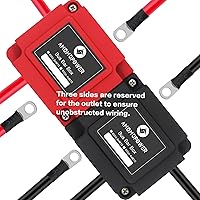
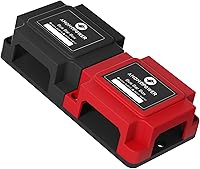
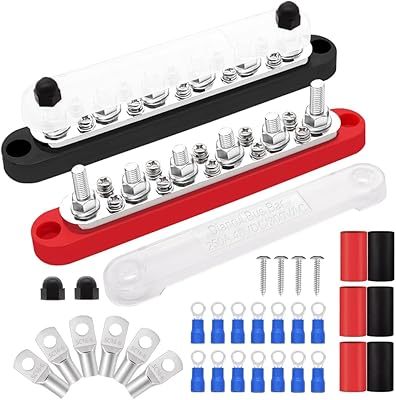
The AMOMD 400A 8-Stud Bus Bar is a serious power distribution block built for 12–48V DC systems that need reliable, high-capacity wiring hubs. Whether you're wiring a solar battery bank, rigging a boat, or organizing the electrical system in a truck camper, this bus bar offers a modular, enclosed design that keeps things tidy and safe. The tin-plated copper rail handles real current loads, and the flame-retardant nylon housing adds a layer of protection you don't always get at this price point. It's priced competitively — not the cheapest option out there, but noticeably better built than the bare-rail alternatives that dominate the lower end of the market.
Features & Benefits

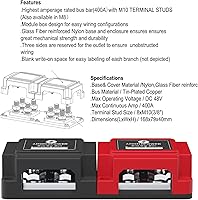
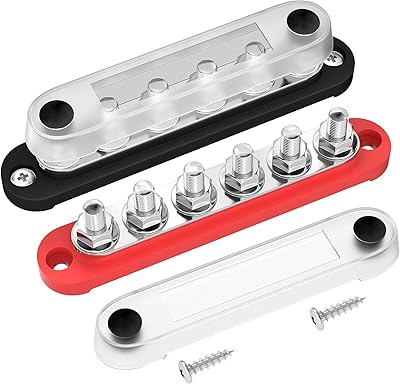
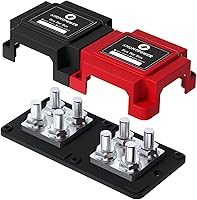
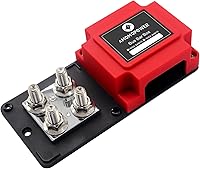
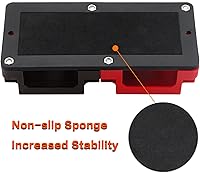
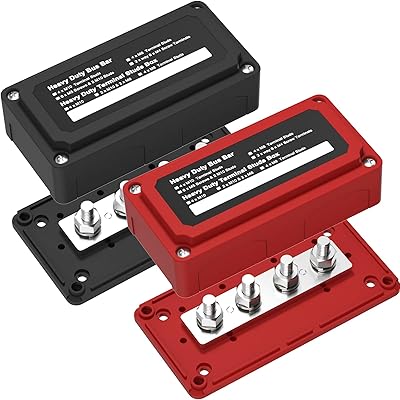
At the core of this power distribution block are eight M10 stainless steel studs, each rated to handle serious current loads when paired with properly sized wire. The bus rail is made from tin-plated purple copper, which keeps resistance low and holds up well against oxidation over time. The flame-retardant, glass-fiber-reinforced nylon base feels genuinely solid — not like the flimsy plastic housings found on cheaper blocks. Wiring is straightforward thanks to cable entry points on three sides, and the serrated flange nuts lock connections down firmly without needing a second tool. The anti-slip sponge base keeps everything stable on flat surfaces during installation.

Best For

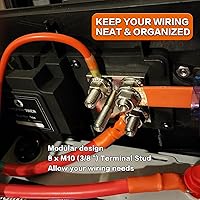
This junction block makes the most sense for anyone building or upgrading a DC power system where multiple cables need a clean, central termination point. It's a natural fit for off-grid solar installations — particularly where you're combining outputs from multiple batteries or charge controllers into one hub. Marine builders will appreciate the corrosion-resistant hardware and enclosed design that limits moisture exposure. RV and van conversion projects benefit from the compact footprint and the ability to route cables in from multiple directions. It's also a practical upgrade for anyone tired of daisy-chaining terminals and wanting a more organized wiring layout under 50 volts DC.

User Feedback

Buyers generally respond well to this bus bar, with most pointing to the solid build quality and the ease of getting cables seated without fuss. The included hardware — studs, nuts, and mounting screws — is consistently praised as complete and corrosion-resistant right out of the box. On the critical side, a handful of users note that instructions are minimal, which can slow down first-timers. A few mention the cover fit feels slightly loose. The 400A rating is occasionally questioned, and reasonably so — real-world capacity depends heavily on wire gauge and ambient conditions. Overall, most buyers feel they're getting fair value for a well-constructed electrical component.

Pros

  • Eight M10 studs handle high-current multi-source wiring cleanly in a single compact block.
  • Tin-plated copper rail keeps resistance low and resists oxidation over years of service.
  • Enclosed modular housing is a meaningful step up from exposed flat-rail designs at a similar price.
  • Stainless steel fasteners and serrated flange nuts hold connections firmly without loosening over time.
  • Three-sided cable entry makes routing wires into tight enclosures straightforward and flexible.
  • Anti-slip base pad simplifies positioning during installation before final screws are set.
  • Corrosion-resistant hardware performs reliably in marine and high-humidity environments.
  • All mounting hardware ships included — no extra trips to the hardware store required.
  • Compact dimensions fit neatly into RV, van, and boat battery compartments without dominating space.
  • Solid construction feels noticeably more substantial than cheaper alternatives in the same category.

Cons

  • Included instructions amount to little more than a basic diagram — no torque specs or wiring guidance provided.
  • The plastic cover fits loosely on some units, which feels inconsistent in vibration-heavy installations.
  • The 400A continuous rating is optimistic; real-world safe capacity is lower without ideal wiring conditions.
  • Stud threads can feel rough when first seating ring terminals, requiring careful hand-starting.
  • Only two mounting screw points, which may feel insufficient for high-vibration off-road applications.
  • No IP rating or moisture protection spec listed, leaving outdoor installation suitability ambiguous.
  • Inner studs become difficult to torque properly once adjacent positions are loaded with thick cables.
  • Labeling is too minimal for complex multi-source builds where circuit identification matters during troubleshooting.

Ratings

The AMOMD 400A 8-Stud Bus Bar earns solid marks across the board based on AI-analyzed verified buyer reviews sourced globally, with spam, bot-generated, and incentivized feedback actively filtered out. Buyers across solar, marine, and automotive builds have put this junction block through real-world testing, and the scores below reflect both what works well and where a few genuine frustrations surfaced. Nothing is glossed over — the highs and the sticking points are represented equally.
Build Quality
88%
The tin-plated copper rail and glass-fiber-reinforced nylon housing consistently impress buyers who have handled cheaper bare-rail alternatives. Most users describe it as noticeably heavier and more solid than the price suggests, which builds confidence during installation in a marine or solar environment.
A small number of buyers noted that the plastic cover fits loosely on some units, which feels inconsistent with the otherwise sturdy construction. It is not a structural issue, but for enclosed installs where vibration is a factor — like a truck or boat — it is worth checking before finalizing the mount.
Electrical Performance
83%
Users report stable, low-resistance connections once cables are properly torqued onto the M10 studs. In solar battery bank setups handling high charge and discharge cycles, buyers noted no measurable heat buildup under normal operating loads with correctly gauged wire.
The 400A continuous rating draws some skepticism from experienced electricians, and rightly so — actual safe capacity depends heavily on wire gauge, ambient temperature, and connection quality. A few buyers who pushed the block hard reported it gets warm faster than expected if wiring is undersized.
Ease of Installation
91%
Three-sided cable entry points and a flat-mount design make routing wires genuinely easy, especially in tight enclosures like RV electrical compartments or marine battery boxes. Most buyers with moderate DIY experience report getting everything wired up cleanly in under an hour.
The included instructions are minimal at best — basically a diagram with no torque specifications or wiring guidance. First-time builders working on a van conversion or solar setup may need to rely on YouTube or forums to fill in the gaps, which adds time to the process.
Hardware & Fastener Quality
86%
The stainless steel studs and serrated flange nuts are consistently praised for holding firm and resisting rust, even after extended exposure to the humidity found in boat bilges and outdoor solar enclosures. Buyers appreciate that the included hardware feels complete and ready to use without substitutions.
A handful of users mentioned that the stud threads felt slightly rough when first threading on ring terminals, requiring careful hand-starting before torquing. It is a minor inconvenience, but worth noting for anyone working with fine-threaded lugs or expensive terminals.
Value for Money
79%
21%
Compared to bare copper bus bars at half the price, most buyers feel the enclosed modular design and quality materials justify the cost difference. For solar and marine builders who need reliability over multiple seasons, the mid-range investment feels reasonable given the construction.
Budget-conscious buyers who only need basic battery connections may find the price harder to justify, particularly when cheaper terminal blocks handle lighter loads just fine. The value equation is strongest for high-current, multi-source builds — less so for simple single-battery setups.
Corrosion Resistance
84%
The tin plating on the copper rail provides a meaningful layer of oxidation resistance, and buyers using this in salt-air marine environments report no visible corrosion after a year or more of service. The stainless steel fasteners hold up equally well in wet conditions.
The nylon housing offers no IP rating or stated moisture protection beyond general resistance, so buyers in fully exposed outdoor installations should plan for an additional weatherproof enclosure. A few marine users mentioned surface discoloration on the base after prolonged exposure to bilge humidity.
Current Rating Accuracy
67%
33%
Under typical loads — solar charge controllers, inverters, and distribution runs in RVs — most buyers report the block handles its rated amperage without issue when wiring is correctly sized. In controlled, well-ventilated installs, performance holds up reliably.
The 400A rating appears optimistic to several electricians who tested it under sustained high loads, noting temperature rise at connections before reaching that threshold. Real-world safe operation likely sits closer to 250–300A depending on installation conditions, which is still adequate for most use cases but worth calibrating expectations around.
Modular Design & Flexibility
87%
The enclosed box design with multiple wiring entry points gives builders more flexibility than a flat-rail bus bar, particularly when organizing positive, negative, and ground runs in a single compact area. Van and truck camper builders in particular praise how cleanly it tidies up complex wiring harnesses.
The modular format, while useful, does add some bulk compared to a bare rail of the same stud count. In very space-constrained installs — like a small boat battery compartment — the extra height of the enclosure can complicate fitment alongside other components.
Labeling & Identification
61%
39%
The block arrives with basic positive and negative labeling that is adequate for standard dual-polarity setups. For straightforward solar or marine installs where the wiring is simple, the existing labels are functional enough.
Several buyers working on more complex multi-source systems found the labeling too sparse for easy troubleshooting after installation. There are no stud numbers or circuit identifiers, which makes diagnosing wiring issues harder once everything is connected and the cover is on.
Mounting Stability
82%
18%
The anti-slip sponge pad on the base adds a surprising amount of grip on flat surfaces, making initial positioning easy and keeping the block in place during wiring before final screws are set. Buyers mounting it in vibration-prone environments like truck beds report it stays put once properly fastened.
The mounting footprint relies on just two screw points, which some buyers felt was insufficient for high-vibration applications like off-road vehicles. A four-point mounting pattern would offer more confidence in demanding mechanical environments.
Packaging & Out-of-Box Experience
78%
22%
Most buyers describe the packaging as clean and well-organized, with all hardware accounted for and no missing components upon arrival. The block arrives pre-assembled and ready to mount, which saves time on the job.
The documentation inside the box is thin — just a basic spec sheet and a small diagram. Buyers expecting a proper installation guide or torque recommendations will not find one, and the brand's online support resources are not easy to locate.
Compatibility with Common Wire Gauges
81%
19%
The M10 stud size accommodates a wide range of ring terminal sizes commonly used in solar and marine DC systems, from 4 AWG up to 2/0 AWG with appropriate lugs. Most buyers found their existing cable hardware fit without needing to source specialty terminals.
Buyers using very large cables — 3/0 AWG or 4/0 AWG common in high-power inverter installs — sometimes found terminal clearance tight between adjacent studs, particularly when using thick-barreled lugs. Spacing is adequate for most builds but can feel cramped in maximum-load configurations.
Thermal Management
69%
31%
Under moderate, steady-state loads, the copper rail distributes heat reasonably well and buyers report no concerning warmth at the terminals during normal solar charging cycles or typical marine draw scenarios.
The enclosed nylon housing, while adding protection, limits heat dissipation compared to open-rail designs. Under sustained high-current draw — particularly in warm engine compartments or direct sun — the enclosure can trap heat, which is a consideration for anyone planning to push the block near its upper rating.
Stud Spacing & Terminal Access
76%
24%
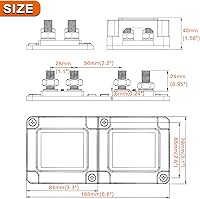
Eight studs spread across a 168mm length gives reasonable per-stud spacing for most ring terminal sizes. Buyers building solar arrays with multiple parallel battery strings found each position easy to reach with standard hand tools.
With all eight positions occupied and multiple thick cables in close proximity, the working space becomes noticeably tight. A few professional installers mentioned they had to sequence the connections carefully to avoid torquing issues on inner studs once outer ones were already loaded.

Suitable for:

The AMOMD 400A 8-Stud Bus Bar is a strong match for anyone building or expanding a serious DC power system who needs a centralized, organized termination point for multiple cables. Off-grid solar builders combining outputs from several batteries or charge controllers will find the eight-stud layout and enclosed modular design particularly practical. Marine and boat electricians benefit from the corrosion-resistant hardware and compact footprint that fits neatly into tight battery compartments without sacrificing connection capacity. RV owners, van converters, and truck camper builders dealing with complex 12V or 24V wiring harnesses will appreciate how cleanly this junction block consolidates positive and negative runs in one place. It also suits DIY electricians who have outgrown basic terminal strips and want something more robust — without stepping up to a full custom busbar fabrication.
Not suitable for:

The AMOMD 400A 8-Stud Bus Bar is not the right call for every situation, and it is worth being honest about that. Buyers who only need to split one or two circuits in a simple single-battery setup are paying for capacity and hardware quality they will never use — a basic terminal block handles that job for a fraction of the price. Anyone expecting to run sustained loads close to the 400A ceiling should approach that rating with caution, since real-world safe capacity depends heavily on wire gauge, ambient temperature, and connection quality; this block is not a substitute for proper system engineering. Installers working in fully exposed outdoor environments without an additional weatherproof enclosure may also find the nylon housing insufficient for long-term protection against direct rain or salt spray. Finally, buyers who rely on detailed printed instructions will be frustrated — the documentation is sparse, and beginners without prior DC wiring experience may need outside resources to complete a safe installation.
Specifications

  • Max Current: Rated for up to 400A continuous DC current under ideal wiring and ventilation conditions.
  • Max Voltage: Supports DC systems up to 48V, covering 12V, 24V, and 48V battery configurations.
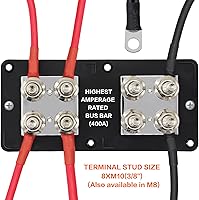
  • Stud Count: Eight M10 (3/8″) threaded studs are evenly spaced along the copper bus rail.
  • Bus Material: The current-carrying rail is made from tin-plated purple copper for low resistance and oxidation resistance.
  • Base Material: The housing base is constructed from flame-retardant, glass-fiber-reinforced nylon for structural rigidity and electrical insulation.
  • Cover Material: The protective cover is made from nylon, providing a basic physical barrier over the terminal connections.
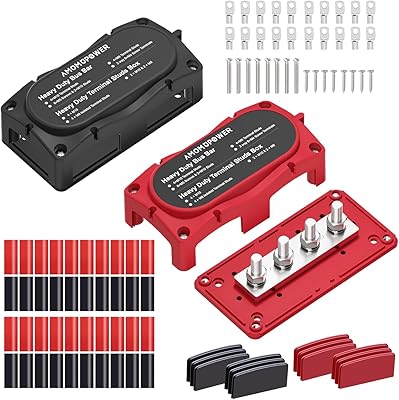
  • Fasteners: Stainless steel mounting screws and one-piece serrated flange nuts are included for corrosion-resistant, secure connections.
  • Dimensions: The block measures approximately 6.61″ x 3.11″ x 1.57″ (168 x 79 x 40 mm) in length, width, and height.
  • Weight: The complete unit weighs 1.32 pounds, making it manageable for single-person installation.
  • Mounting Type: Designed for flat-surface screw mounting with an anti-slip sponge pad on the underside for added stability.
  • Cable Entry: Wiring access holes are provided on three sides of the housing for flexible cable routing directions.
  • Stud Size: All eight studs are M10 (3/8″) diameter, compatible with standard ring terminals used in solar and marine DC wiring.
  • Current Type: Rated for DC current only; not designed or rated for AC power distribution applications.
  • Compatible Systems: Suitable for use in solar battery banks, marine electrical systems, RV and van builds, and industrial DC control panels.
  • Anti-Slip Base: A foam sponge pad is bonded to the base to prevent sliding during installation and reduce surface vibration transfer.
  • Design Type: Modular enclosed box design allows independent positive and negative blocks to be configured side by side as needed.
  • BSR Ranking: Ranked #63 in Distribution Connecting Blocks on Amazon at the time of review, indicating strong market traction.
  • Brand: Manufactured and sold under the AMOMD brand, with the model number US1-AOA1533-400A-BR.

Related Reviews
AMOMD 300A Bus Bar Box
85%
91%
Value for Money
94%
Build Quality
85%
Ease of Installation
92%
Current Handling Capacity
88%
Versatility (Marine, RV, Solar Systems)
More
A LA MAISON Cherry Blossom Bar Soap - 3 Bars, 8.8oz
87%
88%
Moisturization
80%
Scent Strength
91%
Lather Quality
85%
Skin Sensitivity Compatibility
78%
Fragrance Longevity
More
Molton Brown Black Pepper Body Scrub Bar, 8.8 oz
86%
88%
Exfoliation Effectiveness
90%
Fragrance Longevity
85%
Skin Hydration
70%
Gentleness on Sensitive Skin
80%
Texture and Feel
More
Wavertree & London Lavender D'Provence Scented Soap Bars (8 Bars, 7oz)

85%
89%
Moisturizing Effectiveness
85%
Fragrance Quality & Longevity
92%
Value for Money
88%
Gentleness for Sensitive Skin
80%
Bar Size & Usage Duration
More
A LA MAISON Sweet Almond Bar Soap (8 Bars, 3.5 oz each)
86%
88%
Moisturizing Effectiveness
83%
Fragrance Strength & Duration
91%
Sustainability & Eco-Friendliness
89%
Gentleness on Sensitive Skin
85%
Lather Quality & Longevity
More
Sony BRAVIA Theater Bar 8 Soundbar
86%
92%
Sound Quality
88%
Ease of Setup
91%
PS5 Integration
75%
Bass Performance
89%
Connectivity Options
More
DAIERTEK 12V Bus Bar Power Distribution Block
86%
91%
Build Quality
89%
Ease of Installation
88%
Versatility
92%
Current Handling Capacity
90%
Durability (Corrosion Resistance)
More
RVBOATPAT 275A 12-Terminal Power Distribution Bus Bar
79%
76%
Build Quality
68%
Terminal & Stud Quality
83%
Corrosion Resistance
81%
Safety & Protective Cover
88%
Ease of Installation
More
Jamgoer 300A 4xM8 Power Distribution Bus Bar
76%
83%
Build Quality
88%
Value for Money
91%
Ease of Installation
71%
Waterproofing & Weather Resistance
78%
Current Handling & Electrical Performance
More
Dianrui 12V Bus Bar Power Distribution Block 250A
86%
92%
Build Quality & Durability
88%
Ease of Installation
84%
Versatility in Applications
90%
Performance in Harsh Environments
80%
Visibility & Maintenance
More

FAQ

Technically yes, but only under ideal conditions — meaning correctly sized wire, clean tight connections, and adequate ventilation. In practice, most real-world installations operate safely in the 200–300A range. If you are regularly pulling close to 400A, make sure your wire gauge and lug quality are up to the task, and monitor for heat at the terminals during initial use.

You will need two separate blocks — one for positive and one for negative. The modular design is specifically intended for this kind of side-by-side paired configuration, and the blocks are sold individually. Many buyers purchase a matched pair and mount them next to each other on the same panel or board.

The tin-plated copper rail and stainless steel fasteners are well-suited for marine use. The nylon housing also resists moisture reasonably well. That said, there is no official IP rating, so if the block will be fully exposed to spray or condensation on a regular basis, mounting it inside a weatherproof enclosure is a smart precaution.

The 3/8″ M10 studs are compatible with most standard ring terminals used in DC wiring, typically accommodating cable from around 4 AWG up to 2/0 AWG with appropriate lugs. If you are using very large cables like 3/0 or 4/0 AWG, the thick barrel lugs can make adjacent studs feel cramped, so check terminal dimensions before committing.

Yes — the package includes stainless steel mounting screws, serrated flange nuts, and all the hardware needed to secure the block to a flat surface. Nothing critical is missing out of the box, which buyers consistently appreciate.

The physical installation is fairly straightforward — mount it flat, run cables in through the side entry holes, and torque down the nuts. The tricky part is that the included instructions are minimal, with just a basic diagram and no torque specifications. If you are new to DC wiring, spending 20–30 minutes watching an installation video before you start will save you a lot of guesswork.

Yes, the screw-mount design works on any flat surface regardless of orientation. The anti-slip pad is really only useful during horizontal flat mounting, but the screw holes provide secure attachment in any direction. Just make sure cables are supported so their weight is not pulling on the terminals.

The main differences are the enclosed housing, the included cover, and the overall material quality. A bare copper rail will conduct electricity just as well, but it offers no physical protection over the terminals and is generally made from thinner, lower-grade copper. This power distribution block is a meaningful step up for anyone who values a cleaner, safer installation — especially in spaces where accidental contact with the terminals is a real concern.

Most buyers report no issues, but a few have noted the cover fits slightly loose on some units and can rattle slightly in high-vibration environments like off-road trucks. It is not a structural problem, and a small strip of foam tape along the inside edge fixes it easily if the fit bothers you.

Yes, the junction block is rated up to 48V DC, which makes it compatible with 48V lithium battery banks used in off-grid solar systems. Just ensure your charge controllers, inverters, and cables are all rated for the full system voltage and current, as the block itself is only one component in the overall safety chain.