Overview

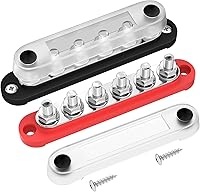
The DAIERTEK 6-Stud 12V Power Distribution Bus Bar is a paired positive and negative DC distribution solution designed to bring order to messy wiring builds without breaking the bank. You get one red bar and one black bar, both built around copper plate conductors and stainless steel studs — a material combination that separates it from cheaper all-aluminum alternatives. Sitting at a mid-range price point, it targets capable DIYers who want dependable hardware without paying premium-brand prices. It holds the #19 spot in its Amazon category, which, across 457 reviews, suggests this isn't just a novelty buy.
Features & Benefits

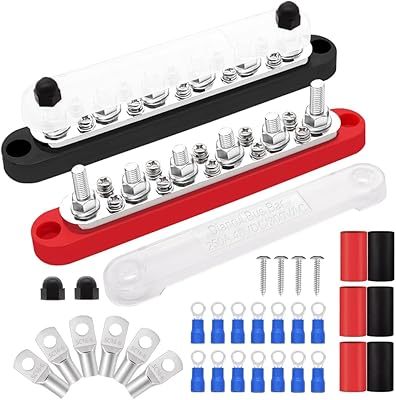
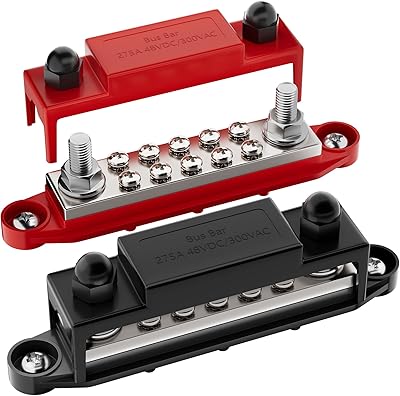
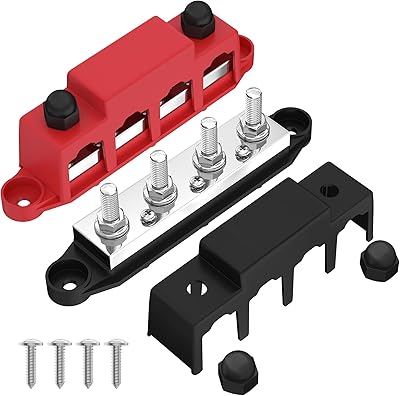
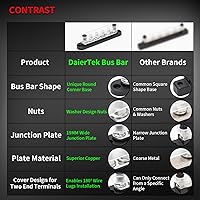
Each bar packs six M8 terminal studs, which means you can connect up to six separate circuits per polarity without any daisy-chaining or improvised splicing. The rated capacity sits at 150A DC continuous — respectable headroom for most DIY setups, though real-world performance will vary depending on your wire gauge and ambient temperature, so don't treat that number as an absolute ceiling. The round-corner base slots into tight spaces more cleanly than squared-off designs, and the cover is built to allow lugs to be installed at any angle within 180 degrees, giving you real routing flexibility. The matched red and black pair is a practical inclusion — no hunting for a separate negative bar.

Best For

This distribution block pair earns its place in a few specific scenarios. If you're wiring a campervan conversion, it's exactly the kind of hardware you'd want between your battery bank and your fuse panel — clean, organized, and rated for the job. It works equally well in small solar setups, where multiple charge controllers or loads need a common DC point. Car audio builders and marine enthusiasts doing their own wiring runs will also find it practical. Where it's less suited is high-draw commercial or industrial applications; those environments call for heavier-duty certified gear. For budget-conscious DIY builds in the 12V–48V range, though, it's a capable and honest choice.

User Feedback

Across 457 ratings, this 6-stud power bar sits at 4.7 stars — strong, though not quite the unanimous verdict that number might imply. Most buyers highlight how straightforward the installation is and that the hardware feels solid and well-machined for the price. The paired design gets frequent praise from people doing full battery wiring jobs. On the critical side, a small number of reviewers mention that the cover fit can feel slightly loose, and a few note that stud tightness varies unit to unit. Technically savvy buyers occasionally flag that the amperage rating assumes ideal conditions. Not a perfect product, but the overall consensus clearly leans positive, especially among solar and RV users.

Pros

  • Comes as a matched red and black pair, covering both polarity buses in one purchase.
  • Copper plate conductors keep resistance low and reduce heat buildup during sustained current draws.
  • Six studs per bar handle multiple independent circuits without messy splicing or wire tapping.
  • The 180-degree open cover accommodates a wide range of lug sizes and wire routing angles.
  • Round-corner base fits neatly into tight enclosures where squared-off blocks cause installation headaches.
  • Rated for up to 48V DC, making it compatible with both standard and lithium-based battery systems.
  • Stainless steel studs resist corrosion better than zinc-plated alternatives common at this price tier.
  • Holds a strong 4.7-star average across hundreds of verified buyer reviews in a competitive category.
  • Straightforward installation that most competent DIYers can complete without any specialized tools.

Cons

  • The 150A DC rating assumes ideal conditions; real-world safe limits are lower depending on heat and wire quality.
  • Some buyers report inconsistent stud tightness between units, suggesting quality control is not perfectly uniform.
  • Cover fit can feel slightly loose on certain units, reducing confidence in high-vibration installations.
  • No circuit position labeling on the bar itself, which can complicate tracing individual connections after installation.
  • Six studs per bar may fall short for complex builds with many accessories, requiring a second kit.
  • Not appropriate for applications where certified or code-rated electrical components are required.
  • Brand warranty documentation and post-purchase support are sparse compared to established electrical hardware manufacturers.
  • Amperage headroom may feel marginal once real-world derating is factored in for warm enclosed spaces.

Ratings

The scores below were calculated by our AI engine after processing hundreds of verified owner reviews of the DAIERTEK 6-Stud 12V Power Distribution Bus Bar from across major retail platforms worldwide, with bot-driven, incentivized, and low-signal responses actively filtered out before analysis. Each category reflects what real buyers experienced in actual use — from campervan wiring builds and small solar installations to marine projects — rather than what the spec sheet claims. Both genuine strengths and recurring frustrations are represented transparently so the scores tell the full story.
Build Quality
84%
Most buyers were impressed by the weight and rigidity of the copper plate base when they first handled it — noticeably more substantial than competing kits at a similar price. The stainless steel studs thread in cleanly without wobbling, which gives real confidence during installation in an RV battery compartment or engine bay.
A small but consistent minority of reviewers noted slight variation in machining tolerance between units, particularly around the stud seating. It does not match the tight fit-and-finish of premium-tier brands, which becomes apparent if you compare the two side by side on a workbench.
Value for Money
89%
For a kit that includes two fully equipped bars — positive and negative — at a mid-range price, the value calculation is straightforward. Buyers fitting out a campervan or solar shed consistently mention that getting both polarity buses in one order, with copper conductors included, saves real money compared to sourcing components separately.
Budget-focused buyers comparing on price alone can find visually similar products for a few dollars less, though those alternatives typically use aluminum conductors or lower-grade plating on the studs. The savings at the very bottom of the market tend to come with performance trade-offs that show up later.
Electrical Performance
78%
22%
Under normal DIY operating loads — running car audio components, solar charge controllers, or RV accessories — buyers report no heat issues and no measurable voltage drop at the distribution point. The copper plate conductor design holds up well across multiple circuits simultaneously, which is exactly the scenario this bus bar kit was built for.
The 150A DC rating is a ceiling, not a working target. Buyers who have thermally imaged their installations note that heavy sustained draws in enclosed spaces push the bar closer to its limits than the spec suggests, and technically experienced reviewers have flagged that real derating under heat is not communicated clearly anywhere on the product.
Installation Ease
86%
The round-corner base sits flush against most panel and enclosure surfaces without fighting for space, and the 180-degree cover orientation means you are not forced into a single wire entry direction. Buyers doing campervan builds commonly note that installation takes under an hour even when routing cables from multiple directions.
No mounting hardware is included, which catches some buyers off guard if they have not read the spec sheet carefully before ordering. A few reviewers also mentioned that the absence of any terminal numbering on the bar itself makes it harder to document which stud corresponds to which circuit after the wiring is complete.
Cover & Protection
67%
33%
The cover does more than look tidy — it physically prevents accidental contact with live terminals in enclosed spaces, which matters during maintenance when reaching into a crowded RV battery bay. The open-access design lets you keep the cover fitted while still routing new wires in, which is genuinely convenient in live systems.
Cover fit is one of the most consistently mentioned criticisms across buyer reviews. A meaningful fraction of units arrive with a cover that snaps on but rocks slightly or does not seat evenly, which undermines confidence in its protective value, especially in vibration-prone installations like boats or off-road vehicles.
Conductor Quality
83%
Copper plate conductors are the right material choice for sustained DC distribution work, and buyers consistently report no noticeable resistance increase or discoloration at connections even after months of use in solar and RV setups. This puts the distribution block pair clearly above aluminum-conductor alternatives available in the same price bracket.
The copper plate is functional but not as thick or precisely finished as what you would find in branded distribution blocks from established electrical component makers. Those with truly demanding high-current applications may notice a performance ceiling that more substantial copper work would push higher.
Stud & Terminal Quality
74%
26%
The M8 stainless steel studs accept standard ring terminals cleanly, and buyers fitting out marine or automotive installations generally report that the threads hold torque well without stripping at normal tightening force. The stud diameter is wide enough to stack two ring terminals per position if needed, giving some flexibility for crowded connections.
Quality consistency across units is where this category loses points. A recurring complaint in the review base involves studs that feel looser than expected straight from the package, and a few buyers noted minor thread irregularities requiring careful nut seating. It is not a pervasive problem, but it appears often enough to be a real pattern.
Corrosion Resistance
76%
24%
Stainless steel studs and a copper base plate make a reasonably corrosion-resistant combination for the price point, and buyers using this 6-stud power bar on boats, in coastal RVs, and in outdoor solar installations have generally reported no oxidation or terminal degradation over the first year of use with basic maintenance.
The product is not sealed or rated to any specific IP standard, so direct water ingress remains a risk in truly wet environments. Buyers in high-humidity climates or with direct saltwater exposure have noted that dielectric grease application is essentially mandatory to maintain connection quality — a maintenance step the product does not mention.
Circuit Capacity
81%
19%
Six independent connection points per bar is the sweet spot for most mid-complexity builds — enough to run lighting circuits, a refrigerator, a USB bank, and a 12V outlet simultaneously without running out of terminals. Buyers with typical campervan or small boat electrical setups consistently report that six circuits covers their needs comfortably.
For more complex builds — a fully loaded off-grid cabin or a heavily accessorized overlanding rig — six circuits can feel limiting quickly. Buyers who underestimated their expansion needs have returned to note they ended up purchasing a second kit, which works but adds cost and complicates the installation layout.
Fit & Sizing
82%
18%
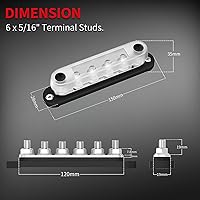
At 5.9 inches wide, the bars fit comfortably in standard battery compartments without modification. The round-corner profile is a detail that buyers working in tight spaces genuinely appreciate — the bar slides in without catching on adjacent components, which makes a real difference during the final stages of a van conversion or solar installation.
For micro-builds and ultra-compact installations, the 5.9-inch footprint may exceed what the available space allows. A handful of buyers working on compact marine helm panels or small enclosed battery boxes mentioned having to reconfigure their layout entirely to accommodate the bar, which was not a smooth experience.
Wire Routing Flexibility
79%
21%
The 180-degree lug access through the cover is the feature buyers mention most when describing clean wiring runs. Being able to feed cables from almost any direction — including parallel to the bar rather than perpendicular — is something DIY installers building van or boat wiring looms genuinely value where cable tidiness matters.
Very large gauge cables — such as 2/0 AWG feeding a high-current main circuit — can feel cramped depending on the lug profile and stacking arrangement. A small number of technically experienced buyers noted that clearance around the end terminals in particular is tighter than they expected from the product photos.
Polarity Organization
88%
The matched red-and-black pairing eliminates a real category of wiring mistakes during installation. Buyers consistently mention that the color coding helped keep builds organized and made it easier to explain the system to someone else later — a practical benefit that even experienced DIYers appreciate on complex wiring days.
Beyond color, there is no permanent polarity marking embossed or stamped into the bar body itself. In installations where the bars end up partially covered by cable runs, the only remaining visual cue is the bar color, which can be obscured once the mounting area fills with wiring.
Thermal Management
71%
29%
Copper conducts heat away more effectively than aluminum, and under the modest loads typical of RV and solar builds, buyers report that the bars stay cool to the touch even after several hours of continuous use. Normal household-level DC loads — a fridge, lighting, and USB charging — do not stress the thermal design.
At high sustained loads approaching the rated maximum, heat dissipation becomes a concern in sealed or poorly ventilated spaces. Technically minded buyers who ran load tests reported surface temperatures suggesting real derating was occurring well before the 150A ceiling, pointing to a need for better thermal headroom guidance from the manufacturer.
Labeling & Clarity
58%
42%
The red and black color coding does the most important labeling job adequately — polarity separation is immediately clear when the bars are mounted side by side. For straightforward two-polarity builds, this visual cue is all most buyers need, and the identification holds up without fading or peeling over time.
Beyond color, there is no stud numbering, no circuit designation, and no visual guide to maximum load per stud on the bar itself. Buyers who want accurate wiring documentation often end up adding their own adhesive labels, which is an extra step that comparable products at a similar price handle natively.
Long-term Reliability
73%
27%
Buyers who purchased this distribution block pair a year or more ago and came back with updated reviews generally describe stable connections with no loosening at the terminal studs and no signs of corrosion on either the copper base or the stainless steel fasteners. In well-maintained installations, long-term performance appears solid.
Long-term reliability data is naturally limited given the product has only been available since mid-2022, and the review base skews toward recent buyers. A few experienced electrical installers noted that unit-to-unit quality control variation introduces a degree of uncertainty about lifespan under continuous heavy-load conditions that longer-established brands do not carry.

Suitable for:

The DAIERTEK 6-Stud 12V Power Distribution Bus Bar is purpose-built for DIYers who need a clean, organized way to distribute power across multiple circuits in 12V to 48V DC systems. If you're converting a campervan and need a central point to feed your lighting, USB chargers, and refrigerator without a tangle of wire splices, this bus bar kit fits that role well. Solar builders running a small off-grid setup will appreciate having a dedicated positive and negative distribution point that keeps wiring neat and traceable. RV owners and boat builders who need a compact terminal block capable of handling a reasonable continuous load without overheating will also find it a solid match. It's particularly well-suited for anyone who prioritizes an organized build on a modest budget, rather than specifying industrial-grade hardware.
Not suitable for:

If your application demands certified hardware with documented test ratings — think commercial marine installations, professional vehicle builds, or anything subject to safety inspections — the DAIERTEK 6-Stud 12V Power Distribution Bus Bar is not the right tool. The 150A DC figure on the spec sheet assumes ideal conditions, and real-world derating for ambient heat, wire resistance, and connection quality means your practical safe limit will be noticeably lower, which matters in high-draw or continuously loaded setups. Buyers who need more than six circuits per polarity will quickly outgrow this distribution block pair and may find themselves purchasing a second set, which undercuts the neatness advantage. Those expecting the fit and finish of premium brands like Blue Sea Systems will likely notice differences in labeling clarity and manufacturing tolerances. If your build involves aggressive vibration or saltwater immersion rather than occasional marine exposure, it is worth considering more heavy-duty certified alternatives.
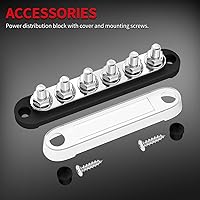
Specifications

  • Brand: This bus bar kit is manufactured by DAIERTEK, a brand focused on DC electrical distribution components.
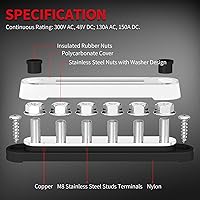
  • Conductor Material: Each bar uses a copper plate conductor, which keeps electrical resistance low and manages heat buildup effectively under continuous load.
  • Stud Material: Terminal studs are made from stainless steel, offering meaningful corrosion resistance compared to standard zinc-plated alternatives.
  • Terminal Count: Each individual bar has six threaded terminal studs, allowing up to six independent circuits per polarity.
  • Stud Size: Studs are M8 thread, equivalent to 5/16-inch, which is compatible with the vast majority of standard ring terminals and cable lugs.
  • Stud Pitch: Terminal studs are spaced at a 0.31-inch pitch, giving standard ring lugs enough room to sit side by side without overlapping.
  • DC Voltage Rating: Each bar is rated for a maximum of 48V DC, covering 12V, 24V, and 48V battery-based systems.
  • AC Voltage Rating: When used in AC applications, the bars are rated for up to 300V AC continuous.
  • DC Current Rating: Continuous DC current capacity is rated at 150A, though practical safe limits will be lower depending on ambient temperature and wire gauge.
  • AC Current Rating: In AC applications, the continuous current rating is 130A.
  • Dimensions: Each bar measures 5.9″ wide by 1.37″ high, making it compact enough for most enclosed wiring compartments.
  • Weight: The complete two-bar kit weighs 13.9 oz total.
  • Color Coding: The kit includes one red bar designated for positive connections and one black bar for negative, providing clear polarity identification.
  • Cover Design: The protective cover is engineered for 180-degree lug access, allowing wire exits from multiple angles without modification.
  • Base Design: The base features a round-corner profile that reduces snagging risk and makes fitting into radiused enclosures more manageable.
  • Mounting Type: Both bars are designed for rack or panel mounting using the integrated attachment points on the base.
  • Compatible Systems: The bars are suitable for use in automotive, marine, solar, and RV DC electrical systems operating within the rated voltage and current range.

Related Reviews

Jamgoer 300A 4xM8 Power Distribution Bus Bar
76%
83%
Build Quality
88%
Value for Money
91%
Ease of Installation
71%
Waterproofing & Weather Resistance
78%
Current Handling & Electrical Performance
More
RVBOATPAT 275A 12-Terminal Power Distribution Bus Bar
79%
76%
Build Quality
68%
Terminal & Stud Quality
83%
Corrosion Resistance
81%
Safety & Protective Cover
88%
Ease of Installation
More
Dianrui 12V Bus Bar Power Distribution Block 250A
86%
92%
Build Quality & Durability
88%
Ease of Installation
84%
Versatility in Applications
90%
Performance in Harsh Environments
80%
Visibility & Maintenance
More
Joinfworld BB300 300A Power Distribution Block
75%
83%
Build Quality
88%
Current Handling Capacity
71%
Waterproofing & Weather Resistance
74%
Stud & Hardware Quality
62%
Cable Routing & Installation Ease
More
Joinfworld 400A Power Distribution Block 12V
86%
91%
Performance
94%
Durability and Build Quality
88%
Ease of Installation
89%
Safety Features
92%
Value for Money
More
Chunzehui F-1011 6-Position Power Distribution Block
82%
91%
Build Quality
88%
Connector Compatibility
93%
Electrical Performance
84%
Ease of Installation
76%
Connector Insertion Feel
More
Champion Power Equipment 201174 Power Distribution Box
85%
92%
Build Quality & Durability
89%
Safety Features
90%
Weather Resistance
85%
Ease of Setup
65%
Portability
More
HITRENDS 6-Outlet 6-USB Surge Protector Power Strip
81%
88%
Build Quality
79%
Surge Protection
91%
Outlet Spacing & Layout
72%
USB Charging Performance
61%
USB Port Compatibility
More
Touch of Mink Fresh Scent All Natural Mink Oil Cleansing Bath or Shower Bars - 6 Bars
86%
88%
Moisturizing Effectiveness
92%
Suitability for Sensitive Skin
75%
Fragrance Appeal
87%
Texture and Feel on Skin
91%
Value for Money
More
TESSAN TS-1013-2 Surge Protector Power Strip
81%
88%
Build Quality
83%
Surge Protection
91%
Individual Switches
89%
Outlet Spacing
79%
Mounting Design
More

FAQ

You get both in the box — one red bar for the positive side and one black bar for negative. There is no need to hunt down a matching negative bar from another brand or a separate listing.

The studs are M8, which is the same as 5/16-inch, so any ring terminal or cable lug with an M8 hole will fit cleanly. That covers the majority of standard automotive, marine, and solar lugs available at hardware or electrical supply stores. If you're already mid-build with pre-terminated cables, there's a good chance you're already set.

Yes, the bars are rated up to 48V DC, so both 24V and 48V systems fall comfortably within spec. This makes the distribution block pair a practical option for anyone upgrading from a legacy 12V lead-acid setup to a modern lithium bank.

It's a nominal rating achieved under ideal lab conditions — clean connections, adequate wire gauge, and controlled ambient temperature. In a warm engine compartment, a sealed RV battery box, or a sunny marine deck, your real-world safe working limit will be meaningfully lower. A good rule of thumb for continuous loads is to plan for around 70 to 80 percent of the stated rating to give yourself a sensible thermal margin.

The base includes mounting points for panel or rack installation, but no fasteners are included in the box. You will need to pick up screws or bolts appropriate to your mounting surface, which is standard practice for components of this type. Most builders already have suitable hardware on hand.

Stainless steel handles occasional saltwater spray and humid marine air significantly better than zinc-plated hardware. That said, this is not a sealed or IP-rated enclosure, so prolonged direct exposure to saltwater is not ideal. Applying dielectric grease to the connections during installation and doing periodic visual checks will help extend service life in harsher conditions.

It is actually a very natural fit for that application. The DAIERTEK 6-Stud 12V Power Distribution Bus Bar lets you run each amplifier and auxiliary component back to a single clean distribution point rather than daisy-chaining splices, which reduces voltage drop and keeps troubleshooting straightforward if something misbehaves down the road.
The cover does serve a genuine protective function, and under normal conditions it stays in place. A small number of buyers have noted that the fit can feel slightly loose on some units. If your installation involves significant vibration — a diesel truck, a rough-water boat — it is worth adding a cable tie or a small dab of adhesive as secondary retention rather than relying solely on the snap fit.

Six circuits per bar covers most mid-complexity builds comfortably, but if your accessory list runs to eight or more separate circuits, you will either need a second kit or a larger distribution block with more studs. Two kits can be mounted side by side if space allows, though at that point it may be worth comparing total cost against a single higher-capacity block.

For a modest off-grid setup — a battery bank, a charge controller, and a handful of DC loads like lighting, a fan, and a small inverter — this 6-stud power bar covers the relevant bases well. The copper conductors handle the current efficiently, the paired design keeps positive and negative runs neatly separated, and the amperage headroom is more than adequate for typical off-grid cabin loads. Just make sure your combined circuit draw stays comfortably below the rated capacity with some buffer to spare.