Overview

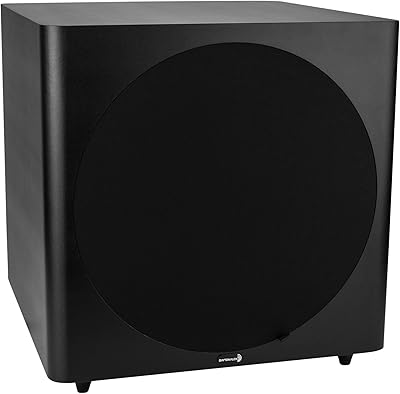
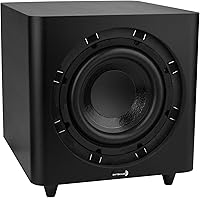
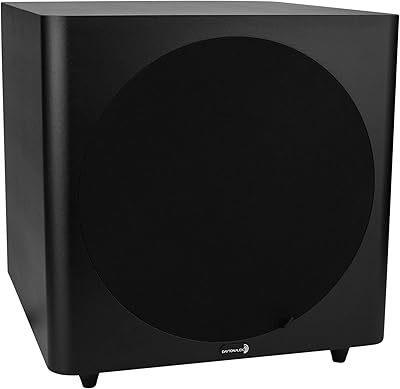
The Dayton Audio SUB-800 8″ Powered Subwoofer has been a quiet staple in the budget home audio world since 2011 — and for good reason. Dayton Audio built a reputation around delivering real performance without the premium markup, and this compact subwoofer fits that mold well. The ported, downward-firing enclosure pulls more low-end presence out of an 8-inch driver than you might expect, and the wood cabinet wrapped in textured black vinyl looks unobtrusive tucked beside a TV stand or bookshelf. It's not flashy, but for a first sub or a small-room upgrade, it doesn't need to be.
Features & Benefits

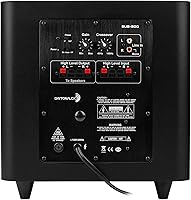
The SUB-800 runs an 80-watt built-in amplifier paired with a long-throw 8-inch woofer — enough muscle for a small room without rattling the walls. The crossover is continuously variable from 40 Hz to 140 Hz, so you can dial it in precisely to hand off cleanly to whatever satellites you're running. One genuinely useful detail: it accepts both RCA line-level and speaker-level inputs, which means it works whether you have a proper AV receiver or just a basic stereo amp. The phase switch helps prevent that hollow, phasey quality when the sub and mains don't quite time-align, and auto on/off keeps things tidy day-to-day.

Best For

This entry-level sub is most at home in smaller listening spaces — apartments, dorm rooms, or a dedicated media room under roughly 200 square feet. If you've got a pair of bookshelf speakers that start rolling off around 80 Hz, pairing them with the SUB-800 fills that gap naturally without a large budget commitment. It also works well as a desktop near-field sub, adding warmth to music or movie audio without overwhelming the room. That said, if you need wall-shaking output or plan to fill a larger open-plan space, a 10- or 12-inch option would serve you better.

User Feedback

Owners consistently highlight clean, controlled bass as this compact subwoofer's standout quality — it doesn't boom or drone the way cheaper subs often do. Long-term reliability is another theme; plenty of buyers report years of trouble-free use, which says something for a product at this price tier. On the downside, the auto-on circuit gets occasional criticism for being slow to wake up or missing weak input signals entirely — a minor annoyance, not a dealbreaker. Some users also wish for a more accessible volume control rather than depending entirely on the receiver. Overall, the complaints are modest relative to what you're spending.

Pros

  • Produces clean, punchy bass without the bloated drone common in budget subwoofers
  • Accepts both RCA and speaker-level inputs, making it compatible with almost any amp or receiver
  • The continuously variable crossover spans a wide range, giving real flexibility when matching to satellites
  • Wood cabinet construction feels noticeably more solid than plastic-bodied alternatives at this price
  • Long-term owners report years of reliable, trouble-free performance with no significant failures
  • Compact footprint fits easily under a TV console or beside a bookshelf without dominating the room
  • Phase switch helps eliminate muddiness when integrating with main speakers — rare at this price tier
  • Setup is genuinely beginner-friendly, with no confusing menus or complex wiring required
  • The speaker-level pass-through lets you run a proper 2.1 system even without a subwoofer output on your amp

Cons

  • Low-frequency extension bottoms out around 40 Hz, leaving truly deep bass content underrepresented
  • Auto-on circuit can lag noticeably or fail to trigger on low-level audio signals
  • No Bluetooth or wireless connectivity limits compatibility with modern streaming and wireless speaker setups
  • Crossover knob has no intermediate markings, making it hard to repeat a specific setting reliably
  • Output compresses and loses definition when pushed hard in rooms larger than roughly 200 square feet
  • Phase control is a fixed 0/180 toggle rather than a variable dial, which is a blunt adjustment tool
  • No high-pass filtering on the speaker-level pass-through means main speakers still receive full-range signal
  • The textured vinyl finish scuffs with contact over time and offers no premium aesthetic options

Ratings

The Dayton Audio SUB-800 8″ Powered Subwoofer has accumulated a meaningful body of real-world feedback over more than a decade on the market, and the scores below are generated by AI after analyzing verified global buyer reviews — with spam, bot activity, and incentivized posts actively filtered out. The ratings reflect honest consensus: where this compact sub genuinely delivers and where it falls short depending on your room, setup, and expectations.
Bass Quality
83%
For its driver size and price tier, the SUB-800 produces impressively clean, punchy bass that avoids the bloated, one-note quality common in budget subs. Users watching movies or streaming music in small rooms consistently describe the low end as tight and controlled rather than muddy.
The 40 Hz low-frequency floor is a real-world limit — movie soundtracks with deep sub-bass rumble below that point sound noticeably thin. Listeners expecting the kind of chest-thumping depth you get from a 12-inch driver will be disappointed at moderate to high volumes.
Value for Money
91%
This is where the SUB-800 earns its strongest marks. Buyers repeatedly note that nothing else in the price range offers this combination of flexible inputs, a real wood cabinet, and reliably clean output. For a first subwoofer purchase, the cost-to-performance ratio is hard to argue with.
A small segment of buyers feel the price has crept up over the years without corresponding feature updates, and point to newer competitors that now offer Bluetooth or DSP controls at a similar spend. It remains good value, but less of a runaway deal than it once was.
Build Quality
78%
22%
The wood enclosure wrapped in textured black vinyl feels noticeably more solid than plastic-bodied competitors at the same price. Long-term owners — some reporting five or more years of daily use — rarely mention rattles, panel flex, or driver issues, which speaks to honest construction.
The finish, while durable, can show scuffs over time and is not particularly resistant to contact in high-traffic spots. A few buyers noted the input panel and knobs feel slightly plasticky relative to the cabinet itself, which is a minor but noticeable contrast.
Setup & Ease of Use
89%
Nearly every first-time subwoofer buyer in the review pool describes setup as straightforward. The dual-input design — accepting both RCA line-level from an AV receiver and speaker-level from a basic stereo amp — means it connects to almost any existing system without adapters or guesswork.
The owner's manual is minimal, and dialing in the crossover and phase settings without any reference guide can take some trial and error for true beginners. There is no app, no visual feedback, and no memory for settings if the unit loses power.
Auto On/Off Reliability
61%
39%
When it works well, the auto-on feature is genuinely convenient — the sub wakes up when you start playing audio and powers down quietly when you stop. For set-and-forget users who never want to think about manually switching the sub on, this covers most daily scenarios without issue.
This is the most consistently criticized feature in the review pool. Some users report a noticeable lag before the sub activates, causing it to miss the first beat or two of a track. Low-level signals — background TV audio, for example — sometimes fail to trigger it at all.
Volume & Output for Room Size
72%
28%
In rooms up to roughly 150 to 200 square feet, the 80-watt amplifier keeps up without strain. Apartment living rooms, bedrooms, and small dedicated media rooms are the sweet spot, and at moderate listening levels the output feels well-matched to the driver size.
Push this sub in a larger open-plan room or crank the volume for party-level playback and it runs out of headroom fairly quickly. Bass starts to compress and lose definition, which is not a flaw exactly — just a hard physical limit of an 8-inch driver at this power rating.
Crossover Flexibility
81%
19%
The continuously variable crossover spanning 40 Hz to 140 Hz is unusually wide for this price range and covers essentially every practical satellite-pairing scenario. Users running small two-way bookshelves appreciate being able to push the handoff point higher to fill the mid-bass gap those speakers leave.
The control is a simple analog knob with no markings beyond the frequency endpoints, so repeating a specific setting after adjustment is purely by feel. Buyers accustomed to digital or stepped crossover controls may find the imprecision frustrating during critical setup.
Phase Control
76%
24%
Having a phase switch — even a simple 0/180 toggle rather than a continuously variable dial — is genuinely useful and not always present at this price. Users who take the time to switch between both positions typically report a noticeable improvement in bass integration with their main speakers.
A binary 0/180 switch is a fairly blunt tool; in rooms where the ideal phase alignment falls somewhere in between, it only gets you part of the way there. Buyers who have used higher-end subs with variable phase controls tend to find this limitation frustrating during fine-tuning.
Input & Connectivity Options
84%
Offering both RCA line-level and speaker-level inputs in the same unit removes one of the most common compatibility headaches for new buyers. Users with vintage receivers, budget stereo amps, or full AV setups all report being able to connect without purchasing additional cables or adapters.
There is no wireless connectivity whatsoever — no Bluetooth, no Wi-Fi — which is increasingly a friction point as more buyers run wireless speaker systems. For a wired-only home theater setup this is a non-issue, but for anyone building a modern mixed or wireless system it is a genuine gap.
Cabinet Aesthetics & Footprint
74%
26%
The compact square cabinet and neutral black vinyl finish mean the SUB-800 tucks neatly under a TV console or beside a bookshelf without drawing attention. Apartment dwellers and buyers with limited floor space repeatedly mention the relatively small footprint as a deciding factor.
The design is purely functional — there is nothing visually interesting about the enclosure, and it lacks the more refined finish options found on subs from brands targeting the living room aesthetics market. For buyers who care about how their gear looks, this is a plain, utilitarian box.
Low-Frequency Extension
63%
37%
Within its operating range, the ported downward-firing design extracts solid low-end weight from the driver and the 40 Hz spec is largely achievable in a small, well-placed setup. For music listening and standard TV content, the extension is more than adequate.
Forty Hz is the realistic floor, and home theater content regularly dips below that. Action film soundtracks, organ recordings, and electronic music with true sub-bass content reveal this limit quickly. Buyers migrating from a larger sub will find the extension noticeably shallower.
Long-Term Reliability
86%
The ownership timeline in user reviews skews unusually long for a budget product — multiple buyers reference three, four, or even six years of continuous use with no significant issues. The amplifier and driver appear to be conservatively rated, which tends to translate to durability in practice.
A small but consistent cluster of reviews mentions amplifier board failures after extended use, usually presenting as a sudden loss of output. These appear to be outlier cases rather than a systemic pattern, but they are worth noting for buyers expecting decade-long service.
Speaker-Level Pass-Through
77%
23%
The ability to route speaker-level signal through the sub to the main speakers is a practical feature that lets buyers without a dedicated subwoofer output on their receiver still run a proper 2.1 system. It simplifies cabling and removes the need for a Y-splitter or external crossover.
The pass-through is fixed — there is no high-pass filtering applied to the signal sent to the main speakers, which means the mains still receive full-range signal. Buyers expecting the sub to relieve their satellites of bass duties via this output will need to manage that separately.

Suitable for:

The Dayton Audio SUB-800 8″ Powered Subwoofer is a strong match for anyone building their first home theater or 2.1 stereo setup on a practical budget. If you're living in an apartment, a dorm room, or a smaller dedicated media space, this is the kind of sub that adds genuine low-end weight without overwhelming the room or your neighbors. It pairs especially well with bookshelf speakers that start rolling off around 80 Hz — brands like Polk, Klipsch, or Micca all benefit from the added foundation this sub provides. The dual-input design means it connects cleanly whether you have a full AV receiver with a dedicated LFE output or just a basic stereo amp with speaker terminals, so compatibility is rarely an issue. Buyers who want a set-and-forget solution — plug it in, dial the crossover roughly to match their speakers, and leave it — will find the SUB-800 accommodating and low-maintenance.
Not suitable for:

The Dayton Audio SUB-800 8″ Powered Subwoofer is not the right tool if your room is large, open-plan, or if you genuinely want to feel action movie bass in your chest. The 40 Hz low-frequency floor is a real physical ceiling — content with deep sub-bass below that point, common in blockbuster soundtracks and electronic music, will simply sound thinner than you might expect. Buyers stepping down from a 10- or 12-inch subwoofer are likely to notice the output difference immediately and may find it underwhelming at moderate to high volumes. This is also not a fit for anyone building a wireless or Bluetooth-based speaker system — the SUB-800 is strictly wired, and there is no way around that. Listeners who prioritize fine-grained digital control, DSP room correction, or app-based tuning will find the analog-only controls limiting compared to newer competitors. If you are an enthusiast looking for reference-quality bass reproduction, this entry-level sub was not designed for that bar and will not meet it.
Specifications

  • Woofer Size: The driver measures 8 inches in diameter and uses a long-throw design to maximize cone excursion within the compact enclosure.
  • Amplifier Power: An internal amplifier rated at 80 watts drives the woofer, sized appropriately for small to medium listening rooms.
  • Frequency Response: The SUB-800 operates across a range of 40 Hz to 140 Hz, covering standard home theater and music bass frequencies.
  • Enclosure Type: The cabinet uses a ported design with a downward-firing flared port, which extends low-end output compared to a sealed enclosure of the same size.
  • Crossover Control: A continuously variable crossover knob allows adjustment from 40 Hz to 140 Hz at a slope of 12 dB per octave.
  • Inputs: The unit accepts both RCA line-level input from an AV receiver and speaker-level input from amplifiers without a dedicated subwoofer output.
  • Output: A speaker-level pass-through output allows the main speakers to be connected directly to the subwoofer without an additional amplifier or receiver.
  • Phase Switch: A two-position phase switch (0 or 180 degrees) helps align the subwoofer's output timing with the main speakers to reduce cancellation.
  • Auto On/Off: The subwoofer includes an automatic signal-sensing power function that activates the unit when audio is detected and powers it down during silence.
  • Power Requirement: The unit runs on standard North American mains power at 120 VAC, 60 Hz, and is not compatible with 220V systems without a converter.
  • Cabinet Material: The enclosure is constructed from wood and finished in a textured black vinyl wrap that resists minor surface abrasion.
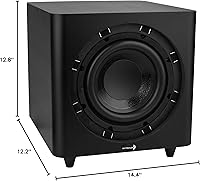
  • Dimensions: The cabinet measures 12-3/4″ in height, 12-3/16″ in width, and 14-3/8″ in depth, not including grille or cable protrusions.
  • Weight: The unit weighs 23.1 pounds, which is typical for a wood-cabinet powered subwoofer of this driver size.
  • Connectivity: All connections are wired only; the SUB-800 does not include Bluetooth, Wi-Fi, or any other wireless audio technology.
  • Surround Compatibility: The subwoofer is compatible with 2.1 and 5.1 surround sound configurations and integrates with standard home theater receiver setups.
  • Color & Finish: The unit is available in black only, with a textured vinyl surface that blends into most home entertainment furniture arrangements.
  • Warranty: Dayton Audio provides a limited warranty with this subwoofer; buyers should confirm current warranty terms directly with the manufacturer or authorized seller.

Related Reviews
Dayton Audio SUB-1200 12″ Powered Subwoofer
79%
91%
Value for Money
74%
Bass Performance
78%
Build Quality
93%
Ease of Setup
67%
Amplifier Power
More
Dayton Audio SUB-1000 10″ Powered Subwoofer
79%
83%
Bass Output & Extension
91%
Value for Money
93%
Ease of Setup
76%
Build Quality
62%
Room Size Suitability
More
Dayton Audio SUB-1500 15-inch Powered Subwoofer
75%
88%
Bass Output & Depth
63%
Amplifier Power
91%
Value for Money
74%
Build Quality
86%
Setup & Installation
More
MTX Audio RT8PT 8-Inch Powered Subwoofer
83%
88%
Bass Performance
92%
Value for Money
89%
Build Quality
85%
Ease of Installation
80%
Sound Clarity
More
Dayton Audio SD215A-88 8″ DVC Subwoofer
85%
92%
Sound Quality
89%
Bass Response
85%
Ease of Installation
90%
Durability
87%
Value for Money
More
Planet Audio P10AW 10-Inch Amplified Car Subwoofer
76%
91%
Ease of Installation
83%
Value for Money
67%
Bass Output & Impact
74%
Build Quality
62%
Sound Clarity
More
BOSS Audio Systems BASS8 8-Inch Under Seat Powered Car Subwoofer
86%
89%
Bass Quality
91%
Ease of Installation
94%
Space Efficiency
85%
Sound Clarity
88%
Power Output
More
Kanto SUB8 8-inch Powered Subwoofer
80%
89%
Bass Accuracy
67%
Low-End Extension
91%
Speaker Integration
83%
Build Quality
86%
Setup & Ease of Use
More
Rockville RTB80A 8″ Powered Car Subwoofer
69%
88%
Ease of Installation
71%
Bass Output
82%
Value for Money
67%
Build Quality
44%
Power Accuracy
More
Polk Audio PSW10 10-inch Powered Subwoofer
75%
78%
Bass Performance
93%
Ease of Setup
67%
Build Quality
84%
Value for Money
72%
Room Suitability
More

FAQ

Yes, it will. The speaker-level inputs let you connect the sub directly to your amp's speaker terminals, the same way you would wire a regular speaker. This is one of the more practical features on the SUB-800 and makes it usable with a wide range of older or budget stereo amplifiers.

Realistically, it works best in rooms up to about 150 to 200 square feet — think a bedroom home theater, a small apartment living room, or a dedicated listening nook. In larger or open-plan spaces, the 8-inch driver simply runs out of room-filling ability at higher volumes, and you will notice the bass compress and thin out.

It works most of the time, but it has a known quirk: low-level signals — like quiet background TV audio — sometimes do not trigger it, and there can be a short lag before it activates on louder content. Most users find it acceptable once they are aware of it, but if the idea of occasionally missing the first second of bass bothers you, you can simply leave the sub in manual-on mode.

The Dayton Audio SUB-800 8″ Powered Subwoofer reaches down to about 40 Hz under real-world conditions, which covers the large majority of music and standard TV content comfortably. That said, some movie soundtracks include bass content that dips below 30 Hz, and that range will sound thinner on this sub than it would on a 10- or 12-inch model. For casual movie watching it is fine; for dedicated home cinema with explosive action content, the limitation is noticeable.

Absolutely — that is one of the most common setups for this sub. If your receiver has an LFE or subwoofer output, connect that via RCA directly to the sub. If it does not, use the speaker-level input and the pass-through output to wire your bookshelf speakers through the sub. Either way, it integrates cleanly.

If your receiver has proper bass management with a configurable crossover, use that and run the sub's own crossover dial wide open at its maximum setting to keep it out of the signal path. If you are using a basic stereo amp without any bass management, the on-board crossover becomes genuinely useful for preventing bass overlap between the sub and your mains.

At moderate listening levels, the compact subwoofer produces enough bass to enhance your experience in the room without causing serious problems through walls and floors. That said, no subwoofer is completely neighbor-proof — low bass frequencies travel through building structures, and playing at high volumes late at night will likely still be heard. The 8-inch driver is inherently more neighbor-considerate than a larger sub at equivalent volume settings.

Yes, it can make a meaningful difference depending on where your sub is placed relative to your main speakers. With the sub behind or to the side of your listening position, switching phase can reduce a hollow or weak-sounding bass character. The easiest test is to play something with steady bass, flip the switch, and choose whichever position sounds fuller.

Based on long-term owner feedback, many buyers report four to six or more years of regular use without major issues. The amplifier board is the most likely point of eventual failure, but outright failures appear to be the exception rather than the rule. Keeping it in a well-ventilated spot and not running it at maximum volume continuously will help it last longer.

It is not ideal. The downward-firing port needs some clearance below the unit to work properly — placing it directly on thick carpet or inside a tight enclosed cabinet can restrict airflow and affect bass output quality. On hard floors or a low-pile rug with a few inches of open space around it, the port design performs as intended.