Overview

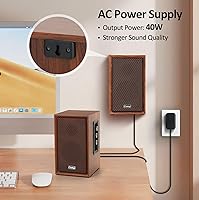
The Cinnkeyi C5201 Bookshelf Speakers are a straightforward audio upgrade for anyone tired of the thin, flat sound coming from their laptop or monitor. cinnkeyi is a relatively new name in the speaker market, so there is no long track record to lean on — what you get is a compact 2.0 stereo pair powered by a 24V AC adapter, housed in a wood grain enclosure that immediately looks more considered than the typical plastic box at this price. One thing worth knowing upfront: no 3.5mm input exists on this model. It is USB and Bluetooth only, which rules it out entirely if your device lacks those outputs.

Features & Benefits

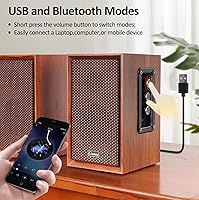
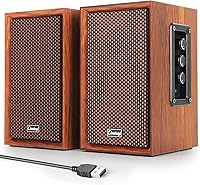
At 40W continuous output, the C5201 pair punches noticeably harder than most compact desktop speakers its size — your laptop's built-in audio simply cannot compete once you have heard the difference. Two physical knobs handle bass and mid-high tuning independently, so you can dial things in by ear without opening any software. Built-in DSP keeps the sound from falling apart at louder volumes, a weakness that trips up a lot of budget options. The single USB cable handles both audio and power from your PC, while the included RCA cable links the two speakers together internally. Switching to Bluetooth is just a short button press away.

Best For

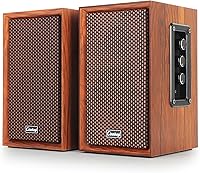
These desktop speakers make the most sense for home office workers and casual listeners who want real stereo sound on their desk without adding a subwoofer to the mix. The wood finish aesthetic suits warm, minimalist setups better than the glossy black plastic common at this price. Bluetooth streamers who occasionally work at a desktop PC will appreciate not having to swap hardware when switching sources. That said, this wooden speaker set is not the right call for everyone — if your computer or audio interface only has a 3.5mm output, you are out of luck until the brand releases a compatible variant. Portability is not an option either; these live on a desk.

User Feedback

Buyers consistently mention being surprised by the bass output from something this compact — most were not expecting much at this size, and that appears to be a genuine highlight. On the flip side, some users have hit USB recognition issues depending on which port or hub they use, so plugging directly into the PC rather than a docking station is worth trying first. The wood build gets mixed reactions: it photographs well, but a few reviewers note it feels closer to a printed veneer than solid wood up close. Bluetooth range in typical room distances earns mostly positive marks, though the setup guide drew criticism for being sparse, particularly from less tech-savvy buyers.

Pros

  • Bass output is surprisingly strong for the compact cabinet size — no subwoofer needed for casual listening.
  • Dual USB and Bluetooth connectivity handles both wired PC use and wireless phone streaming without extra hardware.
  • Physical bass and mid-high knobs let you tune the sound by hand without opening any software or app.
  • The 40W output gets genuinely loud for a small-to-medium room without audible strain.
  • Wood grain enclosures look noticeably more polished than plastic rivals in the same price bracket.
  • Single USB cable handles both audio and power from the PC, keeping desk cable clutter minimal.
  • Built-in DSP helps maintain cleaner sound at higher volumes where budget speakers typically fall apart.
  • Switching between Bluetooth and USB mode requires just a short button press with an audio confirmation tone.
  • Compact per-speaker dimensions fit comfortably alongside a standard monitor without sacrificing workspace.

Cons

  • No 3.5mm analog input at all — a hard dealbreaker for a large portion of potential buyers.
  • USB connection can fail or go unrecognized when used through hubs or docking stations rather than a direct port.
  • The wood finish is a printed wrap, not real veneer — looks better in photos than it feels in person.
  • Volume knob lacks a smooth low-end taper, making quiet background listening tricky to dial in precisely.
  • The bass knob has no center detent, so returning to a preferred setting by feel is hit or miss.
  • Setup documentation is too sparse for non-technical users, and the required USB-first startup order is poorly communicated.
  • Bluetooth auto-reconnect after a power cycle is inconsistent, requiring a manual re-pair in some cases.
  • cinnkeyi has a limited track record, making long-term reliability and warranty support harder to predict.
  • Sub-bass extension drops off noticeably below 60Hz, which affects genres like electronic and hip-hop at high volume.
  • No finish or color variants available, limiting options for buyers with cooler or darker desk aesthetics.

Ratings

The scores below reflect an AI-driven analysis of verified global buyer reviews for the Cinnkeyi C5201 Bookshelf Speakers, with spam, bot-generated, and incentivized feedback actively filtered out before any category was scored. Reviewers ranged from home office workers to casual gamers, giving us a broad picture of how these speakers hold up across different real-world desks and habits. Both the genuine highlights and the recurring frustrations are represented here without softening either side.

Sound Quality
78%
22%
Most buyers were genuinely impressed by how full the sound feels coming from speakers this compact — the kind of impression you get when you first switch from laptop audio and realize how much you were missing. The DSP helps keep things clean at moderate-to-loud volumes, which is where budget speakers usually start to crack.
At the absolute top of the volume range, some listeners noted a slight hardness in the upper midrange that becomes noticeable during extended listening sessions. It is not a dealbreaker for background music, but critical listeners spending hours at a desk will pick up on it.
Bass Performance
82%
18%
The bass output consistently surprises buyers who expect compact desktop speakers to sound thin and shallow. With the bass knob dialed up, the low-end presence is strong enough for casual gaming, hip-hop, and electronic music without needing a separate subwoofer on the desk.
The bass is punchy rather than deep — there is a clear drop-off below around 60Hz, so if you listen to music that relies on sub-bass frequencies, you will notice the floor. The physical knob also lacks detents, making it hard to return to a favorite setting by feel.
Build Quality
69%
31%
The wood grain finish gives the C5201 pair a visual step up over similarly priced all-plastic alternatives, and in photos or across a desk it genuinely looks more polished. Several buyers mentioned that the speakers felt solid and did not rattle or buzz even when pushed to higher volumes.
Up close, the wood finish reads more like a printed wrap than real wood veneer, which disappoints buyers who expected something more tactile. The knobs feel functional rather than premium, and a few reviewers noted slight wobble in the volume control after a few weeks of use.
USB Connectivity
63%
37%
The single-cable USB setup is genuinely convenient for a clean desk — one cable handles everything, and on compatible setups it works immediately without driver installation. Windows users with a direct motherboard USB port reported a smooth, hassle-free experience.
USB compatibility is the most divisive aspect in buyer feedback. Users connecting through USB hubs, docking stations, or certain Mac configurations reported intermittent recognition failures or no audio signal at all. Plugging directly into the PC resolves the issue most of the time, but that is not always practical.
Bluetooth Performance
74%
26%
Pairing is quick and the audio feedback tone confirms connection status without having to check a screen, which buyers appreciate in a shared office or bedroom setup. Streaming music from a phone at normal room distances — up to about 20 feet — was described as stable by the majority of reviewers.
A handful of users reported occasional dropouts when walls or other devices were in the signal path, and re-pairing after a power cycle can sometimes require a manual button press rather than auto-reconnecting. The Bluetooth range is adequate but not exceptional for the category.
Ease of Setup
71%
29%
For most buyers, getting the speakers up and running took under ten minutes — connect the RCA cable between the two units, plug in the USB, and power on. The audio feedback system that announces connection mode is a genuinely useful touch for first-time users.
The included quick-start guide is sparse, and several non-technical buyers found it confusing to understand the correct startup order — the USB must be connected before powering on, and missing that step causes issues that are not clearly flagged in the documentation.
Tone Controls
76%
24%
Having separate physical knobs for bass and mid-high frequencies is a meaningful advantage over speakers in this price range that offer no adjustment at all. Buyers who like heavier bass for gaming or a flatter profile for podcasts appreciated being able to switch between them quickly by hand.
The two-knob system is simple rather than precise — there is no way to fine-tune a specific frequency band, and the knobs do not have clear center detents to indicate a neutral position. Audiophile-minded buyers expecting something closer to an equalizer will be underwhelmed.
Volume Output
83%
At 40W, these desktop speakers get genuinely loud for a small room or shared office space — loud enough to fill a medium-sized bedroom without straining. Buyers moving from portable Bluetooth speakers or laptop audio consistently noted that volume headroom was not a concern.
The volume knob lacks a smooth taper at the low end, meaning the first portion of the dial goes from very quiet to fairly loud in a short range. Fine-tuning low-volume listening for quiet environments proved frustrating for some users who work in shared spaces.
Design & Aesthetics
81%
19%
The rectangular wood-tone cabinets fit naturally into warm or minimalist desk setups, and buyers frequently mentioned that the speakers look more expensive than they are. For those who care about the visual side of their workspace, these stand out clearly from the glossy black plastic standard in budget audio.
The design is conservative and the wood wrap can look slightly artificial in bright lighting. There are no color or finish variations available, so buyers who prefer a darker or more modern aesthetic do not have an alternative option within this product line.
Input Flexibility
47%
53%
Covering both USB and Bluetooth in one unit does handle the two most common modern connection scenarios for desktop and mobile users. Switching between the two modes via a short button press is quick and the audio tone confirms which mode is active.
The absence of a 3.5mm analog input is a hard limitation that disqualifies these speakers for a meaningful portion of buyers — anyone using a headphone amplifier, older PC, gaming console analog output, or a portable music player is simply out of options. This single omission narrowed the audience considerably.
Value for Money
73%
27%
Taken as a package — 40W output, dual connectivity, physical tone controls, and a wood enclosure — the C5201 pair delivers more on paper than most rivals in the same price bracket. Buyers who matched this set to their actual needs generally felt they got more than they paid for.
Buyers who discovered the missing 3.5mm input only after purchase felt the value proposition collapsed immediately. There are also competing options at a similar price from more established audio brands, which gives some buyers pause about long-term reliability and support from a newer manufacturer.
Desk Footprint
79%
21%
At just over 7 inches wide per unit, these speakers sit comfortably on either side of a standard monitor without eating into workspace. The compact footprint was specifically called out by home office buyers who run dual-monitor setups and have limited surface area.
Because the speakers are AC-powered and require an RCA cable connecting the two units, cable management on a tidy desk takes a bit of planning. Users who wanted a truly minimal cable run found the dual-power and inter-speaker wiring slightly awkward to route cleanly.
Setup Documentation
54%
46%
The physical setup — connecting two speakers with an RCA cable and a single USB — is simple enough that technically confident users had no trouble working it out independently. The printed guide covers the basic connection diagram adequately for that audience.
The documentation falls short for users who are less comfortable with audio hardware. The critical instruction to connect USB before powering on was buried or absent in some packaging versions, leading to confusion and unnecessary troubleshooting among first-time buyers.
Long-Term Reliability
61%
39%
Short-term build impressions were generally positive — no reports of early failures in the first weeks of use, and the AC-powered design removes battery degradation as a concern entirely. Buyers using the speakers for daily listening reported consistent performance over the initial months.
cinnkeyi is a new brand with a limited track record, and there is simply not enough long-term owner data yet to rate reliability with confidence. The limited warranty coverage and uncertain after-sale support availability add a layer of risk that more established brands do not carry.

Suitable for:

The Cinnkeyi C5201 Bookshelf Speakers are a well-matched pick for anyone whose current audio setup is a laptop, a small monitor, or nothing at all — essentially anyone starting from zero on desktop sound. Home office workers who want background music or podcast audio without dedicating half their desk to a subwoofer will find the compact footprint and single-cable USB setup genuinely practical. Casual gamers who want fuller, room-filling sound during long sessions but are not ready to spend on a premium audio system will get a noticeable step up without overthinking the purchase. The wood grain design also makes these a natural fit for minimalist or warm-toned workspaces where a generic black plastic speaker would look out of place. Bluetooth users who also need a reliable wired connection for their PC — and want to switch between the two without buying separate hardware — will appreciate having both options built in.

Not suitable for:

Anyone whose computer, audio interface, or console outputs audio exclusively through a 3.5mm headphone jack should stop here — the Cinnkeyi C5201 Bookshelf Speakers simply do not have that input, and no adapter will add it. That rules out users with older PCs that lack USB audio output, portable media players, and a wide range of gaming consoles or hi-fi equipment that rely on analog connections. Critical listeners or home studio users expecting precise, flat frequency reproduction will find the tone shaping too basic and the overall sound profile too colored for serious work. Buyers who prioritize brand longevity and robust after-sale support should also weigh the fact that cinnkeyi is a newer manufacturer with a limited track record — if long-term reliability or warranty service matters to you, that is a real consideration. Finally, anyone looking for a portable or battery-powered speaker is in the wrong category entirely; these are strictly desk-bound, corded speakers.

Specifications

  • Output Power: The speakers deliver 40W of continuous power across both channels in a 2.0 stereo configuration.
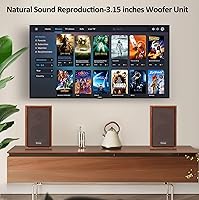
  • Driver Size: Each cabinet houses a 3.15-inch dynamic woofer driver responsible for both mid and bass frequency reproduction.
  • Frequency Response: Audio coverage spans from 50Hz on the low end up to 20KHz at the top of the audible range.
  • Connectivity: Supported inputs are USB audio and Bluetooth wireless; no 3.5mm analog input is available on this model.
  • Power Source: The system is powered by a 24V AC adapter included in the box; it is not battery-powered or USB bus-powered.
  • Enclosure Material: Both cabinets feature a wood grain finish enclosure designed to reduce resonance compared to standard plastic housings.
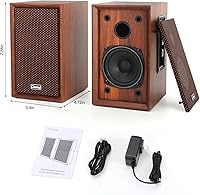
  • Dimensions: Each speaker unit measures 3.4″ deep, 7.28″ wide, and 4.72″ tall.
  • Total Weight: The combined weight of both speaker units is approximately 5.24 pounds (2.38 kilograms).
  • Audio Processing: A built-in DSP (Digital Signal Processor) is included to manage distortion control at higher playback volumes.
  • Tone Controls: Two independent physical knobs allow separate adjustment of bass and mid-high frequencies without any software or app.
  • Volume Control: A touch-sensitive volume button on the unit also functions as the input mode switch via a short press.
  • Speaker Config: The system is a 2.0 channel stereo setup with no dedicated subwoofer channel or output.
  • Inter-Speaker Link: The two cabinets are connected to each other using an RCA cable that is included in the package.
  • Compatible Devices: Designed for use with desktops, laptops, smartphones, tablets, and gaming consoles that support USB audio or Bluetooth output.
  • Channel Layout: Left and right channels are split across the two separate cabinets for standard stereo separation on a desk.
  • In-Box Contents: The package includes both speaker units, a 24V power adapter, an RCA inter-speaker cable, and a printed quick-start guide.
  • Model Number: The unit is identified by model number C5201, with regional variants designated C5201-US and C5201-UK.
  • Warranty: The product is covered by a limited manufacturer warranty; buyers should confirm specific terms and duration with the seller at time of purchase.
  • Waterproofing: These speakers carry no water resistance rating and are intended strictly for dry indoor desktop environments.
  • Launch Date: This model was first made available for purchase in October 2024, making it a relatively recent product with limited long-term ownership data.

Related Reviews
Probox BT16 Bookshelf Speakers
75%
78%
Sound Clarity
54%
Bass Performance
84%
Bluetooth Stability
82%
USB DAC Quality
63%
Build Quality
More
Edifier S2000MKIII Bookshelf Speakers
86%
92%
Sound Quality
89%
Bluetooth Performance
88%
Build Quality
85%
Ease of Use
91%
Connectivity Options
More
Riowois DS6800M Bookshelf Speakers
83%
85%
Sound Quality
90%
Ease of Installation
82%
Build Quality
88%
Space-Saving Design
78%
Bass Performance
More
Fluance XL8SW Bookshelf Speakers
87%
90%
Sound Quality
84%
Bass Response
91%
Clarity of Midrange
87%
Ease of Installation
88%
Design & Build Quality
More
KEF Q150 Bookshelf Speakers
87%
88%
Sound Quality
75%
Bass Performance
93%
Build Quality
90%
Design & Aesthetics
85%
Treble Clarity
More
Orroplus OR-02 Powered Bookshelf Speakers
77%
83%
Sound Clarity & Midrange
61%
Bass Performance
91%
Connectivity & Input Range
78%
Bluetooth Performance
72%
Setup & Ease of Use
More
KEF Q350 Bookshelf Speakers
86%
93%
Sound Quality
80%
Bass Performance
88%
Build Quality
91%
Design and Aesthetics
85%
Ease of Setup
More
MEVOSTO DS19 Bookshelf Speakers
85%
89%
Sound Quality
91%
Bass Performance
85%
Treble Clarity
88%
Bluetooth Connectivity
90%
Design & Aesthetics
More
Sanyun SW208 3″ Bookshelf Speakers
86%
88%
Build Quality
84%
High-Frequency Clarity
91%
Mid-Range Warmth
78%
Bass Performance
93%
Control Ergonomics
More
Micca MB42X Bookshelf Speakers
84%
89%
Sound Quality
92%
Value for Money
85%
Ease of Setup
77%
Bass Performance
91%
Design & Aesthetics
More

FAQ

They are compatible with Mac computers, but the experience can vary depending on how you connect them. USB audio on Mac is generally plug-and-play without drivers, but some users have had better luck plugging directly into a port on the machine rather than going through a hub or dongle. Bluetooth pairing on Mac works the same way it would with any other Bluetooth device.

Yes, as long as your TV or console has a USB audio output or Bluetooth capability. If your television only has an optical, HDMI ARC, or 3.5mm output, these speakers will not work with it directly since there is no analog or optical input on this model. Consoles like newer PlayStation and Xbox models that support Bluetooth audio would be compatible wirelessly.

No — the Cinnkeyi C5201 Bookshelf Speakers do not have a 3.5mm analog input on the current version. The brand has indicated a 3.5mm variant is planned for a future release, but the current model is strictly USB and Bluetooth only. If your only audio output is a headphone jack, these are not the right pick for you right now.

A short press of the volume button toggles between the two input modes, and the built-in audio feedback system plays a tone to confirm which mode you have switched into. There is no app or screen involved — it is all handled physically on the unit, which keeps things simple once you get used to the button behavior.

The most common fix is to plug the USB cable directly into a port on your computer rather than through a hub, docking station, or USB-C adapter. Some users also report that the order of operations matters — connect the USB cable before powering the speakers on, not after. If you are on Windows, check your sound settings to make sure the C5201 is selected as the active playback device.

They do make a real, audible difference — turning the bass knob up adds a clear low-end punch that works well for music genres like hip-hop or electronic, while pulling it back gives you a cleaner, more neutral sound better suited to speech or classical music. The mid-high knob adds brightness and presence when turned up. Neither knob has a center detent, so you will need to find your preferred position by ear rather than resetting to a marked neutral point.

For a typical desk setup, placing them roughly two to three feet apart on either side of your monitor works well. The RCA cable that connects the two units is long enough to handle standard desk widths without pulling tight. If your desk is unusually wide, you may want to measure before assuming the included cable covers the distance.

It is a printed wood grain wrap rather than solid or real veneer wood. From a normal viewing distance it looks convincingly natural, but up close you can tell it is a surface finish rather than actual wood grain. It still serves its functional purpose of reducing cabinet resonance better than thin plastic would.

Technically you could place them side by side, but you would lose the stereo separation that makes them worth having in the first place. The two cabinets carry the left and right channels independently, so spreading them apart is what delivers that wider, more immersive sound compared to a single-unit speaker. Keeping them together would make them sound much closer to a mono source.

At 40W they get significantly louder than you might expect for a compact pair of desktop speakers. Most users report they are more than adequate for a bedroom or small home office, and that hitting max volume is rarely necessary for comfortable listening. They are not designed to replace a living room stereo system, but for a desk or a small room they have real headroom to spare.