Overview

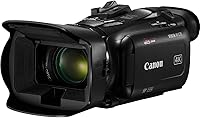
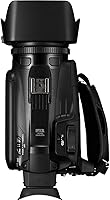
The Canon VIXIA HF G70 Camcorder sits in an interesting spot: capable enough for semi-professional work, yet approachable enough for serious enthusiasts who've outgrown consumer-grade gear. Canon's optical heritage carries real weight here — this isn't a brand slapping a 4K label on bargain components. The DIGIC DV6 processor works alongside the 4K UHD sensor to produce footage that holds up under scrutiny, not just on paper. One genuinely useful workflow addition is the OSD time stamp recording, which bakes date, time, and timecode directly into your files — a detail that matters on busy shoot days. At this price tier, buyers rightly expect solid build quality and reliable optics, and the HF G70 largely delivers.
Features & Benefits

The 20x optical zoom is where this Canon camcorder earns its keep in the field — rack from wide to tight without the image softening that digital zoom inevitably introduces. Paired with advanced image stabilization, handheld shots stay composed even during extended takes. The Hybrid AF system with face detection is genuinely quick, locking onto subjects without the hunting behavior that plagues cheaper autofocus systems. For live streaming, the UVC connection means you plug into a Mac or PC and you're broadcasting in HD — no capture card, no driver headaches. The 8-blade aperture gives highlights a rounded, natural blur, and the 3.5-inch LCD provides a comfortable monitoring experience in varied lighting conditions.

Best For

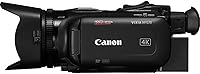
This prosumer camcorder makes particular sense for event videographers — wedding shooters, conference documenters, and ceremony crews who need accurate timecode embedded without post-production patching. The plug-and-play USB streaming also speaks directly to educators and corporate presenters who want reliable live output without assembling a separate rig. Solo shooters who need a trustworthy zoom range in a body that weighs around a pound will appreciate how little fatigue builds over a long day. It's also a strong upgrade path for videographers moving up from entry-level camcorders who want real optical quality and responsive autofocus without committing to a large cinema camera system.

User Feedback

Owners consistently highlight autofocus accuracy and zoom smoothness as standout strengths, with shooters noting that face detection holds up reliably during fast-moving events. The USB live streaming setup draws praise for its simplicity — most users report it working without additional software. Battery life is a recurring concern; extended shooting sessions often require a spare pack on hand. The OSD time stamp feature gets positive marks from corporate and event users who rely on it for documentation workflows. Where this prosumer camcorder draws criticism is in challenging low-light conditions — the 1/2.3-inch sensor has real limits compared to larger-sensor rivals at comparable prices. Ergonomics and button layout generally land well, though preferences vary.

Pros

  • Face detection autofocus is fast and reliable, holding focus during fast-paced event shoots without constant manual adjustment.
  • The 20x optical zoom covers a wide shooting range without any image quality penalty from digital magnification.
  • USB live streaming works out of the box on both Mac and PC — no capture card or driver installation needed.
  • OSD time stamp recording embeds timecode directly into files, cutting down post-production organization time significantly.
  • At roughly one pound, this Canon camcorder is light enough for extended handheld shoots without fatigue building up quickly.
  • Advanced image stabilization keeps footage steady even when shooting handheld at longer focal lengths.
  • The 8-blade aperture produces smooth, rounded highlight blur that gives footage a noticeably polished, professional look.
  • The 3.5-inch LCD screen is large enough to frame shots confidently in varied outdoor and indoor lighting conditions.
  • SDXC card support and MP4 output make file management and editing workflow straightforward on any modern computer.
  • Build quality and button layout are consistently described as solid and well-organized for day-to-day professional use.

Cons

  • Low-light performance is a genuine weak point — the small sensor struggles in poorly lit venues where larger-sensor cameras excel.
  • Battery life is limited for full-day shoots; most users find a spare battery pack is a practical necessity, not an optional accessory.
  • No XLR audio inputs means external microphone options are restricted compared to professional camcorders in adjacent categories.
  • The digital zoom beyond the optical range degrades image quality noticeably and is rarely usable in serious production work.
  • Fixed lens design rules out any creative flexibility through optics changes, unlike mirrorless systems at similar price points.
  • There is no built-in ND filter, which can complicate exposure control when shooting outdoors in bright conditions.
  • Competitors at similar price points offer larger sensors, giving buyers a real trade-off to weigh before committing.
  • The HF G70 lacks advanced log picture profiles, limiting serious color grading potential in post-production workflows.
  • Streaming is capped at HD rather than 4K output, which may disappoint creators targeting higher-resolution live broadcasts.
  • For buyers without a specific recurring use case, the overall cost is difficult to justify against more versatile camera systems.

Ratings

The Canon VIXIA HF G70 Camcorder has been evaluated through AI-powered analysis of verified global user reviews, with spam, bot activity, and incentivized feedback actively filtered out to ensure the scores reflect genuine buyer experiences. Across thousands of real-world assessments from event videographers, content creators, educators, and corporate shooters, both the standout strengths and the honest frustrations of this prosumer camcorder are transparently reflected below.
Autofocus Performance
88%
Event shooters consistently praise the Hybrid AF system for locking onto faces quickly and holding focus through unpredictable subject movement — a real advantage during wedding ceremonies or corporate panels where you cannot manually adjust mid-shot. Adjustable focusing speed gives experienced operators extra control that entry-level systems simply don't offer.
In very low-contrast scenes or when subjects are backlit, the autofocus can hesitate noticeably before committing to a target. A small number of users shooting fast-moving subjects in challenging light reported brief focus hunting that disrupted otherwise clean takes.
Optical Zoom Range
91%
The 20x optical zoom is one of the most consistently praised aspects of the HF G70, giving shooters the flexibility to cover wide establishing shots and tight close-ups from a fixed position — ideal for event work where repositioning mid-ceremony isn't an option. Zoom speed control keeps pulls smooth and professional-looking.
At the far end of the zoom range, any camera movement becomes more pronounced, and even with stabilization engaged, very long handheld shots can show subtle drift. The 800x digital zoom is largely unusable for serious work due to significant image quality degradation at extreme magnification.
4K Image Quality
83%
In well-lit conditions — outdoor ceremonies, conference halls with proper stage lighting, bright indoor venues — the 4K footage from this Canon camcorder is sharp, detailed, and color-accurate in a way that holds up on large screens and in post-production. The DIGIC DV6 processor handles color rendering with notable consistency across mixed lighting scenarios.
The 1/2.3-inch sensor is the defining limitation here: it cannot match the image quality of larger-sensor competitors once light levels drop. Noise becomes visible in moderately low-light conditions that a Micro Four Thirds or Super 35 sensor would handle cleanly, which is a real trade-off buyers at this price tier should weigh carefully.
Low-Light Performance
58%
42%
With the f/1.8 maximum aperture working in its favor, the HF G70 performs reasonably well in moderately dim environments — evening receptions with ambient lighting or indoor conference settings with standard ceiling fixtures generally produce acceptable footage without excessive noise.
This is the most frequently cited frustration among buyers who expected more from a camera at this price point. Genuinely dark venues — candlelit dinners, nighttime outdoor events, poorly lit stages — push the small sensor past its comfort zone quickly, resulting in noisy, soft footage that requires significant noise reduction in post.
Live Streaming Capability
86%
The plug-and-play USB streaming via UVC is consistently described as one of the most friction-free live streaming setups users have encountered at this level. Educators and corporate presenters particularly appreciate that it works with Zoom, OBS, Teams, and most other platforms without hunting for drivers or configuring capture devices.
The streaming output is capped at HD rather than 4K, which is a limitation for creators specifically targeting high-resolution live broadcasts. A small number of users reported minor compatibility quirks with certain older operating system versions that required a software update before the camera was recognized correctly.
Image Stabilization
84%
Advanced optical stabilization keeps handheld footage genuinely usable across a wide range of shooting conditions, including slow walking shots and extended telephoto captures where camera shake typically becomes a serious problem. Event shooters report it adds meaningful confidence when shooting without a tripod during dynamic moments.
At the far end of the optical zoom range, stabilization effectiveness decreases noticeably, and abrupt movements — stepping over obstacles, sudden turns — still produce visible jerks in the footage. It is not a substitute for a gimbal or tripod in situations requiring perfectly locked-off shots.
OSD & Timecode Recording
89%
The on-screen display time stamp recording is a standout workflow feature that event and corporate videographers specifically sought out this camera for. Having date, time, and timecode embedded directly into the original file removes a tedious manual logging step and makes multi-camera syncing and archival documentation significantly faster.
The OSD configuration menus can feel buried and unintuitive for users encountering them for the first time, with a learning curve that a few buyers found frustrating during initial setup. Once configured correctly, however, the feature operates reliably with minimal intervention during shoots.
Build Quality & Ergonomics
81%
19%
The body feels solid and purposefully assembled — not fragile like lower-tier consumer camcorders, and not unnecessarily bulky. Button placement is well-considered for one-handed operation, and the grip is comfortable enough for extended handheld shoots without causing fatigue in the operating hand.
A handful of users noted that the body, while well-built, lacks weather sealing — shooting outdoors in light rain or dusty conditions requires extra caution. Some buyers with larger hands found the control layout slightly cramped when using gloves or during cold-weather shoots.
Battery Life
62%
38%
The included Lithium Ion battery handles shorter shooting sessions — seminars, short ceremonies, classroom recordings — without issue, and the camera powers up quickly without a long initialization wait that could cause you to miss a critical moment.
Battery life is a recurring pain point for users doing full-day event coverage. Most shooters report needing to swap batteries at least once during a typical wedding day or all-day conference, and the cost of genuine Canon spare batteries adds meaningful overhead to the total ownership investment.
Audio Recording
67%
33%
The built-in microphone captures serviceable audio for reference and basic use cases, and the 3.5mm input allows connection of external microphones for improved quality in professional contexts. AAC encoding keeps file sizes manageable without audible compression artifacts under normal conditions.
The absence of XLR balanced audio inputs is a real limitation for professional event work where wireless lavelier receivers and professional boom microphones are standard. Users who need clean, interference-free audio typically need a separate audio recorder, which adds complexity and cost to the overall setup.
Ease of Use
78%
22%
Shooters upgrading from consumer camcorders generally find the learning curve manageable — physical controls are logically arranged, the menu system is structured in a familiar Canon style, and the camera does not demand extensive technical knowledge to produce good results quickly in standard shooting scenarios.
Users new to prosumer-level video gear can find the depth of the menu system initially overwhelming, particularly when configuring OSD features, autofocus behavior, or streaming settings for the first time. The manual and online documentation, while available, require patience to navigate effectively.
Connectivity & Outputs
79%
21%
HDMI output for external monitors, USB for streaming and file transfer, and SDXC card support together make this a well-connected camera for its class. Videographers who work with field monitors or feed video to a switching system appreciate having reliable HDMI output without adapters.
There is no built-in Wi-Fi or Bluetooth for wireless file transfer or remote control, which feels like a notable omission at this price point compared to some competing cameras that offer app-based remote operation and wireless clip transfer directly to a smartphone.
Value for Money
71%
29%
For buyers whose workflow aligns specifically with what this prosumer camcorder does well — event recording, USB streaming, long optical zoom, reliable autofocus — the investment delivers tangible professional-level results that justify the cost relative to entry-level alternatives.
At this price point, buyers increasingly have access to mirrorless alternatives with significantly larger sensors and more versatile shooting capabilities. For general-purpose videographers without a specific need for the HF G70's event-focused feature set, the cost-to-capability ratio is harder to defend against the competition.
Setup & Out-of-Box Experience
82%
18%
Most buyers report being operational within minutes of opening the box — the battery, included accessories, and basic factory settings allow shooting to begin quickly without extensive configuration. The USB streaming setup in particular is described as nearly zero-effort on both Mac and PC platforms.
Users who want to unlock the full feature set — particularly OSD time stamp configuration, autofocus fine-tuning, and custom button assignment — face a longer initial investment of time before the camera behaves exactly as they need it to in professional deployment.

Suitable for:

The Canon VIXIA HF G70 Camcorder is a strong match for videographers who shoot structured events — weddings, corporate conferences, graduation ceremonies — where having timecode and date stamps embedded directly in the file saves real time in post-production. Solo operators who need a reliable zoom range without carrying a heavy rig will appreciate how much reach the 20x optical zoom delivers in a body that barely tips the scales at a pound. Educators and corporate trainers who broadcast live sessions will find the USB streaming setup genuinely low-friction; plug in, select the source, and you are on air without extra hardware cluttering your desk. Content creators who are ready to step beyond smartphone or entry-level camcorder quality — but aren't prepared to learn the full complexity of a mirrorless cinema setup — will find this prosumer camcorder hits a practical middle ground. The responsive face-detection autofocus also makes it a dependable choice for anyone who shoots interviews, panel discussions, or presentations where subjects move unpredictably.
Not suitable for:

The Canon VIXIA HF G70 Camcorder is not the right tool for shooters whose primary battlefield is low-light environments. The 1/2.3-inch sensor is a real constraint — in dimly lit venues like candlelit receptions or poorly lit conference halls, it will struggle in ways that larger-sensor mirrorless cameras simply won't. Cinematographers or narrative filmmakers who need shallow depth-of-field control and log footage profiles for serious color grading will find this prosumer camcorder too limiting creatively. If you're already working with a professional broadcast setup and need XLR audio inputs, interchangeable lenses, or ND filter wheels, the HF G70's feature set won't satisfy those demands. Budget-conscious buyers should also weigh whether the investment makes sense relative to capable mirrorless alternatives that offer larger sensors and more versatile shooting modes at comparable or lower price points. This is not a casual purchase, and buyers who don't have a clear, recurring use case for its specific strengths may find the cost hard to justify.
Specifications

  • Sensor: The camera uses a 1/2.3-inch 4K UHD CMOS sensor designed to capture detailed, sharp footage across a range of lighting conditions.
  • Processor: Canon's DIGIC DV6 image processor handles video rendering, noise reduction, and overall image pipeline performance.
  • Optical Zoom: A 20x optical zoom lens provides substantial reach without any of the image degradation associated with digital zoom.
  • Digital Zoom: An 800x digital zoom extension is available, though image quality degrades noticeably at extreme magnification levels.
  • Aperture: The lens features a maximum aperture of f/1.8 and an 8-blade aperture design that produces rounded, cinema-style out-of-focus highlights.
  • Video Resolution: Maximum recording resolution is 4K UHD, with footage saved in MP4 format for broad compatibility with editing software.
  • Audio Format: Audio is recorded in AAC format, which balances file size efficiency with acceptable quality for event and corporate video work.
  • Storage: The camera records to SDXC flash memory cards, which are widely available and support the high data rates required for 4K recording.
  • Display: A 3.5-inch LCD monitor is built into the body for framing, playback review, and menu navigation in the field.
  • Connectivity: The camera includes HDMI output for external monitoring and USB connectivity for both data transfer and live streaming.
  • Live Streaming: UVC1-compliant USB streaming allows direct HD video output to a Mac or PC without requiring a separate capture card or additional drivers.
  • Autofocus: A Hybrid AF system combines contrast and phase detection methods, with face detection and adjustable focusing speed control built in.
  • Stabilization: Advanced optical image stabilization is built into the lens system to reduce camera shake during handheld and moving shots.
  • OSD Recording: On-screen display time stamp recording embeds date, time, and timecode data directly into the original camera files during capture.
  • Weight: The body weighs approximately 1 pound, making it manageable for extended handheld shooting sessions without significant operator fatigue.
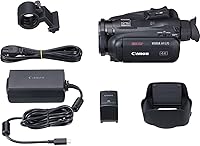
  • Battery: One Lithium Ion battery pack is included in the box and is required to operate the camera.
  • Memory Format: SDXC is the supported flash memory card format, with compatibility for high-capacity and high-speed cards needed for sustained 4K recording.
  • Video Format: Recorded files are saved as MP4, a widely supported container format compatible with most professional and consumer editing applications.

Related Reviews
Canon VIXIA HF R500 Camcorder
75%
91%
Zoom Performance
93%
Ease of Use
78%
Image Stabilization
82%
Video Quality (Daylight)
54%
Low-Light Performance
More
Minolta MN80NV Camcorder
83%
88%
Value for Money
92%
Ease of Use
86%
Night Vision Performance
89%
Image Quality (Video)
78%
Build Quality
More
Canon PowerShot Zoom Compact Telephoto Monocular
73%
94%
Portability & Form Factor
88%
Optical Zoom Performance
51%
Digital Zoom Quality (800mm)
83%
Image Stabilization
78%
Autofocus Reliability
More
Canon EOS R Full-Frame Mirrorless Camera
75%
93%
Image Quality
89%
Autofocus Performance
67%
Video Capability
78%
Autofocus in Low Light
84%
Build Quality & Ergonomics
More
LUKPOW 4K Camcorder DV112
80%
88%
Video Quality
91%
Ease of Use
80%
Battery Life
85%
Screen Versatility
78%
Night Vision Performance
More
Panasonic HC-VX3 4K Camcorder
75%
88%
Video Quality (Daylight)
61%
Low-Light Performance
91%
Image Stabilization
84%
Zoom Versatility
86%
Ergonomics & Handling
More
ZIMOCE HDV900PRO 4K Camcorder
81%
92%
Value for Money
88%
Video Quality
76%
Zoom Performance
83%
Build Quality
90%
Ease of Use
More
WIKICO HDV01-8K Camcorder
70%
81%
Value for Money
54%
Video Quality
67%
Low-Light Performance
84%
Ease of Use
71%
Build Quality & Design
More
Godox TT350C TTL Flash for Canon
80%
94%
Portability & Size
74%
TTL Accuracy
88%
Wireless Reliability
61%
Flash Power Output
86%
High Speed Sync (HSS)
More
Godox V100-CU Canon Touchscreen Flash
82%
93%
Output Power
91%
Touchscreen Interface
82%
TTL Accuracy
88%
High-Speed Sync Performance
84%
Detachable Sub Flash
More

FAQ

No, you do not. The HF G70 supports UVC streaming natively over USB, which means most Mac and PC systems recognize it as a webcam source without any additional hardware or driver installation. You simply plug it in and select it as your video source in your streaming or conferencing software.

The camera uses SDXC format cards. For 4K recording, you'll want a card rated at a high write speed — look for UHS Speed Class 3 or Video Speed Class 30 at minimum to avoid dropped frames or recording interruptions during long takes.

The Hybrid AF system with face detection is one of this prosumer camcorder's stronger practical features. It tracks faces reliably and recovers focus quickly when subjects move in and out of frame. Most event shooters report it handles typical ceremony and reception conditions well, though very low-contrast or extremely dark scenes can slow it down.

Yes, though the options are limited compared to higher-end professional camcorders. The camera has a standard 3.5mm audio input, so you can connect a mini-jack microphone or use an adapter for certain external mics. It does not have XLR inputs, so professional-grade balanced audio will require a separate audio recorder or a dedicated XLR adapter.

Honestly, this is where you need to set realistic expectations. The 1/2.3-inch sensor is capable in decent light, but genuinely dark environments — candlelit receptions, dimly lit conference halls, evening outdoor events — will push it toward its limits. If low-light performance is your top priority, a camera with a larger sensor will serve you better.

Battery life varies by usage, but most shooters find a single charge covers roughly 60 to 90 minutes of continuous recording under typical conditions. For a full day of event shooting, bringing at least one spare battery is a practical necessity rather than a luxury.

The optical zoom is motorized and adjustable in speed, which gives you smooth, gradual pulls between wide and telephoto — important for professional event work where abrupt zooms look amateur. Most users describe the zoom control as one of the more polished aspects of this camera's handling.

It embeds date, time, and timecode data visibly or invisibly into your recorded files during capture. For event videographers, corporate communicators, and documentary-style work, this is genuinely useful — it saves time during editing and file organization and provides an auditable record for documentation purposes. You can configure what data is displayed and how it appears on screen.

Yes, the HDMI port supports external monitor connectivity, which is useful if you're using a field monitor for critical focus checking or color reference during a shoot. Verify the specific HDMI output resolution in Canon's official documentation if 4K passthrough to your monitor is a firm requirement.

For the right user, absolutely. If you're coming from a basic consumer camcorder and you regularly shoot events, do corporate video, or produce content that requires a solid zoom range and reliable autofocus, the step up in optical quality and workflow features is tangible. Just go in with clear expectations about the sensor size — it is a real trade-off compared to larger-sensor mirrorless alternatives at a similar investment level.

Where to Buy

Walmart
In stock $1,124.98
Best Buy
In stock $1,159.95
Newegg.com
In stock $1,229.95
Adorama
In stock $1,299.00
Sweetwater
In stock $1,299.00
B&H Photo-Video-Audio
In stock $1,299.00
Full Compass Systems
In stock $1,399.00
www.occamera.com
In stock $999.00
Roberts Camera
In stock $1,299.00