Overview

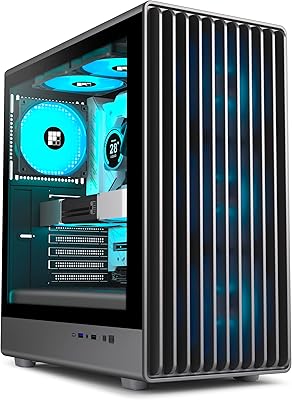
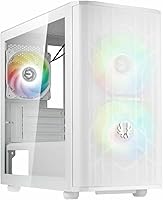
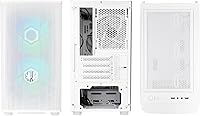
The BitFenix Nova Mesh mATX PC Case enters the compact mid-tower market as a genuinely airflow-focused option at a price that won't break a modest build budget. The defining choice is the mesh front panel, which keeps temperatures in check without forcing you into a larger chassis. It supports both Micro ATX and Mini-ITX motherboards, so platform flexibility is reasonable. The white colorway paired with a tempered glass side panel makes clean, visible builds easy to pull off. This is squarely aimed at entry-to-mid enthusiasts who want a capable, good-looking enclosure without overspending on the chassis itself.

Features & Benefits

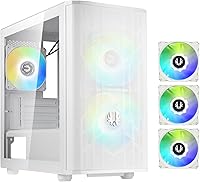
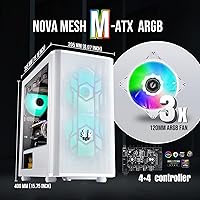
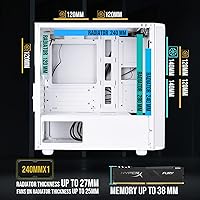
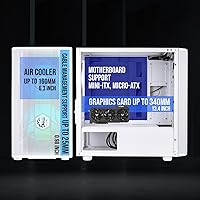
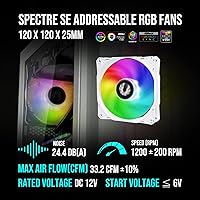
Three pre-installed 120mm ARGB fans are a genuine perk here — you're not hunting for compatible fans or spending extra to get lights inside the case. The perforated front works in tandem with those fans to push air straight through, and the design is open enough that even passive airflow helps in less demanding scenarios. Top-mounted support for a 240mm AIO radiator gives builders the option to run liquid cooling without any modifications. GPU clearance extends to 345mm, covering most cards you'd realistically pair with a mATX build. Front I/O handles both USB 2.0 and USB 3.0, and the steel-and-glass construction holds up reasonably well for what you're paying.

Best For

This mesh mATX case is a strong pick for builders who care about thermals but aren't ready to stretch their budget into premium territory. If you're assembling your first rig and want ARGB lighting without a separate fan purchase, it checks that box cleanly. The 345mm GPU clearance means you're not locked into lower-tier cards — mid-range and even some higher-end GPUs fit without issue. White-build enthusiasts will find the aesthetic easy to work with, especially with the glass panel showing off the interior. It's less ideal for people chasing top-tier build quality, but for compact gaming builds on a sensible budget, it delivers where it counts.

User Feedback

Buyers rating the Nova Mesh at 4.4 out of 5 across 180 reviews tend to agree on a few things. Cable management comes up frequently as a positive — the routing options are better than you'd expect at this price. The ARGB fans get praise for their brightness, though expectations need to be grounded: these are budget-tier fans, not premium units. On the other side, some builders flag minor panel fitment issues and limited fan controller functionality. A handful note that removing the front panel requires more force than feels comfortable. Assembly is generally described as straightforward, with standoff placement being the one step that trips up beginners. Overall, solid value for the price tier.

Pros

  • Three ARGB fans come pre-installed, saving extra cost and setup time right from the start.
  • The mesh front panel delivers noticeably better airflow than solid-front alternatives at this price point.
  • GPU clearance up to 345mm means most mid-range and upper-tier cards fit without issue.
  • Top 240mm AIO support gives builders a liquid cooling path without buying a larger case.
  • Cable management options are better organized than you would typically expect in this price tier.
  • The white finish and tempered glass side panel make for a clean, attractive interior view.
  • Micro ATX and Mini-ITX compatibility keeps platform options flexible for compact builds.
  • At its price point, the Nova Mesh consistently outperforms similarly priced competitors on thermals.
  • Front I/O covers both USB 2.0 and USB 3.0, handling everyday peripheral needs without compromise.

Cons

  • Fan controller functionality is basic and limits RGB customization without an external controller.
  • Front panel removal requires more force than feels comfortable, raising durability concerns over time.
  • Panel fitment can feel slightly inconsistent, with minor gaps or alignment issues on some units.
  • Standoff placement inside the case can trip up first-time builders without clear guidance.
  • Included ARGB fans are budget-grade and may need replacing for builders wanting quieter operation.
  • Interior space, while functional, feels tight when managing cables around larger PSUs.
  • Build materials feel noticeably lightweight, which can reduce confidence during assembly.
  • No dust filter on the top radiator mount means extra cleaning attention is needed over time.

Ratings

The BitFenix Nova Mesh mATX PC Case scores below are generated by AI after analyzing verified buyer reviews from global sources, with spam, bot-submitted, and incentivized feedback actively filtered out. This analysis covers both the consistent strengths and the honest pain points that real builders have encountered, giving you a transparent picture before you commit. Whether you're a first-time builder or upgrading a compact rig, the scores reflect what actually matters at this price tier.

Airflow Performance
88%
The mesh front panel is genuinely effective — builders consistently report lower CPU and GPU temperatures compared to similarly priced solid-front cases. The three front-intake fans work in tandem with the open panel to create a reliable pressure gradient across the interior, which matters most during sustained gaming sessions.
Without a rear exhaust fan included, hot air can linger at the back of the case under heavy loads. Builders running high-TDP components may want to add a 120mm exhaust to get the most out of what the front intake setup establishes.
Value for Money
91%
Getting three ARGB fans, a tempered glass panel, and a mesh front at this price point is a genuinely good deal — you would spend noticeably more sourcing those components separately. Buyers repeatedly flag this as one of the most cost-efficient ways to start a compact gaming build without compromising on thermals or aesthetics.
The value equation holds as long as expectations are calibrated correctly. If you compare the fit and finish against cases costing significantly more, the budget-tier compromises become apparent, particularly around panel alignment and fan controller quality.
Build Quality
67%
33%
The steel chassis provides enough rigidity to hold components securely during assembly, and most builders report no structural issues over normal use. For the price bracket, the combination of metal and tempered glass feels more substantial than some cheaper plastic-heavy alternatives.
Panel fitment inconsistencies are a recurring theme in buyer feedback — minor gaps and slight misalignment on the front mesh or side panel are reported with enough frequency to be a real pattern. The overall feel of the panels is noticeably lightweight, which can reduce confidence when applying force during cable routing.
Ease of Assembly
72%
28%
The interior layout is logical for an mATX build and cable routing channels are better organized than expected. First-time builders generally get through the process without major issues, and the space around the motherboard tray is workable for standard component configurations.
A few specific steps consistently frustrate builders — removing the front mesh panel requires more force than feels safe, and standoff placement is not as clearly marked as it should be for newcomers. These are not dealbreakers, but they add friction at the exact moments where a beginner needs confidence.
ARGB Lighting
74%
26%
The three pre-installed fans produce a reasonably bright and visually appealing ARGB effect that shows well through the tempered glass panel. For builders who want a lit interior without a separate fan purchase, the out-of-box result looks good under normal viewing conditions.
These are budget-tier fans, and the lighting consistency across all three units is not always perfectly matched. The bundled controller offers only basic mode cycling, so anyone wanting fine-grained color control will need a compatible motherboard header or an aftermarket hub.
Cable Management
79%
21%
Buyers specifically call out cable management as a standout positive, which is not something you hear often at this price point. The routing channels and tie-off points behind the motherboard tray are positioned practically, making it feasible to achieve a clean look visible through the side panel.
The space behind the tray is functional but not generous — thicker cable bundles from modular power supplies can make the rear panel harder to close cleanly. Builders with particularly dense wiring setups may need to plan their routing carefully before installing the motherboard.
GPU Compatibility
86%
The 345mm GPU clearance covers nearly every card that makes practical sense in a Micro ATX build, including current-generation mid-range and upper-tier options. Builders report no clearance surprises with popular cards, which removes a common anxiety point from the planning process.
The clearance is strong for length but side-clearance for very thick triple-slot cards can feel snug depending on the specific model. It is worth cross-referencing your exact card dimensions against the interior width before assuming a perfect fit.
Cooling Flexibility
77%
23%
Top support for a 240mm AIO radiator is a meaningful inclusion in a case at this size and price, giving builders a genuine liquid cooling option without needing a larger chassis. The pre-installed fans also leave room to expand the cooling configuration without immediately hitting limits.
The top mount supports only up to 240mm, which rules out the increasingly popular 280mm and 360mm radiators that many modern AIO kits use. Builders who already own or plan to buy a larger cooler will find this a hard constraint.
Noise Level
61%
39%
Under light workloads the fans are unobtrusive and blend comfortably into ambient room noise, which works well for everyday desktop use or light gaming. At mid-range RPMs the case is genuinely quiet enough for most home environments.
At full speed the included fans are clearly audible, and the mesh front panel does nothing to dampen noise the way a solid front would. Builders building a home theater PC or a quiet workstation will likely want to replace the fans with lower-noise alternatives fairly quickly.
Aesthetics
83%
The white colorway is clean and consistent across the exterior and interior, which makes for an attractive backdrop when the ARGB fans are running. The tempered glass panel is large enough to show off a well-built interior, and the overall silhouette looks appropriately modern for a gaming-oriented case.
The white finish shows dust and smudges more readily than darker alternatives, so it requires more frequent wiping to maintain the look. Some buyers also note that the panel edges and seams are not as refined as higher-end white cases, which becomes visible under close inspection.
I/O Port Accessibility
69%
31%
Having both USB 2.0 and USB 3.0 ports on the front panel means common peripherals like mice, keyboards, and flash drives connect conveniently without reaching around to the back of the system. The port placement on the top-front edge is ergonomic for a desk-mounted build.
The absence of a USB-C front port is a notable omission for a case releasing in this era, particularly for builders who use modern smartphones or peripherals that expect USB-C connectivity. This will become an increasingly noticeable gap as USB-C adoption continues to grow.
Fan Controller
53%
47%
A basic fan and RGB controller is included in the box, which lets buyers without a compatible motherboard header still cycle through lighting modes and manage basic fan behavior. It is a functional inclusion that removes the need for an immediate extra purchase.
The controller is minimal to a fault — mode selection is limited to a simple button cycle with no speed granularity or software integration. Builders who care about matching their ARGB setup to a broader ecosystem will find it inadequate and will likely bypass it in favor of a motherboard header.
Dust Management
58%
42%
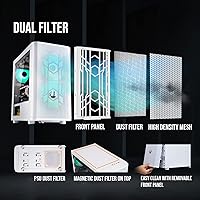
A bottom PSU intake filter is included and is reasonably effective at catching larger particles before they enter the power supply. For less dusty environments the mesh front also acts as a loose pre-filter in practice.
The top radiator mount and the mesh front panel have no dedicated fine-mesh filtration, meaning dust accumulates inside the case faster than it would with filtered equivalents. Regular compressed air cleaning is essentially mandatory if this case is placed at floor level or in a dusty room.
Compact Footprint
82%
18%
The overall dimensions are well-suited for builders who want a capable gaming machine that does not dominate a desk or require a large floor space. The case manages to keep a small external profile while still accommodating 345mm GPUs and a 240mm AIO internally.
The compact size that makes it attractive for small desks is also the reason it cannot accommodate ATX motherboards or larger radiators. Builders whose component choices push the limits of the interior may find the space constraints frustrating during a more complex build.

Suitable for:

The BitFenix Nova Mesh mATX PC Case is a strong fit for builders who want respectable thermal performance without dedicating a large chunk of their budget to the chassis. It makes the most sense for first-time builders on a Micro ATX or Mini-ITX platform who want to skip the hassle of sourcing fans separately — the three pre-installed ARGB units mean the build looks good and stays cool right out of the box. Gamers putting together a compact rig around a mid-range GPU will appreciate the 345mm clearance, which covers most cards that make sense in this price bracket. The white colorway and tempered glass panel also appeal to builders who care about aesthetics but aren't ready to pay a premium for them. If your priority is airflow per dollar in a small footprint, this mesh mATX case punches well above its weight class.

Not suitable for:

Builders with higher expectations around fit, finish, and component quality may find the BitFenix Nova Mesh mATX PC Case underwhelming once they start handling the panels up close. The fan controller is limited, which can frustrate anyone wanting granular control over RGB behavior or fan curves without a third-party hub. People planning particularly dense or complex cable runs inside a compact chassis may also hit friction, as the interior space is efficient but not generous. If you're building a near-silent workstation or a system where acoustic performance is a priority, the included fans aren't tuned for quiet operation. This compact gaming enclosure also isn't the right call for anyone who needs ATX motherboard support, since it tops out at Micro ATX.

Specifications

  • Form Factor: Supports Micro ATX and Mini-ITX motherboards, making it compatible with the two most common compact build platforms.
  • Dimensions: The case measures 15.16″ long by 8.07″ wide by 15.75″ tall, providing a compact footprint without sacrificing internal clearance.
  • Weight: The unit weighs 10.1 pounds unloaded, reflecting a steel-and-glass construction that balances rigidity with manageable handling.
  • Front Panel: The front face uses a perforated mesh design that allows air to pass through freely with minimal resistance in both active and passive scenarios.
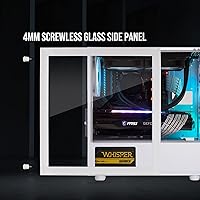
  • Side Panel: A tempered glass side panel is fitted on the left side, providing a clear view of the internal components and lighting.
  • Pre-installed Fans: Three 120mm ARGB fans come installed at the front of the case, ready to operate immediately without additional hardware purchases.
  • Fan Size: All included and supported fan positions accommodate 120mm fans, which are widely available and easy to replace or supplement.
  • Top Radiator Support: The top of the case accepts radiators up to 240mm, enabling a dual-fan AIO liquid cooler without any structural modification.
  • GPU Clearance: The interior supports graphics cards up to 345mm in length, covering the majority of current mid-range and high-end GPU models.
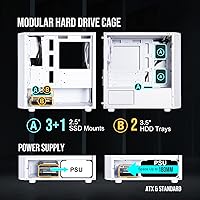
  • PSU Mount: The power supply is mounted at the rear-bottom of the case in a standard ATX orientation with a dedicated shroud area.
  • Front I/O: The front panel provides two USB 2.0 ports and two USB 3.0 ports alongside a combined 3.5mm audio jack for headsets.
  • ARGB Lighting: ARGB lighting is integrated into all three pre-installed fans and is controllable via motherboard headers or a bundled controller.
  • Material: The chassis is constructed from steel with a tempered glass side panel, offering a reasonable structural foundation for the price tier.
  • Case Type: Classified as a mid-tower form factor, the case strikes a balance between compact desk presence and usable internal volume.
  • Color: The reviewed variant ships in white, with a matching white interior finish that works well with light-themed builds.
  • BSR Ranking: The case holds a Best Sellers Rank of approximately #370 in the Computer Cases category on Amazon at time of review.
  • Average Rating: Based on 180 customer ratings, the case carries an average score of 4.4 out of 5, indicating strong overall buyer satisfaction.

Related Reviews
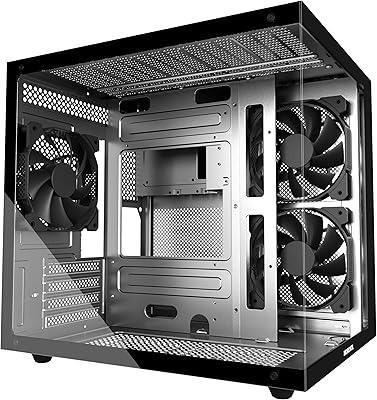
Jonsbo C6 Mini MATX Mesh PC Case
84%
91%
Airflow Performance
95%
Ease of Assembly
87%
Build Quality
88%
Cooling System Customization
65%
Cable Management
More
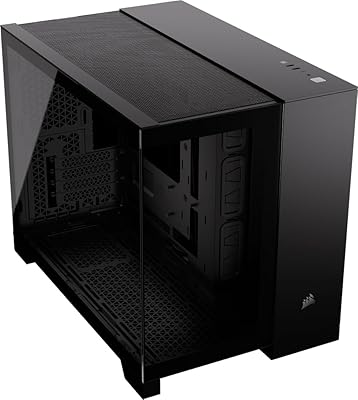
MOROVOL V3 Micro-ATX Tower PC Case
78%
88%
Tempered Glass Quality
76%
Airflow & Thermal Performance
61%
Cable Management
73%
Build Quality & Materials
91%
Value for Money
More
Apevia Destiny Mesh Mid Tower PC Case
76%
83%
Airflow Performance
71%
Build Quality
88%
Value for Money
62%
Cable Management
79%
Ease of Assembly
More
SAMA V Mesh Mid Tower PC Case
79%
91%
Airflow Performance
88%
Included Fans
86%
Value for Money
67%
Build Quality
83%
Ease of Assembly
More
Corsair 2500X mATX PC Case
82%
91%
Build Quality
93%
Cable Management
88%
Cooling Flexibility
89%
Tempered Glass Panels
86%
Reverse Motherboard Compatibility
More
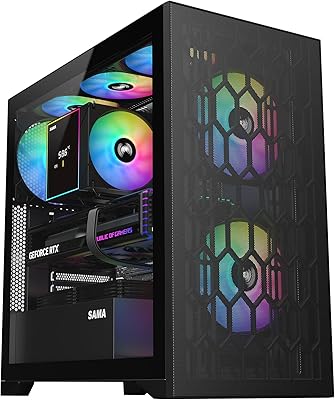
Raidmax X921 ATX Mid Tower PC Case
78%
91%
Value for Money
88%
Included Fans
83%
Airflow Performance
71%
Build Quality
79%
Tempered Glass Panel
More
FOIFKIN M9 ATX Mid-Tower PC Case
76%
93%
Aesthetic Design
88%
Value for Money
76%
Cooling Performance
71%
Build Quality
58%
Cable Management
More
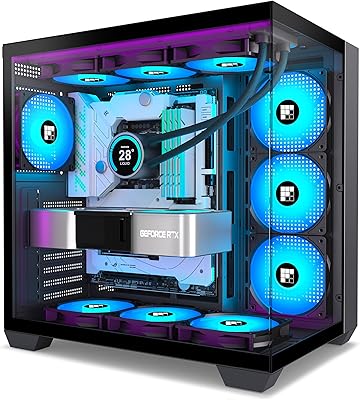
FOIFKIN F300 2025 ATX Mid-Tower PC Case
76%
88%
Value for Money
91%
Aesthetic Design
79%
Cooling Performance
86%
Hardware Compatibility
58%
Cable Management
More
FOIFKIN K6 ATX Mid-Tower PC Case
73%
88%
Value for Money
66%
Build Quality
83%
Cooling Performance
54%
Cable Management
81%
Ease of Assembly
More
FOIFKIN F600
FOIFKIN F600
77%
91%
Value for Money
78%
Airflow Performance
74%
Build Quality
93%
Aesthetics & RGB Lighting
63%
Cable Management
More

FAQ

No, it does not. The Nova Mesh is designed specifically for Micro ATX and Mini-ITX boards. If you are planning a build around a standard ATX motherboard, you will need to look at a larger chassis.

The top mount supports up to a 240mm radiator, so a 280mm or 360mm unit will not fit there. The front can also accommodate some radiator configurations depending on fan placement, but you should verify clearances against your specific cooler dimensions before committing.

Almost certainly yes. Both of those cards fall well within the 345mm GPU length limit. As long as your card is not a triple-slot model with unusual dimensions, you should have no fitment problems.

The included fans use a standard 5V 3-pin ARGB connector, which is compatible with ASUS Aura Sync, MSI Mystic Light, and most other major motherboard RGB ecosystems. If your board lacks an ARGB header, a bundled controller lets you cycle through lighting modes independently.

It uses a side-hinge or latch mechanism depending on the revision, and most builders find it straightforward to swing open. It is not a tool-free design in all versions, so keep a screwdriver nearby during your initial assembly.

At full speed they are audible, as you would expect from budget-tier 120mm fans. They are not particularly quiet at high RPMs, but under typical gaming loads they blend into background noise reasonably well. If near-silent operation matters to you, swapping them out for aftermarket fans is worth considering.

Generally it is manageable, but a couple of steps catch beginners off guard. Installing the motherboard standoffs and removing the front mesh panel for radiator access both require a bit more effort than expected. Taking your time and consulting a build guide specific to mATX cases will help.

There is a filter at the bottom for the PSU intake. The front mesh and top panel have more limited filtration, so expect to clean the interior more frequently if your environment is dusty. Adding aftermarket magnetic filters to the top is a common upgrade.

Yes. The case supports additional fan positions depending on configuration, including top and potentially rear mounts. Running a rear 120mm exhaust fan is a popular addition that improves front-to-rear airflow meaningfully.

There is a reasonable amount of space, and buyers consistently mention cable routing as a positive aspect of this enclosure. It is not as generous as premium cases, but with some planning and zip ties you can achieve a clean look behind the glass panel.