Overview

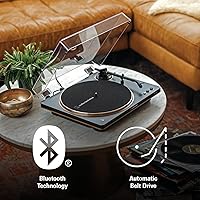
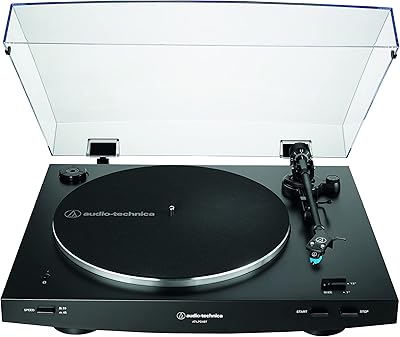
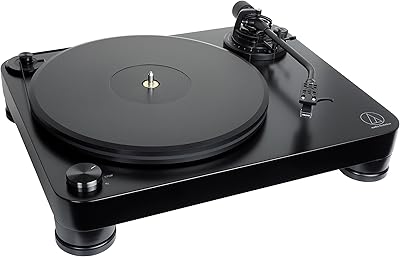
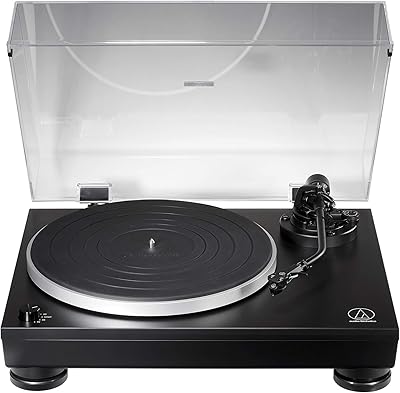
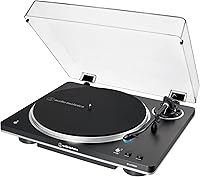
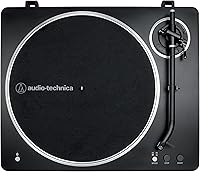
The Audio-Technica AT-LP70XBT sits in an interesting middle ground — not a beginner throwaway deck, but not a serious audiophile rig either. Audio-Technica has been making cartridges and turntables for decades, and that pedigree shows in how this wireless record player is put together. The fully automatic operation alone separates it from the crowded manual-only entry-level field, and the three-piece chassis construction signals a more thoughtful build than the LP60X line it effectively succeeds. Add dual connectivity — Bluetooth out or traditional RCA wired — and you have a deck that genuinely fits modern listening habits without forcing immediate compromises.
Features & Benefits

The VM95C cartridge is arguably the most future-proof thing about this Bluetooth turntable. It ships ready to play, but the entire VM95 stylus family is interchangeable — meaning a real sound upgrade is just a needle swap away, no new deck required. The built-in switchable preamp handles both phono and line-level output, connecting directly to powered speakers or a standard amp without extra boxes. The J-shaped tonearm keeps tracking more accurate toward inner grooves where straight arms tend to struggle. On the wireless side, aptX Adaptive support is a genuine differentiator — lower latency and better fidelity than most competing decks offer over Bluetooth.

Best For

This wireless record player makes the most sense for a few specific buyer types. If you are new to vinyl and dreading the idea of manually cueing a tonearm every play, the automatic mechanism removes that friction entirely. It also suits apartment listeners who have invested in Bluetooth speakers and want to avoid running cables across a room. Upgraders coming off an LP60X-class deck will notice a genuine step up in both build quality and sound. For gift buyers, the combination of a trusted brand, an approachable setup experience, and a real stylus upgrade path makes this a confident, lasting choice.

User Feedback

With 429 ratings averaging 4.4 out of 5 stars, this Bluetooth turntable earns its reception honestly. Buyers consistently highlight the setup experience — out of the box and playing in minutes — and the automatic tonearm return is called out repeatedly as a reliable, low-stress feature. Wireless pairing draws mostly positive notes, though some users report occasional range limitations or the need to re-pair after idle periods. More critical voices point to the plastic plinth as a weak spot at this price tier, and dust cover durability draws a mention or two. That said, the VM95C cartridge pulls genuine sound quality compliments when stacked against competing decks.

Pros

  • Fully automatic tonearm return means no babysitting the deck at the end of a record side.
  • The VM95C cartridge ships ready to play and upgrades easily across the entire VM95 stylus family.
  • aptX Adaptive Bluetooth codec delivers noticeably better wireless fidelity than basic SBC competitors.
  • Built-in switchable phono/line preamp connects directly to powered speakers or any amplifier without extra gear.
  • Die-cast aluminum platter and felt mat provide meaningfully more stable playback than all-plastic alternatives.
  • The AT-LP70XBT sets up in minutes — no cartridge alignment, no technical experience required.
  • External AC adapter keeps power conversion noise out of the signal chain for a cleaner wired output.
  • Dual connectivity means you can run wired to a Hi-Fi system one day and Bluetooth to a speaker the next.
  • J-shaped tonearm reduces tracking errors in inner grooves where cheaper straight-arm decks tend to smear detail.
  • A 4.4-star average across more than 400 verified reviews reflects consistent real-world satisfaction.

Cons

  • Plastic plinth feels underwhelming and introduces resonance that a heavier chassis would suppress.
  • Bluetooth range drops noticeably through walls and in RF-congested apartments.
  • The deck sometimes requires re-pairing after sitting idle, which gets old quickly.
  • Dust cover hinge has drawn durability concerns, with some users reporting looseness within months of use.
  • No 78 RPM speed option limits usefulness for buyers with any shellac record collection.
  • Only one Bluetooth device can be connected at a time — switching sources means a full re-pair.
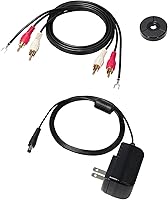
  • The included RCA cable is functional but noticeably budget-grade, prompting many buyers to replace it early.
  • Long-term reliability of the automatic return mechanism is less proven than the simpler belt-drive components.
  • The built-in preamp, while convenient, does not match a dedicated external phono stage at a comparable price.
  • Minor production inconsistencies — cosmetic marks or misaligned dust covers — appear in a small but notable share of unit reports.

Ratings

The Audio-Technica AT-LP70XBT scores here reflect AI-driven analysis of verified buyer reviews gathered globally, with spam, bot activity, and incentivized feedback actively filtered out before scoring. Across more than 400 confirmed ratings, this wireless turntable earns a strong overall position — but not without some clear trade-offs that prospective buyers should weigh honestly. Both the standout strengths and the recurring frustrations are represented transparently in each category below.
Ease of Setup
92%
Buyers consistently describe unboxing to first play in under 15 minutes, with no cartridge alignment or manual anti-skate adjustment required. The automatic mechanism means there is genuinely nothing intimidating for a first-time vinyl listener to navigate — plug in, pair via Bluetooth, and drop the needle.
A small number of users noted the initial Bluetooth pairing can require a few attempts if the device was already connected to another source. The manual provides only basic guidance, which can leave newer buyers uncertain about the phono/line preamp switch setting.
Sound Quality
78%
22%
The VM95C cartridge performs noticeably above what most competing automatic decks ship with at this price tier. Users transitioning from budget entry-level players frequently comment on a cleaner midrange and better stereo separation, particularly on well-pressed records.
Serious listeners point out the plastic plinth introduces some resonance coloration that a heavier chassis would suppress. At high volumes on bass-heavy pressings, a small but vocal group of reviewers noticed a subtle muddiness that a stylus upgrade to the VM95E or VM95ML helps address.
Bluetooth Performance
74%
26%
The aptX Adaptive codec support puts this wireless record player ahead of most rivals that ship with basic SBC Bluetooth. Users pairing it with quality wireless speakers report smooth, low-latency playback that holds up well in living room distances of around 20 to 25 feet.
Range drops off noticeably through walls or in apartments with RF congestion, and several buyers mention needing to re-pair the deck after it sits idle. A handful of users also report the Bluetooth connection drops briefly when the tonearm reaches the end of a record side.
Build Quality
71%
29%
Compared to the LP60X-class decks it effectively replaces, the three-piece chassis feels more substantial and better dampened. The die-cast aluminum platter is a meaningful upgrade over fully plastic platters and contributes to more consistent playback speed.
The plastic plinth remains a point of criticism from buyers expecting more at this price point — it flexes slightly and does not feel premium to the touch. The dust cover hinge has also drawn durability concerns, with a few users reporting it became loose or misaligned within the first few months of regular use.
Automatic Mechanism
89%
The fully automatic tonearm return is one of the most consistently praised aspects across all reviews. For listeners who fall asleep to records or simply do not want to babysit the turntable, having the arm lift and return reliably at record end is a real practical benefit.
A minority of users reported the tonearm occasionally failed to return smoothly after extended use, suggesting some mechanical variability in production. The mechanism also means there is no manual override for cueing mid-record without a degree of care, which can frustrate users coming from manual decks.
Cartridge & Stylus Value
88%
Shipping with the VM95C and offering a clear upgrade path through the entire VM95 stylus family is a smart, genuinely buyer-friendly design choice. Users who later swapped to the VM95E or VM95ML reported significant sound improvements without needing a new deck.
The stock VM95C stylus, while competent, is the entry point of the VM95 family and leaves some headroom on the table out of the box. Buyers who are unaware of the upgrade path may not realize they are getting roughly 60 percent of what the deck is capable of sonically.
Wired Connectivity
83%
The included RCA cable with ground wire is a practical inclusion that most budget decks skip, and the switchable phono/line preamp means this wireless record player connects cleanly to almost any amplifier or powered speaker setup without extra gear.
The detachable RCA cable is functional but not particularly premium, and a few users noted they replaced it relatively quickly. The ground wire, while included, occasionally needs repositioning to eliminate a faint hum depending on the receiving amp.
Platter & Speed Stability
81%
19%
The anti-resonance die-cast aluminum platter with felt mat keeps playback speed notably more consistent than the all-plastic platters found on entry-level decks. Most users report no perceptible wow or flutter under normal listening conditions.
Precision speed-testing by more technically inclined reviewers shows minor variance at 33-1/3 RPM that would not bother a casual listener but might register to someone with a sensitive ear for pitch. No built-in speed adjustment is available if belt stretch occurs over time.
Noise Floor & Signal Cleanliness
80%
20%
Moving the AC adapter outside the chassis to handle power conversion externally is a small but meaningful engineering call. The result is a quieter signal path than decks that integrate the power supply internally, and most buyers using the wired output report a clean, hiss-free signal.
Some users pairing the deck directly into a receiver via the phono input noted a faint residual hum that required careful grounding to eliminate. The built-in preamp, while convenient, does not match the performance of a dedicated external phono stage costing a similar amount.
Value for Money
76%
24%
For a buyer who wants Bluetooth, automatic operation, a upgradeable cartridge, and a built-in preamp in a single box from a brand with genuine vinyl heritage, the price is defensible. The stylus upgrade path extends the useful life of the deck considerably compared to fixed-cartridge competitors.
At this price, buyers reasonably expect a more premium physical build, and the plastic plinth undermines that expectation. Competing decks from Pro-Ject and Rega at similar or slightly higher prices offer better chassis construction, though they sacrifice automatic operation and built-in Bluetooth.
Aesthetics & Design
77%
23%
The black and silver colorway is clean and contemporary without being ostentatious, and the overall footprint fits comfortably on a media console or bookshelf. The hinged dust cover is a practical touch that protects the stylus when the deck is not in use.
The overall visual impression reads as slightly utilitarian rather than designed, and buyers used to the understated elegance of European decks may find it a bit plain. The dust cover, while functional, feels noticeably lightweight and does not close with the satisfying solidity of higher-end alternatives.
Compatibility & Versatility
85%
Supporting both 33-1/3 and 45 RPM out of the box, offering both Bluetooth and RCA wired output, and including a 45 RPM adapter makes this one of the more flexible all-in-one decks at this tier. It pairs cleanly with Bluetooth speakers, headphones, and traditional Hi-Fi setups alike.
There is no 78 RPM speed option, which limits use for buyers with a shellac collection. The Bluetooth connection supports one device at a time, meaning switching between a wireless speaker and wireless headphones requires a manual re-pair each time.
Packaging & Unboxing
86%
The packaging does a good job of protecting the stylus and platter during shipping, and buyers report receiving the deck in ready-to-use condition without the alignment headaches that plague some competitors. Included accessories are practical and immediately useful.
A small number of buyers reported receiving units with minor cosmetic marks or misaligned dust covers, suggesting some inconsistency in final quality checks before shipping. The documentation inside the box is sparse and relies on buyers finding setup guidance online.
Long-Term Reliability
72%
28%
The belt-drive mechanism has a strong track record across Audio-Technica's lineup, and replacement belts are widely available and inexpensive. Users who have owned the deck for over a year report consistent performance with no major mechanical degradation.
The automatic return mechanism introduces more moving parts than a manual deck, and a small percentage of long-term owners report it becoming less reliable after 18 to 24 months of regular use. Belt replacement is simple, but sourcing original replacement parts for the auto mechanism can require going directly through Audio-Technica.

Suitable for:

The Audio-Technica AT-LP70XBT is built for a specific kind of buyer, and it serves them well. If you are new to vinyl and the idea of manually cueing a tonearm feels unnecessarily fussy, the fully automatic mechanism removes that friction entirely — drop the needle, the record plays, the arm returns on its own. It is equally well-suited to apartment listeners who have already invested in a Bluetooth speaker setup and want to spin records without routing cables across the room. Upgraders who started on an LP60X-class deck and have outgrown its limitations will find a meaningful step up here in both build substance and sound quality without jumping into intimidating manual territory. For gift buyers, the combination of a trusted brand name, a genuinely easy out-of-the-box experience, and a real stylus upgrade path makes this a thoughtful choice that grows with the recipient rather than becoming a shelf ornament within a year.
Not suitable for:

Buyers with serious audiophile expectations will run into the ceiling of the Audio-Technica AT-LP70XBT fairly quickly. The plastic plinth introduces resonance coloration that a heavier, more inert chassis would suppress, and at higher volumes on bass-heavy pressings that limitation becomes harder to ignore. If your system already includes a quality external phono stage, the built-in preamp becomes redundant rather than useful. Those with a shellac record collection will hit an immediate dead end — there is no 78 RPM speed option here. Buyers who prize manual control and want to cue records mid-side with precision may also find the automatic mechanism more of a constraint than a convenience. And if your living space involves thick walls, significant wireless interference, or a multi-device Bluetooth rotation, the connection reliability may frustrate more than expected.
Specifications

  • Drive Type: Belt-drive mechanism isolates the motor from the platter to reduce vibration transfer into the stylus.
  • Operation: Fully automatic: the tonearm cues, plays, and returns to rest at the end of a record without any manual intervention.
  • Speeds: Supports both 33-1/3 and 45 RPM playback; a 45 RPM adapter is included in the box.
  • Cartridge: Fitted with an AT-VM95C Integral Dual Moving Magnet phono cartridge as standard.
  • Stylus Upgrade: The fixed cartridge body accepts any stylus from the VM95 Series, ranging from the VM95C up to the VM95ML and beyond.
  • Tonearm: J-shaped tonearm geometry is engineered to reduce tracking distortion, particularly toward the inner grooves of a record.
  • Platter: Anti-resonance die-cast aluminum platter with a felt mat, measuring standard 12-inch diameter for LP playback.
  • Bluetooth Codec: Supports Qualcomm aptX Adaptive wireless audio, offering lower latency and higher fidelity than standard SBC Bluetooth.
  • Preamp: Built-in switchable phono/line preamplifier allows direct connection to powered speakers or a standard amplifier input.
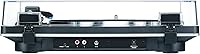
  • Wired Output: Detachable dual RCA male-to-male output cable with ground wire is included for connection to wired audio systems.
  • Chassis: Three-piece anti-resonance construction dampens vibration more effectively than the single-piece chassis used on the LP60X series.
  • Power Supply: External AC adapter handles AC-to-DC conversion outside the chassis to minimize electrical noise in the signal chain.
  • Dimensions: The turntable measures 15.75 x 12.99 x 4.33 inches (400 x 330 x 110 mm) including the dust cover in the closed position.
  • Weight: Unit weighs 6.4 pounds (approximately 2.9 kg), making it light enough to relocate easily between rooms.
  • Dust Cover: Removable hinged dust cover protects the stylus and platter surface when the deck is not in use.
  • Compatibility: Pairs wirelessly with any Bluetooth-enabled speaker, soundbar, or headphone, and connects via RCA to any phono or line-level input.
  • In the Box: Package includes the turntable, detachable RCA cable with ground, 45 RPM adapter, AC adapter, and removable hinged dust cover.
  • Model Number: Official model designation is AT-LP70XBT-BS, with BS denoting the Black/Silver colorway.
  • Release Date: First made available for purchase on July 31, 2024, making it a recent addition to Audio-Technica's automatic turntable lineup.
  • Warranty: Audio-Technica provides a standard limited warranty covering manufacturing defects; buyers should confirm current terms directly with the manufacturer.

Related Reviews

Audio-Technica AT-LP3XBT
82%
88%
Sound Quality (Wired)
74%
Bluetooth Audio Quality
93%
Ease of Setup
91%
Fully Automatic Operation
67%
Build Quality
More
Audio-Technica ATH-M50xWH
87%
94%
Sound Quality
89%
Build Quality
82%
Comfort for Extended Use
91%
Noise Isolation
88%
Durability of Detachable Cable
More
Audio-Technica AT-LPW40WN
82%
91%
Sound Quality
88%
Build Quality
89%
Tonearm Performance
86%
Speed Accuracy & Stability
74%
Ease of Setup
More
Audio-Technica ATH-M30x
78%
83%
Sound Accuracy
88%
Mid-Range Clarity
61%
Bass Response
72%
Comfort & Fit
74%
Build Quality
More
Audio-Technica AT-LP5X
84%
93%
Build Quality
91%
Sound Quality
94%
Motor & Speed Stability
88%
Cartridge & Stylus
89%
Tonearm Performance
More
Audio-Technica AT-LP7 Turntable
86%
94%
Sound Quality
92%
Build Quality
80%
Ease of Setup
88%
Manual Control Experience
90%
Tracking Accuracy
More
Audio-Technica AT875R
83%
93%
Sound Rejection
94%
Form Factor & Compactness
88%
Vocal Clarity
82%
Handling Noise Reduction
86%
Build Quality & Durability
More
Audio-Technica AT-LP120XUSB-BK
82%
91%
Build Quality
93%
Speed Accuracy & Stability
84%
Sound Quality
88%
Ease of Setup
76%
Phono Preamp Quality
More
Audio-Technica AT829CW Lavalier Microphone
88%
94%
Sound Quality
88%
Build Quality
91%
Ease of Use
89%
Portability
93%
Connectivity Stability
More
Audio-Technica AT-SP3X
78%
83%
Sound Quality
88%
Bluetooth Performance
86%
Multipoint Pairing
84%
Wired Connectivity
91%
Ease of Setup
More

FAQ

No. The deck has a built-in switchable preamp, so you can connect it directly to powered speakers or any line-level input on an amplifier. Just make sure the switch on the back is set to line if you are going into a line-level input, or phono if your amp has a dedicated phono stage you want to use instead.

Yes, completely wirelessly. The turntable pairs with any Bluetooth-enabled speaker or headphone the same way you would pair a phone. Keep in mind it can only connect to one Bluetooth device at a time, so switching between your speaker and wireless headphones means manually re-pairing.

It is genuinely one of the easier setups in this category. The Audio-Technica AT-LP70XBT arrives with the cartridge pre-installed and aligned, so there is no stylus mounting or fiddly alignment required. Most buyers report being up and playing a record within 15 minutes of opening the box.
Yes, and this is one of the better long-term value features of this deck. The VM95C cartridge body is fixed, but any stylus in the VM95 Series simply pulls off and snaps back on — no tools needed. Stepping up to the VM95E or VM95ML is a meaningful sonic improvement that costs far less than a new turntable.

For music listening it is not an issue at all. For video sync, aptX Adaptive does offer lower latency than standard Bluetooth, but whether that lag is perceptible depends on your TV and speaker combination. For dedicated music use, you are unlikely to notice any delay.

Yes. Set the preamp switch to phono, connect the included RCA cable to your receiver's phono input, and attach the ground wire to your receiver's ground terminal if it has one. That is all there is to it — no adapter or additional equipment needed.

The mechanism is reliable for the vast majority of users, and the belt-drive components are straightforward to maintain. A small number of long-term owners have reported the auto-return becoming less consistent after 18 to 24 months of heavy use, but replacement belts are widely available and inexpensive if that ever becomes an issue.

It lifts off the hinge posts with no tools and takes about two seconds to remove. Most users take it off during playback to avoid any vibration transfer from the cover rattling, and put it back on when the deck is idle. The hinge is functional but not particularly robust, so treating it gently is a good habit.

In open-plan spaces you can expect reliable connection at around 20 to 30 feet. Through walls or in apartments with heavy wireless traffic, range drops more noticeably, and a few users report occasional dropouts in those conditions. Keeping the receiver device within the same room is the most reliable approach.

No. This wireless record player supports 33-1/3 and 45 RPM only — there is no 78 RPM setting. If shellac records are part of your collection, you would need a different deck that supports the third speed and ideally a stylus designed for the wider grooves of 78s.