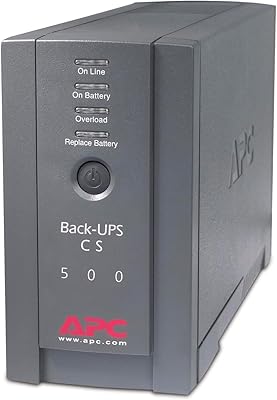
Overview

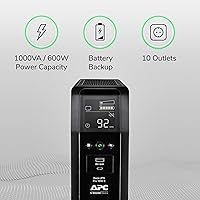
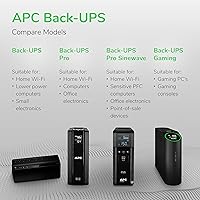
The APC BR1000MS 1000VA Sinewave UPS Battery Backup sits in a category most buyers don't fully appreciate until the lights go out. This isn't a basic power strip with a battery bolted on — it delivers pure sine wave output, the kind of clean, stable electricity that sensitive electronics actually expect. At 1000VA and 600W of real capacity, this APC sinewave UPS can realistically keep a desktop, monitor, and router running for several minutes during an outage — enough time to save your work and shut down properly. APC has been a trusted name in power protection for decades, and the BR1000MS reflects that with an LCD display and automatic voltage regulation you won't find on cheaper units.
Features & Benefits

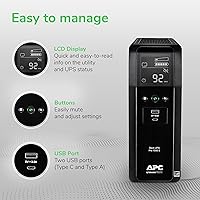
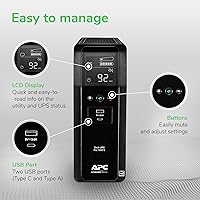
What separates this battery backup unit from the budget crowd comes down to a few practical realities. Pure sine wave power isn't marketing jargon — it matters for desktop PCs with active power supplies, NAS drives, and audio interfaces that can behave erratically on the simulated sine wave output cheaper UPS units produce. The Automatic Voltage Regulation quietly handles minor fluctuations in incoming power without touching the battery at all, which meaningfully extends battery life over time. Ten outlets split between six battery-backed and four surge-only gives you flexibility for a full workstation setup. The LCD readout shows live load, battery level, and voltage — genuinely useful data. One honest caveat: the shared 15W USB charging is underwhelming for modern devices.

Best For

The BR1000MS is the right call for home office setups where a desktop PC, external monitor, and modem all need to stay alive long enough for a controlled shutdown. Content creators running high-end workstations, and gamers with power-hungry rigs, will appreciate the clean sine wave that protects against file corruption from sudden drops. It's also well-suited to anyone living in an area prone to brownouts or voltage sags — situations where a surge strip offers zero protection. And because the battery is user-replaceable rather than sealed away, this APC sinewave UPS is a genuinely long-term investment rather than a unit you discard after a few years when the battery degrades.

User Feedback

Across more than 2,200 ratings, this battery backup unit holds a solid 4.4-star average — and reading through the feedback, it's well-deserved. Buyers consistently highlight the quiet operation, the accuracy of the LCD panel, and the near-instantaneous switchover to battery during outages. The most common complaints aren't about reliability — they're about practicalities. At 22.5 pounds, getting it positioned under a desk takes real effort, and the shared 15W USB port draws fair criticism for not keeping pace with modern charging expectations. Some users also compare the BR1000MS favorably against CyberPower's sine wave options for output consistency, though runtime at heavier loads — naturally — decreases as more devices draw power.

Pros

  • Pure sine wave output keeps modern PCs, NAS drives, and audio gear running cleanly during outages.
  • Automatic voltage regulation handles daily power fluctuations without touching the battery, extending its useful life.
  • The LCD panel gives live load, battery level, and voltage data — actually useful information, not just a status light.
  • Six battery-backed outlets plus four surge-only ports cover a full workstation without wasting backup capacity on peripherals.
  • The BR1000MS switches to battery fast enough that monitors do not flicker and active transfers do not drop.
  • User-replaceable battery makes this a long-term investment — swap the cells after a few years instead of buying a new unit.
  • Quiet fan operation under normal load makes it unobtrusive in a home office or bedroom setup.
  • Over 2,200 verified ratings averaging 4.4 stars reflects consistent, real-world satisfaction across diverse use cases.
  • APC's decades-long reputation in power protection means replacement parts, support, and documentation are easy to find.

Cons

  • At 22.5 pounds, positioning this battery backup unit under a desk or on a shelf often requires two people.
  • The shared 15W USB charging output is too slow for modern smartphones and tablets — a dated limitation at this price.
  • Mac users get no PowerChute support, losing automated shutdown and power event logging entirely.
  • Runtime drops sharply under heavier loads; high-wattage rigs may only get 4 to 6 minutes during an outage.
  • Bulky wall-wart adapters can physically block neighboring outlets, reducing the effective usable outlet count.
  • The battery ships partially discharged, requiring several hours before the unit provides full protection — expect a wait after unboxing.
  • The LCD screen angle is fixed and can be hard to read from certain desk configurations without crouching.
  • Replacement batteries carry an added cost that buyers should budget for upfront, not treat as a future surprise.

Ratings

The APC BR1000MS 1000VA Sinewave UPS Battery Backup has been scored below using an AI-driven analysis of thousands of verified global user reviews, with spam, incentivized, and bot-flagged submissions actively filtered out before any score was calculated. The results reflect a candid picture of where this unit genuinely excels and where real buyers have run into friction — nothing is glossed over.
Power Protection Reliability
93%
Buyers repeatedly report that the BR1000MS kicks in almost instantly during outages, with no perceptible flicker on connected monitors or NAS drives. The switchover speed is fast enough that active file transfers and video calls continue without interruption, which is exactly what users in outage-prone areas depend on.
A small but consistent subset of users noted that during extended or repeated outages in the same day, the unit occasionally took slightly longer to recover its charge before being fully ready again — a minor but real limitation for those experiencing back-to-back grid instability.
Pure Sine Wave Output Quality
91%
Users running high-end workstations, home recording setups, and active PFC power supplies specifically call out the clean sine wave as the reason they chose this over cheaper alternatives. Audio interfaces stay noise-free, and tower PCs with modern PSUs don't complain or shut unexpectedly during transfer.
The benefit is largely invisible to buyers who don't have sine-wave-sensitive gear, and some users feel they paid a premium for a feature their setup didn't strictly require. It is not a flaw in the unit, but it does mean the value proposition is uneven depending on the equipment being protected.
Automatic Voltage Regulation (AVR)
88%
Buyers in regions with inconsistent grid power — where lights dim during peak hours — highlight AVR as the feature that keeps their equipment stable day-to-day, not just during full outages. Because AVR corrects fluctuations without drawing on the battery, several long-term owners report the battery holding its capacity longer than expected.
AVR performance during severe, sustained undervoltage events is less consistent. A handful of users living in rural areas with chronically low line voltage noted the unit still switched to battery mode more often than anticipated, which gradually affected battery cycle count over a year or two.
Battery Runtime
76%
24%
Under a moderate load — a desktop, monitor, and router — most users report getting somewhere between 8 and 15 minutes of runtime, which is more than enough for a clean shutdown or to ride out a brief outage. For lightweight setups like a modem and a laptop charger, runtime stretches noticeably further.
Push the load closer to the 600W ceiling and runtime drops fast — some users running gaming rigs or dual-monitor workstations were surprised to get only 4 to 6 minutes. Runtime expectations need to be calibrated to actual wattage, and the unit offers no way to estimate this without a separate tool or careful reading of the LCD load percentage.
Build Quality & Materials
84%
The all-metal chassis feels substantial and purpose-built rather than plasticky. Users who have owned the unit for three or more years note that the casing shows minimal wear, and the outlets maintain a firm grip without loosening over repeated plug-in cycles — a detail that budget units often fail on.
At 22.5 pounds, the solid build comes at a cost in portability and placement flexibility. Several buyers mentioned struggling to position it under a desk or on a shelf without help, and the rubber feet, while functional, don't inspire confidence on polished or slightly elevated surfaces.
LCD Display & Monitoring
86%
The real-time LCD readout showing load percentage, input voltage, and battery charge level is consistently praised for being genuinely informative rather than decorative. Home office users especially appreciate being able to glance down and know exactly how much headroom they have during an ongoing outage.
The display is not backlit in a way that reads well from an angle or in bright ambient lighting. A few users noted that in certain desk configurations, the screen is aimed at a spot that is hard to see without crouching — a minor but recurring ergonomic complaint.
Outlet Layout & Capacity
82%
18%
The split between six battery-backed and four surge-only outlets is a practical design choice that users actually notice and appreciate. It means you can plug a desk lamp or phone charger into the surge-only side without wasting battery capacity on devices that don't need it during an outage.
Ten outlets sounds generous, but wall-wart adapters on neighboring ports can block adjacent sockets — a frustration several users mentioned. There is no outlet spacing designed for bulkier adapters, which limits the effective usable count in real-world setups.
USB Charging Ports
54%
46%
Having USB ports at all is a convenience during an outage, and for users who just need to trickle-charge a phone while their PC runs on battery, the Type-A and USB-C ports do that job adequately. The inclusion of USB-C is at least a nod toward modern devices.
At 15W shared between both ports, this charging setup feels like an afterthought. Modern smartphones charge at 25W to 65W, and the shared ceiling means even basic fast-charging is off the table. Several users specifically flagged this as the unit's most dated feature relative to its price point.
Battery Replaceability
89%
The fact that you can swap in a genuine APC replacement battery without tools or a technician is a legitimate long-term advantage. Users who replaced the battery after three to four years of use report the unit performing like new, and the clearly marked model number makes sourcing the correct battery straightforward.
The replacement battery itself carries an additional cost that some buyers did not factor into their initial purchase decision. A small number of users also noted that the battery compartment, while accessible, requires clearing some space around the unit to open comfortably — not ideal if it is wedged under a desk.
Noise Level
87%
Under normal operating conditions, the BR1000MS runs virtually silent. Users who keep it in home offices or bedrooms consistently describe it as unobtrusive, and the fan only becomes audible when the unit is working hard or actively protecting against a surge event.
During a sustained high-load battery discharge, the cooling fan ramps up and becomes clearly audible in a quiet room. It is not disruptive, but users who expected total silence in all conditions were mildly caught off guard the first time it spun up during an outage test.
Software & Smart Monitoring
71%
29%
For Windows 10 and 11 users, PowerChute Personal Edition adds real value — it can trigger automatic safe shutdowns after a defined delay, log power events, and send alerts. Users who set it up once and let it run in the background appreciate having that safety net without any ongoing effort.
Mac users get no PowerChute support and are directed to use native Energy Saver settings, which offer a fraction of the functionality. The initial software setup also has a learning curve that feels steeper than it should for a product at this price point, and the interface looks dated.
Physical Footprint & Placement
66%
34%
The upright tower form factor works reasonably well on the floor beside a desk, keeping outlet access convenient without occupying valuable desktop real estate. Users with standard home office setups generally found a workable spot without too much rearranging.
The weight and size genuinely limit where this unit can live. Shelving above the floor is risky without a solid surface, and the tower orientation means it tips if nudged. More than a few users mentioned the setup process required two people just to get it into position safely.
Value for Money
79%
21%
For a pure sine wave UPS with AVR, an informative LCD, and a replaceable battery, buyers largely feel the pricing reflects real engineering rather than brand markup. The long-term calculus — factoring in battery replacement instead of full unit replacement — makes the total cost of ownership look reasonable over five or more years.
Entry-level shoppers who just want basic surge protection with a battery buffer will find more affordable options that serve simpler needs. The pricing is justified for the target use case, but buyers who do not have sine-wave-sensitive equipment may feel they are paying for capabilities their setup never exploits.
Setup & Initial Configuration
74%
26%
Out of the box, the unit is ready to use after a brief initial charge — most users had it running within an hour. The physical setup requires no electrical knowledge, and the outlet labels are clear enough that pairing devices to battery-backed versus surge-only ports is intuitive.
The battery comes partially discharged and requires several hours of charge before the unit is fully operational, which frustrates buyers who expected immediate protection. The instruction manual is thin on practical guidance, particularly around runtime expectations and load management, leaving some users to figure those out independently.

Suitable for:

The APC BR1000MS 1000VA Sinewave UPS Battery Backup is the right investment for anyone whose work or workflow depends on electronics that can't tolerate dirty or interrupted power. Home office workers running a desktop PC, an external monitor, and a router will find that this unit covers their full setup with capacity to spare, buying enough runtime to finish a call or save a project before shutting down cleanly. Content creators, audio engineers, and serious gamers with modern tower rigs benefit especially from the pure sine wave output, which keeps active power factor correction PSUs stable in ways that cheaper UPS units simply cannot. Small business owners protecting a point-of-sale terminal or a workstation used for client-facing work will appreciate the reliability and the LCD panel that lets them monitor the unit at a glance. People in areas with chronic brownouts or voltage sags — not just full blackouts — get real daily value from the automatic voltage regulation, which silently handles fluctuations before they ever reach connected gear. And for anyone thinking long-term, the swappable battery means this is a multi-year asset rather than something you replace wholesale when the cells wear out.
Not suitable for:

The APC BR1000MS 1000VA Sinewave UPS Battery Backup is genuinely overkill — and overpriced — for buyers who just want basic surge protection or a simple battery buffer for a laptop and a desk lamp. At 22.5 pounds, it is not something you reposition casually, and anyone working in a cramped setup or hoping to mount it on a shelf should think carefully about placement before buying. Mac users will also find the software story disappointing: PowerChute, the companion monitoring app, only runs on Windows 10 and 11, leaving macOS users with nothing beyond the operating system's built-in energy settings. If your connected equipment has modest, predictable power demands — say, a basic router and a streaming device — you will likely never use more than a fraction of the 600W capacity, and a lighter, less expensive unit would serve you just as well. The shared 15W USB charging cap is also a real limitation for anyone hoping to fast-charge phones or tablets during an outage; by current standards, that ceiling is inadequate. Buyers on a tight budget who are comparing this to simulated sine wave alternatives should honestly assess whether their equipment requires true sine wave output — if it does not, the price gap is hard to justify.
Specifications

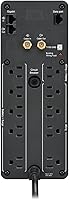
  • Capacity: This unit provides 1000VA and 600W of total power capacity, suitable for running a desktop PC, monitor, and networking gear simultaneously during an outage.
  • Output Waveform: The unit delivers true pure sine wave output, making it safe for modern electronics with active power factor correction power supplies.
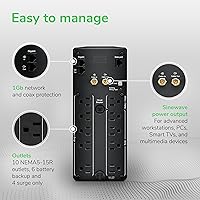
  • Battery Backup Outlets: Six of the ten NEMA 5-15R outlets are backed by the internal battery, providing continued power to critical devices during an outage.
  • Surge-Only Outlets: Four additional NEMA 5-15R outlets offer surge protection only, intended for peripherals that do not require battery runtime.
  • Voltage Regulation: Automatic Voltage Regulation (AVR) corrects under- and over-voltage conditions without switching to battery, helping preserve battery cycle life.
  • Input Voltage: The unit operates on a standard 120V AC input, compatible with North American household and office wall outlets.
  • USB Ports: Two USB charging ports are included — one USB-C and one Type-A — sharing a combined maximum output of 15W.
  • Battery Type: The internal battery is a sealed lead acid (SLA) cell, which is maintenance-free and resealable within the unit's chassis.
  • Replacement Battery: The internal battery is user-replaceable using the genuine APC model APCRBC160, available separately through APC and major retailers.
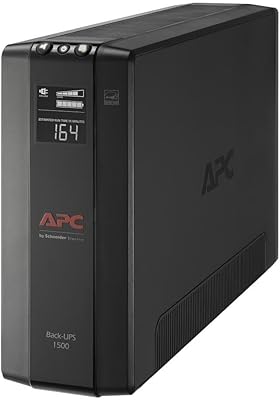
  • LCD Display: The front-mounted LCD panel shows real-time data including load percentage, battery charge level, and input and output voltage readings.
  • Weight: The unit weighs 22.5 pounds, which should be factored into placement decisions, particularly for shelf or elevated surface installations.
  • Enclosure Material: The outer chassis is constructed from metal, contributing to the unit's durability and its considerable weight relative to plastic-bodied alternatives.
  • Color: The unit ships in a black finish that blends into standard home office and IT environments without drawing visual attention.
  • Compatible Software: PowerChute Personal Edition software supports automated shutdown and power event logging on Windows 10 (22H2) and Windows 11 Pro; macOS users rely on native Energy Saver settings instead.
  • Total Outlets: Ten NEMA 5-15R outlets are included in total, split between battery-backed and surge-only groups to support a full workstation setup.
  • Model Number: The official APC model designation for this unit is BR1000MS, which is the identifier to use when sourcing replacement batteries or compatible accessories.
  • User Rating: Based on over 2,200 verified ratings on Amazon, the unit holds a 4.4 out of 5 star average, reflecting broadly positive long-term user satisfaction.
  • Market Rank: The unit holds a Best Seller Rank of number 32 in the Computer Uninterruptible Power Supply category on Amazon as of the most recent available data.

Related Reviews

APC Smart-UPS 1000VA UPS Battery Backup (SMT1000)
87%
88%
Performance
91%
Value for Money
85%
Battery Life
92%
Build Quality
89%
Noise Level
More
APC Back-UPS Pro 1000VA UPS Battery Backup BX1000M
83%
92%
Reliability during Power Outages
88%
Ease of Setup
85%
Build Quality
90%
Surge Protection
80%
Energy Efficiency
More
APC Smart-UPS SMC1500C 1500VA Sinewave UPS Battery Backup

85%
91%
Power Protection Reliability
87%
Ease of Setup & Installation
92%
Remote Monitoring Functionality
85%
Build Quality & Durability
70%
Weight & Portability
More
APC SMT750 750VA Smart-UPS Battery Backup
80%
91%
Power Protection Reliability
88%
Pure Sine Wave Output
89%
Automatic Voltage Regulation
62%
Runtime at Load
87%
Build Quality
More
APC Back-UPS Pro BX1500M 1500VA
79%
83%
Battery Runtime
91%
Voltage Regulation (AVR)
78%
Build Quality & Durability
88%
Ease of Setup
86%
LCD Display & Monitoring
More
APC BE550G 550VA UPS Battery Backup
79%
91%
Reliability
54%
Battery Runtime
88%
Surge Protection
93%
Ease of Setup
67%
Outlet Layout
More
APC BX2200MI Backup Battery UPS
85%
94%
Reliability during Outages
88%
Setup & Installation
91%
Surge Protection Performance
89%
Voltage Regulation (AVR)
85%
Build Quality & Durability
More
APC BE425M UPS 425VA
78%
93%
Reliability & Uptime
74%
Battery Backup Duration
51%
Battery Longevity & Replaceability
96%
Ease of Setup
72%
Outlet Layout & Count
More
GOLDENMATE 1000VA/600W Lithium UPS Battery Backup
86%
91%
Value for Money
94%
Battery Life
88%
Ease of Use
85%
Build Quality
80%
Performance Under Load
More
APC BK500BLK Back-UPS Battery Backup Surge Protector
86%
92%
Value for Money
89%
Setup & Installation
94%
Power Protection Performance
85%
Build Quality & Durability
90%
Energy Efficiency
More

FAQ

It depends heavily on what you have plugged in and how much power those devices draw. At a moderate load — say, a mid-range desktop, a monitor, and a router — you can realistically expect somewhere between 8 and 15 minutes of runtime. If you are running a high-wattage gaming rig or workstation closer to the 600W ceiling, that window shrinks to around 4 to 6 minutes. The LCD panel shows your current load percentage, which is the best tool for estimating your personal runtime.

If your desktop PC uses a modern power supply with active power factor correction — which most do — then yes, sine wave output matters. Simulated sine wave UPS units can cause those power supplies to run hot, behave erratically, or even shut down unexpectedly under load. For NAS drives, audio interfaces, and medical-grade equipment, the difference is even more pronounced. If you are just protecting a router and a basic laptop charger, simulated sine wave is probably fine.

Yes, and this is one of the BR1000MS's genuine long-term advantages. The battery compartment is designed for user access, and the correct replacement is the APC model APCRBC160, which you can order directly from APC or find through most major electronics retailers. No special tools or technical knowledge are required. Most people replace the battery every 3 to 5 years depending on how frequently the unit cycles.

The hardware works fine with any computer — Mac included. The limitation is software. APC's PowerChute app, which handles automated shutdown scheduling and power event logging, is Windows-only. Mac users are directed to use the built-in Energy Saver settings in macOS, which offer basic UPS integration but far less control. It is functional, but noticeably less capable than the Windows experience.

AVR quietly corrects minor voltage sags and surges from the grid without ever touching the battery. This is most valuable in areas where power quality is inconsistent — if your lights occasionally dim or flicker, AVR is handling those fluctuations so your equipment never sees them. Beyond protecting your devices, it also means the battery is not cycling unnecessarily on small voltage dips, which helps it hold capacity longer over the years.

Under normal conditions it is nearly silent — the fan does not run continuously. You will hear a soft hum from the transformer if you are very close to it, but nothing disruptive. The fan spins up noticeably when the unit is working hard, such as during a sustained battery discharge, but even then it is more noticeable than loud. Most users with it under a desk report forgetting it is there.

You can physically plug them in, but it is not recommended. Space heaters and laser printers draw very high wattage — often close to or exceeding the unit's 600W capacity on their own. Doing so would drain the battery almost immediately during an outage and could potentially overload the unit. Stick to the surge-only outlets for high-draw devices you do not need running on battery, or leave them off the unit entirely.

At 22.5 pounds it is genuinely heavy for a home electronics device — more than many people expect when they first order it. Placement does matter. Getting it under a desk solo is awkward, and putting it on a shelf requires confidence that the shelf can handle the sustained weight. The floor beside a desk is the most practical spot for most people. If you are planning to install it in a specific location, measure and check load ratings before it arrives.

For topping off a phone with minimal battery? Sure. But the two ports share a combined 15W output, which means neither one can fast-charge a modern smartphone, let alone a tablet. By today's standards that ceiling is quite low. Think of the USB ports as a convenience feature for low-priority charging, not a reliable fast-charge solution during an emergency.

Both brands produce competitive units in this category, and the choice often comes down to brand preference and software ecosystem. APC has a longer track record and broader replacement parts availability, which matters when you are thinking about a 5-plus year ownership window. CyberPower's equivalent models are generally praised for output consistency too, but a recurring theme among buyers who have owned both is a slight edge to APC in long-term reliability and battery longevity. Neither is a bad choice — APC just has more documented history.

Where to Buy