Overview

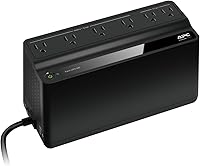
The APC BE425M UPS 425VA is a compact, no-frills battery backup unit built around one practical goal: keeping your home network and small electronics running when the power cuts out. It draws on APC's decades-long reputation in power protection, sitting within the well-regarded Back-UPS line that has been a staple in homes and small offices for years. With a 225W real power output and a sealed lead acid battery, it handles short-duration outages comfortably. A 3-year warranty and a connected-equipment guarantee back the purchase, and the wall-mountable design with a right-angle plug makes placement flexible even in cramped spots.
Features & Benefits

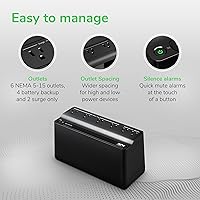
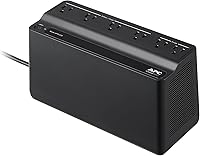
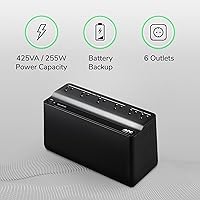
This APC backup unit offers six outlets split into two groups: four provide both battery backup and surge protection, while the remaining two cover surge protection only. That distinction matters — plug your modem and router into the backup outlets and save the other two for a lamp or phone charger. At 225W of real power, it will realistically sustain a modem, router, and a small NAS for somewhere between 20 and 40 minutes. One honest limitation worth noting: there is no automatic voltage regulation, so if your area sees frequent brownouts or voltage swings, this unit may fall short of your needs.

Best For

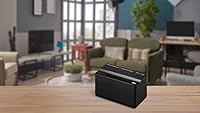
The BE425M punches well above its weight for anyone running a home network setup — specifically people whose biggest concern is keeping the wifi on when the grid hiccups. It also suits small home office users who just need a few extra minutes to save work and shut down cleanly. If you live somewhere with generally stable power and are mostly after surge protection with occasional battery backup, this is a practical, right-sized choice. The compact build and wall-mount option make it especially useful for apartments and rentals where space is at a premium. It is not built for heavy workloads or extended runtimes.

User Feedback

Across thousands of verified reviews, this home UPS earns consistently high marks for quiet, reliable operation — buyers often mention setting it up and forgetting about it for years. The ease of installation and the peace of mind during outages come up repeatedly as genuine highlights. That said, the most common frustration surfaces when the battery eventually degrades: owners discover it cannot be swapped at home and requires a technician, which catches many people off guard. A handful of reviewers also wished for more backup outlets or voltage regulation. The stiff outlet fit gets mentioned occasionally but rarely escalates to a real complaint.

Pros

  • Trusted APC brand with a long track record of reliable power protection in the home market.
  • Setup takes minutes — unbox, plug in, and it works with zero configuration required.
  • Runs completely silently during normal operation, making it ideal for bedrooms and living rooms.
  • Four battery-backed outlets handle a full home network stack without issue.
  • Compact footprint tucks away easily behind furniture or mounts flat on a wall.
  • Three-year warranty plus a substantial connected-equipment guarantee adds real purchase confidence.
  • Right-angle plug design reduces cord clutter in tight or crowded outlet areas.
  • Solid runtime on light loads — a router and modem alone can stay online for 20 to 40 minutes.
  • Years of trouble-free operation are the norm; most owners simply forget it is there.

Cons

  • Battery cannot be replaced at home — a technician is required, which surprises most buyers.
  • No automatic voltage regulation leaves equipment unprotected during brownouts and voltage fluctuations.
  • No USB charging ports, which competing units at a similar price often include.
  • Only six outlets total, which fills up fast in a moderately equipped home office.
  • No display or runtime indicator — you have no way to see remaining battery capacity at a glance.
  • The audible alarm during outages cannot be silenced, which becomes irritating during extended power failures at night.
  • Five-foot power cord can feel short depending on where your router and modem are located.
  • Battery degradation typically begins around the three-to-five year mark, effectively setting a finite product lifespan.

Ratings

The APC BE425M UPS 425VA has been evaluated by our AI rating system after processing thousands of verified global buyer reviews, with spam, bot-generated feedback, and incentivized posts actively filtered out before scoring. The result is a transparent picture of where this home UPS genuinely delivers and where it falls short — no glossing over the frustrations, no inflating the praise.
Reliability & Uptime
93%
Buyers across the board report years of silent, dependable operation with zero intervention needed. It kicks in the moment power drops, with no noticeable lag on connected routers or modems — exactly the kind of behavior people buy a UPS for in the first place.
A small number of users report the unit failing to hold a charge after extended storage before first use. This appears tied to battery conditioning rather than a defect, but it still creates a frustrating out-of-box experience for a handful of buyers.
Battery Backup Duration
74%
26%
For the use case it is designed around — keeping a modem and router alive — runtime is genuinely solid. Many owners report 20 to 40 minutes of backup on a lightly loaded network setup, which is more than enough to ride out a typical brief outage or shut down gracefully.
Push the load even slightly beyond a router and modem — say, adding a NAS or a small monitor — and runtime drops noticeably. Buyers who expected to keep a full workstation running were consistently disappointed, as 225W of real capacity simply was not built for that job.
Battery Longevity & Replaceability
51%
49%
The sealed lead acid battery is reasonably well-suited for the light, intermittent demands of a home network backup role. Under normal conditions, with infrequent deep discharges, users commonly get three to five years of functional life before degradation becomes obvious.
This is the single most repeated frustration in owner reviews: when the battery eventually dies, you cannot replace it yourself. It requires a qualified technician, which surprises and annoys a significant portion of buyers who assumed DIY replacement was standard. The cost and hassle often push people to simply buy a new unit instead.
Ease of Setup
96%
Setup is about as close to plug-and-play as power protection gets. Buyers consistently describe unboxing, plugging in, and having a fully functional backup unit within minutes — no software, no configuration, no manual required for basic operation.
The outlets are noticeably stiff on first use, which is actually mentioned in the product documentation but still catches people off guard. A few users initially worried something was wrong before realizing it was intentional. It resolves with normal use but the first impression is not ideal.
Outlet Layout & Count
72%
28%
The split between four battery-backed outlets and two surge-only outlets is a practical design for network-focused setups. Most home users find that four protected outlets comfortably cover a modem, router, and one or two additional small devices without conflict.
Anyone with a more populated home office or entertainment area will quickly feel the six-outlet limit. The two surge-only outlets are useful but not particularly generous, and there are no USB charging ports — a noticeable omission at this price point compared to competing models.
Surge Protection
78%
22%
The built-in surge protection handles standard residential voltage spikes reliably and is backed by a substantial connected-equipment guarantee. For most home environments, it provides a meaningful layer of protection against common power events like lightning-induced surges.
It would be a stretch to treat this as a replacement for a dedicated, high-joule surge protector strip. The surge protection here is solid for everyday use but is secondary to the battery backup function — buyers who prioritize surge protection above all else have better-optimized options available.
Voltage Regulation (AVR)
38%
62%
For users in areas with stable, consistent grid power, the absence of AVR is essentially a non-issue. The unit handles clean power delivery fine, and the majority of home users in urban or suburban settings with modern infrastructure will never miss it.
The lack of automatic voltage regulation is a genuine hardware gap, not just a spec-sheet footnote. Anyone living in a region with frequent brownouts, voltage sags, or rural grid instability will find this unit inadequate — connected equipment remains exposed to damaging under-voltage events that AVR would otherwise correct.
Build Quality & Form Factor
82%
18%
The physical construction feels solid for its weight class. The compact footprint — roughly 4 by 10 by 5.5 inches — makes it easy to position discreetly behind a desk or entertainment center, and the wall-mount option is a genuine convenience in tight spaces.
The all-plastic housing, while acceptable for the price tier, does not project premium durability. A few buyers noted minor flex in the casing under pressure. It is unlikely to cause functional issues, but it does reinforce the impression that this is a budget-friendly unit rather than a hardened one.
Noise Level
91%
Under normal conditions, this APC backup unit runs completely silently. There is no fan, no buzz, and no audible hum during standby — a real quality-of-life win for bedroom or living room deployments where ambient noise matters.
When the battery activates during an outage, the unit emits a periodic beeping alarm. Most users accept this as standard UPS behavior, but a handful found it annoying during extended outages, particularly at night, and noted there is no way to silence it without disconnecting the unit.
Value for Money
86%
At its price point, the combination of a trusted brand, solid reliability record, three-year warranty, and connected-equipment coverage represents strong overall value. For buyers who simply want their router and modem to stay on during brief outages, the cost-to-utility ratio is difficult to argue with.
The value calculation shifts if you factor in the battery replacement situation. Since self-servicing is not an option, the effective lifespan cost is higher than it appears upfront. Buyers who expected to swap the battery and extend the product's life for a few dollars found themselves buying an entirely new unit instead.
Warranty & Support
84%
A three-year manufacturer warranty on a product in this category is genuinely above average. The connected-equipment guarantee adds a layer of financial reassurance that competing budget units rarely offer, and APC's customer service reputation within the power protection space is generally positive.
Some users reported friction when attempting to make claims or get support, describing slow response times or unclear guidance on the service-replacement battery process. The warranty terms are solid on paper but the actual support experience is inconsistent based on buyer reports.
Compatibility with Home Network Gear
94%
Modern modems, routers, mesh network nodes, and cable boxes all fall well within the power envelope this unit handles. Buyers routinely report keeping their entire home network stack — modem, router, and a small switch — running simultaneously without any issues during outages.
Pairing this unit with anything that draws more than roughly 200W of sustained load is asking for trouble. Buyers who tried connecting a desktop PC, a mid-range NAS with multiple drives, or even a laser printer encountered performance issues or shortened runtime to nearly nothing.
Indicator Lights & Feedback
63%
37%
The status indicator does its basic job — owners can quickly tell whether the unit is on battery, charging, or operating normally at a glance. For the minimalist use case it is designed for, this level of feedback is usually sufficient.
There is no LCD display, no runtime estimation, and no load percentage readout. Buyers upgrading from or comparing against mid-range UPS units with detailed displays will find the information feedback here quite sparse. You essentially have to guess how loaded the unit is or how much runtime remains.
Physical Footprint & Installation
89%
The right-angle wall plug is a thoughtful detail that makes a real difference in cramped outlet areas — it eliminates the awkward cord-sticking-straight-out problem that plagues many competing units. Wall-mounting works cleanly and the unit stays out of the way once positioned.
The five-foot power cord, while adequate for most placements, can feel limiting if your router is positioned some distance from the nearest outlet. A handful of buyers needed an extension setup, which partially undermines the clean, compact installation the design otherwise enables.

Suitable for:

The APC BE425M UPS 425VA is an excellent fit for anyone whose primary concern is keeping their home network alive during a power outage — specifically people who rely on a modem, router, or mesh system for remote work, streaming, or smart home devices. If you live in an area with generally stable grid power but experience occasional brief outages, this unit covers that exact gap without overcomplicating things. Small home office workers who need a few minutes of runtime to save files and shut down cleanly will find it more than adequate for that purpose. The compact, wall-mountable form factor also makes it a practical choice for apartment dwellers and renters where space near the outlet is limited. Budget-conscious buyers who want a reputable, well-supported brand without paying for features like AVR or an LCD display will feel the value here immediately.
Not suitable for:

The APC BE425M UPS 425VA is the wrong tool if you need to keep a full desktop workstation, a gaming PC, or any power-hungry equipment running through an outage — 225W of real output is not built for that load, and buyers who try will be disappointed by the runtime. Anyone living in a region with frequent brownouts, voltage sags, or rural grid instability should also look elsewhere, since the absence of automatic voltage regulation leaves connected equipment exposed to those conditions entirely. If you are planning to extend the product's useful life by swapping the battery yourself every few years, you will run into a hard wall: the battery requires a qualified technician to replace, and many owners find it more practical to just buy a new unit when the time comes. Power users who want runtime estimation, load percentage readouts, or USB charging ports will find the feedback and feature set here quite thin compared to mid-range alternatives at a modest price premium.

Specifications

  • Model Number: This unit carries the official model designation BE425M, part of APC's Back-UPS product line.
  • Capacity: The unit provides 425VA of apparent power and 225W of real power output for connected devices.
  • Battery Type: An internal sealed lead acid (SLA) battery provides backup power during outages.
  • Outlets: Six total NEMA 5-15R outlets are included: four with full battery backup and surge protection, two with surge protection only.
  • Dimensions: The unit measures 4.13″ deep, 9.98″ wide, and 5.52″ tall.
  • Weight: The unit weighs 5.72 pounds, making it manageable for wall mounting or repositioning as needed.
  • Input Voltage: Designed for standard North American 120V AC power supply.
  • Power Cord: A 5-foot power cord with a right-angle 3-prong NEMA 5-15P plug is included.
  • Wall Mountable: The unit supports wall mounting, which is useful for tight spaces behind desks or entertainment centers.
  • AVR: Automatic voltage regulation is not included, so the unit does not correct brownouts or voltage sags.
  • Display: No LCD screen is present; status is communicated via indicator lights only.
  • USB Ports: No USB charging ports are available on this unit.
  • Battery Access: The battery is sealed and not user-replaceable; service must be performed by a qualified technician.
  • Warranty: APC provides a 3-year limited warranty covering defects in materials and workmanship.
  • Equipment Protection: A connected-equipment guarantee of up to $75,000 covers damage to devices caused by power events while properly connected.
  • Noise Level: The unit operates silently during normal standby; an audible alarm activates when running on battery power.
  • Best Sellers Rank: Ranked #7 in the Computer Uninterruptible Power Supply Units category on Amazon at time of evaluation.
  • First Available: This model was first made available for purchase in August 2016 and has not been discontinued.

Related Reviews
APC Smart-UPS 750VA UPS Battery Backup
85%
91%
Value for Money
93%
Power Protection Performance
89%
Ease of Setup
85%
Battery Life
87%
Build Quality
More
APC Smart-UPS SRT 3000VA Rack-Mount UPS
86%
94%
Power Backup Performance
92%
Reliability
88%
Ease of Use
90%
Energy Efficiency
89%
LCD Display Interface
More
APC Smart-UPS 500VA Lithium Ion UPS SCL500RM1UC
85%
88%
Performance
91%
Build Quality
85%
Usability
76%
Battery Life
94%
Remote Monitoring Features
More
APC Smart-UPS 1000VA UPS Battery Backup (SMT1000)
87%
88%
Performance
91%
Value for Money
85%
Battery Life
92%
Build Quality
89%
Noise Level
More
APC Smart-UPS SMC1500C 1500VA Sinewave UPS Battery Backup
85%
91%
Power Protection Reliability
87%
Ease of Setup & Installation
92%
Remote Monitoring Functionality
85%
Build Quality & Durability
70%
Weight & Portability
More
APC Back-UPS Pro 1000VA UPS Battery Backup BX1000M
83%
92%
Reliability during Power Outages
88%
Ease of Setup
85%
Build Quality
90%
Surge Protection
80%
Energy Efficiency
More
APC Back-UPS Pro BX1500M 1500VA
79%
83%
Battery Runtime
91%
Voltage Regulation (AVR)
78%
Build Quality & Durability
88%
Ease of Setup
86%
LCD Display & Monitoring
More
APC Smart-UPS Sine Wave 1500VA Rackmount UPS with Extended Run Option
84%
90%
Performance
88%
Build Quality & Durability
85%
Ease of Installation
86%
Battery Runtime
82%
Value for Money
More
APC Back-UPS 1200VA BVK1200M2
85%
94%
Performance during Power Outages
88%
Ease of Setup
90%
USB Charging Ports
85%
Build Quality
80%
Battery Runtime at Load
More
APC Smart-UPS SRT2200RMXLA 2200VA
85%
93%
Performance during Power Outages
89%
Battery Life
84%
Ease of Setup and Installation
88%
Flexibility of Rack/Tower Configuration
91%
Reliability and Consistency
More

FAQ

Under a typical light load — a modem and a standard home router — most users report somewhere between 20 and 40 minutes of runtime. That is usually more than enough to ride out a brief outage or at least finish saving your work before shutting down. If you add more devices, expect that window to shrink proportionally.

Unfortunately, no. The battery in the BE425M is sealed inside the unit and is designated as service-replaceable, meaning a qualified technician needs to handle it. This catches a lot of buyers off guard, so it is worth knowing upfront. When the battery degrades — typically after three to five years — many owners find it simpler to buy a replacement unit rather than arrange a service call.

Not for any meaningful length of time. With a real power output of 225W, this home UPS is designed for light loads like network gear and small electronics — not a full desktop PC, which can easily draw 300W or more under load. If PC backup is your primary goal, you should look at a higher-capacity unit.

This is one area where the unit has a genuine limitation: it does not include automatic voltage regulation (AVR). That means it will not correct undervoltage conditions or brownouts — it only switches to battery during a complete power loss. If your area experiences frequent voltage instability, a UPS with built-in AVR would serve you better.

Nothing is wrong. APC actually notes this in the product documentation — the outlets are designed with a tighter fit initially, and modest force is needed to seat plugs fully. It resolves naturally with normal use, and the firmness is intentional rather than a defect. Just push plugs in with a bit more pressure than you might expect.

Yes, the unit is wall-mountable, which is one of its more practical design features. It works well tucked behind a router shelf or mounted near an outlet in a media cabinet. Just make sure you orient it correctly per APC's mounting guidelines so the battery sits in the right position during operation.

Not directly, unfortunately. There is no LCD display and no runtime indicator on this unit. You get basic status LEDs that tell you whether the unit is on battery, charging, or operating normally — but no percentage readout or estimated runtime remaining. If that level of feedback matters to you, a mid-range UPS with a display would be a better fit.

Prioritize your most critical gear for the four battery-backed outlets — that means your modem, router, and anything else you absolutely need to stay on during an outage. The two surge-only outlets are fine for devices that just need spike protection, like a lamp, phone charger, or printer, where continuous power during an outage is not essential.

Yes, it works very well in that context. Mesh network nodes, smart home hubs, and streaming devices all fall comfortably within the power budget, and keeping them powered through a brief outage means your smart home devices and automations stay functional. It is actually one of the better use cases for this unit.

During normal operation it is completely silent — no fan, no hum, nothing. When it switches to battery, it starts beeping periodically to alert you that you are running on backup power. That alarm cannot be disabled while the unit is active, which some people find irritating during nighttime outages, but it is standard behavior for UPS units in this class.