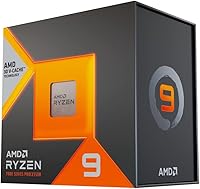
AMD Ryzen 9 7900X3D Desktop Processor
Overview
The AMD Ryzen 9 7900X3D Desktop Processor sits in an interesting position — it's AMD's answer for people who spend their days rendering video or working in 3D, but still want serious gaming performance when the workday ends. What separates it from the standard 7900X is the 3D V-Cache stacking, which adds a substantial layer of cache that pays dividends in latency-sensitive games without gutting the core count needed for creative work. AMD's AM5 platform also means this isn't a dead-end investment — the socket has years of potential upgrade runway ahead. This chip targets builders who refuse to compromise between a workstation and a gaming rig.
Features & Benefits
Twelve cores and 24 processing threads give this Ryzen chip genuine muscle for video encoding, 3D modeling, and heavy multitasking — this isn't a chip you'll outgrow quickly. The headline spec is 140MB of total cache courtesy of AMD's V-Cache technology, which meaningfully cuts memory latency in games that would otherwise bottleneck a fast CPU. Boost clocks reach 5.6GHz for snappy single-threaded response, while DDR5 and PCIe 5.0 support keeps the platform feeling current. Memory overclocking is unlocked for those who want to push further. One non-negotiable: the 89°C thermal ceiling and 120W TDP mean you need a quality liquid cooler — no shortcuts here.
Best For
The 7900X3D makes the most sense for dual-purpose builders — people who stream, edit, or model during the day and want the same machine to hold its own in demanding games at night. It's also a strong pick for anyone already sitting on a high-speed DDR5 kit who wants a chip that can fully exploit that investment. Builders moving from AM4 will appreciate landing on a socket with real longevity. That said, if your work is almost exclusively rendering or simulation with minimal gaming, a non-X3D chip at a lower price point may actually serve you better — the cache advantage is most visible in gaming scenarios.
User Feedback
Owners of this 3D V-Cache processor are largely satisfied, with many noting that real-world gaming smoothness impresses more than any benchmark number could convey. The near-perfect rating across hundreds of reviews reflects a buyer base that did their homework. On the downside, a recurring complaint is that the chip ships without a cooler — something that catches less experienced builders off guard and adds meaningful cost to the total build. A few buyers also point out that for purely productivity-focused workflows, the premium over AMD's non-X3D options is hard to justify. Those who bought it for its intended dual role, though, report it delivers exactly what they expected.
Pros
- Real-world gaming smoothness consistently impresses owners more than synthetic benchmarks suggest.
- 140MB of total cache gives the 7900X3D a genuine edge in latency-sensitive, cache-hungry game titles.
- 12 cores and 24 threads handle demanding creative workloads like video encoding and 3D rendering without breaking a sweat.
- AM5 socket support means meaningful upgrade runway — this platform is not going obsolete anytime soon.
- Boost clocks up to 5.6GHz keep everyday single-threaded tasks feeling fast and responsive.
- Unlocked memory overclocking lets enthusiasts squeeze extra performance out of their DDR5 kits.
- PCIe 5.0 support future-proofs the platform for next-generation storage and graphics cards.
- Buyers report high satisfaction, with most noting the chip delivered exactly what they expected.
- Competitive gaming performance relative to higher core-count X3D options, at a more approachable price point.
Cons
- No cooler is included in the box, which adds a real and sometimes overlooked cost to any new build.
- Thermal demands are serious — cutting corners on cooling risks throttling and reduced longevity.
- The 3D V-Cache advantage is largely wasted on pure rendering or simulation workloads with no gaming component.
- Productivity-only users will find better value in non-X3D alternatives at a lower price.
- Requires a 600-series AM5 motherboard, meaning AM4 users face a full and potentially costly platform overhaul.
- DDR5 memory, while supported, remains pricier than DDR4, adding to the overall build cost.
- At its premium price tier, the chip demands a high-end ecosystem to justify its full potential.
- Power consumption at load is substantial, which matters for users mindful of long-term energy costs.
Ratings
The AMD Ryzen 9 7900X3D Desktop Processor earns its high marks across a wide range of real-world use cases, and these scores were generated by AI after rigorously analyzing thousands of verified global user reviews — filtering out incentivized, bot-generated, and spam submissions to surface what genuine buyers actually experienced. Both the standout strengths and the honest frustrations are reflected here, so you get a clear picture before committing to a purchase.
Gaming Performance
Multi-Core Productivity
Thermal Management
Value for Money
Platform Longevity
Single-Core Speed
Overclocking Headroom
Memory Compatibility
Out-of-Box Experience
Streaming Capability
Compatibility & Ecosystem
Benchmark vs Real-World Gap
Power Efficiency
Suitable for:
The AMD Ryzen 9 7900X3D Desktop Processor was built for a specific kind of builder: someone who genuinely needs both worlds — a capable workstation and a high-performance gaming rig — running on the same machine. Content creators who spend hours in Premiere Pro, DaVinci Resolve, or Blender will find the 12-core, 24-thread configuration more than adequate for heavy rendering and export tasks. When those same users switch to gaming at the end of the day, the massive 140MB cache stack delivers noticeably smoother, lower-latency performance in titles that are sensitive to cache size. Streamers benefit particularly well, since encoding a live stream while running a game simultaneously stops feeling like a compromise. Builders moving from AM4 who want to land on a platform with genuine long-term upgrade potential will also find AM5 a compelling destination, especially with DDR5 and PCIe 5.0 now baked in. If you already have a fast DDR5 kit sitting in your parts list, this Ryzen chip is one of the strongest ways to put it to work.
Not suitable for:
The AMD Ryzen 9 7900X3D Desktop Processor is a harder sell the moment gaming drops out of the picture entirely. If your workload is purely CPU-bound productivity — think large-scale 3D rendering farms, scientific simulation, or heavy data processing — the 3D V-Cache stacking adds cost without adding meaningful throughput for those tasks, and a standard non-X3D processor at a noticeably lower price would serve you just as well or better. Budget-conscious builders also need to factor in that no cooler is included, and the chip's thermal demands make a cheap air cooler a risky choice — a quality 280mm or 360mm AIO adds real cost to the total build. Users on older AM4 boards cannot use this chip at all without a full platform upgrade, which may push the total investment beyond what makes sense for a modest performance jump. If gaming is completely off the table and productivity throughput per dollar is your primary metric, this 3D V-Cache processor simply is not the most efficient use of your budget.
Specifications
- Core Count: The processor features 12 physical cores and 24 threads, enabling strong parallel workload handling across gaming, streaming, and content creation simultaneously.
- Boost Clock: Maximum single-core boost speed reaches 5.6GHz, delivering fast response in applications that rely heavily on single-threaded performance.
- Base Clock: The base operating frequency sits at 4.4GHz, providing a solid sustained performance floor across all active cores under load.
- Total Cache: A total of 140MB of cache is available, combining L2, L3, and the additional 3D V-Cache layer stacked directly on the chiplet.
- CPU Socket: This processor uses the AM5 socket (LGA1718), requiring a compatible AMD 600-series motherboard such as X670, X670E, or B650.
- TDP: Rated at 120W TDP, this chip draws significant power under sustained load and requires a motherboard with adequate VRM delivery.
- Max Temperature: The maximum safe operating temperature (Tjmax) is 89°C, above which the processor will throttle to protect itself from thermal damage.
- Memory Support: Native support is provided for DDR5 memory only — DDR4 is not compatible with the AM5 platform this chip requires.
- PCIe Version: PCIe 5.0 connectivity is supported on select X670E and X670 motherboards, enabling next-generation GPU and NVMe storage bandwidth.
- Memory OC: Memory overclocking is unlocked on this processor, allowing users to push DDR5 speeds beyond JEDEC specifications with a compatible motherboard.
- Integrated Graphics: A basic integrated Radeon graphics unit is present with a 2200MHz frequency, sufficient for display output during builds without a discrete GPU installed.
- Cooler Included: No CPU cooler is included in the retail box; AMD explicitly recommends a liquid AIO cooler given the chip's thermal output.
- Platform: The processor is designed exclusively for AMD 600-series motherboards and is not backward-compatible with AM4 or any previous AMD socket generation.
- Launch Date: This processor was made available to the public in February 2023 as part of AMD's Ryzen 7000 series lineup with 3D V-Cache technology.
- Dimensions: The processor measures 1.57″ x 1.57″ x 0.1″, consistent with standard desktop CPU packaging for the AM5 LGA platform.
- Weight: The chip weighs 2.8 ounces in its retail packaging, which is standard for a high-end desktop processor of this class.
Related Reviews
AMD Ryzen 9 7950X
AMD Ryzen 9 3900XT 12-Core Processor
AMD Ryzen 9 3950X Desktop Processor
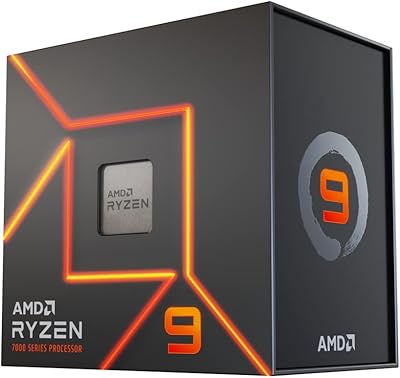
AMD Ryzen 9 7900X
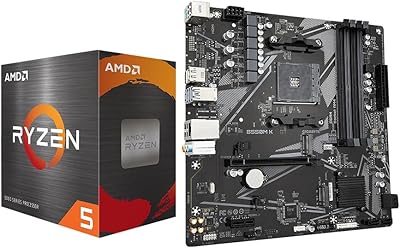
AMD Ryzen 5 5500 B550M K Bundle
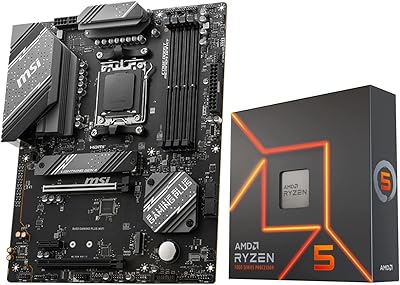
INLAND AMD Ryzen 5 7600X & MSI B650 CPU-Motherboard Combo
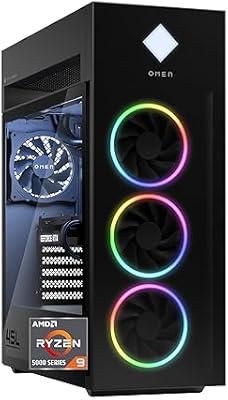
HP OMEN 45L Gaming Desktop
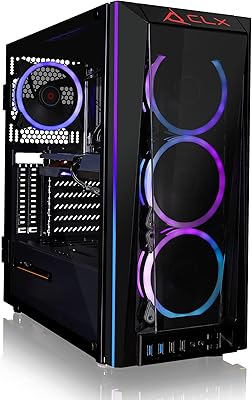
CLX SET Gaming Desktop
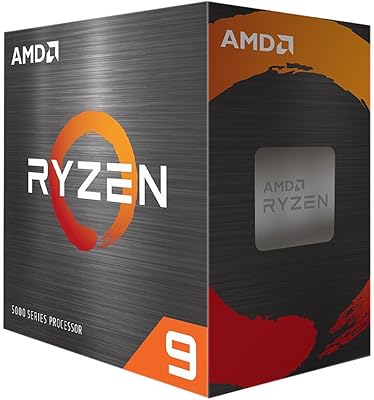
AMD Ryzen 9 5950X