Overview

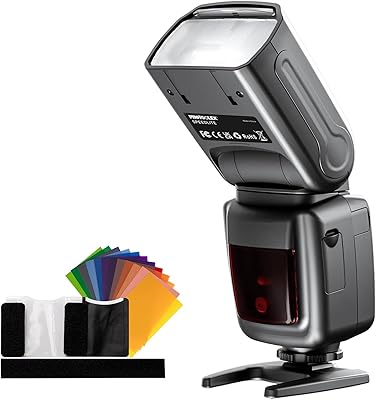
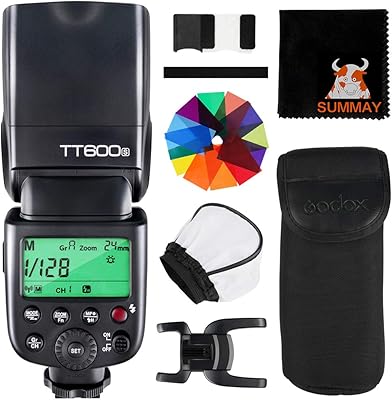
The AMBITFUL AF970 Camera Flash Speedlite is a manual speedlite aimed squarely at hobbyist and enthusiast photographers who want reliable off-camera lighting without spending a fortune. It works across a surprisingly wide range of camera brands — Canon, Nikon, Sony, Fuji, Olympus, and Panasonic — which makes it flexible enough to follow you if you ever switch systems. The built-in 2.4G wireless receiver is a genuine highlight at this price point, since most competing units require a separate receiver to go wireless. The box also includes a diffuser, mini stand, storage bag, and 12 gel filters. One thing to be clear about upfront: this is a manual-only flash. There is no TTL. If you want automatic metering, look elsewhere.
Features & Benefits

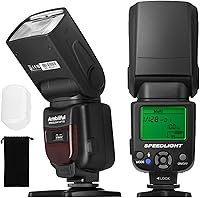
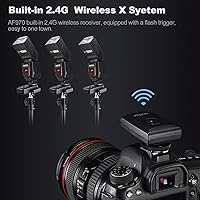
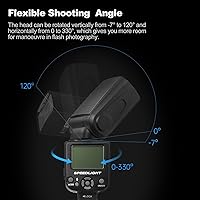
The built-in wireless receiver means you can pull the AF970 off your hot shoe and start shooting off-camera light right out of the box — no dongles, no adapters needed. Power control spans eight steps from full output down to 1/128, giving you genuine precision over exposure rather than rough guessing. Recycle time sits between 0.1 and 2.5 seconds depending on power level, which is fast enough for portrait sessions without frustrating pauses. The flash head rotates 270 degrees horizontally and tilts from -7 to 90 degrees vertically, so bouncing light off ceilings or walls is easy to arrange. The strobe multi-flash mode goes up to 199Hz, opening the door to motion-freeze experiments. Color temperature holds at 5600K, which keeps skin tones looking natural under daylight.

Best For

This manual flash punches above its weight for a specific crowd. If you are just getting into off-camera flash and do not want to spend big on a brand-name unit, the AF970 offers a practical starting point. Strobist-style multi-light setups are a natural fit — pair two or three of these with a 2.4G commander and you have a wireless studio on a tight budget. At 390 grams, it is light enough to toss in a bag for event work. Portrait photographers who shoot with manual power dialed in will feel right at home. The strobe mode also makes it appealing for anyone wanting to experiment with high-speed motion photography without committing to expensive gear. It is not the right call, though, for fast-moving subjects where TTL automation would be a real advantage.

User Feedback

Sitting at 4.4 stars across around 100 verified ratings, this speedlite earns broadly positive marks. Buyers consistently praise the reliable wireless performance and the brightness they get relative to what they paid — build quality also draws favorable mentions, with many noting it feels sturdier than the price suggests. Where opinions diverge is the learning curve: photographers who expected automatic exposure control quickly discovered this flash demands hands-on manual dialing. A handful of reviewers noted that battery draw feels high at full power, though switching to quality alkaline or rechargeable AAs largely addresses that. The included gel filters were a welcome bonus, with several buyers reporting they genuinely used them for color work. Against similarly priced rivals, the built-in wireless receiver consistently tips the scales in its favor.

Pros

  • Built-in 2.4G wireless receiver lets you shoot off-camera flash without buying extra accessories.
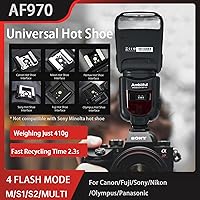
  • Compatible with Canon, Nikon, Sony, Fuji, Olympus, and Panasonic bodies via a single-contact hot shoe.
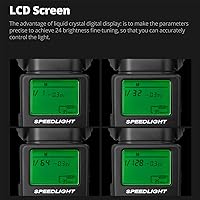
  • Eight manual power steps from full output to 1/128 give precise, repeatable lighting control.
  • Recycle time as fast as 0.1 seconds at low power keeps up with active portrait sessions.
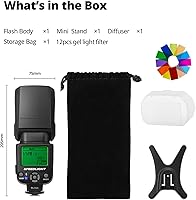
  • The AF970 ships with 12 gel filters, a diffuser, mini stand, and storage bag — an unusually complete kit.
  • 270-degree horizontal rotation and wide vertical tilt range make bounce flash practical in almost any room.
  • Strobe multi-flash mode up to 199Hz opens creative possibilities rarely available at this price point.
  • 5600K color temperature produces natural-looking skin tones without heavy white balance corrections in post.
  • At 390 grams, it is light enough for all-day event work without straining your wrist or camera mount.
  • Overall build quality consistently exceeds what buyers expect based on the price alone.

Cons

  • No TTL metering of any kind — every shot requires manual power adjustment, which has a real learning curve.
  • Battery drain at full power is high; plan to carry spare AA sets for any shoot longer than a couple of hours.
  • Batteries are not included, which is an immediate out-of-pocket addition on day one.
  • Wireless reliability can drop at longer distances or outdoors in bright, high-interference conditions.
  • The LCD panel is difficult to read in strong sunlight, making on-location adjustments unnecessarily awkward.
  • Color output shifts slightly at the lowest power settings, which can affect critical color-accurate work.
  • The included mini stand tips easily on uneven surfaces and does not accept standard light stand adapters.
  • Control menus are not intuitive for first-time flash users and the included documentation offers little help.
  • Long-term durability under professional-frequency use is uncertain given the all-plastic body construction.
  • High-frequency strobe output becomes inconsistent near the top of the stated 199Hz range.

Ratings

The AMBITFUL AF970 Camera Flash Speedlite has been evaluated by our AI system after analyzing verified buyer reviews from multiple global markets, with spam, bot-generated, and incentivized feedback actively filtered out. Scores reflect the honest consensus of real photographers — from first-time flash users to experienced strobists — and are weighted to surface both what genuinely impresses and what frustrates in day-to-day shooting. Nothing here is softened to protect the brand; strong points and recurring pain points are represented with equal weight.
Value for Money
91%
At this price tier, getting a built-in wireless receiver, a full set of gel filters, a diffuser, and a storage bag in a single purchase is unusual. Buyers consistently report feeling like they got more than they paid for, especially when comparing spec-for-spec against similarly priced options from competing brands.
A small group of reviewers feel the savings come with trade-offs in long-term reliability, noting that the AF970 may not hold up as well as pricier units over years of heavy professional use. For casual hobbyists it still stacks up well, but working photographers may eventually outgrow it.
Wireless Performance
84%
The built-in 2.4G receiver is the single feature buyers mention most favorably. In controlled indoor settings — home studios, small event rooms, portrait sessions — triggering is described as consistent and lag-free, with no need to purchase a separate receiver unit.
Outdoor wireless range in direct sunlight or at longer distances draws some criticism, with a handful of users noting occasional misfires beyond roughly 10 meters in bright conditions. The system works well within typical indoor ranges but should not be pushed to its limits in high-interference environments.
Manual Power Control
88%
Eight discrete power steps from full output down to 1/128 give photographers precise control over exposure without guesswork. Strobist users and manual shooters particularly appreciate how predictably the output tracks across steps, making repeatable lighting setups straightforward during portrait and product sessions.
There is no TTL mode whatsoever, which is a hard stop for beginners who expect the flash to meter automatically. Photographers transitioning from camera-mounted bounce flash often need time to adapt, and a few reviewers admit they underestimated how much trial-and-error manual power dialing actually requires.
Recycle Time
82%
18%
At lower power settings, the AF970 recycles quickly enough to keep pace with moderately fast portrait sessions without forcing awkward pauses between frames. For candid event work and single-subject portraits, the 0.1 to 2.5 second range feels practical rather than limiting.
At full power, the upper end of that recycle window becomes noticeable, particularly in continuous shooting scenarios. Battery condition matters a lot here — worn or low-quality AA cells push recycle times toward the slower end and some reviewers found this mildly frustrating during longer shoots.
Build Quality
74%
26%
For an entry-level unit, the AF970 feels reasonably solid in hand. The flash head rotates and tilts with a satisfying resistance rather than feeling loose, and the LCD panel is legible in most lighting conditions. Buyers who handled pricier flashes are usually pleasantly surprised by how the body presents.
Plastic construction is apparent on close inspection, and a small number of reviewers reported cosmetic wear — scuffing on corners, slight play in the hot shoe connection — after several months of regular use. It does not feel fragile, but it also does not feel built to absorb the knocks of daily professional work.
Flash Head Adjustability
86%
The 270-degree horizontal rotation and near-full vertical tilt range make bounce flash easy to arrange in almost any room configuration. Portrait photographers find the flexibility particularly useful when switching between horizontal and vertical compositions without repositioning light stands.
The tilt mechanism lacks the micro-adjustment stops that more premium speedlites offer, so locking the head at very precise intermediate angles can be slightly fiddly. It is not a dealbreaker, but shooters accustomed to finer detents will notice the difference.
Strobe & Multi-Flash Mode
78%
22%
The strobe mode running up to 199Hz gives hobbyists and creative photographers a genuine playground for motion-freeze imagery and light painting. At frequencies that would cost significantly more on a branded unit, the AF970 delivers a functional and entertaining capability that many buyers did not expect at this price.
Outputs at very high strobe frequencies can be inconsistent, and battery drain during prolonged strobe use is accelerated noticeably. A few experimenters noted that the feature works reliably up to moderate frequencies but becomes less predictable at the upper range of its stated spec.
Cross-Brand Compatibility
87%
The single-contact hot shoe design works reliably across Canon, Nikon, Sony, Fuji, Olympus, and Panasonic bodies without adapters or firmware fiddling. Photographers who own cameras from multiple manufacturers appreciate having one flash that mounts and fires correctly on all of them.
Because this is a manual-only unit, advanced proprietary communication protocols like Canon E-TTL or Nikon i-TTL are entirely out of reach. Compatibility is broad but shallow — it fires on almost anything, but advanced automation features specific to any camera brand are simply not available.
Color Consistency
79%
21%
The 5600K color temperature output sits comfortably in daylight-balanced territory, meaning skin tones in portrait work look natural without heavy white balance correction in post. Several reviewers specifically mentioned that color accuracy was better than they anticipated for a flash in this price bracket.
Color temperature can shift slightly at the lowest power settings, which is a known characteristic of Fresnel-based speedlites at minimum output. In critical color work — beauty photography or product shots for print — the variance at 1/128 power is noticeable enough to require careful post-processing.
LCD Panel & Controls
73%
27%
The LCD panel displays current settings clearly in reasonably well-lit environments, and button layout is logical enough that most users can navigate modes and power levels without constantly consulting the manual after the first session or two.
Outdoor readability in bright sunlight is limited — the display lacks backlight intensity to compete with strong ambient light. Several reviewers also noted that the button labels are small and the menu hierarchy is not immediately intuitive for first-time flash users coming from fully automatic camera modes.
Battery Efficiency
63%
37%
The automatic power-saving shutdown is a practical addition that helps preserve battery life during interrupted sessions, and the AF970 does manage respectable flash counts at mid-range power settings with quality alkaline cells installed.
Battery consumption at full or near-full power draws consistent criticism. Reviewers shooting event coverage report burning through AA sets faster than expected, and the fact that batteries are not included means buyers need to budget for them from day one. Rechargeable NiMH cells help, but the unit still runs hungry under heavy use.
Accessories & Bundle
89%
Twelve gel filters, a diffuser, a mini stand, and a storage bag arriving in the box without any upcharge is genuinely appreciated. Several buyers mentioned using the gels immediately for color-graded portrait work and found the diffuser softened light output usably for close-range subject photography.
The mini stand is functional but basic — it tips easily on uneven surfaces and does not accept standard light stand adapters without a separate converter. The storage bag is thin neoprene rather than padded hard-case material, offering minimal real-world protection for travel.
Weight & Portability
85%
At 390 grams, the AF970 adds minimal burden to a camera bag or on-camera hot shoe. Event photographers and travel shooters specifically mention appreciating the balance it strikes between a substantial feel and carry-friendly weight during full-day sessions.
The physical dimensions are slightly longer than compact travel flashes from competing brands, which can make it feel just a touch unwieldy when mounted on smaller mirrorless bodies. It is not heavy, but the proportions can look and feel a little awkward on compact camera systems.
Ease of Setup
68%
32%
Mounting, powering on, and firing the AF970 in basic on-camera mode takes only seconds. Buyers who have previous flash experience report the wireless setup as straightforward — channel matching and group assignment are handled quickly through the LCD menu.
True beginners with no prior manual flash experience report a steeper learning curve than expected. Without TTL to fall back on, new users must invest time learning the relationship between guide number, distance, and aperture before getting reliably exposed results, and the included documentation is minimal.

Suitable for:

The AMBITFUL AF970 Camera Flash Speedlite is a strong fit for photographers who already understand manual exposure and want to expand into off-camera lighting without committing to a large budget. Hobbyists building their first strobist setup will appreciate that the built-in 2.4G receiver means they can go wireless from day one — no extra hardware required. Portrait photographers who shoot tethered or in controlled home studio environments will find the eight power steps and flexible flash head give them plenty of creative room. The broad compatibility across Canon, Nikon, Sony, Fuji, Olympus, and Panasonic also makes it a practical choice for photographers who own or plan to own cameras from multiple brands. Lightweight event shooters who need a capable flash that does not weigh down a bag will also find the 390-gram body easy to live with across long shooting days.
Not suitable for:

The AMBITFUL AF970 Camera Flash Speedlite is not the right purchase for anyone expecting TTL automatic metering — there is none, full stop, and beginners who rely on their camera to handle exposure automatically will find this flash frustrating rather than freeing. Wedding and news photographers who need a reliable, fast-reacting flash in unpredictable conditions may find the manual-only workflow too slow to adapt on the fly. Shooters who require consistent output at the absolute lowest power settings for precision work — macro photography, high-key beauty shots — should be aware that color and intensity can drift slightly at 1/128 output. Professionals who depend on their equipment under sustained heavy use may eventually find the plastic construction falls short of the durability standards set by higher-end speedlites. Finally, anyone hoping to use advanced proprietary features like Canon E-TTL II, Nikon i-TTL, or Sony ADI metering will simply not find that functionality here.
Specifications

  • Guide Number: Rated at GN35 measured at 35mm focal length and ISO 100, providing sufficient power for indoor portraits and small-to-medium shooting environments.
  • Flash Modes: Supports four operating modes: Manual (M), Slave optical S1, Slave optical S2, and Strobe multi-flash mode for creative and studio applications.
  • Power Control: Manual output is adjustable across 8 discrete steps: 1/1, 1/2, 1/4, 1/8, 1/16, 1/32, 1/64, and 1/128 of full power.
  • Recycle Time: Flash recycle time ranges from 0.1 seconds at minimum power to approximately 2.5 seconds at full output, depending on battery condition.
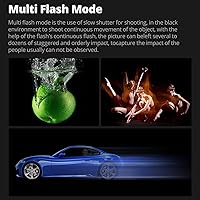
  • Strobe Frequency: Multi-flash strobe mode operates across a frequency range of 1 to 199Hz, enabling motion-freeze and creative stroboscopic exposures.
  • Color Temperature: Flash output is calibrated to 5600K ±100K, consistent with daylight-balanced illumination suitable for natural-looking portrait and product photography.
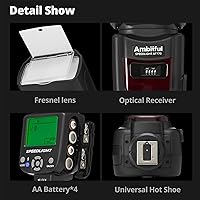
  • Wireless Protocol: Features a built-in 2.4G wireless receiver, enabling remote triggering without any additional receiver hardware when paired with a compatible 2.4G commander.
  • Hot Shoe Type: Mounts via a single-contact hot shoe, ensuring broad compatibility with Canon, Nikon, Sony, Fuji, Olympus, Panasonic, and Pentax camera bodies.
  • Head Rotation: The flash head rotates 0 to 270 degrees horizontally, allowing flexible bounce and off-axis light direction across a wide range of shooting orientations.
  • Head Tilt: Vertical tilt range spans -7 degrees downward to 90 degrees upward, supporting direct, bounce, and angled lighting setups.
  • Flash Lifespan: Rated for approximately 100 to 1,500 flashes per set of batteries, with the range dependent on the selected output power level.
  • Power Source: Powered by four AA alkaline batteries, which are not included in the package and must be purchased separately before first use.
  • Weight: The flash unit weighs 390 grams (0.86 lb), keeping it practical for extended on-camera or travel use without significant added load.
  • Dimensions: Body measures 6 × 20.5 × 7.5 cm (2.36 × 8.07 × 2.95 inches), fitting a standard full-size speedlite form factor.
  • Lens Design: Uses a Fresnel lens construction to concentrate and focus the flash output, improving light efficiency compared to bare-bulb diffused designs.
  • Power Saving: Includes an automatic power-saving shutdown function that cuts power after a period of inactivity to extend battery life during interrupted sessions.
  • Included Accessories: Package contains the flash unit, a mini stand, a diffuser, a storage bag, and 12 gel color filters for creative lighting applications.
  • Package Dimensions: Retail packaging measures 9.06 × 4.02 × 3.23 inches with a total packaged weight of 1.12 pounds including all included accessories.
  • Availability Date: The AF970 model was first made available for purchase in August 2024, making it a relatively recent addition to AMBITFUL's speedlite lineup.
  • TTL Support: This unit provides no TTL, E-TTL, i-TTL, or any automatic metering mode — all exposure control is handled exclusively through manual power adjustment.

Related Reviews

Photoolex FK300 Camera Flash Speedlite
76%
88%
Value for Money
91%
Ease of Setup
74%
Flash Power & Output
58%
Build Quality
71%
Wireless Slave Performance
More
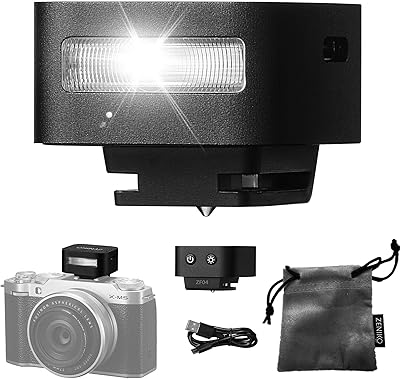
Zeniko ZF04 Mini Hot Shoe Flash
80%
96%
Portability & Size
91%
Ease of Use
51%
Power Control & Flexibility
83%
Recycle Time
87%
Battery Life
More
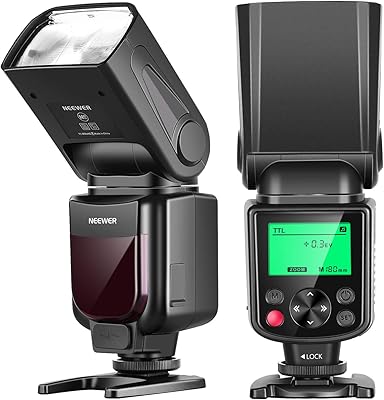
NEEWER 750II TTL Camera Flash Speedlite
84%
88%
Flash Power & Performance
85%
Ease of Use
72%
Build Quality
90%
TTL Functionality
80%
Portability & Weight
More
ZENIKO ZF08 Mini Camera Flash Speedlite
79%
94%
Portability & Form Factor
91%
Ease of Use
61%
Build Quality
58%
Output Power & Range
67%
Color Temperature Accuracy
More
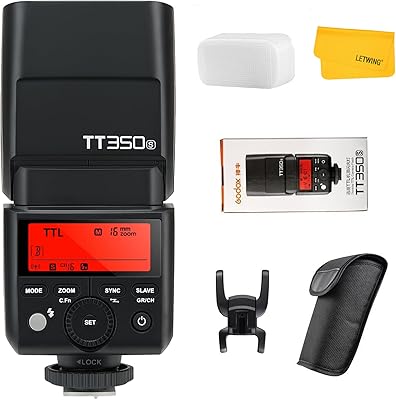
Godox TT350S Mini Speedlite Flash
81%
83%
TTL Accuracy
88%
High Speed Sync (HSS)
86%
Wireless Performance
93%
Portability & Form Factor
78%
Build Quality
More
NEEWER NW635II-S TTL Camera Flash Speedlite
86%
88%
Value for Money
91%
Performance
75%
Build Quality
85%
Ease of Use
92%
Portability
More
Canon Speedlite EL-10 Camera Flash
78%
88%
Build Quality
84%
Flash Performance & Output
86%
Wireless Control
83%
Multi-Function Shoe Integration
81%
Bounce & Swivel Head Range
More
NEEWER Z880-C TTL Camera Flash Speedlite
83%
83%
Build Quality
88%
TTL Accuracy
86%
HSS Performance
74%
Wireless Reliability
91%
Battery Life
More
NEEWER Z2-F 2.4G TTL Camera Flash Speedlite for Fujifilm
86%
88%
Performance
85%
Ease of Use
91%
Wireless Connectivity
83%
Battery Life
90%
Flash Power Output
More
Godox TT520II Speedlite Flash
76%
91%
Value for Money
78%
Build Quality
84%
Wireless Performance
82%
Flash Output Consistency
76%
Ease of Use
More

FAQ

Yes, the AF970 is compatible with Sony mirrorless bodies including the a7, a7II, a7III, a7R III, a6000, a6300, and a6500 series via its single-contact hot shoe. Keep in mind it fires in manual mode only — there is no ADI or TTL metering regardless of camera brand.

No, that is actually one of the standout features of the AMBITFUL AF970 Camera Flash Speedlite — the 2.4G wireless receiver is built directly into the unit. You will need a compatible 2.4G transmitter or commander on your camera, but no separate receiver dongle is required on the flash itself.
It runs on four standard AA alkaline batteries, which are not included in the box. That is worth factoring into your first order — pick up a pack of quality alkaline or rechargeable NiMH AAs before your first shoot. Rechargeable cells tend to handle high-power recycle demands a bit better over repeated sessions.

Absolutely. In its basic configuration the AF970 mounts directly to your camera hot shoe and fires via the standard sync contact, no wireless setup required. The wireless capability is there when you want to go off-camera, but on-shoe use is perfectly straightforward.

It depends on your expectations. If you are ready to learn manual exposure — understanding the relationship between flash power, distance, and aperture — then this speedlite is a capable and affordable starting point. If you are expecting the flash to meter automatically like your camera does with ambient light, you will be disappointed because there is no TTL mode at all. A short online course on manual flash basics will make a big difference before diving in.

Both S1 and S2 are optical slave modes that trigger the AF970 when they detect another flash firing nearby. S1 fires on the very first flash pulse it detects, which works fine with most cameras. S2 is designed for cameras that use a pre-flash for metering — it ignores that first pulse and fires on the main flash instead, which prevents underexposure issues when shooting alongside TTL-enabled flashes or on-camera pop-ups.

Strobe mode fires the flash repeatedly at a set frequency within a single long exposure, which lets you capture multiple positions of a moving subject in one frame — think a dancer frozen mid-spin three times in the same shot. It is also used for certain creative light painting techniques. At higher frequencies it draws battery power quickly, so keep sessions short and have spare AAs on hand.

Yes, this is actually one of the better use cases for the AF970. Because each unit has a built-in wireless receiver, you can position several of them around your subject and trigger them all from a single 2.4G commander on your camera. You can control groups and channels through each unit's LCD menu, which makes building a basic multi-light portrait setup quite practical without spending a lot per head.

The tilt and rotation mechanism has enough resistance to stay where you set it under normal shooting conditions. It is not as precise or firm as the locking mechanisms found on premium speedlites, but it does not drift freely either. For static setups like studio portraits it holds position reliably; just give it a check if the flash takes a knock during a busy event session.

More useful than you might expect, honestly. The 12 gels cover a practical range of warming, cooling, and color-creative options. Many buyers report using the CTO warming gels to match tungsten ambient light in indoor portraits and the colored gels for background accent work. They are thin snap-on sheets rather than professional Rosco-grade material, but for the price they are a genuinely handy addition, especially for someone just starting to experiment with colored flash.