Overview

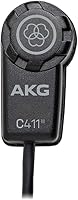
The AKG C411 PP Vibration Pickup is AKG's professional answer for acoustic and stringed instrument players who need clean, honest amplification without drilling holes or permanently modifying their instrument. AKG has long been trusted on concert stages and in recording studios, and this pickup reflects that heritage — it's built for musicians who take their tone seriously. The adhesive mounting system attaches directly to the instrument body, keeping the setup non-invasive and reversible. What sets it apart structurally is the sealed condenser capsule, which blocks mechanical noise and outside coloration from sneaking into your signal chain.
Features & Benefits

The capsule itself is tiny — barely larger than a fingertip — which means it adds virtually no weight to your instrument and won't shift its acoustic balance. That matters more than people realize, especially on lighter instruments like violin or mandolin. The figure-8 polar pattern captures audio from both sides accurately, helping reject unwanted ambient noise in live environments. With a signal-to-noise ratio of 78 dB, quiet passages come through with impressive clarity and minimal hiss. The MPAV-standard XLR connector plugs directly into any standard mixer or interface without adapters, though phantom power is required — worth confirming if you're running older gear.

Best For

This AKG contact mic is a natural fit for acoustic guitarists and violinists who perform live and need a reliable, transparent pickup without permanently altering their instrument. It works especially well for musicians who move between multiple instruments in a single set — the lightweight design and quick-attach adhesive make swapping setups genuinely practical. Studio players recording acoustic strings will appreciate how little the pickup colors the source tone. That said, this isn't aimed at casual hobbyists; the XLR-only connectivity and pricing put it squarely in the professional bracket. If you're gigging regularly or recording in a quality-conscious environment, the C411 PP pickup earns its place in the toolkit.

User Feedback

Across 241 verified ratings, this vibration pickup holds a solid 4.3 out of 5 stars, and the praise is consistent: buyers highlight sound transparency and build quality as genuine strengths, with several noting how natural their instrument sounds compared to competing options at a similar level. The recurring criticism centers on the adhesive — specifically, how long it holds over time and whether reattaching it degrades performance. The honest answer is that the adhesive works well initially, but some long-term users report needing to replace the compound eventually. A few buyers also flagged the phantom power requirement as an unexpected hurdle when pairing it with basic gear. Overall, working musicians rate it highly.

Pros

  • Delivers remarkably transparent tone with minimal coloration, letting the instrument sound like itself amplified
  • The capsule is genuinely tiny and featherlight, adding no perceptible weight or balance shift to the instrument
  • A 78 dB signal-to-noise ratio means quiet passages and subtle playing dynamics come through cleanly
  • Bidirectional polar pattern does a solid job rejecting off-axis ambient noise in live environments
  • MPAV-standard XLR connector works with virtually any professional mixer or audio interface without adapters
  • Adhesive mounting system keeps the installation non-invasive and reversible — no drilling, no permanent mods
  • Build quality feels professional and robust, consistent with AKG's broader reputation in studio and live audio
  • Included microphone bag and adhesive compound make the kit ready to use out of the box
  • Holds a 4.3-star rating across 241 verified buyers, reflecting strong real-world satisfaction among working musicians

Cons

  • Requires phantom power — older or budget gear may not provide it, adding setup complexity or extra cost
  • XLR-only output means no direct connection to smartphones, tablets, or basic acoustic amps without additional hardware
  • The adhesive compound can degrade over time and may need periodic replacement for consistent hold and tone
  • Reattaching the pickup after removal carries a small risk of surface marking on delicate or vintage instrument finishes
  • Setup has a modest learning curve for users new to contact microphones, particularly around optimal placement
  • No wireless option is included, which can limit stage mobility for performers who prefer cable-free setups
  • At its price point, it faces stiff competition from other pro-tier pickups that some players may find more versatile
  • Not practical for hobbyists or occasional players where the cost-to-use ratio is difficult to justify

Ratings

Our editorial team used AI to analyze verified buyer reviews worldwide for the AKG C411 PP Vibration Pickup, actively filtering out incentivized and bot-generated feedback to surface what real musicians actually experience. The scores below reflect a transparent synthesis of both the strengths that keep professionals coming back and the friction points that genuinely frustrate users. No aspect has been glossed over — the ratings follow the evidence.

Sound Transparency
91%
Players consistently describe the tone as honest and uncolored — what they hear acoustically is what comes through the PA or recording interface. Violinists and acoustic guitarists in particular praise how natural their instrument sounds without the processed quality common in cheaper contact mics.
A small number of users noted a slight emphasis in the upper midrange that becomes noticeable at higher gain settings, requiring subtle EQ correction. In very close miking scenarios on certain instruments, some pick up minor mechanical resonance from the capsule housing itself.
Build Quality
88%
The sealed capsule feels solid and purposeful, and the XLR connection shows no wobble or loose tolerances even after extended live use. Multiple buyers with years of regular gigging report no degradation in physical condition, which matters when gear gets handled roughly on the road.
The cable between capsule and connector, while functional, feels thinner than some players would expect at this price point. A few users mentioned being cautious about stress at the cable entry point when the setup is moved frequently between sets.
Adhesive System
63%
37%
The included adhesive compound holds reliably on freshly cleaned instrument surfaces and stays put through a full gig without slipping — which is the core job it needs to do. Players who leave it attached to a single instrument for extended periods report very few problems.
Repeated removal and reattachment is where the system struggles: the compound gradually loses its grip, and sourcing replacement adhesive can be an annoying extra step. On instruments with aged lacquer or nitrocellulose finishes, there is a documented risk of surface marking that has frustrated a meaningful number of buyers.
Signal-to-Noise Performance
87%
The 78 dB signal-to-noise ratio is genuinely audible in practice — soft fingerpicked passages and delicate bow strokes come through with a clean floor, free from the distracting hiss that plagues lower-tier pickups. Studio users recording sparse acoustic arrangements found this particularly valuable.
Getting the full benefit of the low noise floor depends heavily on the quality of the preamp in the signal chain. When paired with noisier budget interfaces, the pickup's inherent cleanliness is partially masked, which leaves some users underwhelmed if their front end is not up to the same standard.
Compatibility & Connectivity
82%
18%
The MPAV-standard XLR output connects without adapters to virtually every professional mixer, interface, and preamp on the market, making integration into an existing rig straightforward. Touring musicians appreciate not having to carry proprietary adapters or cables to make it work.
The mandatory phantom power requirement is a recurring sticking point — players with older acoustic combo amps or basic portable PAs often discover mid-setup that their gear does not supply it. This is not a flaw in the pickup itself, but it catches buyers off guard more than it should.
Weight & Balance Impact
93%
The capsule is so light that most players forget it is attached while performing, which is genuinely impressive for a condenser transducer. Violinists and mandolin players — who are acutely sensitive to any added mass — specifically call out how it does not change how the instrument feels or responds.
The lightness does mean the capsule can shift position slightly during vigorous playing if the adhesive contact area is not large enough or properly prepared. Players who move aggressively on stage occasionally need to recheck placement between sets.
Live Performance Suitability
79%
21%
In controlled live environments with attentive sound engineers, the C411 PP pickup performs at a professional level — giving front-of-house a clean, workable signal that holds up across a full show. Many gigging musicians use it as their primary pickup precisely because it avoids the noise floor problems of overhead miking.
Feedback management requires real attention in louder stage setups, particularly when monitoring wedges are positioned close to the instrument. Without careful EQ and gain discipline, the bidirectional pattern can cause problems in high-SPL environments that a more directional pickup would handle more forgivingly.
Studio Recording Quality
86%
The pickup captures enough nuance for close-up studio work on acoustic instruments where a full condenser overhead mic is impractical or picks up too much room. String players recording solo arrangements or overdubs find it a reliable, quick-to-deploy tool that integrates cleanly into most DAW workflows.
For critical studio recordings where absolute fidelity is the goal, some engineers prefer a well-placed large-diaphragm condenser microphone over any contact pickup. The vibration pickup approach inherently captures body resonance differently than air pressure, which is noticeable to trained ears in A/B comparisons.
Ease of Setup
71%
29%
Once a player has learned optimal placement for their specific instrument, the setup routine becomes quick and repeatable. Experienced users can have the pickup mounted and signal-checked in a few minutes before a soundcheck.
First-time users frequently need several sessions to dial in placement and gain staging, and the lack of detailed instrument-specific guidance in the documentation leaves some buyers guessing. The phantom power dependency adds one more variable for players who are new to professional XLR signal chains.
Value for Money
68%
32%
For professional gigging and studio musicians who rely on it regularly, the per-use cost over time is reasonable given the build longevity and sound quality. Players who have tried cheaper alternatives and been disappointed by coloration or noise tend to view the investment as justified.
For occasional players or hobbyists, the cost is difficult to rationalize against simpler or less expensive pickup solutions that would serve their needs adequately. The additional cost of phantom power adapters — if not already in the signal chain — pushes the real entry cost higher than the list price suggests.
Noise & Handling Rejection
84%
The sealed enclosure does a commendable job of keeping mechanical handling noise out of the signal — players who move around on stage report less unwanted thumping and clothing rustle compared to clip-on condenser microphones. This gives sound engineers fewer problems to manage during a live show.
The figure-8 polar pattern, while excellent at lateral noise rejection, is still susceptible to low-frequency structural vibrations transmitted through the instrument body itself. In environments with significant floor or stage vibration, some rumble can creep into the signal unless filtered at the desk.
Durability Over Time
77%
23%
The capsule and housing hold up well to the demands of regular live use, and long-term owners who have used the pickup over multiple years report no significant degradation in audio performance. AKG's manufacturing consistency means unit-to-unit variation is low.
The adhesive compound is effectively a consumable, and its replacement is the most commonly cited long-term maintenance issue. Some users also report that the included microphone bag, while handy, is not robust enough for serious road use without additional protection.
Instrument Versatility
74%
26%
While optimized for stringed instruments, players have successfully used this AKG contact mic on a wider range of acoustic sources including hand percussion, resonator instruments, and even certain wind instrument bodies. The transparent character means it adapts reasonably well beyond its intended category.
Players expecting the same results across very different instrument types will find that placement optimization is essentially a new learning exercise for each one. It is genuinely purpose-built for stringed instruments, and that focus limits how broadly it translates without significant experimentation.

Suitable for:

The AKG C411 PP Vibration Pickup is built for working musicians who need professional-grade amplification without compromising their instrument's natural tone or physical integrity. Acoustic guitarists, violinists, cellists, and mandolin players performing live will find the adhesive-mount approach particularly practical — it avoids permanent modifications and can be repositioned between gigs. Studio musicians tracking acoustic strings will appreciate how little the pickup colors the source, making it easier to shape tone in post without fighting an artificial-sounding signal. It's also a strong choice for players who rotate between multiple instruments in a single set, since the lightweight capsule and relatively quick attachment process reduce changeover time. If you're running a professional XLR signal chain — into a quality preamp, mixer, or audio interface — this AKG contact mic fits right in without adapters or workarounds.

Not suitable for:

The AKG C411 PP Vibration Pickup is not the right call for casual players or beginners who are still figuring out their setup. It requires phantom power, which means older or simpler gear may not support it without an additional inline adapter — a hidden cost some buyers discover only after purchase. The XLR-only connectivity also rules it out for anyone hoping to plug directly into a smartphone, tablet, or basic acoustic amp without an external preamp. Players on a tight budget will find the investment hard to justify if they're only playing at home or at open-mic nights where a less specialized solution would perform adequately. And if you're using a vintage or particularly delicate instrument with a fragile lacquer finish, the adhesive compound — while designed to be removable — does carry a small risk of surface marking over repeated applications, so caution is warranted.

Specifications

  • Product Type: Miniature condenser vibration pickup designed for acoustic and stringed instruments.
  • Polar Pattern: Bidirectional (figure-8) pattern captures audio from both sides of the capsule while rejecting off-axis noise.
  • Audio Sensitivity: Sensitivity is rated at -53 dBV/Pa, suitable for close-contact instrument body pickup applications.
  • Signal-to-Noise Ratio: A 78 dB signal-to-noise ratio delivers a clean, low-hiss signal even during quiet or delicate playing.
  • Capsule Housing: The condenser capsule sits inside a sealed enclosure that minimizes mechanical interference and unwanted coloration.
  • Connector Type: Uses an MPAV-standard XLR connector, compatible with professional mixers, audio interfaces, and mic preamps.
  • Power Requirement: Requires phantom power from a compatible mixer, preamp, or audio interface to operate.
  • Capsule Dimensions: The capsule body measures approximately 1 x 0.6 x 0.4 inches, making it one of the smallest in its class.
  • Kit Weight: The full kit weighs approximately 7.9 oz (225 g), inclusive of all included accessories.
  • Mounting Method: Attaches to the instrument body using an included adhesive compound that is designed to be removable and residue-conscious.
  • Included Accessories: Package includes the pickup capsule, adhesive compound for mounting, and a protective microphone bag for storage and transport.
  • Compatible Devices: Works with audio interfaces, mixing consoles, and any mic preamp that provides standard 48V phantom power.
  • Number of Channels: Single-channel mono output, standard for professional contact microphone applications.
  • Form Factor: Classified as a mini microphone form factor, intended for discreet on-body instrument placement.
  • Color: Available in black, with a low-profile finish that remains visually unobtrusive on most instrument finishes.
  • Manufacturer: Designed and manufactured by AKG, a professional audio brand with a longstanding presence in studio and live sound markets.
  • Model Number: Official model identifier is 2571H00040, with the product marketed under the C411 PP designation.
  • Availability Status: As of the time of writing, this pickup has not been discontinued by the manufacturer and remains in active production.

Related Reviews

AKG K52 Closed-Back Over-Ear Headphones
79%
83%
Sound Quality
88%
Comfort & Fit
61%
Build Quality
79%
Noise Isolation
91%
Value for Money
More
AKG K702 Open-Back Studio Headphones

70%
94%
Soundstage & Imaging
91%
Sound Accuracy
52%
Amplifier Requirement
78%
Comfort & Fit
74%
Build Quality
More
AKG K72 Closed-Back Studio Headphones
78%
83%
Sound Quality
86%
Comfort & Fit
79%
Sound Isolation
61%
Build Quality
88%
Value for Money
More
AKG C1000S Small-Diaphragm Condenser Microphone

78%
88%
Build Quality
74%
Sound Quality
83%
Versatility
81%
Battery Power
71%
Value for Money
More
AKG K371
AKG K371
89%
94%
Sub-Bass Extension
91%
Midrange Accuracy
88%
High-Frequency Detail
83%
Passive Noise Isolation
86%
Long-Term Comfort
More
AKG K812PRO Audiophile Headphones

85%
96%
Sound Quality
85%
Comfort for Extended Use
89%
Build Quality
94%
Soundstage & Imaging
60%
Noise Isolation
More
AKG K361 Studio Headphones
85%
91%
Sound Quality
84%
Comfort & Fit
90%
Noise Isolation
88%
Build Quality
86%
Portability
More
AKG C214
AKG C214
87%
92%
Vocal Clarity
89%
Acoustic Instrument Capture
94%
Build Durability
91%
High-Volume Handling
93%
Value for Money
More
AKG P170
AKG P170
82%
93%
Sound Clarity & Detail
91%
Transient Response
84%
Build Quality
89%
SPL Handling & Pad Performance
94%
Value for Money
More
AKG D5
AKG D5
89%
94%
Feedback Rejection
91%
Vocal Clarity
96%
Build Durability
87%
Handling Noise
93%
Value for Money
More

FAQ

Yes, the C411 PP pickup needs phantom power to operate — typically 48V, supplied by most modern mixers and audio interfaces. If your gear doesn't provide it, you'll need an inline phantom power supply, which is an added cost worth budgeting for. Running it without phantom power simply means you'll get no signal, so it's worth checking your signal chain before buying.

This is genuinely the most common concern buyers raise, and it deserves a straight answer: the adhesive compound included is designed to be removable, but no adhesive is completely risk-free on every finish. On modern lacquered instruments it typically comes off cleanly, but on vintage instruments with aged or delicate finishes, there's a real — if small — risk of surface marking. If you're unsure, test the adhesive on a non-visible area of your instrument first.

It works well on any acoustic stringed instrument with a resonant body — cello, upright bass, mandolin, and even some percussion instruments with suitable mounting surfaces. The key is finding a placement on the body where the capsule picks up vibration cleanly without excessive low-end rumble. Many orchestral players use this type of pickup precisely because it avoids the awkward positioning of a traditional stand microphone.

Placement is genuinely something you'll want to experiment with. On acoustic guitar, the area near the bridge or on the lower bout often produces a balanced tone. On violin, many players position it near the tailpiece or on the upper bout. The general rule is to avoid areas that produce too much low-frequency resonance and to stay away from the soundhole on guitars, as that can cause feedback in live settings.

The adhesive compound does degrade with repeated removal and reattachment, and some long-term users find they need to replace it after a while. AKG sells replacement adhesive pads separately, and third-party equivalents exist as well. It's a relatively minor ongoing cost, but worth knowing about if you plan to use this pickup regularly across different instruments or venues.

That depends on your amplifier. If your acoustic amp has an XLR input with phantom power, you're set. Many combo acoustic amps have XLR inputs but do not supply phantom power, which means you'd need an external phantom power adapter in the signal chain. Check your amp's specifications before assuming it will work plug-and-play.

Contact microphones like this one tend to produce a more natural, acoustic-sounding tone compared to magnetic soundhole pickups, which can sound somewhat electric. Compared to undersaddle piezo pickups, this AKG contact mic avoids the installation process entirely — no luthier visit required. The trade-off is that contact mics can be more sensitive to feedback in loud stage environments, so proper placement and EQ management matter more.

No XLR cable is included — you'll need to supply your own. The length you need depends on your stage setup or studio configuration. For live use, a 15-foot to 20-foot XLR cable is typically practical, giving you enough freedom to move without excess slack. Make sure you're using a decent-quality shielded cable to avoid picking up interference, especially in electrically noisy environments.

There is a modest one, mostly around placement and gain staging. Getting the positioning right takes some trial and error, and new users sometimes struggle with setting an appropriate gain level without causing feedback or clipping. A few sessions of careful experimentation — ideally in a rehearsal setting rather than on stage — will get most players comfortable with it fairly quickly.

This vibration pickup is generally better at rejecting ambient room noise than an overhead microphone would be, which helps in noisy environments. That said, no contact mic is immune to feedback, and using it near a loud stage monitor without any EQ management is asking for trouble. Running it through a feedback suppressor or carefully high-passing the low frequencies in your mix goes a long way toward keeping things under control at gigging volumes.

Where to Buy

Music Store US
In stock $129.00
Front End Audio
In stock $185.00
Farralane Lighting & Audio
In stock $185.00
NLFX Professional
In stock $185.00
Lunchbox Audio
In stock $185.00
Gear Club Direct
In stock $185.00
Sole Source AV Supply
In stock $185.00