Overview

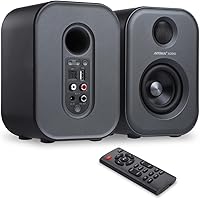
The AIYIMA S400 Bookshelf Speakers are a compact, active 2.0 system that entered the budget desktop audio market in mid-2024 under YIMA TECH. Each cabinet packs a 3-inch woofer and a 1-inch horn tweeter into a surprisingly tidy enclosure — roughly 5 inches wide and just over 7 inches tall. The whole pair weighs under 4.4 lbs combined, making them easy to reposition or move between rooms. Everything arrives in the box — optical cable, RCA cable, power adapter, and a remote — so it is a genuinely plug-and-play setup. For anyone comparing entry-level powered speakers, these compact powered speakers line up against names like Edifier and Moukey, built for buyers who want real stereo sound without a big outlay.
Features & Benefits

The S400 pair covers nearly every input scenario most users encounter. Bluetooth 5.3 handles wireless streaming from a phone or laptop across a room — the 10-meter range holds up in most living rooms without dropouts. Plug in via optical TOSLINK and you get a clean digital path for a TV or game console; RCA handles older gear, and USB rounds out the options. A front-panel display shows the active input at a glance, and the included remote lets you swap sources or adjust volume from the couch. The horn tweeter design broadens dispersion and helps vocals project clearly at moderate volumes, though some listeners may notice a slight edge to the treble when pushed harder.

Best For

This desktop speaker set makes the most sense for people wanting a genuine step up from built-in laptop or monitor audio without a complicated install. Sit them on a desk, pair via Bluetooth, and you are listening in under five minutes. The optical input makes them a practical pick for a bedroom TV if a full soundbar feels like overkill. Gamers who switch between a console and a PC will appreciate how quickly the remote lets them flip inputs. One honest caveat: bass-heavy music and film soundtracks will expose the limits of the 3-inch woofers, so listeners who prioritize deep low end may eventually want to add a small subwoofer.

User Feedback

With roughly 148 ratings averaging 4.2 out of 5, reception for these compact powered speakers has been broadly positive — though the sample is still modest given the mid-2024 launch, so treat the score as an encouraging early read rather than a settled verdict. Buyers frequently highlight the straightforward setup and a soundstage that feels fuller than the cabinet size implies. Remote convenience earns consistent praise. On the other side, a number of users mention the ABS housing feels lighter than expected, and some flag treble fatigue during extended listening at higher volumes. Bass depth criticism is predictable given the driver size. Overall, sentiment tilts positive for what this speaker set costs.

Pros

  • Everything needed to start listening arrives in the box — cables, power adapter, and a remote included.
  • Bluetooth 5.3 pairs fast, reconnects reliably, and holds a steady signal across a typical room.
  • Four input types cover virtually every source device a home or desk setup is likely to include.
  • The compact cabinet size fits naturally on a desk, shelf, or nightstand without dominating the space.
  • Vocal clarity and mid-range detail are genuinely strong at moderate listening volumes for the price.
  • The front-panel display removes all guesswork about which input is active at any given moment.
  • Remote control at this price point is a practical convenience that many competing options skip entirely.
  • Setup takes under ten minutes and requires no technical knowledge or additional equipment.
  • The horn tweeter widens sound dispersion, making the sweet spot forgiving for off-axis listening positions.
  • These compact powered speakers hold up well for daily casual streaming, podcasts, and background music.

Cons

  • Bass output is thin on music genres that rely heavily on sub-bass or heavy low-end punch.
  • The ABS plastic housing feels noticeably lightweight and hollow compared to wood-cabinet alternatives.
  • Horn tweeter can sound edgy or fatiguing on bright recordings when volume is pushed past 70 percent.
  • No 3.5mm aux input means users with headphone-output sources need an adapter cable as a workaround.
  • Infrared remote requires a direct line of sight and loses responsiveness at distances beyond roughly 3 meters.
  • Touch controls on the unit itself require deliberate firm presses and can feel unresponsive in daily use.
  • Long-term durability is unproven given the mid-2024 launch date and limited review sample size so far.
  • Display brightness is fixed, making it intrusive in a dark bedroom during late-night listening sessions.
  • USB input does not function as a computer audio interface, limiting its usefulness for PC-connected setups.
  • Brand warranty support and after-sales service remain largely untested outside of the initial purchase window.

Ratings

The AIYIMA S400 Bookshelf Speakers have been evaluated by our AI rating system after analyzing verified buyer reviews from global markets, with spam, bot-generated, and incentivized feedback actively filtered out. The scores below reflect where these compact powered speakers genuinely deliver and where real-world frustrations emerge — no cherry-picking. Both the strengths that keep buyers satisfied and the recurring pain points that prompt returns are transparently captured in each category.
Sound Quality
72%
28%
For a compact desktop setup, the S400 pair produces a soundstage that surprises most first-time listeners at moderate volume. Vocal clarity comes through cleanly during podcasts, acoustic tracks, and streaming, with the horn tweeter doing real work in the mid-range.
The overall sound profile is tuned to flatter rather than to reveal. Audiophiles who have spent time with better-resolving speakers will notice compression in layered recordings, and the presentation lacks the openness that separates genuinely good speakers from passable ones.
Bass Performance
54%
46%
The 3-inch woofers handle bass lines in pop and lo-fi music with enough presence to feel engaging at desktop listening distances. Casual listeners who are not comparing directly against a subwoofer-equipped system tend to find the low end acceptable for daily use.
Sub-bass is essentially absent, and mid-bass thins out quickly on electronic music, hip-hop, or film soundtracks with deep rumble. This is a physics constraint of the cabinet size and driver, not a fixable issue — buyers expecting chest-feel impact from this speaker set will be disappointed.
Treble & High-Frequency Response
67%
33%
The horn tweeter design helps treble project across a wider angle than dome tweeters typical at this price, making the speaker workable even when slightly off-axis. At low to moderate volumes, detail in cymbals and string instruments comes through without obvious harshness.
Several users report listener fatigue during longer sessions when volume is pushed beyond about 70 percent. The horn loading can introduce a slight edge to sibilance in vocalists, and some tracks that are already bright in the original recording will expose this sensitivity quickly.
Connectivity & Input Options
88%
Four distinct input types — Bluetooth 5.3, optical TOSLINK, RCA, and USB — on a speaker at this price is genuinely useful. Switching between a TV via optical and a phone via Bluetooth without re-cabling is the kind of practical flexibility that daily users notice and appreciate.
The USB input is limited in scope compared to what the label implies; it primarily reads audio files from drives rather than functioning as a proper USB DAC input for computers. Users expecting direct USB audio from a laptop may need to rely on Bluetooth or a 3.5mm-to-RCA cable instead.
Bluetooth Performance
79%
21%
Bluetooth 5.3 pairs fast and re-connects reliably when a previously linked device comes back into range. Across a normal-sized bedroom or home office space, the signal holds without stutter, and latency is low enough that lip-sync in video calls and streaming stays acceptable.
The stated 10-meter range assumes a clear line of sight; walls and furniture cut that down noticeably. A handful of reviewers mention occasional dropouts when their phone is in a different room, which is fairly standard Bluetooth behavior but worth knowing if wireless reliability is critical to your setup.
Build Quality & Materials
61%
39%
The metal-reinforced internals add some structural rigidity, and the cabinets arrive without any obvious cosmetic defects based on buyer reports. For the price bracket, the assembly tolerances are reasonable and the grilles attach firmly without wobble.
The ABS plastic outer shell is the most common source of criticism — it feels lightweight and hollow when tapped, and the matte finish picks up fingerprints. For buyers used to MDF-cabinet speakers at even a slightly higher price, the material quality difference is immediately apparent.
Value for Money
83%
Considering that the package includes the speakers, a full cable set, a power adapter, and a working remote, there is genuine usefulness in what you receive. For desktop audio upgrades or a bedroom secondary system, the all-in price is hard to argue against at this tier.
The value equation only holds if expectations are calibrated correctly. Buyers who push into the segment expecting near-hi-fi output will feel let down and may find competing options from Edifier at a small premium are noticeably more satisfying over the long term.
Setup & Ease of Use
91%
Unboxing to audio takes under ten minutes without reading a single page of the manual. The included cables cover every input scenario out of the box, and the front-panel display removes any guesswork about which source is active. First-time speaker buyers consistently rate setup as frictionless.
The instruction manual uses translated English that is occasionally unclear, which can confuse users trying to configure specific input priorities. Touch controls on the unit itself are also slightly inconsistent in responsiveness, requiring firm deliberate presses rather than casual taps.
Remote Control
77%
23%
Having a remote included at this price is not guaranteed, and buyers who use these speakers with a living room TV or from across a desk genuinely appreciate not walking to the cabinet to adjust volume. The layout is simple and the button travel is tactile enough to use without looking.
The remote requires a AAA battery and operates on infrared, which means it needs a reasonably direct line of sight to the front panel. Response angle is narrower than ideal, and a few buyers note the remote stops registering reliably at distances beyond about 3 meters.
Display & Controls
74%
26%
The front-facing display that shows the active input source and volume level is a practical touch that removes ambiguity during daily use. Switching inputs through the front controls works consistently when the remote is out of reach or the battery has run flat.
The display brightness has no adjustment, which makes it more prominent than ideal in a dark bedroom at night. Some users also note that the font on the display is small enough to be unreadable from more than a meter away, reducing its usefulness in larger room setups.
Volume & Output Headroom
69%
31%
At desk distance the S400 pair gets genuinely loud before distortion becomes noticeable — loud enough to fill a small room during a casual gathering. The claimed 100W figure is peak rather than continuous, but real-world output is sufficient for most non-party scenarios.
Pushing beyond roughly 75 percent of maximum volume introduces audible compression and some harshness, particularly in the upper mid-range. These compact powered speakers are not suited to filling large rooms, and buyers who frequently listen at high volumes may find the performance ceiling frustrating.
Design & Aesthetics
71%
29%
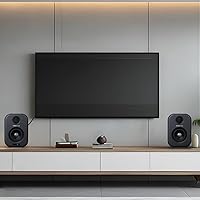
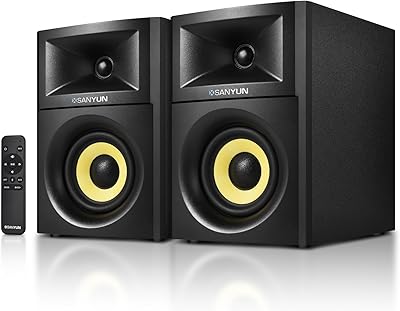
The rectangular profile and all-black finish are inoffensive and blend into most desk setups without demanding visual attention. The compact footprint — just over 5 inches wide per cabinet — means they fit neatly on a crowded desk or a narrow shelf without monopolizing space.
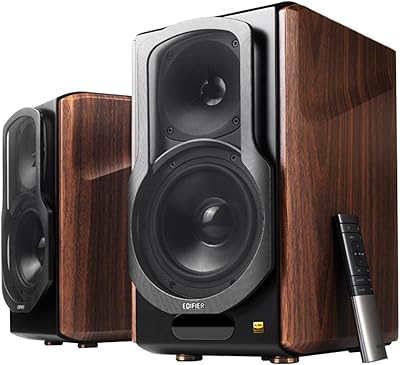
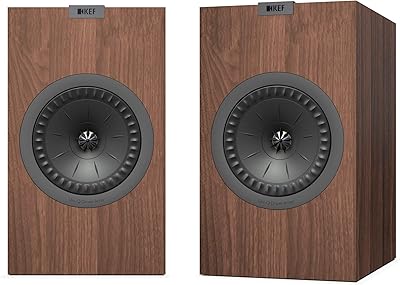
The overall design is functional rather than distinctive. Compared to competitors that offer wood veneer finishes or more considered industrial design at a similar price, the all-plastic exterior feels generic. For buyers who consider speaker aesthetics important in a visible room, this may be a deciding factor.
Compatibility & Versatility
85%
The combination of optical, RCA, Bluetooth, and USB inputs means the S400 pair connects to almost any source device a typical household owns. Swapping between a gaming console, a smart TV, and a smartphone over the course of a day requires no adapters or workarounds.
There is no 3.5mm aux input, which is an omission that occasionally frustrates users with older MP3 players, portable DACs, or laptop headphone outputs they want to use directly. A 3.5mm-to-RCA adapter solves it, but it is an extra step that should not be necessary at this tier.
Long-Term Reliability
63%
37%
Early buyer reports through the first several months post-launch have not surfaced any widespread hardware failure patterns, which is an encouraging sign for a new product from a relatively unfamiliar brand in Western markets. The power supply is a standard DC adapter and easy to replace if needed.
The product launched in mid-2024 and the review pool is still limited, making it genuinely difficult to assess durability beyond the first year of use. Brand warranty support has not been widely tested, and buyers outside the US may find after-sales assistance harder to access if issues arise later.

Suitable for:

The AIYIMA S400 Bookshelf Speakers are a solid fit for anyone who wants to escape the flat, lifeless audio of built-in laptop or monitor speakers without committing to a complicated or expensive setup. Desktop workers who spend hours on video calls, streaming music, or watching YouTube will notice an immediate and meaningful improvement over what a typical laptop can deliver. Students in dorms or renters in small apartments benefit from the compact footprint — under 5.5 inches wide per cabinet — which fits on a crowded desk or narrow shelf without taking over the space. The optical input makes these a practical secondary TV speaker for a bedroom where a full soundbar feels like overkill, and the Bluetooth 5.3 connection means a phone or tablet pairs quickly without hunting through menus. Gamers who switch between a console and a PC throughout the day will appreciate how the remote lets them flip inputs from across the room rather than reaching behind a desk.

Not suitable for:

Buyers who prioritize deep, physical bass from their audio setup should look elsewhere before purchasing — the AIYIMA S400 Bookshelf Speakers are built around 3-inch woofers, and physics limits what that driver size can produce at the low end of the frequency range. Electronic music listeners, hip-hop fans, and home theater users who watch action films will find the bass response thin and unsatisfying without a dedicated subwoofer added to the chain, which eliminates much of the cost advantage at this price tier. Audiophiles or critical listeners who evaluate speakers against studio monitors or even well-regarded passive bookshelf speakers paired with a proper amplifier will find the resolution and soundstage too limited for serious listening sessions. People who listen primarily at high volumes should also be cautious — pushing the output beyond roughly 70 to 75 percent of maximum introduces noticeable compression and treble harshness that makes extended listening uncomfortable. Finally, buyers who value build quality and premium materials in a product they will see every day may find the lightweight ABS plastic housing underwhelming compared to MDF-cabinet alternatives available at a modest step up in price.
Specifications

  • Speaker Type: Active 2.0 powered bookshelf system with built-in amplification — no external amplifier required.
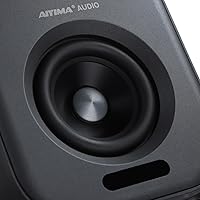
  • Driver Config: Each cabinet houses a 3-inch woofer and a 1-inch horn tweeter in a 2-way configuration.
  • Peak Power: Maximum output power is rated at 100W across the stereo pair under peak conditions.
  • Frequency Range: The system is specified to reproduce frequencies from 45Hz at the low end up to 20kHz at the top.
  • Signal-to-Noise: Signal-to-noise ratio is rated at 80 dB, which is adequate for casual listening at normal room volumes.
  • Distortion: Total harmonic distortion is specified at less than 1 percent, indicating clean playback at moderate output levels.
  • Impedance: Driver impedance is 6 ohms on the woofer and 8 ohms on the tweeter in each cabinet.
  • Inputs: Four inputs are available: Bluetooth 5.3 wireless, optical TOSLINK digital, RCA stereo analog, and USB.
  • Bluetooth: Bluetooth 5.3 with a stated wireless range of up to 10 meters in open-space conditions.
  • Dimensions: Each cabinet measures 4.53″ deep by 5.12″ wide by 7.28″ tall.
  • Weight: The complete pair weighs 4.36 lbs (1.98 kg) combined, making them easy to reposition.
  • Cabinet Material: Cabinets are constructed from ABS plastic with metal-reinforced internal components.
  • Power Supply: Powered via an included DC 21V adapter compatible with AC mains voltage from 110V to 240V worldwide.
  • Controls: Unit includes touch-sensitive controls on the cabinet face and a full-function infrared remote control.
  • Display: A front-panel display shows the currently active input source and volume level at a glance.
  • Included Cables: Package includes a digital optical cable, an RCA-to-RCA stereo audio cable, and a DC power cable measuring 1.8 meters.
  • Remote Battery: The infrared remote control requires one AAA battery, which is not pre-installed in the package.
  • Warranty: Covered under a limited manufacturer warranty from YIMA TECH; specific duration and claim process should be confirmed with the seller.

Related Reviews

MEVOSTO DS19 Bookshelf Speakers
85%
89%
Sound Quality
91%
Bass Performance
85%
Treble Clarity
88%
Bluetooth Connectivity
90%
Design & Aesthetics
More
Orroplus OR-02 Powered Bookshelf Speakers
77%
83%
Sound Clarity & Midrange
61%
Bass Performance
91%
Connectivity & Input Range
78%
Bluetooth Performance
72%
Setup & Ease of Use
More
Riowois DS6800M Bookshelf Speakers
83%
85%
Sound Quality
90%
Ease of Installation
82%
Build Quality
88%
Space-Saving Design
78%
Bass Performance
More
Edifier S2000MKIII Bookshelf Speakers
86%
92%
Sound Quality
89%
Bluetooth Performance
88%
Build Quality
85%
Ease of Use
91%
Connectivity Options
More
Sanyun SW205
Sanyun SW205
78%
83%
Sound Quality
61%
Bass Performance
87%
Soundstage & Imaging
89%
Connectivity & Inputs
84%
Bluetooth Performance
More
Micca MB42X Bookshelf Speakers
84%
89%
Sound Quality
92%
Value for Money
85%
Ease of Setup
77%
Bass Performance
91%
Design & Aesthetics
More
KEF Q150 Bookshelf Speakers
87%
88%
Sound Quality
75%
Bass Performance
93%
Build Quality
90%
Design & Aesthetics
85%
Treble Clarity
More
Probox BT16 Bookshelf Speakers
75%
78%
Sound Clarity
54%
Bass Performance
84%
Bluetooth Stability
82%
USB DAC Quality
63%
Build Quality
More
Sanyun SW208 3″ Bookshelf Speakers
86%
88%
Build Quality
84%
High-Frequency Clarity
91%
Mid-Range Warmth
78%
Bass Performance
93%
Control Ergonomics
More
Fluance XL8SW Bookshelf Speakers
87%
90%
Sound Quality
84%
Bass Response
91%
Clarity of Midrange
87%
Ease of Installation
88%
Design & Build Quality
More

FAQ

No, the AIYIMA S400 Bookshelf Speakers are fully active, meaning the amplifier is already built into the right-channel cabinet. You just plug in the power adapter, connect your source via whichever input you prefer, and you are ready to go — no extra equipment needed.

Yes, and the optical TOSLINK input is the cleanest way to do it. Most modern TVs have a digital optical output in their audio settings, so you run the included optical cable from the TV to the speaker and select the optical input using the remote. It works well for casual TV watching in a bedroom or secondary room.

Pairing is standard Bluetooth: put the speaker in pairing mode, find it on your phone or laptop, and connect. The speaker remembers previously paired devices, so reconnection is usually automatic when a known device comes back into range. Switching between two different Bluetooth sources does require disconnecting one device first, which is typical for speakers at this price.

Honestly, not without some expectation management. The 3-inch woofers handle mid-bass reasonably well, but anything that relies on deep sub-bass — heavy kicks, 808s, deep synth rumble — will sound noticeably thin. If bass is important to your listening, you would either need to add a small powered subwoofer or consider a speaker with larger drivers from the start.

There is no 3.5mm aux input on this desktop speaker set, which is a genuine omission. If you want to connect a device that only has a headphone output — like an older MP3 player or a laptop headphone jack — you will need a 3.5mm-to-RCA adapter cable, which is inexpensive but adds a step that should not really be necessary.

At desk distance they get quite loud — enough to fill a small bedroom. Most users find performance stays clean up to about 70 to 75 percent of maximum volume. Beyond that, you may start to hear some compression and a sharpening in the treble, particularly on bright recordings. They are not designed to push large rooms at high volumes.

The USB input on this speaker set reads audio files from a USB flash drive rather than functioning as a USB audio device or DAC for a connected computer. For PC use, the most practical options are Bluetooth if your computer supports it, or an RCA connection using a USB audio adapter or a 3.5mm-to-RCA cable from your computer's headphone jack.

The remote uses infrared, so it does need a reasonably clear line of sight to the front panel. It works fine from a normal desk or seated position in a small room, but some users report reduced reliability at distances beyond about 3 meters or when the angle is steep. For couch-distance TV use, positioning the speakers somewhere with a clear sightline to where you sit is worth considering.

They work well for casual PC or console gaming at desk distance. Stereo imaging is decent for the price, and the ability to quickly switch between a console via optical and a PC via Bluetooth using the remote is genuinely convenient. Just keep in mind that competitive gamers who rely heavily on directional audio cues would likely want a more capable or dedicated gaming audio solution.

The all-black finish is clean and unobtrusive, but the ABS plastic housing does feel lightweight when you handle the cabinets. They do not rattle or feel flimsy in use, but tapping the side of the cabinet has that hollow plastic resonance that reminds you this is a budget product. If the look and feel of the speaker matters as much as the sound in your space, it is worth knowing that MDF-cabinet competitors exist at a modest price premium.