Overview

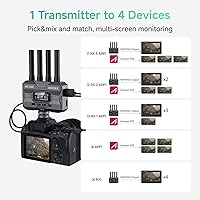
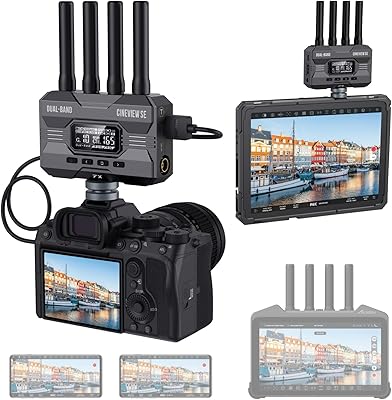
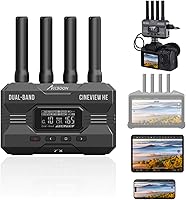
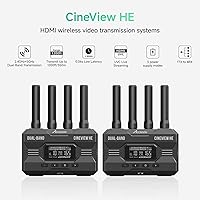
The Accsoon CineView HE Wireless Video Transmitter is a compact dual-band system that arrived in late 2023, targeting the sweet spot between prosumer convenience and professional reliability. It sits in the mid-to-upper tier of the wireless video market — not a toy, but not priced into the stratosphere either. What makes this transmitter-receiver kit stand out early is its ability to feed up to four receivers at once, mixing iOS and Android devices freely. The built-in UVC output is a genuine time-saver for anyone who streams, cutting out the capture card entirely. The HDMI loop-out passes signal to an on-camera monitor with zero added latency.
Features & Benefits

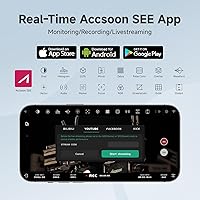
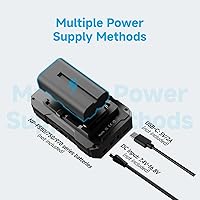
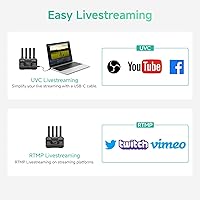
The CineView HE runs on both 2.4GHz and 5GHz bands simultaneously, which matters in environments packed with competing Wi-Fi signals — think conference centers, sports arenas, or busy wedding venues. Latency sits below 60ms in practice, low enough that a director watching a remote feed stays in usable sync with what the lens is capturing. Worth stating clearly: the resolution ceiling is 1080p at 60fps, so shooters working in 4K will need to accept a downscale at the transmitter stage. Power flexibility is a real strength — NP-F batteries, DC input, or USB-C all work, which helps during marathon shoots. UVC support and RTMP via the Accsoon SEE app round out a versatile feature set.

Best For

This wireless video system makes the most sense for crews where cable runs are impractical or just plain messy. Wedding shooters will appreciate handing a monitor to a second shooter or client without dragging cables across a crowded reception floor. Live sports and news crews can push signals across large open venues, though the 1200ft range spec assumes clear line of sight — real-world performance through walls and crowded spaces will be shorter. Solo creators who want to stream directly from a camera without a capture card will find the UVC output particularly handy. Small teams juggling a director feed, focus puller monitor, and live stream simultaneously get the most out of this kit.

User Feedback

With a 4.4-star average across 76 ratings, early reception for the CineView HE is encouraging, though it is worth keeping that sample size in mind before treating it as a settled verdict. Buyers consistently praise how quickly the transmitter and receiver pair up and how stable the signal holds in typical indoor shoots. On the downside, several reviewers flag that batteries and cables are not in the box, adding unexpected cost to an already significant purchase. A handful of users report the quoted range shrinks noticeably in obstacle-heavy or RF-congested environments. App stability with Accsoon SEE gets mixed mentions — solid for most, occasionally frustrating during longer streaming sessions.

Pros

  • Pairs quickly and reliably — most users are up and running within minutes of unboxing.
  • Dual-band transmission holds a clean feed in moderately crowded RF environments like wedding venues.
  • Feeds up to four receivers at once, mixing iOS and Android devices freely with no extra configuration.
  • Built-in UVC output eliminates the need for a separate capture card when streaming from a camera.
  • Zero-latency HDMI loop-out keeps the camera operator's monitor completely unaffected by the wireless transmission.
  • Flexible power options — NP-F battery, DC input, or USB-C — adapt to nearly any shooting situation.
  • Compact enough to mount on a camera cage or slip into a coat pocket without rethinking your kit.
  • The Accsoon SEE app adds useful monitoring tools like LUT overlays and focus aids at no extra cost.
  • Compatible with virtually any HDMI-equipped camera, camcorder, or video source with no adapters needed.
  • Embedded audio transmission carries 24-bit PCM cleanly, with no noticeable compression artifacts reported.

Cons

  • Resolution caps at 1080p60 — not suitable for productions where a full 4K remote feed is required.
  • Advertised 1200ft range is a best-case, open-air figure; indoor range through walls is significantly shorter.
  • No batteries, DC cable, or USB-C cable are included, adding unexpected cost before first use.
  • The Accsoon SEE app has reported stability issues during extended streaming sessions, including occasional crashes.
  • Plastic housing raises durability questions for crews working regularly in rough or wet outdoor conditions.
  • Heat buildup during marathon shoots or simultaneous multi-device streaming can affect performance over time.
  • Running all four receivers at once in a Wi-Fi-dense venue slightly increases the risk of brief signal interruptions.
  • RTMP streaming setup via the app is less intuitive than the marketing implies and rewards pre-shoot practice.
  • HDMI port longevity may be a concern for users who connect and disconnect frequently across multiple shoots.

Ratings

The Accsoon CineView HE Wireless Video Transmitter earns a solid reputation in early buyer feedback, and the scores below reflect what real users worldwide are actually experiencing — not the spec sheet. Our AI has analyzed verified purchase reviews, actively filtering out incentivized and bot-driven submissions, to surface an honest picture of where this transmitter-receiver kit excels and where it still has room to grow. Both the strengths that keep crews coming back and the friction points that frustrate first-time buyers are reflected transparently in every category.
Signal Stability
83%
In typical event environments — wedding receptions, small conference halls, indoor sports facilities — buyers consistently report that the dual-band system holds a clean, dropout-free feed. The ability to hop between 2.4GHz and 5GHz automatically gives it a meaningful edge over single-band competitors in moderately congested RF spaces.
In venues with dense Wi-Fi networks, like large convention centers or packed stadiums, some users note occasional signal hiccups that single-band rivals sometimes handle more gracefully by sitting on a less contested frequency. A small number of buyers report the system needs repositioning to recover rather than self-correcting instantly.
Range Performance
67%
33%
For open outdoor shoots — drone work, sports sidelines, sprawling film sets — the CineView HE regularly delivers usable signal well beyond what a typical crew needs, and several users confirm reliable performance at distances that would render most budget transmitters useless.
The advertised 1200ft figure assumes a clear, unobstructed line of sight, and real-world indoor range falls considerably short. Reviewers shooting through multiple walls or in obstacle-heavy environments report effective range closer to a third of the headline number, which is a meaningful gap for buyers expecting warehouse-to-warehouse coverage.
Latency
88%
Sub-60ms delay is genuinely low enough for a director or focus puller to work from a remote monitor without feeling out of sync with the action. Users doing live event coverage and remote framing for gimbal shots specifically call out how usable the feed feels compared to older Wi-Fi-based systems they had used previously.
The latency floor is not zero, and a handful of users involved in live switching or broadcast-critical workflows note that even a slight delay becomes perceptible when cutting between feeds in real time. It is excellent for monitoring but not a replacement for a hardwired SDI path in broadcast environments where frame-accurate sync matters.
Video Quality
79%
21%
At 1080p and 60 frames per second, the transmitted image holds up well for event videography, live streaming, and standard production work. Users report clean, artifact-free footage under normal signal conditions, and the zero-latency HDMI loop-out means the camera operator sees an untouched image regardless of what the receiver is doing.
The 1080p ceiling is a genuine constraint for productions shooting in 4K or higher — the signal is downscaled at the transmitter, which means the remote monitor feed never matches the full resolution being captured. For high-end commercial or cinema work, this resolution cap is worth weighing carefully before committing.
Ease of Setup
86%
Pairing the transmitter and receiver is fast — most buyers describe a straightforward power-on-and-go experience with no complex menu navigation needed for basic operation. The cold shoe mounts included in the box mean the units attach to a rig or camera cage without hunting for adapters.
Adding the Accsoon SEE app into the workflow introduces a layer of setup that not everyone finds intuitive straight out of the box, particularly for RTMP streaming configuration. A few users mention the app requires some patience during initial network connection, which can be frustrating on a tight shoot schedule.
App Experience
62%
38%
The Accsoon SEE app unlocks genuinely useful monitoring tools — LUT overlays, focus aids, and direct RTMP streaming to platforms like YouTube Live — that would otherwise require a dedicated streaming encoder. For solo creators, being able to broadcast directly without extra hardware is a practical advantage.
App stability draws the most consistent criticism in user reviews. Several buyers report crashes or dropped connections during longer streaming sessions, and the interface feels less polished than the hardware itself. Updates have improved things, but the app remains the weakest link in an otherwise capable system.
Multi-Device Monitoring
84%
Supporting up to four simultaneous receivers — mixing iOS phones, Android tablets, and dedicated hardware receivers freely — is one of the most practically useful features for small crews. A wedding team can hand a monitor to a client, a second shooter, and a director all from one transmitter without any additional configuration.
Managing four connected devices at once can introduce occasional instability, particularly when devices join or drop mid-shoot. Some users note that connecting the maximum four receivers in a Wi-Fi-dense environment slightly increases the chance of a brief feed interruption compared to running just one or two.
UVC and Streaming Capability
81%
19%
Plugging the receiver directly into a laptop via USB and having it recognized instantly as a webcam or capture source is a meaningful time-saver. Content creators who previously carried a separate capture card appreciate removing that device entirely from their kit bag.
RTMP streaming via the app is more reliable on stable Wi-Fi than on mobile data, and a few buyers found the setup process for direct platform streaming less self-explanatory than the product description implies. The feature works, but it rewards users who invest time learning the app before a live event.
Build Quality and Portability
77%
23%
The transmitter and receiver are genuinely small — each unit fits comfortably in a coat pocket — and the physical build feels solid enough for professional use without the bulk of larger competitors. The compact footprint makes it easy to mount on a camera cage or tuck into a bag without rethinking an existing kit setup.
The plastic housing, while reasonably sturdy, does not inspire the same confidence as metal-bodied competitors at a similar price point. A few buyers who work in rough outdoor conditions mention concern about long-term durability, particularly around the HDMI port after repeated plugging and unplugging on location.
Power Flexibility
74%
26%
Accepting NP-F batteries, a DC input, and USB-C gives this transmitter-receiver kit real versatility across different shooting contexts. A gimbal operator can run USB-C from a small power bank, while a studio shooter can wire directly to DC and forget about battery life entirely.
None of the power accessories are included in the box — no batteries, no DC cable, no USB-C cable — which catches a surprising number of buyers off guard. For someone new to the NP-F ecosystem, this adds both cost and a shopping trip before the unit is ready to run.
Value for Money
72%
28%
Relative to dedicated professional wireless video systems from legacy broadcast brands, this transmitter-receiver kit comes in at a fraction of the cost while delivering the core features a working crew actually needs. The UVC output and multi-receiver support in particular represent strong value at this price tier.
Once buyers factor in NP-F batteries, a DC cable, and potentially a second hardware receiver, the out-of-pocket cost climbs noticeably from the base price. At that fully-equipped total, a few users feel the value proposition tightens, especially given the 1080p cap and app reliability concerns.
Compatibility
88%
Working with virtually any HDMI-equipped camera, camcorder, or device means there are almost no compatibility barriers for a typical production crew. Users running Sony mirrorless cameras, Canon DSLRs, and even GoPro adapters all report straightforward plug-in operation with no configuration required.
Compatibility with Accsoon's own ecosystem of monitors and the CineView SE and Quad systems requires some attention to firmware versions, and a small number of users report initial handshake issues when mixing older Accsoon hardware with this newer unit. Cross-brand SDI workflows are not supported at all.
Audio Transmission
76%
24%
Carrying 16-bit and 24-bit PCM audio at both 44.1kHz and 48kHz means the system handles professional audio without compression artifacts that plague cheaper wireless video solutions. Event videographers who rely on camera-mixed audio report clean, sync-accurate sound at the receiver end.
Audio is transmitted embedded in the HDMI signal rather than as a separate output, so crews needing isolated audio monitoring at the receiver end will need to extract it downstream. This is a standard limitation at this product tier but worth noting for multi-camera audio workflows.
Thermal Management
66%
34%
Under typical shooting conditions — an hour-long event, a short documentary segment, a streaming session — the units run warm but manageable. Most buyers do not report any issues with heat during standard-length shoots.
Extended sessions of two hours or more, particularly when streaming simultaneously to multiple devices, generate enough heat that some users report throttling or temporary signal degradation. A small number of buyers working in hot outdoor environments mention the units becoming uncomfortably warm to handle, which raises questions about longevity under sustained heavy use.

Suitable for:

The Accsoon CineView HE Wireless Video Transmitter is genuinely well-suited to working videographers and small production crews who need to cut cable clutter without cutting corners on reliability. Wedding shooters in particular will find real value here — being able to feed a live monitor to a client, a second shooter, and a director simultaneously from one transmitter changes how a reception floor can be covered. Event crews working live sports, news segments, or corporate broadcasts in large open venues will also get meaningful range out of this system, provided sightlines are reasonably clear. Solo creators who have been carrying a separate capture card just to stream from a camera will appreciate the built-in UVC output that removes that device from the bag entirely. Drone and gimbal operators who need a remote framing feed with low enough delay to make compositional decisions in real time will find the sub-60ms latency genuinely workable. If your shoots regularly top out at 1080p and you need a dependable multi-monitor wireless solution that travels light, this transmitter-receiver kit fits the brief well.
Not suitable for:

The Accsoon CineView HE Wireless Video Transmitter is not the right tool for every production, and being clear about those limits will save buyers from a frustrating experience. Cinematographers or commercial directors shooting 4K or higher will hit an immediate wall — the system transmits up to 1080p only, meaning the wireless feed is always a downscaled version of what the sensor is capturing, which is a non-starter on productions where remote monitors need to reflect the full-resolution image. Broadcasters or multi-camera directors who need frame-accurate, latency-free signal switching should look at dedicated broadcast-grade wireless systems, because even sub-60ms delay becomes noticeable in live switching contexts. Anyone planning to run the system through multiple walls or across obstructed indoor environments should temper expectations around range — the 1200ft headline figure assumes open-air line of sight, and real indoor performance can be considerably shorter. Buyers working in extremely RF-dense environments like large convention centers should also know that even the dual-band setup can show strain when competing with dozens of overlapping Wi-Fi networks. Finally, this kit does not ship with batteries, a DC cable, or a USB-C cable, so buyers who are not already in the NP-F ecosystem will need to budget extra before the unit is ready to run.
Specifications

  • Transmission Bands: The system operates on both 2.4GHz and 5GHz simultaneously, allowing it to switch dynamically to reduce interference in crowded wireless environments.
  • Max Resolution: Video transmission is supported up to 1080p at 60 frames per second; 4K output is not supported at any stage of the wireless chain.
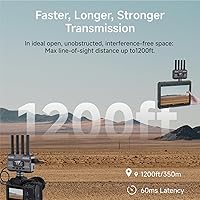
  • Range: Rated range is up to 1200ft (350m) under open-air, line-of-sight conditions; real-world indoor range through walls and obstacles will be considerably shorter.
  • Latency: End-to-end signal delay is specified at under 60ms, which is sufficient for remote monitoring and framing but not for broadcast-critical frame-accurate switching.
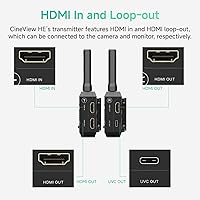
  • TX Ports: The transmitter carries one HDMI input for the camera signal and one HDMI loop-out that passes a zero-latency, lossless copy to an on-camera monitor.
  • RX Ports: The receiver provides one HDMI output for connecting to an external monitor or display, plus a UVC-compatible USB port for direct plug-in to a computer.
  • Max Receivers: Up to four devices can receive the signal simultaneously, using any combination of hardware receivers, iOS devices, and Android devices running the Accsoon SEE app.
  • Audio Format: Embedded audio is transmitted in PCM format at either 44.1kHz or 48kHz sample rates, with support for both 16-bit and 24-bit depth.
  • Power Options: The transmitter and receiver each accept power via NP-F550, NP-F750, or NP-F970 batteries (not included), a DC input (cable not included), or 5V USB-C (cable not included).
  • Streaming Support: The receiver supports UVC plug-and-play recognition on computers without drivers or capture cards, and RTMP streaming to platforms like YouTube Live via the Accsoon SEE app.
  • App Compatibility: The Accsoon SEE app is available for both iOS and Android and provides monitoring tools including LUT overlays, focus peaking, and RTMP broadcast configuration.
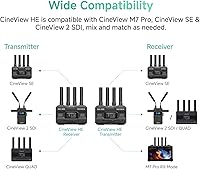
  • Ecosystem Compatibility: The CineView HE is compatible with Accsoon CineView M7 Pro monitors and the CineView SE, CineView 2, CineView SDI, and CineView Quad systems within the Accsoon ecosystem.
  • Unit Dimensions: Each unit measures approximately 3.11 x 2.24 x 0.79 inches, making both the transmitter and receiver compact enough to mount on a camera cage cold shoe without significant added bulk.
  • System Weight: The combined weight of the transmitter and receiver is 1.8 pounds, though this does not account for any NP-F batteries attached during operation.
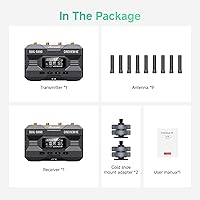
  • In-Box Contents: The package includes one transmitter, one receiver, two cold shoe mount adapters, and a printed user manual; no batteries, DC cables, or USB-C cables are included.
  • Amazon Ranking: The product holds a Best Sellers Rank of number 13 in the Video Transmission Surveillance Systems category on Amazon as of the time of this review.
  • Release Date: The product was first made available for purchase on October 24, 2023, placing it among the more recently launched options in the prosumer wireless video segment.
  • Manufacturer: The CineView HE is designed and manufactured by Accsoon, a brand specializing in wireless video transmission and camera monitoring tools for professional and semi-professional crews.

Related Reviews

Accsoon CineView SE Wireless Video Transmitter & Receiver
86%
91%
Transmission Stability
88%
Range Performance
94%
Latency
85%
Ease of Use
89%
Compatibility with Devices
More
DxInvb Wireless HDMI Transmitter and Receiver Kit
75%
91%
Ease of Setup
58%
Device Compatibility
74%
Wireless Range & Stability
69%
Video Quality
83%
Build Quality & Portability
More
LZLOO Wireless HDMI Transmitter and Receiver
77%
91%
Ease of Setup
74%
Signal Stability
68%
Wireless Range
77%
Video Output Quality
71%
Latency Performance
More
TTQ TR60 Wireless HDMI Transmitter and Receiver
79%
93%
Ease of Setup
78%
Signal Stability
86%
Video & Image Quality
81%
Latency Performance
88%
Build Quality & Materials
More
TPUFO G02 Wireless HDMI Transmitter and Receiver
77%
91%
Ease of Setup
78%
Signal Stability
83%
Video & Image Quality
74%
Transmission Range
87%
Latency Performance
More
Weeryyi Wireless HDMI Transmitter and Receiver 1080p
84%
92%
Value for Money
88%
Transmission Range
91%
Ease of Setup
89%
Video Quality
85%
Multi-Screen Support
More
BRAIDOL TR50 Wireless HDMI Transmitter and Receiver
85%
91%
Performance & Connectivity
89%
Video Quality (4K/1080P)
95%
Ease of Use & Setup
88%
Signal Range (30m)
86%
Portability & Design
More
MpioLife Wireless HDMI Kit V6
74%
91%
Ease of Setup
78%
Wireless Range (Open Space)
47%
Through-Wall Performance
83%
Video Quality
69%
Latency & Responsiveness
More
WELUSOPU 1TX+2RX Wireless HDMI Extender Kit
74%
88%
Ease of Setup
74%
Wireless Range
67%
Video Output Quality
79%
Multi-Receiver Sync
81%
Latency Performance
More
Anytrox THT-020-8 Wireless HDMI Extender
78%
93%
Ease of Setup
78%
Video Quality
71%
Wireless Stability
82%
Audio-Video Sync
67%
Wireless Range
More

FAQ

Yes, and this is one of its more practical strengths. The receiver's USB port appears as a UVC device, meaning your computer recognizes it as a webcam or video input the moment you plug it in — no drivers, no capture card, no additional software required. You can then select it as a video source in OBS, Zoom, or any other streaming or conferencing app.

The transmitter and receiver both accept NP-F series batteries — specifically the NP-F550, NP-F750, or NP-F970 — but none of these are included in the box. Neither are DC power cables or USB-C cables. If you are not already in the Sony NP-F ecosystem, budget for at least a pair of batteries and charger before your first shoot.

Realistically, no. The 1200ft figure is measured in open air with a clear line of sight between the transmitter and receiver. Once you add walls, floors, and the general RF noise of a busy indoor environment, effective range drops considerably — many users in typical indoor venues report reliable performance closer to 100 to 150 feet. Plan your shoot with that in mind rather than the headline spec.

No. The Accsoon CineView HE Wireless Video Transmitter tops out at 1080p at 60fps. If your camera is shooting in 4K, the signal is downscaled at the transmitter before being sent wirelessly. The remote feed your director or focus puller sees will always be 1080p, regardless of what the sensor is capturing.
Up to four devices simultaneously — and you can mix and match hardware receivers with phones or tablets running the Accsoon SEE app. So a director could watch on a dedicated receiver, a focus puller on an iPad, and a client on their phone, all from the same transmitter at the same time.

Not at all. The loop-out on the transmitter passes a lossless copy of the HDMI signal with zero added latency, so whatever the camera operator sees on their on-camera monitor is completely unaffected by the wireless transmission happening simultaneously. The two outputs are fully independent.

For monitoring and basic use, most users find it dependable. For extended RTMP streaming sessions — say, a two-hour live event — the picture is more mixed. A meaningful number of reviewers report occasional app crashes or dropped connections during longer broadcasts. It is worth running a full test stream before relying on it for a high-stakes live event.

Yes, and it is actually one of the better use cases for this transmitter-receiver kit. The sub-60ms latency is low enough that an operator watching a remote feed can make real framing decisions rather than just reviewing footage after the fact. Just keep in mind that range will depend heavily on obstacles and interference between the aircraft or gimbal and the receiver.

Better than most single-band systems, but not perfectly. The dual-band design gives it more room to maneuver in congested RF environments by operating across both 2.4GHz and 5GHz simultaneously. That said, in truly saturated environments like large convention centers with hundreds of active networks, some users do report occasional brief signal interruptions. It is not immune to interference, just more resilient than average.

For cameras, compatibility is essentially universal — if your camera has an HDMI output, this system will work with it. For monitors on the receiver end, any display with an HDMI input will work fine. The deeper Accsoon ecosystem integrations, like pairing with Accsoon-branded monitors, add extra features but are not required for the core wireless video functionality.

Where to Buy