Overview

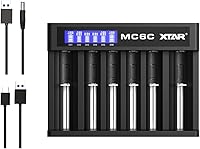
The XTAR MC6C 6-Slot Battery Charger hits a practical sweet spot for anyone who regularly juggles more than a handful of rechargeable cells — flashlight hobbyists, preppers, or photographers who cannot afford to be caught with dead batteries at the wrong moment. It is not trying to compete with professional cell analyzers, but it brings enough intelligence to make bare-bones chargers feel genuinely limited by comparison. The dual-input design, combining USB-C and DC ports, along with a per-slot LCD readout showing live current and capacity, means you actually know what is happening inside each bay instead of just hoping for the best.
Features & Benefits

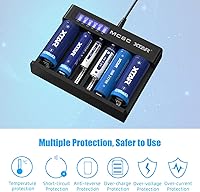
What separates this six-slot charger from cheaper alternatives is that each bay operates independently — slip in an 18650 alongside a couple of AA NiMH cells and they charge without interfering with each other. The soft-start function is quietly useful: if you are reviving an older or deeply discharged cell, the charger ramps up gently rather than hitting it hard from the start. QC3.0 support allows automatic current optimization, though the compatible adapter is not included in the box — worth knowing before you assume maximum charging speed out of the gate. Built-in protection against overcharge and short-circuit rounds out a thoughtful, safety-conscious feature set.

Best For

This multi-battery charger is a natural fit for 18650 cell enthusiasts — people who run high-drain flashlights, vaping devices, or DIY power banks and rotate through cells constantly. It is equally at home for preppers or amateur radio operators who keep a rotating stock of AA and AAA NiMH batteries ready at all times. Outdoor users will appreciate that the USB-C port can draw from a solar panel or a power bank, making field charging genuinely feasible. One important caveat: protected 20700 and 21700 cells are not supported, so if that is your primary format, this charger will not cover you.

User Feedback

Buyers consistently highlight the LCD readout as a standout detail — knowing the exact charge percentage and current on each slot beats staring at an ambiguous blinking LED. The independent slot behavior draws consistent praise from users who mix chemistries or sizes in a single session. That said, a number of owners note that when all six bays are loaded, per-slot current drops noticeably, meaning full charges take longer than expected. The included cables get mixed marks — functional, but not exactly confidence-inspiring. The bigger frustration is discovering that maximum charge speed requires a QC3.0 adapter sold separately. Long-term users generally report solid reliability with no major failures after months of regular use.

Pros

  • Six truly independent slots let you charge different battery sizes and chemistries at the same time without any fuss.
  • The per-slot LCD display shows live charge percentage and current — a real step up from guessing with blinking LEDs.
  • Soft-start function handles deeply discharged or older cells gently, reducing the risk of damaging a borderline battery.
  • USB-C and DC dual-input means you can run this charger from a power bank, solar panel, or standard wall adapter.
  • Built-in protection against overcharge, short-circuit, and overcurrent makes unattended overnight charging feel much safer.
  • Compatible with a wide range of sizes including 18650, 26650, AA, AAA, and several less common formats.
  • QC3.0 support allows the charger to automatically select the best current when a qualifying adapter is connected.
  • Long-term buyers report consistent reliability over months of heavy use with no slot failures or display issues.
  • Consolidates multiple narrower chargers into one unit, freeing up outlet space and reducing clutter.

Cons

  • Protected 20700 and 21700 cells are not supported — a meaningful gap as these formats grow more popular.
  • The QC3.0 adapter needed for maximum charging speed is sold separately and not disclosed prominently enough at purchase.
  • Per-slot current drops noticeably when all six bays are loaded, making full-batch charges significantly slower.
  • Included cables are thin and uninspiring — most serious users will want to replace them with better third-party options.
  • The USB-C input is limited to 5V and does not benefit from higher-voltage USB-C PD for faster throughput.
  • No battery health diagnostics or internal resistance measurement — it charges cells but cannot evaluate their condition.
  • The charger is too large and heavy to pack conveniently for travel or backpacking trips.
  • Manual current selection controls are not intuitive and require reading the manual to use confidently.
  • In variable solar conditions, charge current fluctuates and overall speed becomes unpredictable.

Ratings

The XTAR MC6C 6-Slot Battery Charger has been put through its paces by a wide range of buyers — from flashlight collectors rotating through dozens of 18650 cells to preppers keeping a ready stock of AA NiMH batteries. The scores below are generated by AI after systematically analyzing verified global user reviews, with spam, bot activity, and incentivized feedback actively filtered out. Both the genuine strengths and the real frustrations are reflected here without sugarcoating either side.
LCD Display Clarity
91%
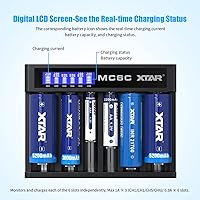
Users consistently describe the per-slot LCD as one of the most useful features they did not know they needed until they had it. Being able to glance and see the exact charge percentage and live current for each individual slot removes the guesswork that plagues LED-only chargers. Hobbyists managing mixed loads especially value this transparency.
A small number of buyers note that in very bright sunlight the display contrast can wash out slightly, making it harder to read outdoors. The text is also fairly small, which a handful of older users found mildly frustrating when checking slots at a distance.
Independent Slot Operation
93%
The ability to drop a 26650, a couple of AA NiMH cells, and an 18650 into the same charger simultaneously — and have each slot behave independently — is something repeat buyers specifically call out as a reason they stuck with this brand. There is no cross-interference, no forced matching of chemistries.
While the independence is real, when all six slots are occupied the per-slot current is shared across the available power budget, meaning full charges on every cell take noticeably longer than charging just two or three at once. This trips up users who expect six-slot speed to match single-slot speed.
USB-C Input & Dual Port Design
86%
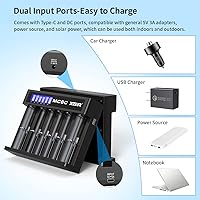
Having both USB-C and a DC barrel port on the same charger is a thoughtful bridge for users who have moved most of their gear to USB-C but still own older DC adapters. Campers and field users particularly appreciate being able to run this charger from a USB-C power bank or a small solar panel without any adapter fuss.
The USB-C port tops out at 5V input, so it does not benefit from higher-voltage USB-C PD charging — it is strictly a convenience port, not a speed port. Users expecting the kind of fast-charge throughput they get from modern phone chargers will be underwhelmed by the actual charge rate in USB-C mode.
Battery Compatibility Range
78%
22%
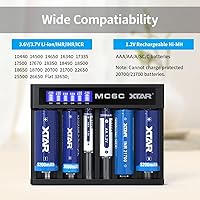
The charger covers an impressively wide spectrum for its size — Li-ion cells from 18650 down to 10440, plus NiMH and NiCD across AA, AAA, C, SC, and more. For most hobbyists, this single unit replaces two or three narrower chargers they used to juggle.
Protected 20700 and 21700 cells are explicitly not supported, which is a real limitation as these formats are increasingly common in high-drain flashlights and vaping setups. Buyers who primarily use those formats will need to look elsewhere, and this incompatibility is not always obvious before purchase.
QC3.0 Performance & Adapter Situation
62%
38%
When paired with a proper QC3.0 adapter, the charger does intelligently select the optimal current for each slot, and the speed difference versus a standard 5V source is tangible, especially when charging only a few cells at a time. The protocol integration works as advertised once you have the right hardware in hand.
The QC3.0 adapter is not included in the box, which catches a significant number of buyers off guard. Several reviewers specifically mention feeling misled after expecting maximum performance only to discover they need to purchase an additional adapter separately — an added cost that some feel should be disclosed more prominently.
Build Quality & Housing
74%
26%
The charger feels reasonably solid for its price bracket — the housing does not flex or creak under normal use, and the slot contacts have enough spring tension to grip both thin AA cells and chunkier 26650s without feeling loose. It has a workmanlike, no-frills construction that prioritizes function over aesthetics.
It is not a premium-feeling unit by any stretch. The plastic has a slightly hollow quality, and a few long-term users report minor cosmetic wear around the slot contacts after heavy use. It does the job reliably, but anyone expecting a premium tactile experience will be left wanting.
Included Cables Quality
58%
42%
Both a DC cable and a USB-C cable are included, which at least means you can start charging right out of the box without hunting for accessories. For casual users, the supplied cables are perfectly functional for day-to-day use at home.
The cables are widely described as thin and uninspiring — they work, but they do not inspire much confidence for long-term use. Several buyers swapped them out immediately for higher-quality third-party cables, and a few reported that the DC cable in particular felt flimsy at the connector.
Charging Speed (Single Cell)
81%
19%
Charging a single 18650 cell in isolation is reasonably quick, and the soft-start behavior means even a deeply discharged cell gets handled gently before ramping to full current. For users who pull one or two cells at a time, the experience is satisfying and noticeably faster than budget alternatives.
Speed drops off when the charger is fully loaded, and the maximum 1A per slot on the corner bays is modest by current standards. Power users who want to top off six cells quickly and move on will find the throughput limiting, particularly if they are not using a QC3.0 source.
Soft-Start & Battery Protection
89%
The soft-start function is one of those features that earns quiet appreciation rather than loud praise. Battery enthusiasts who have revived cells they thought were dead genuinely value the gentle ramp-up approach, and the built-in protection against overcharge and short-circuit adds a meaningful safety margin for unattended overnight charging.
There is no voltage readout or internal resistance measurement, so it does not cross into analyzer territory. Users who want to assess cell health or diagnose aging batteries will still need a dedicated analyzer alongside this charger — it protects batteries but does not evaluate them.
Value for Money
77%
23%
For buyers who genuinely need six independent slots and mixed-chemistry support, the price feels reasonable given what the hardware delivers. It replaces multiple narrower chargers, and the LCD feedback alone justifies the step up from budget options for anyone who charges frequently.
The missing QC3.0 adapter and the somewhat modest cable quality do soften the value proposition slightly. If you factor in the cost of a proper QC adapter to unlock full performance, the effective out-of-pocket cost creeps higher than the sticker price suggests.
Ease of Use
88%
Drop in a battery, plug in the charger, and the LCD tells you everything worth knowing within seconds — there is almost no learning curve. The automatic chemistry detection means you do not need to fiddle with mode buttons for standard cells, which makes it genuinely approachable for less technical users.
The manual current selection controls can be slightly confusing for users who are new to adjustable-current chargers. The button behavior for cycling through current options is not entirely intuitive without reading the manual, and a few reviewers wished the interface had clearer labeling.
Size & Footprint
71%
29%
Six bays in a footprint just over 12 inches long is a reasonable trade-off — it fits comfortably on a desk or shelf without dominating the space. For users who previously stacked multiple single or dual chargers, consolidating into one unit actually saves room overall.
It is not a compact charger by any measure, and it does not travel well. Campers or travelers hoping to pack this in a bag will find the dimensions and weight add up. It is really a home-base or workshop charger, not something designed for portability.
Long-Term Reliability
83%
Repeat buyers and reviewers who have used the unit heavily for six months or more generally report that it keeps working without issues — no slot failures, no display glitches, no sudden shutdowns. For a charger in this price tier, that track record is reassuring.
The sample size of truly long-term reviews is still limited given the product launched in late 2020, and a small subset of users have reported contact corrosion in humid environments after extended use. It is not a widespread complaint, but worth noting for users in coastal or high-humidity climates.
Solar & Off-Grid Compatibility
69%
31%
The dual-input design means this charger genuinely works with portable solar panels that output a stable 5V USB-C — a real differentiator for campers and off-grid users who want to keep a battery rotation going away from shore power. That use case works and works well.
Performance in solar mode is entirely dependent on the quality and output stability of the panel being used. In variable light conditions, charge current fluctuates and progress slows significantly. Users expecting consistent solar charging speeds comparable to wall power will find the experience unpredictable.

Suitable for:

The XTAR MC6C 6-Slot Battery Charger is purpose-built for anyone who manages a rotating stock of multiple rechargeable cells on a regular basis. Flashlight enthusiasts who cycle through 18650s constantly will find the six independent bays genuinely useful — no more staggering charges or running two cheap dual-slot chargers side by side. Preppers, amateur radio operators, and outdoor-minded users who keep AA and AAA NiMH batteries topped off will appreciate that the charger handles mixed chemistries simultaneously without needing to think about it. Campers and off-grid users get a practical bonus in the USB-C input, which can draw from a power bank or a compatible solar panel when wall power is not an option. Photographers or content creators juggling cylindrical camera batteries alongside spare cells will also find it a consolidating solution. If you are someone who charges batteries in batches and has always wanted visibility into what is actually happening in each slot, the per-slot LCD readout alone makes a strong case for this unit.
Not suitable for:

Buyers whose primary cells are protected 20700 or 21700 batteries should look elsewhere — the XTAR MC6C 6-Slot Battery Charger explicitly does not support those formats, and that is a hard limitation, not a workaround situation. Users expecting lightning-fast top-offs across all six slots simultaneously will also be disappointed, since the per-slot current drops when the charger is fully loaded and maximum speed requires a QC3.0 adapter that is not included in the box. Anyone looking for a travel-friendly or portable charger will find the 12-inch footprint and overall bulk impractical for packing. This is not a battery analyzer either — if you need internal resistance readings or detailed cell health diagnostics, you will still need a dedicated analyzer. Budget-focused buyers who are comparing it against simpler two- or four-slot options should weigh whether the six-slot capacity and LCD feedback genuinely match their usage, rather than paying for features they will rarely use.
Specifications

  • Charging Slots: The charger features 6 fully independent bays, each capable of operating at its own current level without affecting the other slots.
  • Compatible Chemistries: Supports Li-ion and IMR/INR/ICR cells at 3.6V and 3.7V, as well as Ni-MH and Ni-CD batteries at 1.2V.
  • Supported Sizes: Compatible with cylindrical cells including 10440, 14500, 16340, 18350, 18650, 18700, 26650, and standard sizes AA, AAA, AAAA, A, C, and SC.
  • Incompatible Cells: Protected 20700 and 21700 batteries are explicitly not supported and should not be used in this charger.
  • Input Ports: Equipped with both a USB-C port and a DC barrel port, allowing connection to a wide range of power sources including power banks and solar panels.
  • Input Voltage: Accepts a 5V input across both the USB-C and DC ports; a standard 5V 3A adapter is required for normal operation.
  • Input Current: Maximum input current is 3A, achievable when using a QC3.0-compatible adapter connected to the USB-C port.
  • Max Charge Current: Slots CH1, CH2, CH5, and CH6 can deliver up to 1A each; current across all six slots when fully loaded is distributed and reduced accordingly.
  • Charge Current Options: The charger supports selectable output modes of 0.5A across six active slots or 0.2A across four active slots, adjustable manually.
  • QC3.0 Support: The USB-C input supports the QC3.0 fast-charging protocol, enabling automatic current optimization — though the QC3.0 adapter is not included in the box.
  • Display: A backlit LCD screen on each slot shows real-time charging current, estimated battery capacity percentage, and charging status at a glance.
  • Protection Circuits: Built-in protection covers overcharge, overcurrent, overvoltage, and short-circuit conditions to prevent damage during unattended charging.
  • Soft-Start Function: An integrated soft-start feature gradually ramps up the charging current when a deeply discharged or heavily aged cell is detected, reducing stress on the battery.
  • Dimensions: The charger measures 12.68 × 8.7 × 2.2 inches, making it suited for desktop or shelf use rather than travel or portability.
  • Weight: The unit weighs 1.06 pounds without cables, giving it a solid feel without being excessively heavy for bench use.
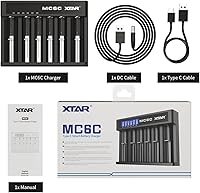
  • In the Box: Package includes the charger unit, one DC cable, one USB-C cable, and a printed user manual; no batteries and no QC3.0 adapter are included.
  • Brand & Origin: Manufactured by XTAR, a brand specializing in lithium-ion charging solutions, with this model first available in November 2020.
  • Output Voltage: The charger delivers a regulated 3.7V output to Li-ion cells and a 1.2V output to Ni-MH and Ni-CD cells upon completion of the charge cycle.

Related Reviews

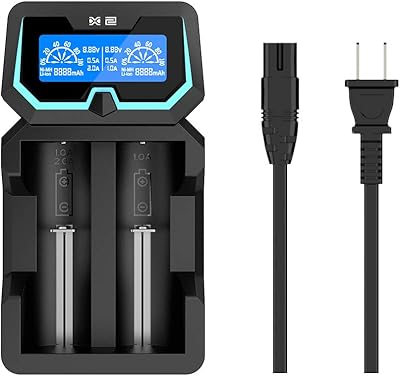
XTAR X2 Smart 2-Slot Battery Charger
86%
92%
Charging Speed
88%
Ease of Use
76%
Portability
85%
Build Quality
94%
Compatibility with Battery Types
More
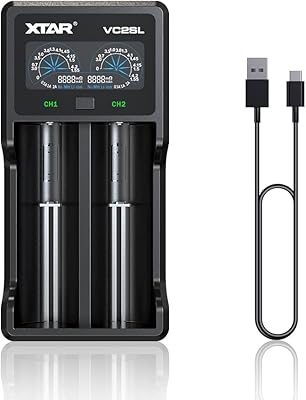
XTAR VC2SL Battery Charger
84%
85%
Charging Performance
88%
Ease of Use
80%
Build Quality
90%
Portability
92%
Battery Compatibility
More
XTAR VC4SL 4-Bay Battery Charger
82%
88%
Charging Accuracy
91%
LCD Display Quality
93%
Battery Compatibility
84%
Grade Mode Usefulness
82%
Build Quality
More
ISDT N8 8-Slot AA/AAA Battery Charger
78%
91%
Independent Channel Performance
78%
Chemistry Compatibility
84%
Build Quality
83%
Display & Interface
86%
Charging Speed
More
Nitecore Q6 Six Slot Battery Charger
86%
92%
Charging Performance
89%
Value for Money
88%
Build Quality
85%
Ease of Use
90%
Safety Features
More
XTAR VP4 Plus 4-Slot Battery Charger Analyzer
79%
91%
Charging Accuracy
93%
Battery Compatibility
88%
Diagnostic Depth
86%
Display Clarity
84%
Capacity Test Accuracy
More
EBL C880 40-Slot Battery Charger
84%
88%
Charging Performance
82%
Build Quality
85%
Ease of Use
90%
Cooling Efficiency
91%
Safety Features
More
ISDT A8 Air 8-Slot Battery Charger
79%
91%
Build Quality
84%
Charging Speed
93%
Independent Channel Performance
62%
App Experience
88%
Battery Chemistry Compatibility
More
XTAR X4 2A Fast AC Power Battery Charger
87%
92%
Charging Speed
89%
Ease of Use
85%
Charging Capacity (Slots)
91%
Display Clarity
88%
Safety Features
More
Nitecore UMS4 Intelligent USB Four Slot Quick Battery Charger
87%
91%
Charging Speed
94%
Battery Compatibility
89%
Ease of Use
88%
LCD Display Clarity
85%
Build Quality
More

FAQ

Not reliably. Protected 20700 and 21700 cells are explicitly listed as incompatible with this unit, so you should avoid trying to force them in. If those formats are your primary cells, you will need a different charger designed specifically for them.

No, it does not. The XTAR MC6C 6-Slot Battery Charger includes a DC cable and a USB-C cable, but the QC3.0 adapter needed to reach maximum charging speed is sold separately. If you want the fastest possible charge rate, budget for a compatible QC3.0 wall adapter alongside the charger.
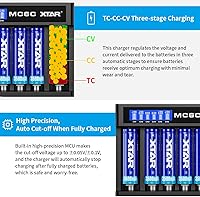
Yes, absolutely — that is one of the more practical things about this charger. Each slot operates independently, so you can mix AA NiMH cells with 18650 Li-ion cells in any combination across the six bays without any interference between them.

Each slot has its own readout showing the real-time charging current, the estimated battery capacity as a percentage, and the current charging status. It is significantly more informative than a simple LED indicator, and experienced users find it genuinely useful for monitoring slow or aging cells.

Yes, it will. When all six slots are active, the total available power is distributed across the bays, and per-slot current decreases noticeably compared to charging just two or three cells. If speed is a priority, charge in smaller batches and use a QC3.0 adapter for the best results.

You can, as long as your solar panel outputs a stable 5V via USB-C or a compatible DC connection. The charger works in off-grid scenarios, but the charge rate will fluctuate with sunlight conditions, so do not expect wall-speed performance from a panel in variable weather.

The built-in protection circuits cover overcharge, overcurrent, overvoltage, and short-circuit conditions, which does add a meaningful safety margin for overnight charging. The soft-start function also handles cell stress on startup. That said, as a general practice with any lithium-ion charger, charging on a hard surface away from flammable materials is always sensible.

Yes, the spring-loaded contacts in each slot accommodate both flat-top and button-top 18650 cells without issue. The slot design has enough travel to handle the slight height differences between cell variants.

The charger has a button interface that lets you cycle through the available current settings per slot. It is functional but not the most intuitive setup, and a few users find it confusing at first — the manual is worth a quick read before assuming the default setting is optimal for your cells.

Soft-start means the charger begins at a very low current when it first detects a deeply discharged or borderline battery, then gradually ramps up rather than hitting the cell with full current immediately. It matters most for older cells or ones that have been sitting discharged for a long time — it can sometimes recover cells that a less careful charger would simply reject.

Where to Buy