Overview

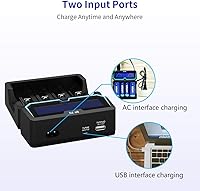
The XTAR X4 4-Slot Li-ion Battery Charger sits comfortably in the mid-range of the enthusiast charger market — capable enough for serious use, without the complexity or cost of a dedicated analyzer. XTAR has built a solid reputation among flashlight collectors, vapers, and photographers who depend on cylindrical cells, and this four-slot charger reflects that pedigree. It handles both Li-ion and Ni-MH/Ni-Cd chemistries, meaning one unit covers everything from 18650s to standard AA rechargeables. The dual-input design — AC wall outlet or Micro USB — is a practical touch that makes it genuinely useful at a desk or on the road. Expect reliable, well-monitored charging, not lab-grade diagnostics.

Features & Benefits

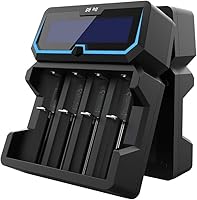
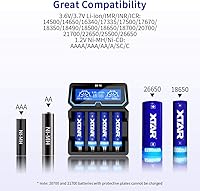
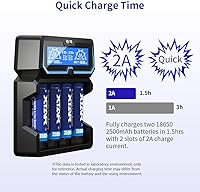
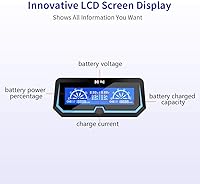
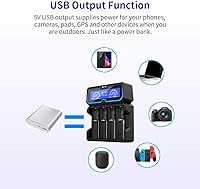
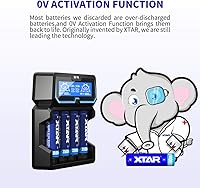
The LCD screen is where this multi-chemistry charger earns its keep daily. At a glance, you can see each slot's voltage, charge percentage, current draw, and capacity filled — useful information if you're tracking the health of older cells or just want confirmation that a charge completed properly. You can manually set each slot to 0.5A, 1A, or 2A, which matters if you're nursing aging batteries or want a fast 90-minute top-up on a pair of 18650s before heading out. The 0V activation feature quietly handles over-discharged cells that most budget chargers simply reject. There's also a 5V USB output port — handy for topping off a phone in a pinch, though it's a convenience feature, not a power bank substitute.

Best For

This four-slot charger makes the most sense for people who maintain a rotating stock of cylindrical cells — think flashlight and EDC enthusiasts swapping between 18650s and 21700s, or vapers who run high-drain cells hard and need dependable, monitored top-ups. Photographers who rely on both rechargeable AAs for speedlights and Li-ion cells for other gear will appreciate not needing two separate units. Frequent travelers benefit from the Micro USB input option, which lets them run the charger off any USB power bank instead of hunting for a wall outlet. It's also a smart pick for anyone who wants real charging data on screen without spending up to a dedicated capacity analyzer.

User Feedback

Across several hundred reviews, the XTAR X4 holds a strong 4.4-star rating, and the praise is consistent: buyers highlight the accurate voltage readings, the compact footprint, and how well it handles a broad range of cell sizes without fuss. Long-term users, however, have raised a few legitimate concerns. The Micro USB input is a real sticking point — in a world of USB-C, it genuinely feels behind the times. Some owners also noticed that slot spring tension can weaken after extended use, affecting contact reliability. A smaller group found that charge times at lower current settings ran longer than expected. Out of the box the unit performs well; the questions tend to surface after months of daily use.

Pros

  • Charges both Li-ion and Ni-MH/Ni-Cd cells in the same unit, covering a wide range of everyday rechargeable needs.
  • The LCD readout shows live voltage, capacity, and current per slot — actually useful for monitoring older or high-use cells.
  • Two slots run simultaneously at 2A, filling a pair of 18650 2500mAh cells in around 90 minutes.
  • Per-slot current adjustment lets you charge sensitive or aging batteries gently at 0.5A without babysitting them.
  • 0V activation brings over-discharged cells back to life that most basic chargers will simply refuse to recognize.
  • Dual-input flexibility — AC wall or Micro USB — gives real options for both home use and travel.
  • Compact and light enough to pack without taking up meaningful luggage space.
  • CE, FCC, and RoHS certified, with hardware-level protections against reverse polarity, short circuits, and overheating.
  • The 5V USB output port can top off a phone or small device in a pinch, adding modest convenience.
  • Compatible with a broad range of cylindrical cell sizes, from small 10440 cells up to large 26650s.

Cons

  • The Micro USB input is a genuine inconvenience for anyone who has standardized on USB-C across their devices.
  • Some long-term users report slot springs losing contact tension over months of daily use, which can cause intermittent charging issues.
  • Charge times at lower current settings can run noticeably longer than the advertised figures suggest.
  • No internal resistance measurement or discharge testing — this multi-chemistry charger is not a substitute for a dedicated cell analyzer.
  • The USB output is too limited in capacity to serve as a real power bank; it is a minor bonus, not a practical backup power source.
  • Only two slots support the full 2A rate simultaneously; running all four slots reduces per-slot current, which can surprise first-time users.
  • No USB-C input means you cannot share a modern laptop or phone charger cable with this unit.
  • The LCD, while informative, lacks backlighting adjustability, which can make it harder to read in bright ambient light.

Ratings

The scores below reflect an AI-driven analysis of verified global user reviews for the XTAR X4 4-Slot Li-ion Battery Charger, with spam, incentivized, and bot-generated feedback actively filtered out to ensure reliability. This multi-chemistry charger earns consistently strong marks in most areas, though a handful of recurring pain points keep it from a perfect standing. Both the genuine strengths and the honest frustrations are captured here so you can make a clear-eyed buying decision.

Battery Compatibility
93%
Reviewers with mixed battery collections repeatedly call out the breadth of supported formats as a standout strength. Being able to drop in a 21700 from a flashlight, an 18650 from a vape mod, and a pair of AA Ni-MH rechargeables all at once — without swapping units — is something buyers genuinely appreciate in day-to-day use.
A small number of users with less common cell sizes reported needing to double-check compatibility before assuming support, as the slot rail tolerances leave little room for non-standard or heavily wrapped cells. Protected cell fitment, while officially supported, occasionally requires some gentle repositioning.
Charging Speed
81%
19%
At 2A per slot across two bays simultaneously, the XTAR X4 turns around a pair of standard 18650 cells in about 90 minutes — fast enough that many users slot in cells before breakfast and have them ready before leaving the house. For high-drain users who cycle through cells daily, that turnaround matters.
Users who expected advertised speed at lower current settings were often caught off guard by notably longer charge times. At 0.5A, which is a legitimate choice for older or sensitive cells, total charge duration can stretch to several hours, and the product documentation does not always set that expectation clearly upfront.
Display & Readout
88%
The LCD panel is one of the most praised aspects across the review pool — buyers coming from basic set-and-forget chargers describe the live voltage and mAh readout as genuinely eye-opening for understanding their cells' real health. Spotting a degraded cell that is only accepting a fraction of its rated capacity is a practical benefit that keeps coming up in longer reviews.
The display lacks brightness adjustment, which means in a sunlit workspace or next to a bright window it can be harder to read without repositioning the unit. A few users also noted that the font size for capacity values feels small if you are monitoring from across a desk.
Build Quality
74%
26%
Out of the box, the construction feels solid and purposeful — the casing has a practical, no-nonsense finish and the slot rails handle repeated cell insertion without rattling. Fire-retardant materials are used throughout, which is a meaningful safety consideration for a device that runs unattended.
Long-term durability is where the picture gets more complicated. A recurring theme across multi-month reviews is that the slot spring tension can weaken with heavy daily cycling, leading to intermittent contact issues that were not present early on. This appears to affect a meaningful minority of users who rotate cells very frequently.
Input Connectivity
58%
42%
Having two input options — AC wall power and Micro USB — is a genuinely useful design choice that most competitors at this tier do not offer. Travelers in particular appreciate being able to run the charger off a USB power bank when no wall outlet is available, which extends its usability significantly beyond a desktop context.
The Micro USB standard is the single most complained-about aspect across the review base, and the frustration is warranted. In a market where USB-C has become universal, having to keep a separate Micro USB cable in a travel kit feels like an avoidable inconvenience, and it is a criticism that has only grown louder in more recent reviews.
Current Adjustment
86%
Per-slot manual current control is a feature that experienced battery users specifically seek out, and reviewers in the flashlight and vaping communities consistently flag it as a reason they chose this unit over simpler alternatives. Being able to slow-charge an aging cell at 0.5A while fast-charging a fresh one at 2A in the next slot is a meaningful operational advantage.
New users occasionally find the current adjustment interface unintuitive without reading the manual first, as the button sequence is not immediately obvious. There is also no memory function, so the charger defaults back to its base current setting each time it is powered off, which can be mildly tedious for users who always prefer a specific setting.
0V Cell Recovery
83%
The ability to attempt recovery on over-discharged cells is something buyers with large cell collections genuinely value — several reviewers describe successfully reviving cells that a previous charger had simply refused to recognize. For those who store cells long-term, this feature alone has saved batches of otherwise-written-off batteries.
Recovery is not guaranteed, and the charger does not clearly communicate whether a revival attempt is in progress or if the cell has simply been rejected. A more informative display state during the 0V activation phase would help users know whether to wait or give up on a particular cell.
USB Output Function
62%
38%
The 5V USB output is a welcome addition for occasional use — a handful of reviewers mention it as a handy backup for topping off a phone or GPS unit when a separate charger is not at hand. It works as advertised for low-draw devices and requires no additional configuration.
The output is not a substitute for a real power bank, and reviewers who expected meaningful capacity or fast-charge speeds from it were consistently disappointed. It requires the unit to be actively connected to mains or a USB source, meaning it adds no standalone emergency power capability, which some buyers had incorrectly assumed it would.
Safety Features
91%
CE, FCC, and RoHS certifications alongside hardware-level protections for reverse polarity, short circuits, and overheating give buyers confidence in leaving this multi-chemistry charger running overnight or unattended. Reviewers who prioritize safe charging — particularly those storing Li-ion cells in enclosed spaces — regularly cite the safety credentials as a purchase driver.
Despite the strong certification lineup, a very small number of users reported unexpected heat levels on the charger body during multi-slot fast charging sessions. These cases appear to be isolated rather than systemic, but they are worth noting for buyers who plan to run all four slots at maximum current continuously.
Value for Money
84%
For a charger that handles multiple chemistries, provides a meaningful LCD readout, and includes features like 0V recovery and adjustable current, the price-to-capability ratio is consistently rated as fair to strong by the majority of reviewers. Buyers comparing it to bare-bones alternatives at lower prices frequently conclude the additional features justify the premium.
Some buyers who only ever need to charge one or two cells at a time feel they are paying for slot capacity and features they rarely use. At this price point, a few users also expected a USB-C input as standard, making the Micro USB input feel like a trade-off that undermines the overall value proposition slightly.
Portability
79%
21%
At just 8.5 ounces and with a compact footprint, this four-slot charger fits comfortably in a carry-on or laptop bag without taking up meaningful space. Travel-focused reviewers specifically mention that it does not feel like a sacrifice to bring it along, especially given the dual-input flexibility that makes it usable without a dedicated wall plug.
The unit is noticeably wider than single or dual-slot chargers, so backpack side-pocket storage is sometimes too tight to accommodate it. A few users also noted that the AC adapter supplied in the box adds bulk, and that sourcing a more compact travel adapter separately is worth considering for minimal packing.
Ease of Use
82%
18%
Auto-detection of battery chemistry and size means most users simply insert a cell and let the charger do its work — an experience that out-of-box reviewers consistently describe as straightforward and confidence-inspiring. The independent slot operation means there is no need to match cells by size or chemistry before loading the charger.
Navigating the manual current adjustment requires a button press sequence that is not intuitive without reading the instructions, which some buyers skip entirely. The lack of an audible completion signal also means users who leave the room have no way of knowing a charge cycle has ended other than returning to check the display.
Long-term Reliability
69%
31%
For buyers who use the charger in moderate rotation — a few cycles per week rather than daily industrial use — the unit holds up well across the review pool, with many reporting consistent performance over a year or more. The underlying charging logic and display remain accurate even as the unit ages, according to longer-term reviewers.
The gap between out-of-box performance and performance after six-plus months of heavy use is one of the clearest patterns in the review data. Slot spring degradation and occasional contact inconsistency are the primary failure modes reported, and they appear to accelerate with frequent insertion of larger-format cells like 26650s.

Suitable for:

The XTAR X4 4-Slot Li-ion Battery Charger is a natural fit for anyone who manages a regular rotation of cylindrical rechargeable cells — flashlight collectors, EDC hobbyists, and vapers especially will find it earns its place on the desk quickly. If you run a mix of 18650s and 21700s alongside standard AA or AAA Ni-MH rechargeables, the ability to charge all of them in one unit without swapping equipment is a genuine time-saver. The dual-input design is particularly valuable for travelers: being able to run the charger off a USB power bank instead of hunting for a wall outlet makes a real difference when you're on the road. Photographers and field workers who depend on both dedicated Li-ion cells and Ni-MH packs for flashes or accessories will also appreciate the chemistry flexibility. Anyone who wants to keep an eye on a cell's health over time — not just blindly top it off — will get real value from the per-slot LCD readout.

Not suitable for:

Buyers who have moved entirely to USB-C across their gear will likely find the Micro USB input a recurring frustration — it means carrying a separate cable just for this charger, which undermines the convenience argument. The XTAR X4 4-Slot Li-ion Battery Charger is also not the right choice for anyone who needs serious battery analysis: it shows you voltage and capacity filled, but it does not perform discharge testing or internal resistance measurement the way dedicated analyzers do. If you only ever charge one or two cells at a time and have no need for LCD feedback, there are simpler, cheaper units that will do the job without the extra features you won't use. Users who prioritize long-term mechanical durability above all else should note that some owners have reported weakening slot spring tension after extended daily use, which can affect contact reliability over months of heavy rotation. Those expecting charge times to match the fastest published figures at every current setting may also come away disappointed, as real-world results at lower amperages can run longer than the spec sheet implies.

Specifications

  • Charging Slots: The charger has 4 independent slots, each capable of being configured with its own current setting.
  • Li-ion Sizes: Compatible Li-ion cell formats include 10440, 14500, 16340, 18350, 18650, 20700, 21700, 26650, and several others in between.
  • Ni-MH/Ni-Cd Sizes: Supports Ni-MH and Ni-Cd rechargeables in AAAA, AAA, AA, A, SC, and C form factors.
  • Max Slot Current: A single slot can deliver up to 3A; two slots running simultaneously max out at 2A each.
  • Current Settings: Each slot can be manually set to 0.5A, 1A, or 2A to suit the age and chemistry of the cell being charged.
  • Input Options: The charger accepts power via an AC wall input (up to 240V) or a Micro USB port, allowing use with standard USB power banks.
  • USB Output: A 5V USB output port lets the unit supply power to phones or small devices when connected to wall power.
  • Display: An LCD screen shows real-time data per slot, including battery voltage, charge percentage, capacity in mAh, current setting, and channel status.
  • 0V Activation: The charger can detect and attempt to recover deeply discharged cells that have dropped to 0V, which most basic chargers cannot handle.
  • Temperature Control: Built-in temperature monitoring pauses or adjusts charging if internal heat exceeds safe operating thresholds.
  • Safety Protections: Hardware-level safeguards cover reverse polarity insertion, short circuits, overcharging, and overheating conditions.
  • Certifications: The unit carries CE, FCC, and RoHS certifications, confirming compliance with international electrical and materials safety standards.
  • Dimensions: The packaged unit measures 8.62 x 5.39 x 1.93 inches, making it compact enough to fit in a travel bag without much difficulty.
  • Weight: The charger weighs 8.5 ounces, light enough for everyday portability without feeling flimsy in hand.
  • Manufacturer: Designed and produced by Shenzhen XTAR Electronics Co., Ltd, a specialist brand focused on battery charging equipment.
  • First Available: The product was first listed for sale in December 2018 and remains an active, non-discontinued model.
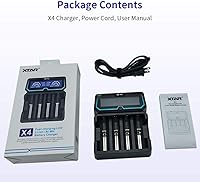
  • Box Contents: Each package includes the charger unit, a QC 3.0 wall adapter, a charging cable, and a user manual.
  • Cell Chemistries: The charger handles both 3.6V and 3.7V Li-ion cells as well as 1.2V Ni-MH and Ni-Cd cells within a single unit.

Related Reviews
XTAR X2 Smart 2-Slot Battery Charger
86%
92%
Charging Speed
88%
Ease of Use
76%
Portability
85%
Build Quality
94%
Compatibility with Battery Types
More
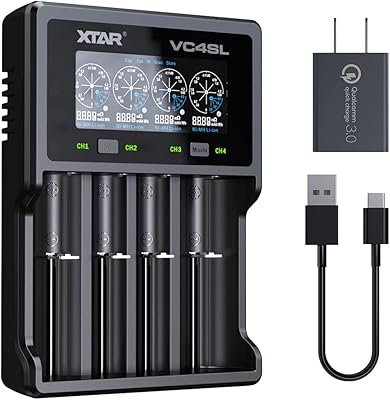
XTAR VC4SL 4-Bay Battery Charger
82%
88%
Charging Accuracy
91%
LCD Display Quality
93%
Battery Compatibility
84%
Grade Mode Usefulness
82%
Build Quality
More
XTAR VC2SL Battery Charger
84%
85%
Charging Performance
88%
Ease of Use
80%
Build Quality
90%
Portability
92%
Battery Compatibility
More
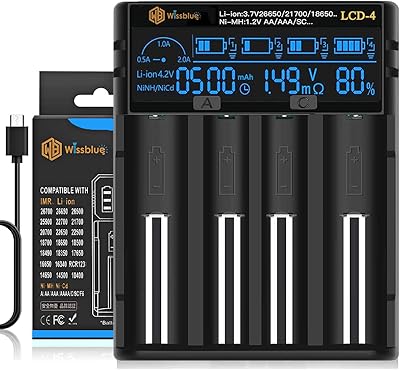
WISSBLUE LCD-4 4-Slot 18650 Battery Charger
81%
88%
LCD Display Quality
86%
Charging Speed
91%
Battery Compatibility
83%
Build Quality
67%
Capacity Reading Accuracy
More
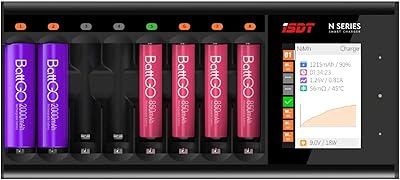
ISDT N8 8-Slot AA/AAA Battery Charger
78%
91%
Independent Channel Performance
78%
Chemistry Compatibility
84%
Build Quality
83%
Display & Interface
86%
Charging Speed
More
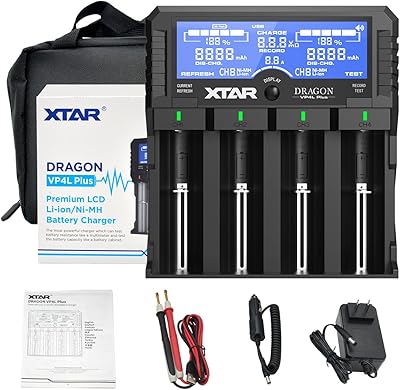
XTAR VP4 Plus 4-Slot Battery Charger Analyzer
79%
91%
Charging Accuracy
93%
Battery Compatibility
88%
Diagnostic Depth
86%
Display Clarity
84%
Capacity Test Accuracy
More
Nitecore Q6 Six Slot Battery Charger
86%
92%
Charging Performance
89%
Value for Money
88%
Build Quality
85%
Ease of Use
90%
Safety Features
More
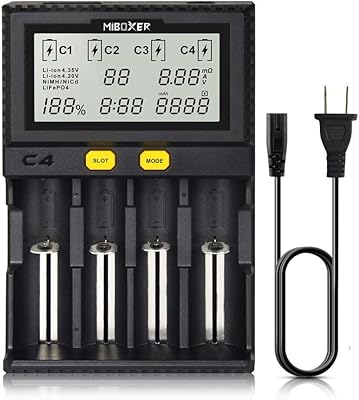
MiBOXER C4 4-Bay Battery Charger
86%
88%
Charging Performance
91%
Usability & Ergonomics
89%
Battery Compatibility
85%
Build Quality
93%
Display & Visuals
More
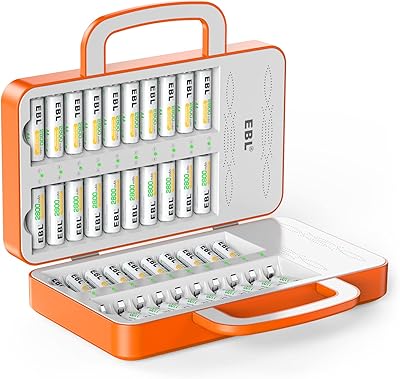
EBL C880 40-Slot Battery Charger
84%
88%
Charging Performance
82%
Build Quality
85%
Ease of Use
90%
Cooling Efficiency
91%
Safety Features
More
ISDT A8 Air 8-Slot Battery Charger
79%
91%
Build Quality
84%
Charging Speed
93%
Independent Channel Performance
62%
App Experience
88%
Battery Chemistry Compatibility
More

FAQ

Yes, the charger handles mixed loads across its four slots simultaneously. You can have a 21700 Li-ion in one slot and a Ni-MH AA in another without any issue — each slot operates independently and auto-detects the chemistry.

Protected 21700 cells are explicitly supported, so physical fitment is not a problem. The slot rails are spaced to accommodate the slightly longer protected variants, which is worth knowing since some four-slot chargers in this category struggle with them.

You can, but with realistic expectations. The 5V USB output works fine for topping off a phone in a pinch, but it draws from the charger's input power, not from stored battery capacity, so the unit needs to be plugged into a wall or power bank at the same time. It is a convenience feature, not a standalone power bank.

When a Li-ion cell is over-discharged — usually from being left unused too long — its voltage can drop below the threshold most chargers will accept. Instead of rejecting the cell outright, the XTAR X4 4-Slot Li-ion Battery Charger applies a small trickle current to nudge the voltage back up to a recoverable level before switching to normal charging. It does not save every dead cell, but it gives over-discharged batteries a meaningful second chance.

With both slots running at 2A, two 18650 cells rated around 2500mAh typically finish in roughly 90 minutes. Larger capacity cells, or those charged at a lower current setting to extend their lifespan, will take proportionally longer.

Yes, any standard Micro USB cable and a USB wall adapter will work. That said, the output wattage of the adapter affects how quickly the charger performs, so using a low-power 5W brick may limit charge speed across multiple slots. The included QC 3.0 adapter is the better choice for full performance.

The display is clear and well-organized at normal arm's length — voltage, percentage, and current are all visible without straining. It does not have adjustable brightness, though, so in a very bright environment you may need to angle it slightly to cut glare.

It is a legitimate pattern that shows up in longer-term reviews. Most buyers find the springs strong and reliable out of the box, but with heavy daily use over many months, some have noticed reduced contact tension. Rotating cells frequently and avoiding oversized cells that stress the rails can help extend the mechanism's life.

Absolutely, and it is one of the more practical features on this multi-chemistry charger. Each slot can be manually set to 0.5A, 1A, or 2A, so you can run older or lower-capacity cells at a slower rate to reduce heat and stress. It takes longer, but it is a worthwhile trade-off for extending battery lifespan.

The AC input supports up to 240V, which covers North American 120V and European 240V grids without a separate voltage converter. You may still need a plug adapter for the physical socket shape depending on your destination, but the charger itself is voltage-universal.