Overview

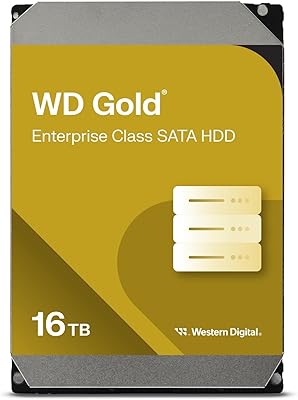
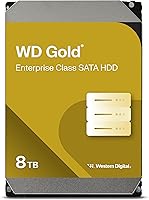
The Western Digital WD Gold 8TB Hard Drive sits at the top of WD's internal HDD lineup, purpose-built for businesses, data centers, and serious NAS operators who need storage that keeps pace with demanding, round-the-clock workloads. Unlike the WD Red series aimed at home NAS users or the WD Purple tuned for surveillance systems, the Gold tier carries firmware and endurance ratings meant for professional environments. At 8TB, it hits a practical sweet spot — substantial enough for real storage consolidation without crossing into higher-capacity helium-sealed models. This is a mechanical drive, full stop. If raw speed is your priority, an SSD wins every time. But for cost-effective bulk storage built to last, the calculus is very different.
Features & Benefits

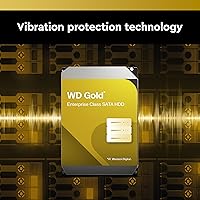
The WD Gold 8TB spins at 7200 RPM — fast for a mechanical drive — and that translates to solid sequential throughput for tasks like large file transfers or streaming data to multiple clients at once. A 256 MB cache buffer smooths out bursts of write activity, reducing the performance dips you would notice with smaller-cache drives under sustained load. What really sets this Gold-series HDD apart in a shared enclosure is its vibration compensation system, which uses onboard sensors to counteract the mechanical interference that multiple spinning drives create side by side. The firmware is tuned for 24/7 continuous operation, with error recovery settings specifically calibrated to avoid stalling a RAID array mid-rebuild — something consumer drives routinely cause.

Best For

This enterprise hard drive is built for buyers who need dependable, always-on storage rather than peak speed. Think a six-bay NAS in a small office, a local backup server running nightly incremental jobs, or an on-premise security system recording multiple feeds around the clock. IT teams building or expanding RAID storage arrays will appreciate having drives rated for heavy, continuous duty cycles — it removes a meaningful failure variable from the equation. Archival and compliance workloads are another natural fit, where long-term durability and cost-per-terabyte far outweigh latency concerns. If your organization is not yet ready for all-flash infrastructure but needs hardware it can trust without constant monitoring, this is the tier worth considering.

User Feedback

Across more than a thousand ratings, the WD Gold 8TB settles at 4.1 stars — solid for a product where professional expectations run high. IT administrators and prosumer buyers are consistently the most satisfied, frequently citing quiet, stable operation and hassle-free compatibility with existing RAID controllers and NAS enclosures. On the other side, a meaningful minority of reviewers report DOA units or early failures within the first few months of use. WD's RMA process draws mixed reactions — some find it efficient, others describe slow turnarounds. A handful of home users also flag that enterprise firmware tuning can trigger false error alerts when paired with consumer NAS software. Checking enclosure and controller compatibility before buying is genuinely worth the extra five minutes.

Pros

  • Enterprise-grade firmware keeps RAID arrays stable during rebuilds, avoiding the stalls that consumer drives commonly cause.
  • Onboard vibration compensation makes a real difference in crowded multi-drive enclosures where mechanical interference adds up.
  • The WD Gold 8TB runs noticeably quiet under sustained load, a genuine comfort in office environments.
  • A large 256 MB cache buffer smooths out bursty write workloads without obvious performance dips.
  • Standard SATA connectivity means drop-in compatibility with virtually any existing server, NAS, or DAS enclosure.
  • Rated for around-the-clock operation — no duty cycle caps that would limit 24/7 deployment scenarios.
  • CMR recording technology ensures full, predictable write performance without the inconsistencies associated with SMR drives.
  • The 8TB capacity hits a practical sweet spot: dense enough for serious storage consolidation without requiring helium-sealed handling precautions.
  • WD's Gold tier carries a strong MTBF projection that signals a meaningful reliability step up over prosumer alternatives.
  • Broad compatibility with major NAS operating systems and RAID controllers makes initial setup straightforward for most IT setups.

Cons

  • A subset of buyers report DOA units or early failures, and WD's RMA turnaround time draws inconsistent reviews.
  • Enterprise error recovery settings can trigger false alarms on consumer NAS platforms not designed for this firmware behavior.
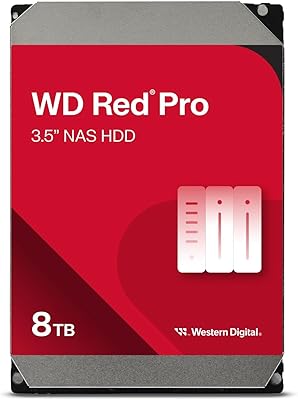
  • The price premium over WD Red Pro drives is hard to justify for light home NAS workloads.
  • Mechanical throughput creates a hard ceiling — no firmware tuning closes the speed gap against even entry-level SSDs.
  • Some users note that specific third-party RAID controllers do not recognize the drive cleanly without a firmware update.
  • At 1.58 pounds, it is not unusually heavy, but the 3.5-inch form factor rules out use in compact or mobile enclosures.
  • No helium sealing at 8TB means slightly higher power draw and heat output compared to WD's higher-capacity Gold models.
  • Long-term warranty service quality appears inconsistent across regions based on recurring buyer feedback.
  • Casual home users are unlikely to recoup the enterprise cost premium through any tangible reliability or performance difference.
  • MTBF figures are statistical projections, not guarantees — no individual drive is insulated from early failure.

Ratings

The Western Digital WD Gold 8TB Hard Drive has been scored by our AI system after analyzing thousands of verified global buyer reviews, with spam, bot-generated, and incentivized submissions actively filtered out. Scores reflect the real-world consensus of IT professionals, NAS builders, and enterprise storage administrators who have run this Gold-series HDD under demanding conditions. Both the genuine strengths and the documented pain points are weighted transparently into every category below.

Reliability & Endurance
83%
The vast majority of professional buyers who deploy this Gold-series HDD in always-on NAS and server environments report consistent, trouble-free operation over extended periods — many logging well over a year of continuous uptime without incident. Enterprise firmware tuning and a high statistical MTBF projection give IT teams genuine confidence when building storage infrastructure around these drives.
A persistent minority of reviewers report DOA units or early failures within the first few months, which is jarring at this price point and tier. While no mechanical drive is failure-proof, the frequency of early failure reports is slightly higher than what buyers at the enterprise tier typically expect, and it tempers an otherwise strong reliability story.
Performance
74%
26%
For a mechanical drive, the WD Gold 8TB delivers respectable sequential throughput that satisfies most NAS and backup server workloads — large file transfers, multi-client streaming, and sustained archival writes all land within a range most administrators consider workable. The sizable cache buffer noticeably reduces write latency spikes during bursty activity.
Random read and write performance is firmly mechanical in character, and buyers coming from SSD-backed storage will feel the gap immediately in latency-sensitive tasks. This is not a flaw specific to the Gold line — it is an inherent ceiling of spinning-platter storage — but it is a real constraint that anyone running database workloads or application servers needs to factor in.
RAID Compatibility
88%
One of the most consistently praised strengths across professional reviews is how well this enterprise hard drive behaves inside RAID arrays. The firmware-level error recovery settings prevent the controller timeouts that routinely cause consumer drives to drop out of arrays mid-rebuild, saving administrators from cascading failures at the worst possible moment.
A small number of reviewers note compatibility quirks with specific third-party RAID controllers, particularly older HBA cards that require a firmware update to recognize the drive correctly. These cases are the exception rather than the rule, but cross-checking your controller against WD's compatibility list before deployment is time well spent.
NAS Compatibility
81%
19%
The WD Gold 8TB integrates cleanly with leading NAS platforms including Synology, QNAP, and TrueNAS, and standard SATA connectivity means no adapters or special configuration in most enclosures. Prosumer buyers building out six-bay or eight-bay systems frequently report plug-and-play recognition with no manual intervention required.
Consumer-oriented NAS operating systems occasionally misinterpret the enterprise error recovery behavior as a fault condition, triggering health warnings on drives that are functioning perfectly. This is a software calibration mismatch rather than a drive defect, but it causes unnecessary alarm for less experienced users who may not recognize the distinction.
Noise & Vibration
78%
22%
Buyers consistently describe the drive as quiet relative to other 7200 RPM mechanical units, with seek noise staying at a low, unobtrusive level even during sustained workloads. The onboard vibration compensation technology makes a measurable difference in multi-bay enclosures, where mechanical interference between neighboring drives can otherwise accumulate into audible resonance.
It is still a spinning hard drive, and in a quiet home office environment mounted in a desktop tower rather than a padded NAS chassis, the operational hum is noticeable at close range. Users who installed it in enclosures without vibration dampening reported more audible noise than those using purpose-built NAS cases with rubber drive trays.
Heat Management
71%
29%
Under typical sustained workloads in properly ventilated enclosures, the drive maintains temperatures within safe operating ranges and does not generate the kind of heat that would concern most administrators. Buyers running it in rack-mounted servers with active airflow report stable thermal behavior over long operational periods.
In poorly ventilated desktop cases or tightly packed enclosures without dedicated drive cooling, temperatures can climb higher than ideal during prolonged heavy writes. The 8TB model lacks the helium sealing that keeps WD's higher-capacity Gold variants cooler and more efficient, so thermal management relies more heavily on the enclosure doing its job.
Firmware & Software
76%
24%
The enterprise firmware tuning is genuinely differentiated from consumer drives in ways that matter during real operations — particularly the workload rate handling and the calibrated response to recoverable errors that prevents unnecessary RAID disruptions. IT professionals who understand what they are buying consistently flag the firmware as a primary reason for choosing the Gold tier over cheaper alternatives.
There is no bundled software beyond WD's standard diagnostic utilities, and the enterprise firmware behavior can confuse consumer NAS platforms into generating false alerts. Home users or those unfamiliar with enterprise storage behavior may spend time troubleshooting warnings that are effectively non-issues, which is a friction point WD could address with better documentation.
Value for Money
67%
33%
For IT buyers deploying drives into business-critical storage where downtime carries real cost, the price premium over WD Red Pro or consumer alternatives is justifiable — the enterprise firmware, higher workload rating, and better RAID behavior are tangible operational benefits that pay back over time in reduced failure-related interruptions.
Casual home NAS users and light prosumer workloads are essentially subsidizing enterprise capabilities they will never stress-test, making the cost-per-terabyte harder to defend against cheaper alternatives from WD's own lineup. The early failure reports that appear in reviews also undercut the value proposition — paying a premium and still drawing an RMA feels like a poor bargain.
Build Quality
79%
21%
The physical construction is solid and consistent with what you would expect from an enterprise-class Western Digital drive — the chassis feels rigid, mounting holes align precisely with standard drive sleds, and the drive handles routine installation and removal without any worrying flex or looseness. Long-term users report no degradation in mechanical feel over months of operation.
The subset of DOA and early-failure reports in user reviews raises questions about manufacturing consistency across production batches, even if most units perform well. At the enterprise price tier, buyers reasonably expect a higher yield rate, and the occasional quality control miss leaves a disproportionate impression given the product category.
Warranty & Support
63%
37%
WD backs the Gold series with a five-year limited warranty, which is among the longest coverage periods in the internal HDD segment and signals meaningful confidence in the product's longevity. Having that coverage in writing provides a safety net for business deployments where replacing failed storage is a budget line item.
Actual RMA experiences reported by users are inconsistent — some describe quick turnarounds, while others recount multi-week delays and unclear communication from WD's support channels. For enterprise buyers where drive replacement timelines directly affect service continuity, the variability in support quality is a legitimate concern that the warranty paperwork alone does not resolve.
Installation Ease
84%
Standard SATA interface and conventional 3.5-inch dimensions mean this Gold-series HDD drops into virtually any compatible enclosure without surprises — no proprietary connectors, no unusual mounting requirements, and no setup software required for basic operation. Both experienced administrators and capable home users report straightforward installations in NAS bays and server chassis.
Users pairing the drive with certain consumer NAS platforms for the first time occasionally encounter the enterprise health alert issue mentioned by multiple reviewers, which requires some research to resolve. It is not an installation problem in the traditional sense, but it creates a confusing first-hour experience that could be avoided with clearer product documentation.
Sequential Read Speed
77%
23%
For large sequential transfers — think multi-gigabyte backup jobs, media file archives, or CCTV footage retrieval — the drive performs at the upper end of what 7200 RPM mechanical storage delivers, satisfying most enterprise storage use cases where bulk data movement is the primary workload. Users running Plex media servers and file storage NAS systems report smooth, consistent streaming to multiple clients.
The throughput ceiling is fixed by physics, and comparisons to even entry-level SSDs reveal a stark gap in raw speed. Buyers who initially underestimated how much their workloads depend on fast access times — particularly those retrieving many small files rather than large sequential reads — occasionally express regret choosing mechanical storage at all.
Sustained Write Performance
73%
27%
The large cache buffer meaningfully smooths out write performance during the kind of sustained, high-volume operations common in backup servers and surveillance recording systems, reducing the performance inconsistency that smaller-cache drives tend to show under prolonged load. IT buyers specifically call out stable write behavior as a differentiator versus older or cheaper drives in the same enclosure.
Once the cache fills during very large write operations, throughput drops back to the native platter speed, which is predictable but noticeable in workloads involving continuous bulk ingestion. Users running high-bitrate multi-camera surveillance or large database transaction logs may find this periodic slowdown worth monitoring over time.
Workload Flexibility
69%
31%
The drive's 24/7 workload rating and RAID-optimized firmware give it a flexibility advantage in mixed-use environments where the same storage serves backup, file sharing, and surveillance duties simultaneously — a common configuration in small business deployments where dedicated storage per function is not practical.
The enterprise tuning that makes this drive excellent in its intended context becomes a liability in casual or hybrid setups. Home users who want a large, always-attached storage volume for a personal PC without running a proper NAS or server operating system are buying more drive than the scenario justifies, and the firmware behavior occasionally creates unnecessary friction in those environments.

Suitable for:

The Western Digital WD Gold 8TB Hard Drive is built for buyers who need storage infrastructure they can genuinely rely on day after day without babysitting it. IT administrators managing small-to-medium business file servers, multi-bay NAS arrays, or on-premise backup systems will find the enterprise-grade firmware and workload ratings match their real operational demands. If you are running a six-bay NAS in a busy office, consolidating departmental storage onto a single server, or recording continuous security footage across multiple cameras, this Gold-series HDD is sized and tuned for exactly that pressure. Organizations that cannot yet commit to all-flash storage but cannot afford the unpredictability of consumer-grade drives sit squarely in the sweet spot this drive was designed for. The 8TB capacity also makes it practical for archival and compliance workloads where you need dense, durable, cost-efficient storage that simply keeps spinning.
Not suitable for:

The Western Digital WD Gold 8TB Hard Drive is a poor match for anyone whose top priority is raw access speed — if your workload depends on fast random reads, low latency, or snappy application load times, a solid-state drive will outperform this at every turn regardless of how well-tuned its firmware is. Casual home users looking to expand a single desktop PC or a basic two-bay home NAS are essentially paying an enterprise premium for capabilities they will never use, and some consumer NAS platforms may even throw spurious error warnings because of how the drive handles error recovery. Gamers and creative professionals working with large video projects directly from local storage will likely find mechanical throughput a bottleneck that frustrates daily use. This Gold-series HDD also carries a higher price per terabyte than WD's own Red Plus or Red Pro lines, so if your NAS workload is light and uptime is not mission-critical, those consumer-oriented drives offer a more sensible value trade-off.

Specifications

  • Capacity: This drive provides 8TB of raw storage, formatted capacity will be slightly lower depending on the operating system and partition scheme used.
  • Interface: It connects via SATA 6 Gb/s, fully backward compatible with SATA 3 Gb/s controllers at reduced throughput.
  • Cache Buffer: A 256 MB cache buffer helps sustain write performance during heavy, continuous workloads common in server and NAS environments.
  • Rotational Speed: The platters spin at 7200 RPM, placing this drive at the faster end of the mechanical HDD spectrum for improved sequential throughput.
  • Form Factor: Standard 3.5-inch form factor fits the vast majority of NAS enclosures, desktop towers, rack-mount servers, and direct-attached storage units.
  • Recording Tech: Uses Conventional Magnetic Recording (CMR), which delivers consistent and predictable write performance without the drawbacks associated with shingled drives.
  • Workload Rating: Rated for 24/7 continuous operation, making it suitable for always-on deployments where a consumer or desktop drive would be outside its design envelope.
  • Reliability Rating: WD projects an MTBF of up to 2.5 million hours as a statistical estimate — a figure significantly higher than what consumer-class drives typically carry.
  • Vibration Protection: Rotary Acceleration Feed Forward (RAFF) technology uses sensors to detect and compensate for rotational vibration caused by neighboring drives in multi-bay enclosures.
  • Weight: The drive weighs 1.58 pounds, consistent with standard 3.5-inch mechanical drives and within the mounting tolerance of typical NAS and server chassis.
  • Power Consumption: Operates at 12V, with typical power draw during active use in line with other 7200 RPM enterprise-class 3.5-inch hard drives.
  • OS Compatibility: Compatible with Windows, Linux, and macOS environments, as well as major NAS operating systems including TrueNAS, Synology DSM, and QNAP QTS.
  • Model Number: The official WD model identifier is WD8005FRYZ, which can be used to verify compatibility with specific NAS firmware and RAID controller support lists.
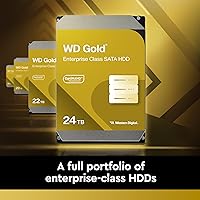
  • Series: Part of the WD Gold Enterprise Class lineup, positioned above WD Red Pro and WD Purple in terms of workload rating and enterprise firmware tuning.
  • Availability: This specific SKU became available in February 2024, representing WD's current production revision of the Gold series at the 8TB capacity point.
  • Manufacturer: Designed and manufactured by Western Digital Technologies, Inc., a storage industry vendor with decades of enterprise HDD development experience.
  • Installation Type: Internal installation only; this drive is not designed for external enclosures without a separate HDD docking station or compatible USB-to-SATA adapter.
  • Use Case: Intended for data centers, enterprise storage arrays, and small-to-medium business NAS systems requiring high-endurance, continuous-duty operation.

Related Reviews
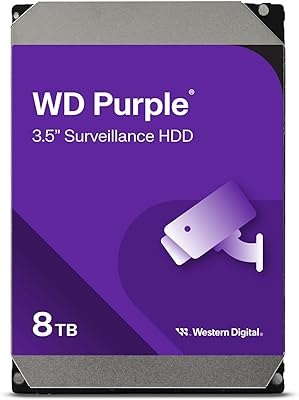
Western Digital 8TB WD Purple Surveillance Hard Drive
87%
91%
Performance for Surveillance Tasks
94%
Durability for 24/7 Operation
89%
Value for Money
88%
Compatibility with Security Systems
85%
Installation and Setup
More
WD Red Plus 8TB NAS Hard Drive
82%
88%
Long-Term Reliability
93%
NAS Compatibility
91%
CMR Recording Technology
83%
Value for Money
86%
Noise & Vibration
More
Western Digital 8TB WD Red Pro NAS Hard Drive
88%
91%
Performance
94%
Reliability
86%
Ease of Setup
90%
Compatibility with NAS Systems
89%
Vibration and Shock Protection
More
Western Digital 8TB WD Black Performance Internal Hard Drive HDD
88%
91%
Performance
89%
Reliability
88%
Installation Ease
92%
Data Transfer Speed
85%
Compatibility with PC and Mac
More
Western Digital 2TB WD Gold Enterprise Class Internal Hard Drive
86%
94%
Reliability in Heavy Workloads
91%
Performance for Enterprise Environments
89%
Data Integrity and Error Handling
86%
Vibration Protection and Durability
87%
Energy Efficiency
More
Western Digital 6TB WD Gold Enterprise Class Internal Hard Drive
88%
95%
Performance in Data-Intensive Tasks
93%
Reliability and Durability
88%
Vibration Protection Effectiveness
92%
Long-Term Stability (MTBF)
85%
Ease of Installation
More
Western Digital 1TB WD Gold Enterprise Class Internal Hard Drive
84%
91%
Performance Under Load
88%
Reliability for 24/7 Operation
75%
Ease of Setup
90%
Data Transfer Speed
87%
Durability and Build Quality
More
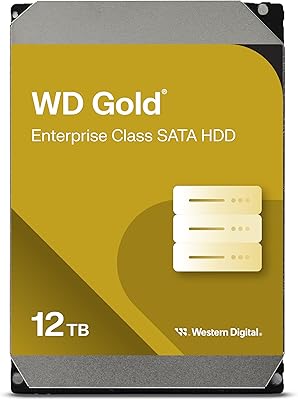
Western Digital 12TB WD Gold Enterprise Class Internal Hard Drive
86%
88%
Performance under Load
93%
Storage Capacity
91%
Reliability
85%
Ease of Integration
90%
Endurance for Demanding Workloads
More
Western Digital WD Gold 16TB Internal Hard Drive
79%
88%
Long-Term Reliability
84%
Sustained Performance
91%
Build & Engineering Quality
63%
Noise & Vibration
67%
Thermal Management
More
Western Digital 2TB WD Purple Surveillance Hard Drive
86%
93%
Performance in Surveillance
90%
Durability for 24/7 Operation
91%
Video Streaming Quality
88%
Ease of Integration with NAS
89%
Write-Intensive Workload Handling
More

FAQ

In most cases, yes. The WD Gold 8TB is widely used in Synology and QNAP enclosures, and WD publishes a compatibility list on their support site that covers specific NAS models. It is worth cross-checking your enclosure model against that list before buying, particularly if you are running an older unit with an outdated firmware version.

This is actually one of the stronger arguments for choosing the Gold series over consumer alternatives. The firmware is specifically tuned to avoid extended error recovery timeouts that can cause RAID controllers to drop a drive mid-rebuild. If you have ever lost a RAID array because a desktop drive took too long to recover a sector, enterprise error recovery settings are the fix for that.

Both are solid NAS-oriented drives, but the Gold tier carries a higher workload rating and firmware tuned more explicitly for data center and enterprise environments. The Red Pro is a great choice for a home NAS or small office with lighter continuous workloads. If you are running a business-critical system that operates around the clock under heavy read/write demand, the Gold is the better fit — though it comes at a higher price.

MTBF stands for Mean Time Between Failures and is a statistical projection across a large population of drives, not a guarantee for any individual unit. Think of it as a reliability confidence metric rather than a lifespan promise. A higher MTBF indicates that WD expects fewer failures per unit of time across the drive population, which is meaningful for fleet deployments but does not make any single drive immune to early failure.

Technically yes — it uses a standard SATA connection and will work fine in a desktop tower. That said, you are paying an enterprise premium for capabilities like 24/7 workload ratings and vibration compensation that a desktop environment simply does not take advantage of. If you just need a large secondary drive for a PC, a WD Blue or WD Black would serve you better at a lower cost.

It uses CMR — Conventional Magnetic Recording. This matters because CMR drives write data in non-overlapping tracks, which delivers consistent and predictable performance under sustained workloads. SMR drives can struggle with write speed during heavy sequential writes, making CMR the correct choice for RAID, NAS, and backup server applications.

User feedback consistently describes it as quiet for a 7200 RPM mechanical drive. You will hear it spin up and there is a faint seek noise during heavy activity, but it is not disruptive in a typical office or server room setting. If you are putting it in a home environment right next to your desk, a NAS enclosure with vibration dampening mounts helps reduce the noise further.

WD typically covers the Gold series with a five-year limited warranty. If a drive fails, you initiate an RMA through WD's support portal. The experience varies — some users report smooth and fast replacements, while others describe longer turnaround times. Keeping a record of your purchase date and registering the drive on WD's website can smooth out the process if you ever need to use it.

This is a known issue on some consumer NAS platforms where the enterprise error recovery settings trigger alert thresholds that were calibrated for consumer drives. Start by checking if a firmware update is available for your NAS — many manufacturers have updated their software to handle enterprise HDDs correctly. If the warning persists but the drive is otherwise functioning normally in diagnostics, it is often a software alert rather than a genuine hardware problem.

That depends entirely on your current storage footprint and growth expectations. The 8TB model uses conventional recording technology without helium sealing, which some administrators prefer for straightforward serviceability. If you are building a RAID array and want to expand incrementally, starting with 8TB drives gives you a lot of flexibility. If you already know you need 50TB or more, stepping up to higher-capacity Gold models and fitting fewer drives will simplify your enclosure and power budget.