Overview

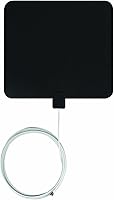
The Winegard FlatWave FL-5000 Indoor TV Antenna is the kind of product that makes cutting the cable cord feel surprisingly straightforward. Winegard has been building antennas in the USA for nearly six decades, and that track record shows. This flat indoor antenna sits in the mid-range price tier — not a throwaway bargain, but well short of the amplified premium options that cost significantly more. It ships ready to use out of the box with a 15-foot coaxial cable already included, no tools required. The ultra-thin body flips between a black or white face, a small but genuinely useful detail for keeping things tidy in any living space.
Features & Benefits

The Winegard FlatWave covers a 35-mile reception range without any amplifier, which handles the vast majority of suburban and urban homes with ease. It picks up both H-VHF and UHF frequencies, meaning the major broadcast networks are all fair game wherever local towers reach. The included 15-foot coaxial cable is longer than what most competing flat antennas bundle in, giving real flexibility to position it near a window or higher on a wall. At 12 inches by 13 inches, it is compact enough to mount or simply rest on a shelf, and the made-in-USA construction gives it a noticeable build quality edge over cheaper imports.

Best For

This cord-cutting antenna is a strong fit for anyone living within 35 miles of a broadcast tower in a suburban or urban area. It is also a natural pick for renters and apartment dwellers who cannot mount anything outside. First-time users will appreciate that there is no setup learning curve — just plug in, run a channel scan, and you are done. For households already paying for a streaming service and simply wanting free local news, live sports, and network primetime without a monthly fee, the Winegard FlatWave fills that gap well. Push beyond 30 to 35 miles from your towers, though, and an amplified model becomes the smarter call.

User Feedback

Across close to 9,000 ratings, this flat indoor antenna holds a solid 4.0 out of 5 — a score built on consistent real-world performance rather than novelty. Buyers in metro and suburban areas consistently highlight strong channel pickup and dead-simple installation as the standout wins. The reversible design earns genuine praise too; it is one of those practical touches people notice after the fact. On the critical side, users in rural or fringe locations report patchy results, which is expected for any non-amplified antenna near its range ceiling. A portion of buyers flag that pushing past roughly 25 to 30 real-world miles often calls for stepping up to an amplified unit. Build quality earns consistent marks throughout.

Pros

  • Genuinely plug-and-play setup takes under five minutes with no tools or prior knowledge needed.
  • The reversible black-and-white panel blends cleanly into most living spaces without drawing attention.
  • A 15-foot coaxial cable is included, giving real flexibility to find the strongest signal spot.
  • Built in the USA, with long-term owners reporting solid durability over multiple years of use.
  • Supports both H-VHF and UHF bands, covering a broader channel range than budget single-band alternatives.
  • No power supply or amplifier needed — fewer components means fewer points of failure.
  • Wall-mount hardware uses adhesive strips, making it renter-friendly with no drilling required.
  • Strong channel pickup in metro and suburban areas within range is consistently confirmed by thousands of real users.
  • At its mid-range price, it outperforms cheaper throwaway antennas in build quality and signal consistency.

Cons

  • Performance drops significantly beyond 25 to 30 real-world miles, well short of the advertised 35-mile ceiling.
  • The coaxial cable is permanently attached — a damaged cable means replacing the entire unit.
  • Rural buyers and those in semi-obstructed locations report frequent dropouts and unreliable channel holds.
  • Adhesive wall-mount hardware does not grip reliably on textured or painted walls over extended time.
  • No amplification option means there is no upgrade path if your signal environment changes.
  • Channel count depends entirely on tower proximity — some users in smaller markets see disappointing scan results.
  • Signal stability can weaken during heavy rain or wind for users already near the range edge.
  • The panel size, at 12 inches by 13 inches, is noticeable in smaller rooms with limited wall or shelf space.

Ratings

The Winegard FlatWave FL-5000 Indoor TV Antenna scores below are generated by AI after analyzing thousands of verified global user reviews, with spam, bot activity, and incentivized feedback actively filtered out. This flat indoor antenna earns strong marks in several key areas, though real pain points — particularly around range limitations and amplification — are reflected just as transparently as the wins. The result is an honest snapshot of what actual cord-cutters experience day to day.

Reception Quality
78%
22%
In metro and suburban areas within 25 to 30 miles of broadcast towers, most users report picking up the major networks cleanly in HD with minimal fuss. Buyers in mid-sized cities frequently mention getting more channels than expected on the first scan, which builds immediate confidence in the antenna.
Push past 30 miles or add any physical obstructions — thick walls, hills, neighboring buildings — and signal consistency drops noticeably. Rural users in particular report frustrating dropouts during weather changes, and some channels that scan successfully do not hold a stable picture.
Ease of Setup
93%
Plug in the coax cable, run a channel scan, done. That really is the full process, and reviewers across all experience levels confirm it takes under five minutes. First-time antenna users specifically call out how confidence-building the setup is compared to their expectations.
A small number of users hit a wall when their TV's channel scan comes up short, often because their set is positioned poorly relative to the tower. The antenna itself is blameless in those cases, but troubleshooting placement is not always obvious without external tools like a signal finder app.
Signal Stability
72%
28%
For households well within the rated range, day-to-day signal stability is genuinely solid — channels stay locked in during normal viewing, and there is no constant retuning needed. Users watching live sports and local news in suburban homes report reliable performance through regular programming hours.
Signal stability degrades more than expected during heavy rain or high winds for users near the range ceiling. A handful of reviewers note that channels strong enough to scan during setup occasionally drop in the evenings, which points to atmospheric interference that a non-amplified antenna cannot overcome.
Build Quality
84%
The made-in-USA origin comes through in how the antenna feels compared to cheaper imports — the panel has a firmness to it and the connector port feels properly secured. Several long-term owners who have had the unit for multiple years report no physical degradation or connector loosening.
The coaxial cable, while a generous length, draws occasional criticism for feeling thinner than expected given the antenna's overall quality. A few users also note that the included cable is not easily replaceable with a standard aftermarket cord without a small adapter.
Design & Aesthetics
88%
The reversible black-and-white panel is a legitimately thoughtful detail — renters and apartment dwellers particularly appreciate being able to flip it to match wall color without buying a different unit. Mounted flat against a white wall, it nearly disappears, which is exactly what most living room setups need.
At 12 inches by 13 inches, it is not tiny, and in smaller rooms with limited wall space it can feel more prominent than expected. A minority of users who preferred to place it on a shelf found the flat profile prone to sliding without the wall mount.
Cable Length & Flexibility
86%
The 15-foot coaxial cable is one of the most consistently praised practical details in user reviews. It gives enough reach to position the antenna near a window or higher on a wall without needing an extension cable right out of the box.
While 15 feet covers most room configurations, buyers with TVs placed far from exterior walls in larger rooms occasionally still need an extension. The cable is also permanently attached, so if it gets damaged, the whole unit is effectively compromised.
Channel Count
67%
33%
Users in densely served metro markets like major US cities report channel counts well into the 40s and 50s after a full scan, covering news, sports, weather, and niche subchannel networks. That breadth genuinely surprises buyers coming from cable.
Channel count is entirely dependent on geography, and this antenna cannot change that reality. Buyers in smaller markets or semi-rural areas sometimes end up with only a handful of usable channels, which creates a gap between the marketed potential and lived experience.
Value for Money
81%
19%
At its mid-range price point, the Winegard FlatWave delivers tangibly better build and reception consistency than the budget antennas it sits above. For someone cutting cable and offsetting a monthly bill, the payback period is measured in weeks, not months.
It costs noticeably more than thin paper-style antennas that perform similarly in strong-signal areas, and it costs less than amplified models that outperform it in weaker-signal zones. Buyers right on the range edge may find themselves wishing they had spent the extra amount on amplification from the start.
Amplification
51%
49%
For urban and close-in suburban users, the absence of an amplifier is actually an advantage — no power supply needed, no amplifier noise introduced into the signal, and one fewer component to fail over time.
The lack of amplification is the single most common reason buyers leave negative reviews. Anyone more than 25 to 30 real-world miles from towers, or blocked by buildings or terrain, will likely need to step up to an amplified model. The non-amplified design is a firm ceiling that placement alone cannot always overcome.
Mounting & Placement Options
77%
23%
The antenna works mounted on a wall or laid flat, and neither option requires drilling — adhesive strips handle the wall mount cleanly. Renters especially appreciate that it leaves no permanent marks, which makes experimentation with placement actually practical.
The wall-mount hardware included is minimal, and on textured or painted drywall the adhesive does not always hold long-term. A few users report the antenna gradually sliding or falling from walls after several weeks, requiring tape or a more permanent mounting solution.
Frequency Coverage
82%
18%
Supporting both H-VHF and UHF bands means the antenna does not leave major network channels on the table in markets where VHF broadcasting is still active. This broader coverage is a real technical advantage over ultra-budget antennas that skip VHF entirely.
Coverage of the lower VHF band is not as strong as dedicated VHF antennas, and in specific markets where low-VHF channels are critical, a few users notice those channels are weaker or inconsistent. It is not a dealbreaker for most, but worth knowing if your local market is VHF-heavy.
Durability Over Time
83%
Long-term owners who have used the Winegard FlatWave for two or more years generally report no performance degradation and no physical breakdown. The US manufacturing standard appears to hold up better than the lifecycle many buyers expect from electronics at this price tier.
There are isolated reports of the coaxial connector developing a loose fit after extended use, particularly if the cable is frequently repositioned. Once that connector loosens, signal drops become unpredictable and the fix is not straightforward without replacing the unit entirely.
Packaging & Out-of-Box Experience
79%
21%
The packaging is clean and minimal, and everything needed is inside — antenna, coaxial cable, and mounting hardware. There is no confusing instruction booklet to parse, and buyers report the unboxing experience matching the product's straightforward identity.
Documentation is thin enough that buyers unfamiliar with coaxial connections or channel scanning have to figure things out independently. A simple quick-start guide with signal-positioning tips would reduce the small but real number of users who give up before optimizing placement.

Suitable for:

The Winegard FlatWave FL-5000 Indoor TV Antenna is built for a specific kind of buyer, and for that buyer it delivers well. If you live in a suburban or urban area within roughly 25 to 35 miles of your local broadcast towers, this flat indoor antenna is likely all you need to pull in the major networks in HD without paying a monthly fee. It is a natural fit for renters and apartment dwellers who cannot mount anything on an exterior wall or rooftop — the adhesive mount leaves no damage, and the reversible panel blends into most room setups without looking like an afterthought. First-time cord-cutters who want a plug-and-play experience will appreciate that there is genuinely nothing to figure out; connect the cable, scan for channels, and you are done. It also works well as a practical complement to a streaming subscription, giving households live local news, network sports, and primetime programming without adding another monthly bill to the pile.

Not suitable for:

The Winegard FlatWave FL-5000 Indoor TV Antenna has real boundaries, and being honest about them will save some buyers a return trip. If you live more than 30 miles from your nearest broadcast towers — especially in a rural area, a basement apartment, or a home surrounded by dense trees or hills — this cord-cutting antenna will likely frustrate you. It carries no amplifier, which is fine for clean-signal environments but becomes a hard ceiling in weak-signal zones where even smart placement cannot compensate. Buyers who need to pull in distant or fringe signals, or who are in markets where low-VHF channels carry important local content, should look at amplified models instead. Similarly, if your TV sits far from any exterior wall and cable routing is already a challenge, the 15-foot cord, while generous, may still fall short without an extension. This is not a universal indoor antenna solution — it is a well-made tool for the right conditions.

Specifications

  • Brand: Manufactured by Winegard Company, a US-based antenna brand with nearly six decades of industry experience.
  • Model: The FL-5000 is the specific model identifier for this flat indoor antenna within the Winegard FlatWave product line.
  • Type: Non-amplified flat indoor TV antenna designed for over-the-air HD broadcast reception.
  • Dimensions: The antenna panel measures 12″ x 13″ x 0.02″, providing an ultra-thin, low-profile footprint.
  • Weight: The unit weighs 12.8 ounces, making it lightweight enough for easy wall mounting or shelf placement.
  • Reception Range: Rated for a maximum reception range of 35 miles from broadcast towers under optimal conditions.
  • Frequency: Supports H-VHF and UHF frequency bands, enabling compatibility with the full range of major local broadcast networks.
  • Impedance: Operates at 75 Ohm impedance, which is the standard for modern TV coaxial connections.
  • Coaxial Cable: Includes a permanently attached 15-foot coaxial cable for flexible antenna placement relative to the TV.
  • Amplified: This antenna is non-amplified and requires no external power source or USB power supply to operate.
  • Color Options: Features a reversible dual-color design with a black face on one side and a white face on the other.
  • Mounting: Compatible with both flat surface placement and wall mounting using the included adhesive hardware.
  • Origin: Designed and manufactured in the United States of America.
  • Compatibility: Works with any TV or smart TV equipped with a standard coaxial (F-type) antenna input port.
  • Signal Format: Receives free over-the-air digital HD broadcast signals, including 1080i and 720p formats where available locally.
  • First Available: This model was first made available to consumers in October 2011 and has remained in active production since.

Related Reviews
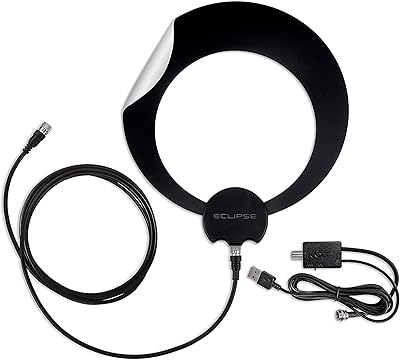
Winegard FL5500A FlatWave Amped Digital HD Indoor TV Antenna
86%
88%
Signal Reception
91%
Ease of Setup
90%
Value for Money
84%
Range Performance
87%
Build Quality
More
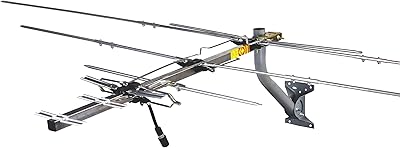
Antennas Direct ClearStream Eclipse Indoor TV Antenna
77%
74%
Signal Reception
67%
Amplifier Performance
93%
Design & Profile
91%
Ease of Setup
62%
Cable Length
More
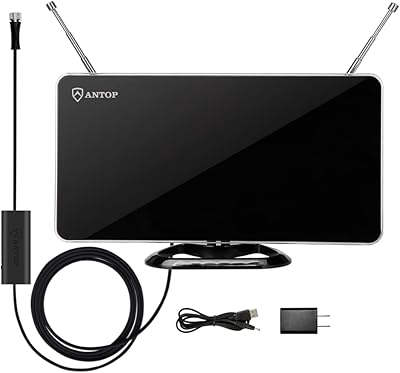
Winegard YA7000C TV Antenna
82%
88%
Reception Quality
91%
Range Performance
85%
Ease of Installation
82%
Build Quality
80%
Durability
More
Mohu Gateway Indoor TV Antenna
86%
87%
Signal Reception
92%
Setup and Installation
89%
Design and Aesthetics
90%
Value for Money
84%
Durability and Build Quality
More
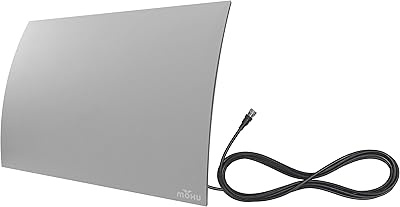
ANTOP AT-211B Indoor TV Antenna
71%
72%
Signal Reception
67%
Amplifier Performance
91%
Ease of Setup
63%
Build Quality
58%
VHF Channel Support
More
iGENJUN ANT-CS8218 Amplified Indoor Outdoor TV Antenna
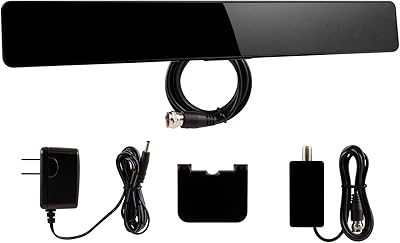
72%
73%
Signal Reception Quality
67%
Amplifier Performance
88%
Ease of Installation
48%
Range Accuracy vs. Claimed Specs
71%
Build Quality & Materials
More
UltraPro 47331 Amplified Indoor TV Antenna
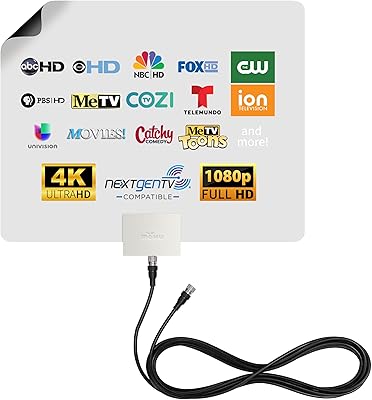
77%
74%
Signal Reception Quality
91%
Ease of Setup
88%
Design & Aesthetics
67%
Amplifier Performance
71%
Channel Count
More
YiziAifsion 2024 Upgraded Indoor TV Antenna
84%
88%
Signal Reception
85%
Picture Quality
91%
Setup & Installation
80%
Build Quality
87%
Range & Coverage
More
GE Pro Bar Indoor TV Antenna 33683
83%
85%
Reception Performance
92%
Ease of Installation
88%
Value for Money
90%
Design & Aesthetics
87%
Mounting Options
More
Mohu Leaf Plus Amplified Indoor TV Antenna
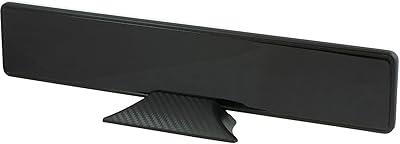
75%
72%
Signal Reception
54%
Range Accuracy
68%
Amplifier Performance
89%
Design & Aesthetics
91%
Ease of Setup
More

FAQ

No, the Winegard FlatWave FL-5000 Indoor TV Antenna requires no power supply at all. It is a passive, non-amplified antenna — just connect the coaxial cable directly to your TV and you are ready to scan for channels.

A free tool like AntennaWeb or the FCC's DTV reception map lets you enter your address and see exactly which towers are nearby and how far away they are. If the majority of your local towers fall within 25 to 30 miles, this flat indoor antenna should perform reliably. If you are closer to 35 miles or beyond, an amplified model is a safer bet.

Yes, as long as your TV has a standard coaxial antenna input — which virtually all HDTVs and smart TVs do — it will work. If you have an older analog TV without a built-in digital tuner, you would need a separate digital converter box between the antenna and the TV.

Higher up and closer to an exterior wall facing your broadcast towers is almost always better. A window placement tends to work well since glass does not block signals the way walls can. If your first scan comes up short, try repositioning the antenna a few feet in either direction — even small moves can make a real difference with indoor antennas.

Not necessarily — channel availability depends entirely on your specific location, how far you are from each tower, and what obstructions are between you and those towers. Two homes a few streets apart can get noticeably different results. Running a channel scan at your address on a site like RabbitEars or TV Fool will give you a realistic expectation before you buy.

Not directly out of the box. To split the signal to multiple TVs, you would need a coaxial signal splitter, but be aware that splitting a non-amplified antenna signal can weaken it. If you need to feed two or more TVs, an amplified antenna or a distribution amplifier is a better starting point.

For most room setups it is plenty, but it depends on where your TV sits relative to the best antenna placement spot. If your TV is far from any exterior wall or window, you may need a coaxial extension cable. Standard F-type extensions are widely available and inexpensive, so it is not a complicated fix.

Over-the-air 4K broadcasting is still in very limited rollout in the US, but this cord-cutting antenna is compatible with ATSC 3.0 signals where they are available, provided your TV supports the new standard. For standard 1080i and 720p HD broadcasts, which cover the vast majority of current local programming, it works fully.

That does happen. Wall materials, especially those with metal components or insulation, can absorb or reflect signals. If mounting kills your signal, try placing it flat on top of a bookshelf or entertainment unit near the window instead. Antenna placement is genuinely trial and error, and there is no penalty for experimenting.

The Winegard FlatWave is built to a higher standard — the materials feel more substantial, the connector is more secure, and the cable is longer than most budget options. In strong-signal areas, a cheap antenna may perform similarly day to day, but the Winegard tends to hold up better over time and handles moderate signal challenges more reliably. If you are in a marginal reception zone, that build difference starts to matter.

Where to Buy