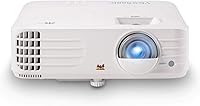
ViewSonic PX701-4K 4K Home Theater Projector

ViewSonic PX701-4K 4K Home Theater Projector — image 1
ViewSonic PX701-4K 4K Home Theater Projector — image 2

ViewSonic PX701-4K 4K Home Theater Projector — image 3
ViewSonic PX701-4K 4K Home Theater Projector — image 4
ViewSonic PX701-4K 4K Home Theater Projector — image 5
ViewSonic PX701-4K 4K Home Theater Projector — image 6
ViewSonic PX701-4K 4K Home Theater Projector — image 7
ViewSonic PX701-4K 4K Home Theater Projector — image 8
ViewSonic PX701-4K 4K Home Theater Projector — image 9
71%
29%

Overview

The ViewSonic PX701-4K 4K Home Theater Projector sits in what is arguably the toughest segment to win in home projection: the sub-$1,000 4K bracket. Released in October 2020, this ViewSonic projector continues to sell actively — not a given in a category where newer models emerge constantly. ViewSonic has a long history in display technology, and that background informs how the PX701-4K approaches its spec priorities. At 6.2 pounds, it's manageable enough to reposition or mount overhead without much effort. Its 4.1-star average across 776 Amazon ratings reflects a broadly satisfied user base, though buyer reviews reveal important nuances worth understanding before committing.

Features & Benefits

At its core, the PX701-4K puts out a native UHD (3840×2160) image at 3,200 ANSI lumens — plenty for a dark room, but not a projector you'd pit against ambient light. For gaming, the specs are legitimately strong: 4.2ms input lag combined with a 240Hz refresh rate produces a noticeably responsive experience when playing fast-paced titles on a 100-inch screen. A key detail worth knowing: those gaming figures apply at 1080p resolution; native 4K input is typically capped at 60Hz. The 1.5–1.6x throw ratio suits most living rooms, and auto keystone correction alongside 4-corner adjustment keeps setup from becoming a frustrating ordeal. Dual HDMI and a powered USB-A cover the main connectivity needs.

Best For

This 4K gaming projector is best suited to buyers who have a room where light can be controlled. Gamers stand to benefit most: at 1080p, the responsiveness approaches what you'd expect from a dedicated gaming monitor, and playing on a 100-inch image is a fundamentally different — and often better — experience than any flat panel can offer at a comparable price. Movie watchers with a proper darkened room will find the image genuinely rewarding. It's also a practical pick for households that want one device to handle both streaming and gaming without compromise. The ceiling-mount compatibility with ViewSonic's own PJ-WMK-007 bracket makes permanent installation straightforward for anyone planning a fixed setup.

User Feedback

Across its 776 Amazon reviews, the PX701-4K earns a 4.1-star rating that holds up broadly — but reading through buyer commentary reveals a more layered picture. On the positive side, image sharpness and gaming responsiveness earn consistent praise, and buyers seem genuinely pleased with what they get on a large screen. On the critical side, fan noise comes up frequently enough that it's worth taking seriously if you're watching in a quiet room. HDR is characterized by many owners as functional rather than impressive — reasonable, given how projectors at this price handle peak brightness. The built-in audio is almost universally written off, and an external speaker should be considered part of the total setup cost.

Pros

  • Native UHD 4K resolution delivers sharp, detailed images on screens up to 150 inches.
  • A 4.2ms input lag makes the PX701-4K one of the more responsive projectors in its class.
  • The 240Hz refresh rate at 1080p produces noticeably fluid motion during fast-paced gaming sessions.
  • Auto keystone and 4-corner adjustment make initial room setup straightforward without professional help.
  • At 6.2 pounds, this ViewSonic projector is light enough to reposition or adapt to a new room easily.
  • Dual HDMI ports let you keep a console and a streaming device connected at the same time.
  • The 1.5–1.6x throw ratio is forgiving enough to work comfortably in most standard living rooms.
  • SuperColor technology produces a wide, natural-looking color range that holds up well for movie content.
  • Ceiling mount compatibility with ViewSonic's own bracket makes permanent installation clean and well-supported.
  • A 4.1-star average across hundreds of real buyer reviews reflects consistent real-world satisfaction.

Cons

  • Fan noise is consistently audible and becomes a genuine distraction during quiet or dialogue-heavy scenes.
  • The built-in speakers are essentially unusable for real home theater listening — an external audio setup is a near-mandatory extra cost.
  • 3,200 lumens cannot compete with ambient light; a properly darkened room is a hard requirement, not a preference.
  • HDR support is functional rather than impressive — peak brightness at this tier falls well short of what a quality HDR flat panel produces.
  • Native 4K input is limited to 60Hz, which meaningfully caps gaming performance for those playing at full resolution.
  • Color accuracy out of the box often requires manual calibration before images look their best.
  • There are no built-in streaming apps, so an external media player or console must always be connected.
  • The 1.1x optical zoom range is narrow, meaning room placement needs deliberate planning in tighter or oddly shaped spaces.

Ratings

The scores below were produced by our AI analysis engine after processing verified global buyer feedback for the ViewSonic PX701-4K 4K Home Theater Projector, with active filtering applied to remove suspected spam, bot-generated, and incentivized submissions. Each category reflects the full ownership picture — strengths and pain points alike — so you get a transparent, ground-level view of what real buyers experience across different use cases and room setups.

Image Quality
83%
In a properly darkened room, buyers consistently describe the 4K picture as genuinely impressive for the price tier. Fine detail in films and the perceived sharpness of 3840×2160 across a 100-inch screen tends to satisfy users who are upgrading from older 1080p projectors.
Out-of-the-box color calibration leaves something to be desired, and many users note that the image benefits significantly from manual picture mode adjustments before it reaches its real potential. A minority of buyers also report edge softness at wider screen sizes near the 150-inch upper limit.
Gaming Performance
88%
At 1080p, the 4.2ms input lag and 240Hz refresh rate translate into a noticeably responsive big-screen experience that genuinely rivals dedicated gaming monitors in feel. Console players in particular praise how well fast-paced titles handle on a 100-inch display without the sluggishness typical of older projectors.
The 60Hz ceiling at native 4K resolution is a meaningful constraint that affects buyers expecting the same fluidity at full resolution. PC gamers who prefer running titles at 4K on high frame rates will find this limitation considerably more frustrating than console users who are content playing at 1080p.
Brightness
67%
33%
At 3,200 ANSI lumens, the PX701-4K holds up well under controlled dim-lighting conditions, producing a rich, punchy image during evening movie sessions or nighttime gaming. Buyers with a dedicated media room or blackout curtains consistently report real satisfaction with the overall brightness level.
Ambient light is this projector's real adversary — even moderate room lighting visibly washes out the image and reduces contrast dramatically. Buyers who assumed 3,200 lumens would handle a typical daytime living room were noticeably disappointed, making lighting control a non-negotiable part of any successful setup.
HDR Performance
57%
43%
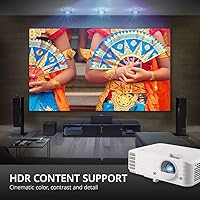
HDR10 and HLG compatibility add a visible layer of depth and color richness to supported content compared to SDR playback, and buyers watching HDR-mastered films in a dark room do notice genuine improvement in shadow detail and perceived color saturation across scenes.
At this brightness level, the projector cannot reach the peak luminance needed to deliver the kind of HDR impact that quality flat panels produce, and several buyers described the output as merely adequate. Expectations rooted in flat-panel HDR performance are likely to leave viewers meaningfully underwhelmed.
Audio Performance
31%
69%
Having any built-in audio at all provides basic utility during initial setup and casual testing, and for short-form content where audio quality is not a priority, the internal speaker is technically functional enough to confirm the unit is working correctly out of the box.
The built-in audio earns near-universal criticism across all buyer use cases — it lacks volume, bass, and clarity in a way that makes it genuinely unsuitable for any sustained watching experience. The strong consensus across hundreds of reviews is unambiguous: an external speaker or soundbar is not optional, it is essential.
Color Accuracy
71%
29%
The SuperColor wide color gamut technology gives this ViewSonic projector a solid foundation for natural-looking colors, and buyers who invest time calibrating picture mode settings report genuinely pleasing results with both film content and vibrant gaming visuals across supported color ranges.
Default factory settings tend to skew saturation and white balance noticeably, meaning the out-of-box image rarely represents what the projector is actually capable of. Buyers who set it up and leave it on default modes are unlikely to be seeing the best the hardware can deliver.
Ease of Setup
82%
18%
Auto keystone correction and the 4-corner manual adjustment make initial geometry alignment far less painful than competing projectors at this price, and most buyers report getting a properly squared image within a few minutes of first boot without needing prior projector experience.
The 1.1x optical zoom range is fairly narrow, so buyers who cannot position the projector at the ideal throw distance will need to rely on digital zoom, which introduces a noticeable image quality trade-off. Ceiling mounting, while supported, adds a layer of complexity that straightforward tabletop placement avoids entirely.
Build Quality
74%
26%
For its weight class and price tier, the PX701-4K feels solid and well-constructed, and the 6.2-pound chassis sits confidently on a shelf or projector stand without feeling flimsy. Short-to-medium-term buyers report no structural concerns or premature wear issues under regular use.
The plastic casing and finish are functional but do not convey a premium feel, and a few users note that the ventilation design contributes to the fan noise issue rather than helping to mitigate it. Long-term durability beyond a typical lamp lifespan remains an open question for a meaningful share of buyers.
Connectivity
77%
23%
Dual HDMI inputs let buyers keep a gaming console and a streaming device connected simultaneously without swapping cables, and the powered USB-A port can drive a streaming stick directly, eliminating the need for a spare wall outlet near the projector location.
Beyond HDMI and USB-A, the port selection is fairly lean — there is no built-in Wi-Fi, no Bluetooth audio output, and no native streaming platform, meaning every source device must be physically cabled in. Buyers who expected wireless streaming capabilities out of the box were frequently caught off guard.
Fan Noise
52%
48%
Under standard use, the fan noise level is not so extreme that it overwhelms a film's dialogue at normal listening volumes, and buyers running the projector in eco brightness mode report a somewhat reduced noise floor during quieter sessions.
During quiet scenes, intimate dialogue-driven films, or late-night sessions in a silent room, the fan hum is consistently described as an ongoing distraction that breaks immersion. This ranks among the most frequently cited recurring complaints across the verified review base and appears to affect units consistently rather than selectively.
Value for Money
78%
22%
At this price tier, getting a native 4K projector with legitimate low-lag gaming credentials and flexible room-setup tools represents solid value, and buyers who researched the competitive landscape generally land on the PX701-4K as a well-balanced choice for its class.
The need to budget for an external speaker, potential lamp replacement costs, and a dark-room-only setup means the total cost of ownership is higher than the unit price alone suggests. Buyers who skipped that mental math occasionally feel the value proposition weakens once the full picture of required extras is added up.
Portability
84%
Weighing in at just 6.2 pounds, this 4K gaming projector is comfortable to carry between rooms, take to a friend's place for a movie night, or reposition as a living space evolves — a practical advantage that heavier units in the category genuinely cannot claim.
While the form factor supports portability well, the standard package does not include a dedicated carrying case, meaning buyers need to arrange their own transport solution for on-the-go use. The compact rear panel can also make cable management feel cramped in permanent fixed installations.
Lamp Longevity
69%
31%
Running in eco mode meaningfully extends lamp life, and buyers who build brightness conservation into their habits report no early lamp degradation concerns within the first couple of years of regular use. ViewSonic offers official replacement lamps, giving the projector a clear and supported long-term service path.
Like all lamp-based projectors, gradual brightness degradation over time is unavoidable, and replacement lamps add a recurring cost to long-term ownership budgets. Buyers running the unit at full brightness consistently will face a shorter replacement cycle than those who rely on eco mode as a default.
Keystone and Zoom Flexibility
76%
24%
The combination of auto keystone, full H/V correction, and 4-corner adjustment gives the PX701-4K a genuinely capable geometry toolkit that handles most real-world placement scenarios — including off-center and slightly angled positions — without requiring a perfectly aligned or purpose-built room.
The 1.1x optical zoom is a real constraint for buyers who need meaningful lens-based image scaling flexibility, and it is narrower than what some competing projectors offer at a comparable price. Curved screen projection support is a useful addition, but it demands careful manual fine-tuning to look consistently clean.

Suitable for:

The ViewSonic PX701-4K 4K Home Theater Projector is a genuinely strong pick for anyone who can dedicate a room — or at least a well-managed viewing space — to it. Console gamers stand to gain the most: the 4.2ms input lag at 1080p brings real responsiveness to a large-screen setup that no flat panel at a comparable price can match in sheer image scale. PC gamers and streamers who want one device to handle both duties will find the dual HDMI ports and broad device compatibility practical without compromise. Home cinema fans who prioritize image size over raw brightness will appreciate the 4K picture on a 100-inch or larger screen in a darkened room. It also suits renters or anyone likely to move, since the 6.2-pound body and flexible throw ratio make adapting to a new room relatively painless. Anyone planning a permanent ceiling installation will find the ViewSonic bracket ecosystem well-supported and straightforward.

Not suitable for:

The ViewSonic PX701-4K 4K Home Theater Projector will disappoint buyers who expect a bright, ambient-light-friendly display. Living rooms with large windows, or anyone watching during daylight hours without blackout curtains, should look elsewhere — 3,200 lumens simply cannot hold up against natural light. Buyers chasing a genuine HDR experience should also manage expectations carefully: while the projector supports HDR10 and HLG, its actual peak brightness puts it well behind what a quality HDR-capable flat panel delivers. Anyone sensitive to fan noise will find it a persistent presence during quiet scenes or late-night viewing. The built-in audio is not a realistic option for serious listening, meaning an external speaker or soundbar becomes an essential added cost. Finally, competitive gamers playing primarily at native 4K resolution should note the 60Hz ceiling at that resolution is a real and meaningful constraint.

Specifications

  • Resolution: The projector outputs a native UHD 4K resolution of 3840×2160 pixels for a sharp, detailed image at any supported screen size.
  • Brightness: Rated at 3,200 ANSI lumens, making it best suited to dim or fully darkened viewing environments rather than rooms with ambient light.
  • Input Lag: Measured at 4.2ms, this figure represents one of the lower input lag ratings available in its class, targeted primarily at gaming use cases.
  • Refresh Rate: Supports up to 240Hz, though this figure applies at lower resolutions such as 1080p; native 4K input is limited to 60Hz.
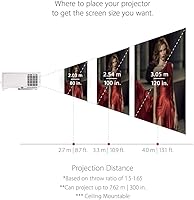
  • Throw Ratio: A 1.5–1.6x throw ratio means a 100-inch image requires roughly 11 feet between the lens and the projection surface.
  • Screen Size Range: Projects image sizes from 80 inches up to 150 inches, achieved across a throw distance range of approximately 8.7 to 16.3 feet.
  • HDR Formats: Compatible with both HDR10 and HLG signal formats, providing improved contrast and color depth over standard dynamic range content.
  • Color Technology: ViewSonic's SuperColor technology delivers a wide color gamut intended to produce more accurate and vibrant hues across a range of content types.
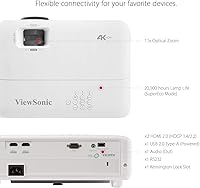
  • Optical Zoom: Includes a 1.1x optical zoom, offering a modest but practical degree of lens-based image size adjustment without repositioning the unit.
  • Digital Zoom: A 0.8–2.0x digital zoom range expands placement flexibility, though using digital zoom beyond the optical range may reduce image sharpness.
  • Keystone Correction: Features automatic horizontal and vertical keystone correction, supplemented by a full 4-corner adjustment and curved screen projection support.
  • Connectivity: Includes dual HDMI inputs and one powered USB-A port, supporting consoles, streaming sticks, PCs, and mobile devices simultaneously across two HDMI sources.
  • Weight: The unit weighs 6.2 pounds, making it light enough for repositioning between rooms or straightforward ceiling mounting.
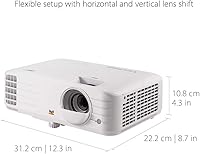
  • Dimensions: Physical footprint measures 8.7 × 12.3 × 4.3 inches, fitting comfortably on a media shelf, coffee table, or standard projector mount.
  • Ceiling Mount: Factory-designed for ceiling installation and officially compatible with the ViewSonic PJ-WMK-007 mounting bracket, sold separately.
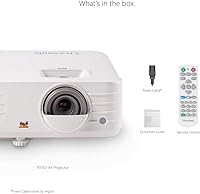
  • Remote Batteries: The included remote control requires two AAA batteries, which are listed as required but may or may not be included depending on the retail package.
  • Release Date: First made available in October 2020 and remains an active, non-discontinued model in ViewSonic's current projector lineup.

Related Reviews
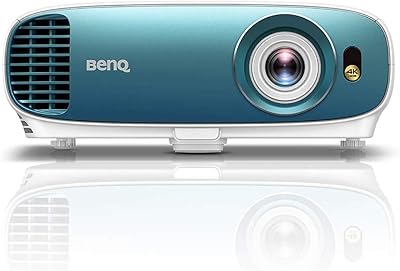
BenQ TK800M 4K UHD Home Theater Projector
86%
93%
Picture Quality
89%
Brightness
91%
Gaming Performance (Low Input Lag)
85%
Ease of Setup
88%
Connectivity Options
More
BenQ TK860i 4K Smart Home Theater Projector
85%
91%
Picture Quality
88%
Ease of Setup
87%
Connectivity Options
65%
Sound Quality
82%
Streaming Performance (Android TV)
More
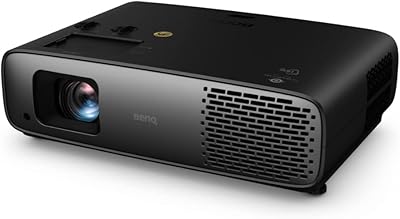
BenQ HT4550i 4K HDR LED Smart Home Theater Projector
85%
94%
Image Quality
89%
Brightness
93%
Color Accuracy
75%
Ease of Setup
65%
Sound Quality
More
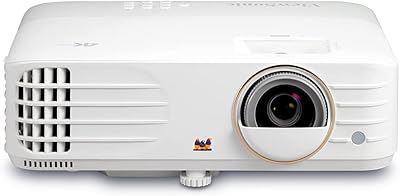
ViewSonic PX748-4K UHD Projector
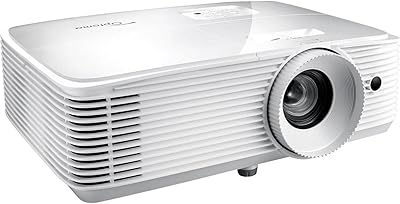
74%
91%
Image Sharpness
93%
Gaming Performance
78%
Brightness & Ambient Light Handling
71%
Color Accuracy
86%
Setup & Installation
More
Optoma HD39HDR Home Theater Projector
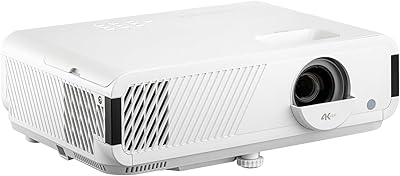
76%
91%
Brightness Performance
88%
Gaming Performance
83%
Image Quality
67%
HDR Quality
79%
Color Accuracy
More
ViewSonic PX749-4K 4K Gaming Projector
71%
84%
Image Brightness
88%
4K Image Sharpness
91%
Gaming Performance
62%
Color Accuracy (Out of Box)
54%
Fan Noise
More
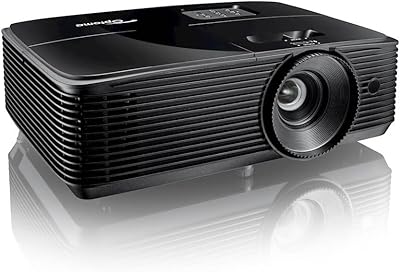
Optoma HD146X Home Theater Projector
74%
88%
Image Brightness
83%
Image Sharpness & Clarity
74%
Contrast & Black Levels
69%
Color Accuracy
77%
Gaming Performance
More
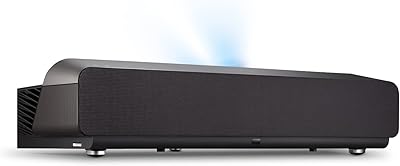
ViewSonic X1000-4K Ultra-Short Throw Projector
87%
92%
Image Quality
70%
Brightness in Well-Lit Rooms
85%
Sound Quality
95%
Space-Saving Design
88%
Ease of Setup
More
BenQ HT2060 1080p Home Theater Projector
79%
93%
Color Accuracy
81%
Image Sharpness
76%
HDR Performance
89%
Gaming Performance
67%
Brightness & Room Versatility
More
Epson Home Cinema 3800 4K Projector
75%
93%
Color Accuracy
91%
Brightness Performance
78%
Image Sharpness & 4K Detail
82%
HDR Performance
84%
Contrast & Black Levels
More

FAQ

It holds up genuinely well for gaming, especially at 1080p where the 4.2ms input lag and 240Hz refresh rate produce a responsive, fluid experience on a very large screen. One thing to be upfront about: at native 4K resolution, the refresh rate is capped at 60Hz, which is fine for most game genres but a real consideration if you play competitive titles where every frame counts.

At its 1.5–1.6x throw ratio, you need roughly 11 feet between the lens and the screen for a 100-inch image. The full usable range runs from about 8.7 feet for an 80-inch picture up to around 16.3 feet for a 150-inch one, so most standard living rooms or dedicated media rooms can accommodate it without major rearranging.

The automatic keystone handles vertical correction reasonably well for standard placements. If the projector is angled or slightly off-center, the 4-corner manual adjustment is where you do the finer work. Most buyers find a combination of both tools gets the image squared up without needing technical know-how or outside help.

A darkened room is genuinely necessary for a satisfying image. At 3,200 ANSI lumens, this 4K gaming projector performs well in dim conditions, but bright overhead lighting or direct sunlight will wash the picture out considerably. If daytime viewing in a lit room is a regular scenario for you, this projector — or most projectors in this brightness class — is likely not the right fit.

It is real and noticeable, but it should be understood for what it is at this price tier. The PX701-4K handles HDR10 and HLG signals and delivers improved contrast and color richness compared to SDR content. That said, a lamp-based projector at 3,200 lumens cannot hit the peak brightness levels that a premium flat panel achieves, so HDR here is an enhancement rather than a reference-quality experience.

Noticeable enough that it comes up consistently in real buyer reviews. It is not so loud that it competes with dialogue at a normal listening volume, but in a quiet room or during a hushed scene, you will hear it running in the background. How much this bothers you depends on personal sensitivity, but it is worth factoring in if you tend to watch in a silent environment late at night.

The built-in audio is fine for confirming the projector works during setup, but essentially every regular user recommends pairing this ViewSonic projector with an external speaker or soundbar. The internal output is thin and lacks the output level and quality needed for real home theater or even casual movie watching. Budget for a basic external audio solution as part of the total setup.

Yes, easily. The two HDMI ports let you keep a console and a streaming device like a Fire TV Stick or Roku connected simultaneously and switch between them via the input menu. The powered USB-A port can also power a streaming dongle directly, which removes the need for a separate wall outlet for the stick.

The projector is designed for ceiling installation and works with ViewSonic's PJ-WMK-007 bracket. At 6.2 pounds, the unit itself is manageable, and the physical mounting process is standard for someone comfortable with basic hardware. The more involved part is usually running power and any HDMI cables cleanly to the mounted position, which may or may not require extra effort depending on your room and ceiling type.

Lamp-based projectors like the PX701-4K will see bulb brightness degrade over time, and eventually the lamp will need replacing. Running the projector in an eco or low-brightness mode extends lamp life noticeably compared to running it at full power consistently. ViewSonic offers replacement lamps for this model, and third-party compatible options are also available at varying price points. Factoring lamp replacement into long-term ownership costs is a sensible habit with any lamp-based projector.

Where to Buy