Overview

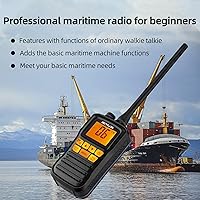
The Retevis RM01 Handheld Marine Two-Way Radio is a compact, practical VHF option aimed at recreational boaters, kayakers, and fishing enthusiasts who want reliable communication without spending a lot. It sits comfortably in the entry-level to mid-range segment, going up against established names like Standard Horizon and Uniden. One design choice that stands out immediately is the battery system — it runs on five AAA Ni-MH cells rather than a built-in lithium pack, which has real implications for convenience and runtime. Since its 2021 debut, this floating VHF radio has built up a solid review base that gives potential buyers a realistic picture of long-term performance.
Features & Benefits

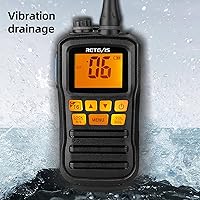
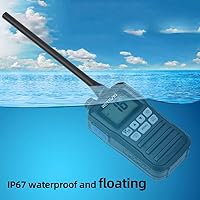
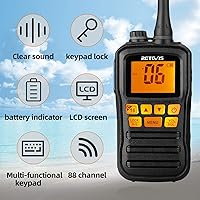
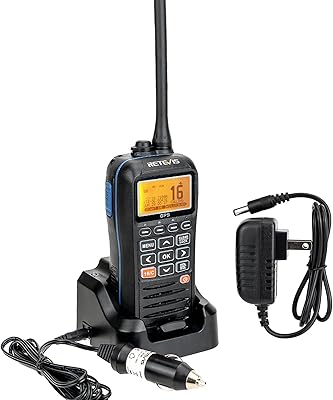
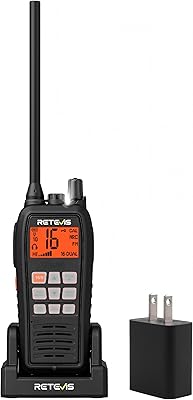
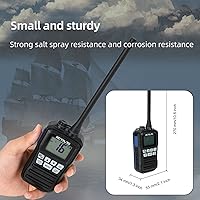
The most attention-grabbing feature of this handheld marine radio is its ability to float. Drop it off a kayak in choppy water and it resurfaces rather than sinking — a detail that could genuinely matter in a real emergency. The IP67 waterproof rating means it handles submersion down to one meter for up to 30 minutes, and a built-in vibration drainage system helps clear water quickly after retrieval. On the communication side, it covers 88 VHF channels, monitors Channel 16 for Coast Guard contact, and pulls in NOAA weather alerts so you know what conditions are coming before you push off from shore. A backlit LCD rounds things out for low-light early morning use.

Best For

This floating VHF radio makes the most sense for paddlers and light recreational boaters — people who want a safety net on the water without the bulk or cost of a fixed-mount unit. Kayak anglers and paddleboarders will appreciate how light and packable it is, and the floating design is genuinely reassuring when leaning over the gunwale. It also works well for beach patrol staff or water sports coordinators who need basic short-range communication. Keep in mind its 3-watt output makes it a short-range tool, not a substitute for a proper fixed VHF. Coastal campers wanting NOAA weather monitoring will also find real value here.

User Feedback

Across its review base, the Retevis RM01 holds a 4.1-star average, and the pattern in buyer feedback is fairly consistent. The floating capability earns frequent praise, especially from solo kayakers who see it as a genuine safety feature rather than a marketing claim. Audio reception in calm conditions also gets positive marks. That said, the AAA battery setup divides opinion — buyers used to Li-ion packs find the runtime shorter than expected, and recharging via the included adapter feels dated compared to USB-C alternatives. A handful of users also raised questions about long-term corrosion resistance in saltwater environments, and wind can affect transmit clarity noticeably. Solid for the price, but worth knowing the trade-offs.

Pros

  • The floating body genuinely resurfaces after being dropped overboard — a real safety feature, not just a marketing claim.
  • IP67 waterproofing handles rain, splashing, and accidental dunks without drama.
  • NOAA weather alerts give you early storm warnings before you leave the dock or launch point.
  • Channel 16 monitoring keeps you in line with standard Coast Guard communication protocol effortlessly.
  • At just over a pound, this floating VHF radio fits easily into a PFD pocket or dry bag.
  • 88 VHF channels with dual and triple watch scanning cover everything a recreational boater actually needs.
  • Backlit LCD makes reading channel and battery info workable during low-light early morning outings.
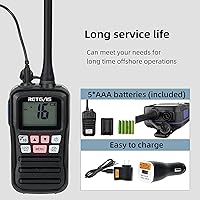
  • Both AC and DC car chargers are included in the box — ready to use without buying extras.
  • A two-year warranty on the radio body is a solid commitment for an entry-level marine radio.
  • Standard AAA batteries mean you can find replacements at nearly any store if you run low on a trip.

Cons

  • The proprietary charging adapter cannot be swapped for a USB-C cable, which frustrates modern buyers.
  • AAA Ni-MH runtime is noticeably shorter than Li-ion alternatives in the same price range.
  • Wind noise during transmission is a persistent issue for paddlers moving in exposed or breezy conditions.
  • At 3 watts, range tops out around two to four miles — inadequate for any open-water or offshore use.
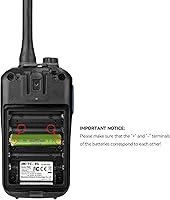
  • The back cover seal must be manually re-tightened after every battery swap to prevent moisture ingress.
  • Long-term salt corrosion resistance has been questioned by buyers using it regularly in full coastal environments.
  • The LCD display washes out in bright direct sunlight, making it harder to read on sunny open-water days.
  • Button differentiation by touch alone is tricky when wearing gloves, which is common in cold-weather paddling.
  • The included lanyard feels thin and lightweight relative to the hardware it is meant to secure.
  • After-sales communication from the manufacturer can be slow, undermining confidence in warranty follow-through.

Ratings

The Retevis RM01 Handheld Marine Two-Way Radio has been scored across multiple performance dimensions by our AI system, which analyzed verified buyer reviews from global markets while actively filtering out incentivized, bot-generated, and spam feedback. The scores reflect where this floating VHF radio genuinely delivers for recreational users — and where real buyers have run into friction. Both strengths and consistent pain points are represented transparently so you can make an informed call before purchasing.
Waterproofing & Water Resistance
83%
The IP67 rating holds up well in real kayaking and fishing scenarios — buyers report the radio surviving accidental dunks, rain squalls, and splashing without issue. The vibration drainage feature genuinely helps expel water quickly, which users in choppy coastal conditions found reassuring rather than gimmicky.
IP67 is submersion-tolerant, not dive-proof, and a handful of users pushed it beyond its rated limits and paid the price. Long-term salt exposure raised corrosion questions among coastal users who use it regularly over multiple seasons.
Floating Ability
91%
This is the feature that genuinely separates the Retevis RM01 from many competitors at this price point. Solo kayakers and paddleboarders consistently call it out as the main reason they chose this radio — dropping it overboard during a rough crossing and watching it resurface is a real confidence builder.
The float works as advertised, but the radio does not have an integrated flashing alert when floating, which some buyers noted would make retrieval even easier in low-visibility or choppy water conditions.
Battery Life & Power System
58%
42%
Using standard AAA Ni-MH cells means you can grab replacements at virtually any gas station or hardware store — a practical advantage if you are on a multi-day trip away from USB charging infrastructure. Some buyers found the runtime sufficient for casual day use on the water.
Buyers accustomed to Li-ion-powered radios from Standard Horizon or Uniden find the runtime noticeably shorter, and the five-cell charging setup via a proprietary adapter feels dated. The inability to use a standard USB-C cable is a recurring frustration in recent reviews.
Audio Clarity & Receive Quality
74%
26%
In calm conditions — anchored at a marina, fishing on a flat lake, or docked — receive audio is crisp and easy to understand. Users monitoring Channel 16 for Coast Guard traffic found the speaker volume more than adequate without needing to crank it to maximum.
Wind noise during transmission is a consistent complaint, particularly for paddlers moving at speed or in exposed coastal waters. The microphone picks up ambient wind readily, which can make your transmissions harder for others to decode in breezy conditions.
NOAA Weather Alert Reception
81%
19%
Weather alert functionality works reliably and gives recreational boaters early warning of developing storms — something buyers heading out for dawn fishing sessions specifically praised. Receiving an automated NOAA broadcast before a front moves in can be the difference between a good day and a dangerous one.
The weather channel coverage depends entirely on your proximity to a NOAA transmitter, which is a system limitation rather than a product flaw — but buyers in remote inland lake areas found reception spotty and should factor that in.
Channel Coverage & Range
71%
29%
With 88 US, Canadian, and international VHF channels plus dual and triple watch scanning, this handheld marine radio covers all the channels a recreational boater actually needs. Channel 16 monitoring is always accessible, which aligns with standard Coast Guard communication protocol.
At 3 watts output, this is a short-range radio — realistically 2 to 4 miles in open water depending on conditions. Buyers who expected fixed-mount VHF range from a handheld unit at this price were disappointed, which is a reasonable expectation gap to flag upfront.
Build Quality & Durability
67%
33%
The housing feels solid enough for the price point, and the rubberized grip provides decent purchase when wet. For occasional recreational use — a few kayak outings per season — the construction holds up without issue for most buyers.
Concerns about long-term salt corrosion surfaced from buyers using the radio in full coastal environments over multiple seasons. The back cover seal requires careful attention; users who did not re-tighten it properly after battery swaps reported moisture ingress over time.
Ease of Use & Controls
78%
22%
The button layout is straightforward enough that new VHF users can get oriented quickly without spending an hour in the manual. Channel scanning, weather access, and volume adjustment are all accessible without navigating deep menus, which suits the casual boater well.
The backlit LCD, while helpful at dawn, is not the sharpest display in direct afternoon sunlight. A few buyers noted the button feedback could be more tactile — distinguishing buttons by feel while wearing gloves is trickier than it should be.
Portability & Ergonomics
84%
At just over a pound and compact enough to slip into a PFD pocket, this floating VHF radio earns genuine praise from kayakers and paddlers who resent carrying bulky gear. The included lanyard lets you keep it secured to your wrist without thinking about it.
The dimensions — while manageable — make one-handed operation a slight stretch for users with smaller hands, particularly when reaching for the PTT button mid-paddle. The belt clip, while included, feels lightweight compared to the clip quality on pricier competitors.
Charging Setup & Convenience
53%
47%
Having both an AC wall charger and a DC car charger included in the box adds genuine flexibility for charging between outings, particularly for users who store the radio in their vehicle between fishing trips.
The proprietary adapter interface is the most commonly cited frustration among recent buyers. In an era where USB-C is universal, being locked into a specific cable that is easy to misplace genuinely irritates users — and the manual explicitly warns against using the adapter for other devices.
Value for Money
77%
23%
For a first marine radio or a backup handheld to leave in a dry bag, the Retevis RM01 delivers a reasonable set of features at a price that does not sting. The floating body and NOAA alerts alone justify the spend for casual recreational users entering the category.
As buyers gain more experience on the water and compare against Standard Horizon or Uniden models, the value proposition starts to erode — particularly given the battery system and range limitations. It is genuinely good for its niche, but experienced boaters may outgrow it quickly.
Included Accessories
72%
28%
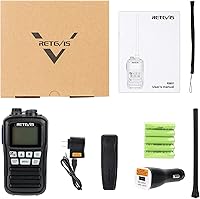
The box includes a belt clip, lanyard, antenna, AC charger, car charger, and five AAA Ni-MH batteries — a more complete out-of-the-box package than some competitors at a similar price who sell the charger separately. You are largely ready to use it straight away.
Accessory build quality lags behind the radio itself — the lanyard in particular feels thin, and the car charger adapter is bulkier than expected. The manual covers basics but leaves more advanced features like dual watch configuration underdocumented for new VHF users.
Warranty & After-Sales Support
69%
31%
A two-year warranty on the radio body is a solid commitment for this price tier, and Retevis does offer continued maintenance service even beyond the warranty period — a meaningful signal that they are not a disappear-after-sale brand.
The one-year limit on accessories feels short given that cables and charging components are typically the first things to fail. Buyers who needed warranty support report that communication with Retevis can be slow, which undercuts confidence in post-purchase care.

Suitable for:

The Retevis RM01 Handheld Marine Two-Way Radio is a smart pick for recreational paddlers, kayak anglers, and casual boaters who want a reliable communication safety net without a major investment. If you spend your weekends on a fishing kayak, a paddleboard, or a small motorboat and you want something you can clip to your PFD and mostly forget about, this handheld marine radio fits that role well. The floating body is the headline feature for this crowd — dropping a radio overboard is a real scenario, not a theoretical one, and knowing it will resurface rather than sink buys genuine peace of mind. Day sailors and motorboat hobbyists who already have a fixed-mount VHF but want a portable backup will also find this a practical companion. Beach patrol staff, water sports instructors, and lake campers who need basic NOAA weather monitoring and short-range coordination will get solid utility here without overspending on features they will never use.
Not suitable for:

Serious offshore sailors, commercial mariners, or anyone venturing far from the coast should look elsewhere — the Retevis RM01 Handheld Marine Two-Way Radio is a 3-watt radio with realistic open-water range of two to four miles, which simply does not cut it when you need to reach the Coast Guard from a distance. Buyers who are accustomed to Li-ion powered radios from Standard Horizon or Uniden will likely find the AAA Ni-MH battery system a step backwards in both runtime and day-to-day convenience, particularly if USB-C charging is a baseline expectation. Those who spend long stretches in exposed saltwater environments — offshore fishing, ocean kayaking, extended coastal cruising — should factor in the corrosion concerns raised by long-term users before committing. If you need a radio that doubles as a primary distress signaling device on anything beyond sheltered inland waters or a protected bay, a more capable unit with a higher watt output and built-in GPS or DSC is the responsible choice.
Specifications

  • Waterproof Rating: Rated IP67, meaning the radio can withstand submersion in up to 1 meter of water for 30 minutes under controlled conditions.
  • Buoyancy: The housing is designed to float on the water surface after submersion, allowing for easy retrieval if dropped overboard.
  • Drainage System: A built-in vibration drainage mechanism actively helps expel water from the radio body after it has been submerged or splashed.
  • Output Power: Transmits at 3 watts, suitable for short-range communication on sheltered inland waterways, bays, and nearshore coastal areas.
  • Frequency Range: Operates across the standard marine VHF band from 156 MHz to 174 MHz, covering all US, Canadian, and international channels.
  • Channel Count: Includes 88 channels covering US, Canadian, and international marine VHF allocations, with all 16 emergency channels accessible.
  • Weather Function: Receives NOAA weather broadcast channels and supports automated weather alerts to notify users of developing storm conditions.
  • Watch Modes: Supports dual watch and triple watch scanning, allowing the radio to alternate monitoring between Channel 16 and one or two additional working channels.
  • Display: Equipped with a backlit LCD screen that remains readable in low-light conditions such as pre-dawn fishing or dusk paddling.
  • Power Source: Powered by five AAA Ni-MH rechargeable batteries rated at 1.2V each, with batteries included in the box.
  • Voltage: Operates at 1.2 volts per cell across the five-battery configuration, delivering standard Ni-MH power output for handheld VHF radios.
  • Charging: Comes with both an AC wall charger adapter and a DC car charger, along with a dedicated charging cable for use exclusively with this radio.
  • Dimensions: Measures 8.62 x 7.76 x 2.8 inches, making it a compact but not ultraslim handheld radio suitable for PFD pocket storage.
  • Weight: Weighs 1.15 pounds with batteries installed, keeping it light enough for all-day carry on a kayak or fishing vest.
  • In-Box Contents: Package includes the radio, antenna, five AAA Ni-MH batteries, AC adapter, DC car charger, charging cable, belt clip, lanyard, and English manual.
  • Warranty: Retevis provides a two-year warranty covering the radio body and a one-year warranty on accessories, with paid maintenance service available beyond those periods.
  • Salt Resistance: The manufacturer states the radio is designed with strong salt and corrosion resistance, though users in sustained coastal environments should rinse and dry the unit regularly.
  • Model Number: The unit is identified by model number RM01-3W, reflecting its product line designation and 3-watt output classification.

Related Reviews
Retevis RT55 Handheld Marine Radio
86%
91%
Waterproof Performance
88%
Ease of Use
84%
Sound Quality
92%
Build Quality
72%
Battery Life
More
Retevis RM21 Handheld Marine VHF Radio
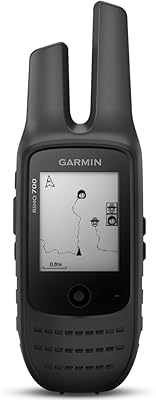
81%
86%
Audio Clarity
83%
Waterproofing & Durability
91%
Floating & Overboard Detection
88%
Battery Life
82%
Noise Cancellation
More
Garmin Rino 700 Handheld GPS and Two-Way Radio
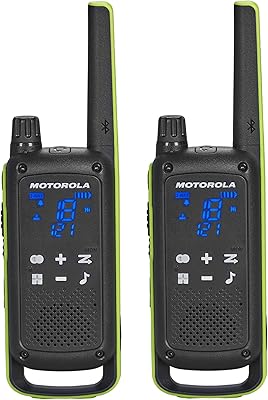
83%
87%
Battery Life
91%
Communication Range
84%
GPS Accuracy
90%
Durability
88%
Ease of Use
More
Retevis RM15 Marine Radio 6W
85%
87%
Communication Range
92%
Waterproof Performance
90%
Battery Life
85%
Build Durability
75%
Ease of Use
More
Retevis RM40 Marine Radio with GPS
84%
91%
GPS Functionality
89%
Waterproof Durability
88%
Ease of Use
90%
Emergency Features (DSC & MOB)
83%
Battery Life
More
Motorola T803 Two-Way Radio
83%
84%
Range Performance
88%
Battery Life
78%
Bluetooth Functionality
90%
Build Quality & Durability
85%
Ease of Use
More
Baofeng AR-5RM Handheld Ham Radio
77%
93%
Value for Money
78%
Ease of Use
61%
Transmission Range
67%
Build Quality
74%
Battery Life
More
Motorola DLR1060 Business Two Way Radios
85%
92%
Battery Life
88%
Ease of Use
75%
Range
87%
Build Quality
90%
Portability
More
Motorola T470 Talkabout Two Way Radios
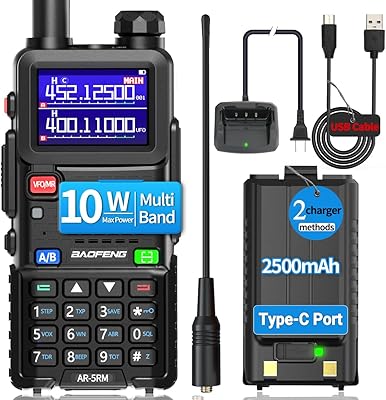
84%
88%
Range Performance
91%
Ease of Use
85%
Build Quality & Durability
83%
Weather Resistance
80%
Battery Life
More
BTECH DMR-6X2 PRO Two-Way Radio
87%
88%
Performance & Signal Quality
91%
Bluetooth Functionality
85%
GPS & APRS Features
83%
Battery Life
92%
Build Quality & Durability
More

FAQ

It genuinely floats. The housing is buoyant by design, so if it goes overboard it will resurface rather than sink. Multiple buyers who kayak solo have tested this in real conditions and confirmed it works as described — though it does not have a built-in flashing light to help you spot it in choppy water.

Yes, that is actually one of the practical advantages of this battery system. Standard alkaline AAA batteries will power the radio in a pinch, which means you can pick up replacements at a gas station or convenience store if you run out during a trip. Just know that alkaline cells will not recharge in the included charger, so swap back to Ni-MH when you get home.

At 3 watts over open water with good line of sight, expect a realistic range of roughly two to four miles in decent conditions. Terrain, atmospheric interference, and obstructions will reduce that. This is a short-range recreational radio — it is not a substitute for a fixed-mount VHF if you are heading offshore or need extended range.

For most recreational kayaking scenarios — splashing, wave wash, rain, and the occasional capsize — IP67 is perfectly adequate. It handles one meter of submersion for up to 30 minutes. That said, IP67 is not a dive rating, so do not push it beyond those limits. For extended surf zone use, dry bag storage between uses is a sensible extra precaution.

Yes, Channel 16 is fully supported and is the default emergency and hailing channel used by the US Coast Guard and international maritime authorities. The dual watch and triple watch modes let you monitor Channel 16 simultaneously with another working channel, which is the standard practice recommended for recreational boaters.

The LCD display shows a battery level indicator that drops as the cells discharge. When you are getting close to empty, the display will flag it. Given the AAA Ni-MH capacity, a conservative habit is to top up the charge after each outing rather than waiting for the low indicator — especially before any longer trip.

Yes, the antenna is removable and connects via a standard BNC connector common to handheld marine VHF radios. Replacement antennas compatible with the 156–174 MHz marine VHF band and a BNC connection should work, though it is worth confirming compatibility before purchasing a third-party replacement.

It covers US, Canadian, and international marine VHF channels — all 88 of them. So whether you are paddling in the Great Lakes region, coastal Canada, or on a sailing trip in European waters, the channel coverage is there. Just note that operating regulations vary by country, so check local maritime authority rules before transmitting abroad.

Yes, like most handheld VHF radios, the Retevis RM01 has a keypad lock function to prevent accidental button presses while the radio is clipped to your gear or stowed in a pocket. The process is outlined in the included English manual, and it is a straightforward button-hold sequence.

Rinse the exterior with fresh water and wipe it dry after every saltwater outing. Pay particular attention to re-tightening the battery compartment back cover before and after each use — this is the most common entry point for moisture if the seal is not properly seated. Storing it in a dry location away from prolonged humidity will also extend its lifespan noticeably.