Overview

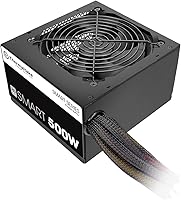
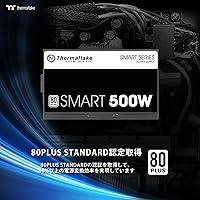
The Thermaltake Smart 500W ATX Power Supply sits comfortably in the budget tier, but it earns its spot with an 80 Plus White certification that separates it from the uncertified units cluttering the low end of the market. That rating means at least 80% efficiency under typical loads — not revolutionary, but meaningful enough to keep your electricity bill honest over time. Built around the ATX 12V 2.3 standard, this 500W unit drops into virtually any mid or full-tower case without fitment headaches. Think of the Smart series as Thermaltake's everyday workhorse line — solid brand pedigree, no frills, and priced for builders who need reliable, certified power without overextending their budget.
Features & Benefits

Five hundred watts of continuous output covers a solid range of builds — a modern processor paired with a mid-tier GPU like an RTX 3060 sits comfortably within that envelope. The active PFC is a quiet but important inclusion; it stabilizes power delivery and pairs well with UPS battery backups, something cheaper uncertified supplies often cannot claim. A single 120mm fan handles cooling without generating the kind of noise that sends you reaching for your headphones. The 100V–240V input range means this unit works globally, a practical bonus if you travel or relocate. One honest caveat: the non-modular cable design means you will need patience and zip ties to keep a tighter build looking clean.

Best For

This 500W unit is a natural choice for first-time PC builders who want a certified, brand-name supply without stretching their parts budget. Office machines, home workstations, and productivity rigs that rarely push past 350–400W of total draw will never stress it. Budget gaming builds centered around cards like an RX 6600 or RTX 3060 are right in the sweet spot. System integrators who need a dependable, widely stocked unit for client builds will appreciate its consistent availability. That said, if you are planning a build around a power-hungry flagship GPU, this is not the supply for that job — know your ceiling before you buy, and size up if your needs are heading in that direction.

User Feedback

Across more than 500 ratings, the Smart series supply holds a 4.5-star average, which is a genuinely strong result for a unit competing in this price bracket. Buyers consistently highlight how straightforward installation is and how quietly it runs under everyday workloads. Long-term owners frequently report it performing reliably well past the one-year mark, which carries more weight than first-week impressions. On the flip side, a recurring complaint involves short cable lengths causing frustration inside larger full-tower cases, and the fixed non-modular harness adds clutter for builders who care about clean interiors. A small number of DOA reports appear, but they seem to be outliers rather than any pattern worth losing sleep over.

Pros

  • 80 Plus White certification guarantees a meaningful efficiency floor that uncertified budget PSUs simply cannot match.
  • Active PFC ensures stable, clean power delivery and full compatibility with UPS battery backup systems.
  • Fits virtually any standard mid or full-tower case with zero fitment concerns thanks to the ATX 12V 2.3 form factor.
  • Runs near-silently under everyday productivity and light gaming workloads — easy to forget it is even spinning.
  • The 100V–240V universal input range makes this 500W unit usable across different countries and power standards.
  • Long-term reliability reports from real owners are genuinely encouraging for a unit in this price bracket.
  • Installation is straightforward enough that first-time builders consistently complete it without guidance or frustration.
  • Holds a 4.5-star average across hundreds of verified ratings, which is a hard number to dismiss in this category.

Cons

  • Non-modular cable design forces all cables out regardless of need, creating clutter in tidier builds.
  • Cable lengths fall short in full-tower cases, causing routing headaches around CPU power and the 24-pin ATX connector.
  • The 500W ceiling leaves no meaningful upgrade headroom for anyone planning to add a more powerful GPU later.
  • Warranty claim experiences are inconsistent, with some buyers reporting slow or frustrating support interactions.
  • A small but recurring rate of DOA units suggests quality control is not perfectly consistent across production batches.
  • Voltage regulation under heavy, variable loads is adequate but noticeably looser than what mid-range or premium units deliver.
  • The Smart series supply carries only the entry-level White tier of 80 Plus certification, lagging behind Bronze or Gold alternatives at a modest price premium.
  • Limited PCIe connector count restricts multi-GPU or high-connectivity builds without additional adapters.

Ratings

Our AI rating system analyzed verified global buyer reviews for the Thermaltake Smart 500W ATX Power Supply, actively filtering out incentivized, bot-generated, and spam submissions to surface what real builders actually experience. The scores below reflect a transparent picture of where this 500W unit genuinely delivers and where it falls short — no sugarcoating, no inflated praise. Both the consistent strengths and the recurring frustrations are weighed equally in every category.

Value for Money
91%
Buyers repeatedly call this one of the smartest spending decisions in a budget build. Getting an 80 Plus White certified unit from a recognizable brand at this price point is something many reviewers explicitly contrast against cheaper, unbranded alternatives they regretted buying earlier.
A handful of buyers who later upgraded to more demanding GPUs felt the 500W ceiling made the unit short-lived for their needs, slightly denting the long-term value argument. For a build you plan to upgrade aggressively, the savings can feel smaller in retrospect.
Reliability & Longevity
84%
A strong contingent of long-term owners report the Smart series supply running without incident well past the one and two-year marks in everyday desktop use. Office machines and light gaming rigs that never push the unit hard tend to produce the most glowing long-term accounts.
A small but notable cluster of DOA and early-failure reports does appear across review pools. While these seem to be outliers rather than a systemic pattern, they are frequent enough that some buyers recommend purchasing from a retailer with a straightforward return window just in case.
Installation Ease
93%
First-time builders consistently single out how painless this unit is to drop into a standard mid-tower. The standard ATX footprint, clear labeling on connectors, and familiar layout mean most people have it seated and cabled within fifteen to twenty minutes, even without prior PSU experience.
The non-modular harness means every cable comes out whether you need it or not, which can make the installation feel tidy in a spacious full-tower but noticeably cramped in compact mid-towers with limited cable routing channels behind the motherboard tray.
Noise Level
88%
Under typical office and productivity workloads the single 120mm fan is effectively inaudible, which earns consistent praise from buyers using this in quiet home office setups. Even during moderate gaming sessions most users describe the fan noise as a soft background hum at most.
Under sustained high loads — think extended rendering or stress testing — the fan audibly spins up, which a few users in silent build setups found more noticeable than expected. It is not loud, but buyers chasing near-silent rigs may want to factor this in.
Cable Length & Management
58%
42%
For standard mid-tower builds the cable lengths reach their destinations without any drama. Builders working with a compact case and a modest component layout generally report no routing issues and call the cable situation perfectly adequate for the price.
This is the most frequently cited frustration in negative reviews. Full-tower users and those with bottom-mounted PSU shrouds regularly report that the 24-pin ATX and CPU power cables fall just short of comfortable routing paths, forcing awkward bends or limiting airflow management options significantly.
Power Stability & Output Quality
82%
18%
The active PFC helps deliver clean, stable power, which is meaningful for component longevity over time. Buyers who run this unit alongside a UPS backup report no compatibility headaches, something that cheaper passive PFC or PFC-less supplies frequently cause.
This is not a unit with tight voltage regulation under variable heavy loads — at 500W near its ceiling, a few technically inclined reviewers noted slightly wider voltage fluctuations than premium units deliver. For typical builds this is rarely a real-world issue, but it is worth knowing.
80 Plus White Efficiency
76%
24%
Hitting at least 80% efficiency at typical loads keeps waste heat and electricity draw noticeably lower than non-certified units in the same class. Buyers coming from old uncertified PSUs often remark that the system runs cooler overall after switching to this 500W unit.
White is the entry-level tier of 80 Plus certification, sitting below Bronze, Silver, Gold, and Platinum. Buyers who eventually compared electricity costs with a Gold-rated PSU noted a measurable if modest difference over several months of daily use.
Build Quality & Fit/Finish
74%
26%
The chassis feels solid enough for the price bracket — no flex, no sharp edges, and the fan grille is firmly mounted. Most buyers describe the physical unit as looking and feeling more expensive than its cost suggests, which contributes positively to the overall impression at unboxing.
The plastic on the modular panel and housing corners does show the cost-cutting compared to mid-range units. A couple of reviewers noted cosmetic imperfections on the housing finish out of the box, though none reported these affecting functionality.
Compatibility & Form Factor
94%
The standard ATX 12V 2.3 spec means this drops into nearly every consumer desktop case on the market without adapter concerns. The 100V–240V input range is a genuine convenience for buyers who travel internationally or source components across regions.
There are no meaningful compatibility complaints in the review pool for this unit. The only edge case is very small form factor ITX builds, where the standard ATX footprint is simply the wrong form factor entirely — but that is a category mismatch, not a product flaw.
Connector & Cable Variety
67%
33%
The connector lineup covers what a standard single-GPU build needs — a PCIe connector for a mid-tier GPU, SATA power for storage drives, and the necessary motherboard headers. For a no-frills office or budget gaming rig, nothing critical is missing.
Builders with multiple storage drives or those wanting a second PCIe connector for future flexibility will find the cable set limiting. The non-modular design also means unused cables must be stuffed somewhere inside the case, which is a consistent minor irritant across reviews.
Thermal Performance
79%
21%
The 120mm fan manages internal temperatures competently across normal workloads, and the specified operating range of 5°C to 40°C covers virtually every real-world home and office environment. Buyers in warm climates have not raised thermal throttling as a concern under regular use.
The Smart series supply is not rated for particularly demanding thermal environments. Users running the unit in poorly ventilated enclosures or in rooms that regularly exceed 35°C report that the fan becomes more active and noticeable, suggesting the thermal headroom is modest rather than generous.
Warranty & Support Experience
62%
38%
Thermaltake as a brand has an established service infrastructure, and buyers who contacted support for genuine defect claims generally report the process eventually resolving in their favor. The brand recognition gives some buyers more confidence than they would have with a no-name unit.
Response times and warranty claim experiences draw notably mixed feedback. Several reviewers describe the process as slow or requiring persistent follow-up, and the warranty terms for this entry-level line are less generous than what Thermaltake offers on its premium PSU tiers.
Suitability for Gaming Builds
77%
23%
For mid-tier GPU pairings — an RX 6600 or RTX 3060 alongside a mainstream processor — this 500W unit handles sustained gaming workloads without complaint. Buyers in this configuration report stable frame delivery with no unexpected shutdowns or power-related artifacts during extended play sessions.
Anyone eyeing an RTX 4070 Ti or RX 7900 XT should look elsewhere. The 500W ceiling leaves no comfortable headroom for high-TDP GPU upgrades, and several reviewers who tried pushing the unit beyond its intended pairing report throttling or shutdowns under load peaks.
Packaging & Unboxing
81%
19%
The unit arrives well-protected with foam padding that prevents transit damage in the vast majority of cases. Buyers note the packaging is practical and functional, with the accessories and cables neatly bundled and easy to locate without digging through loose material.
There is nothing premium about the unboxing experience, which is entirely appropriate for this price tier but worth noting for buyers who gift PC components. A small number of reviewers received units with minor cosmetic damage suggesting the outer box took some handling punishment in transit.

Suitable for:

The Thermaltake Smart 500W ATX Power Supply is a natural fit for anyone putting together a practical desktop without chasing high-end performance numbers. First-time builders benefit most — it removes the anxiety of buying an unbranded, uncertified unit while keeping costs firmly in check. Office workers, students, and home users running productivity software, web browsing, or light creative work will never come close to stressing its 500W ceiling, meaning it should serve reliably for years in those roles. Budget gaming builds paired with a mid-tier GPU like an RTX 3060 or RX 6600 sit comfortably within its power envelope, making it a sensible anchor for a restrained gaming rig. It also makes strong practical sense for system integrators or IT shops building out fleets of office machines where cost per unit matters and certified, brand-name reliability is still a requirement.
Not suitable for:

Builders planning to install or eventually upgrade to a high-TDP GPU — anything in the RTX 4070 Ti, RX 7900 XT, or above class — should skip the Thermaltake Smart 500W ATX Power Supply entirely and size up from the start. The 500W output leaves little to no headroom for power-hungry components, and running a PSU near its rated ceiling under sustained load is a recipe for instability or premature failure. Enthusiasts who care about immaculate cable management will also find the non-modular harness genuinely frustrating, particularly inside larger cases where unused cables become a real routing headache. Anyone building in a compact ITX chassis needs a different form factor altogether, as standard ATX will not fit. If long-term upgradeability is a core part of your build plan, investing in a higher-wattage unit now is almost always the smarter financial decision.
Specifications

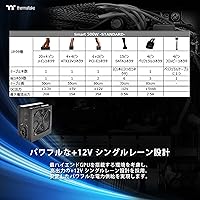
  • Output Wattage: Delivers a continuous 500W of power output, suitable for mainstream desktop builds with mid-tier graphics cards.
  • Efficiency Rating: Certified 80 Plus White, guaranteeing at least 80% energy efficiency at 20%, 50%, and 100% of rated load.
  • Power Factor Correction: Active PFC stabilizes power draw from the wall and ensures full compatibility with UPS battery backup systems.
  • Form Factor: Standard ATX 12V 2.3 form factor fits the vast majority of mid-tower and full-tower desktop cases on the market.
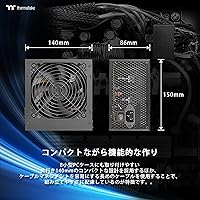
  • Dimensions: Measures 9.84 x 7.87 x 4.33 inches, conforming to the standard ATX physical specification without deviation.
  • Item Weight: Weighs 6.9 ounces, making it lightweight relative to similarly rated units and easy to handle during installation.
  • Input Voltage: Accepts a universal input voltage range of 100V to 240V AC, enabling use across North American, European, and Asian power standards.
  • Input Frequency: Operates across an input frequency range of 50Hz to 60Hz, covering the two dominant global power grid standards.
  • Input Current: Draws a maximum of 8A from the wall outlet under full rated load conditions.
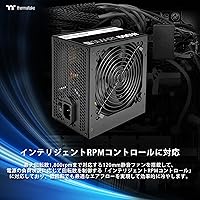
  • Cooling System: A single 120mm fan manages internal thermal dissipation, balancing airflow performance against acoustic output during normal operation.
  • Operating Temperature: Rated for continuous operation in ambient temperatures ranging from 5°C to 40°C, covering typical home and office environments.
  • Power Good Signal: Issues a Power Good Signal within 100 to 500 milliseconds during startup, helping protect connected components during power-on sequences.
  • Standby Power: Maintains a minimum standby time of 16 milliseconds at 60% load, meeting standard ATX standby requirements.
  • Connector Type: Uses a standard ATX connector interface compatible with modern Intel and AMD platform motherboards.
  • Cable Management: Features a fully non-modular cable design, meaning all cables are permanently attached and ship out of the unit regardless of use.
  • Color: Finished in matte black, matching the standard aesthetic of most mid-range and budget desktop PC cases.
  • Manufacturer: Designed and sold by Thermaltake, a Taiwan-based manufacturer with over two decades of PC component and cooling product experience.
  • Availability Status: Currently listed as not discontinued by the manufacturer, meaning replacement units and support remain available through standard retail channels.

Related Reviews
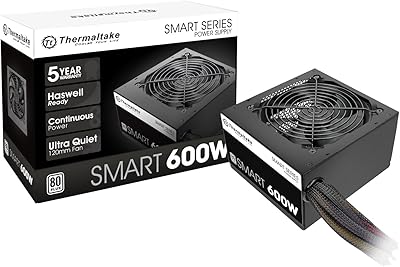
Thermaltake SMART 600W ATX Power Supply
78%
91%
Value for Money
83%
Reliability & Longevity
86%
Power Stability
84%
Noise Level
48%
Cable Management
More
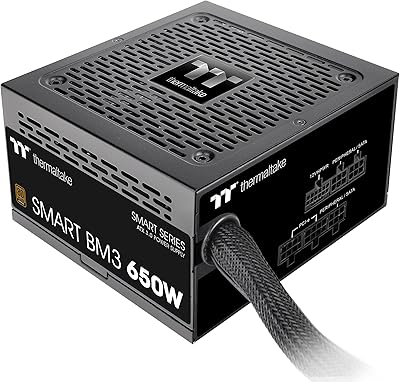
Thermaltake Smart BM3 650W Power Supply
83%
88%
Value for Money
79%
Cable Management
91%
Noise Level
84%
Build Quality
93%
ATX 3.0 and PCIe 5.0 Compatibility
More
Apevia Venus 500W ATX Power Supply
86%
92%
Value for Money
88%
Cooling Efficiency
91%
Protection Features
84%
Build Quality
85%
Compatibility with Components
More
Thermaltake Smart BM3 850W Power Supply
88%
88%
Value for Money
90%
Build Quality & Durability
85%
Energy Efficiency (80Plus Certification)
91%
Noise Levels & Fan Performance
87%
Ease of Installation
More
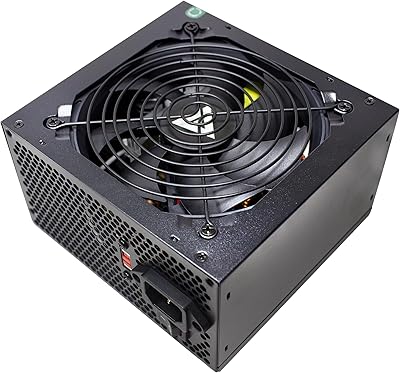
Apevia Raptor 500W ATX Power Supply
72%
83%
Value for Money
88%
Ease of Installation
74%
Connector Availability
58%
Reliability & Longevity
79%
Fan Noise
More
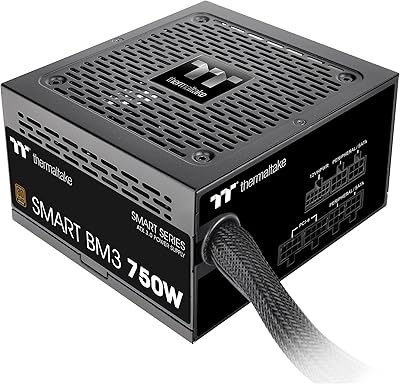
Thermaltake Smart BM3 750W Semi-Modular PSU
82%
88%
Value for Money
83%
Build Quality
86%
Noise Level
79%
Cable Management
92%
ATX 3.0 & PCIe 5.0 Compatibility
More
Thermaltake Smart W3 700W ATX Power Supply
82%
91%
Value for Money
84%
Build Quality
88%
Noise Level
76%
Cable Management
93%
ATX v3.1 Compatibility
More
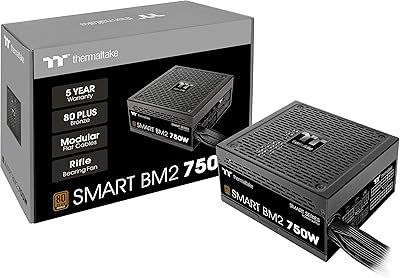
Thermaltake Smart BM2 750W 80+ Bronze Power Supply
86%
88%
Performance
91%
Efficiency
85%
Build Quality
90%
Noise Levels
92%
Value for Money
More
SilverStone FX500-G 500W Flex ATX 80 Plus Gold Power Supply
85%
88%
Value for Money
92%
Power Efficiency
85%
Build Quality
90%
Size and Form Factor
83%
Cooling Performance
More
Apevia ITX-PFC500W 500W Flex ATX Power Supply
77%
88%
Cable Management
91%
Form Factor Compatibility
79%
Power Delivery & Rail Stability
54%
Fan Noise & Acoustics
72%
Build & Component Quality
More

FAQ

Yes, that combination sits comfortably within the 500W ceiling. A Ryzen 5 processor and an RTX 3060 together typically draw well under 400W under gaming load, which leaves reasonable headroom. Just avoid pairing it with anything more power-hungry than that.

No, it is fully non-modular, meaning every cable is permanently attached to the unit. All the cables come out whether you need them or not, so plan to bundle and tuck the unused ones behind your motherboard tray or use velcro ties to keep things tidy.

Yes, and it is actually one of the practical strengths of this unit. The active PFC circuitry makes it fully compatible with the pure sine wave and simulated sine wave output that most consumer UPS systems produce. Cheaper PSUs with passive or no PFC can behave unpredictably with certain UPS units.

Under typical office workloads or light gaming it is effectively inaudible — the 120mm fan spins slowly and quietly at low loads. It does spin up and become noticeable under sustained heavy loads, but for everyday desktop use most people would not register it as a source of noise.

This is one of the more common complaints from real buyers, so it is worth flagging honestly. In standard mid-tower cases the cable lengths are generally fine. In full-tower builds, particularly those with bottom-mounted PSU shrouds and long cable routing paths, the 24-pin ATX and CPU power cables can fall just short of a comfortable, clean run. You may need extension cables to compensate.

It means the unit converts at least 80% of the power it draws from your wall outlet into usable DC power for your components. The remaining percentage turns into heat. In practical terms, a certified unit like this 500W supply wastes noticeably less electricity than an unrated unit, which adds up on your power bill over months and years of daily use.

That really depends on how ambitious your upgrade plans are. If you are thinking about staying in the mid-tier GPU range, you are probably fine. If there is any chance you will move to a high-TDP card like an RTX 4070 Ti or above, it is genuinely worth buying a 650W or 750W unit now rather than replacing this one later. Buying the right wattage upfront is almost always cheaper than replacing a PSU mid-build.

Yes, the universal 100V to 240V input range means it physically works across North America, Europe, Asia, and most other regions without any manual voltage switching. You will just need a plug adapter for the local outlet format, but the PSU itself handles the voltage difference automatically.

A small percentage of buyers do report DOA units, so it happens occasionally. First, double-check all power connections — a loose 24-pin or CPU connector is the most common culprit in builds that appear dead on arrival. If the connections are solid and there is still no power, contact the retailer for a replacement rather than working through the manufacturer warranty process, which some buyers have found slow.

An 80 Plus Bronze unit typically runs at 82–85% efficiency versus the 80% floor here, which translates to a modest but real difference in electricity costs and waste heat over time. For most users in typical builds, the efficiency gap is not dramatic day to day. If you run your PC for long hours every day, stepping up to Bronze is worth considering, but for casual or light users the Smart series supply offers strong value without that added cost.