Teensy 4.0 with Headers

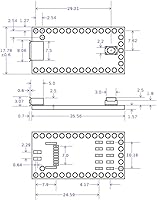
Overview
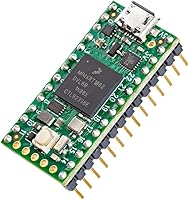
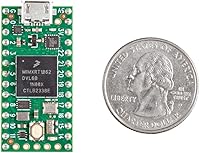
The Teensy 4.0 with Headers is PJRC's most capable compact microcontroller to date, built around an ARM Cortex-M7 core running at 600MHz — a spec that puts most boards in its size class to shame. The pre-soldered headers mean you can drop it straight onto a breadboard without reaching for a soldering iron, which is a genuine time-saver during early prototyping. It shares the same footprint as the Teensy 3.2, so existing shields and layouts carry over without modification. That said, this development board is squarely aimed at experienced makers and embedded engineers. If you're expecting something you can set up in ten minutes with no prior C++ knowledge, look elsewhere.
Features & Benefits
At the heart of this microcontroller board is a dual-issue superscalar processor — it can execute two instructions per clock cycle, which translates to real performance gains in compute-heavy tasks like signal processing or fast control loops. The Tightly Coupled Memory architecture deserves attention: it gives the CPU near-instant access to RAM through dual 64-bit buses, cutting the latency that typically bottlenecks real-time work. With 1MB of Flash and 512KB of RAM, there is comfortable headroom for substantial programs. The power shut-off pin is a thoughtful addition for battery-operated builds, letting you cut the 3.3V rail entirely with a held button press. Arduino IDE support keeps the toolchain familiar without forcing you to abandon your existing workflow.
Best For
This development board really shines in applications where speed and timing precision are non-negotiable. Audio synthesis and DSP work is a natural fit — the processing headroom handles real-time effects, filtering, and multi-channel mixing without strain. MIDI instrument builders find it compelling too, since the low-latency architecture keeps note triggers tight and responsive. Robotics and motor control projects benefit from precise interrupt handling and fast loop execution. For engineers migrating from the Teensy 3.2, the pin-compatible layout means existing designs move over without a full redesign. It also excels at custom USB HID devices and high-speed data logging where standard Arduino boards simply cannot keep pace.
User Feedback
The overall reception for this microcontroller board is strongly positive, particularly among audio and DSP developers who consistently point to raw processing speed as the defining advantage. The headers variant earns praise for out-of-box convenience that experienced users appreciate immediately. On the critical side, a handful of buyers flag noticeable heat buildup when the processor sustains full-clock workloads, so thermal management is worth considering in enclosed builds. Newcomers transitioning from simpler boards also mention a steeper learning curve. The PJRC documentation and active Teensy forums help offset that gap considerably. Repeat purchases among experienced makers suggest this board holds its ground firmly once it earns a spot in someone's toolkit.
Pros
- 600MHz ARM Cortex-M7 delivers processing speed that handles real-time audio and DSP workloads with headroom to spare.
- Pre-soldered headers mean you can go from unboxing to breadboard in minutes, no soldering required.
- Tightly Coupled Memory architecture reduces RAM access latency, directly benefiting time-critical control loops.
- Pin-compatible with Teensy 3.2, so existing shields and PCB layouts carry over without redesign.
- Native USB support enables custom HID and MIDI device profiles without any additional hardware.
- The On/Off pin feature gives battery-powered builds a clean hardware-level power cutoff that software sleep modes cannot match.
- PJRC documentation and active Teensy community forums provide reliable technical backup for complex projects.
- Arduino IDE compatibility keeps the toolchain familiar while still accessing the board's full hardware capabilities.
- Compact form factor fits into space-constrained enclosures where larger single-board computers simply will not go.
- Repeat purchases among experienced developers signal strong long-term confidence in the platform.
Cons
- Steep learning curve makes this development board a poor fit for anyone still building foundational embedded skills.
- Heat buildup under sustained full-clock loads requires deliberate thermal management in enclosed project builds.
- No onboard wireless connectivity means Bluetooth or Wi-Fi requires external modules and additional GPIO usage.
- Advanced topics like custom memory layout and bare-metal development are poorly documented in official resources.
- The Arduino abstraction layer adds overhead that can mask performance issues and complicate low-level tuning.
- Densely packed pads make custom rework or additional soldering work unforgiving and error-prone.
- No onboard mounting holes complicate mechanical integration in permanent or production-style enclosures.
- The value proposition disappears quickly for casual use cases that a much cheaper board could handle equally well.
- Limited granular power scaling options make it less competitive for ultra-low-power IoT designs.
- Library behavior differences from the Teensy 3.2 can surface subtle timing bugs that are not immediately obvious during porting.
Ratings
The Teensy 4.0 with Headers has been put through its paces by embedded developers, audio engineers, and advanced hobbyists worldwide, and our AI rating engine has analyzed verified purchase reviews while actively filtering out spam, incentivized submissions, and bot activity to surface what real users actually experience. The scores below reflect both the strengths that keep this microcontroller board in high demand and the friction points that prospective buyers should weigh honestly before committing.
Processing Performance
Real-Time Responsiveness
Memory & Storage Adequacy
Ease of Setup
Build Quality & Hardware Reliability
Thermal Management
Power Management Features
Community & Documentation
Backward Compatibility
Arduino IDE Integration
Form Factor & Portability
Value for Money
USB & Connectivity Options
Suitable for:
The Teensy 4.0 with Headers is purpose-built for developers and advanced makers who need serious processing muscle in a compact package, and it earns its place most convincingly in audio and DSP-heavy projects where latency and throughput directly affect the end result. If you are building a polyphonic synthesizer, a real-time audio effects processor, or a MIDI controller that needs note-perfect timing, this microcontroller board operates in a different league from standard Arduino-class hardware. Robotics engineers who rely on tight interrupt timing for motor control will find the 600MHz Cortex-M7 core gives them headroom that slower boards simply cannot match. It is equally compelling for engineers prototyping custom USB HID devices — think specialized game controllers, accessibility input devices, or proprietary lab instruments — where reliable, low-latency USB communication is non-negotiable. Developers already invested in the Teensy 3.2 ecosystem will appreciate the physical compatibility, which allows existing PCB layouts and shields to carry forward without a full hardware redesign. The pre-soldered headers make it especially practical for iterative breadboard prototyping, shaving time off each iteration cycle.
Not suitable for:
If you are newer to embedded development and still getting comfortable with concepts like memory management, interrupt service routines, or peripheral configuration, the Teensy 4.0 with Headers will likely frustrate more than it teaches. This development board assumes you already understand what you are asking it to do; it does not hand-hold you through setup the way beginner-oriented platforms do, and the gap between a working Arduino Uno sketch and a well-optimized program on this hardware is meaningful. Hobbyists who simply want to blink LEDs, read a few sensors, or run straightforward automation scripts are genuinely overpaying for capability they will never use. Battery-powered or thermally constrained builds also deserve extra scrutiny, since sustained full-clock workloads generate heat that requires deliberate thermal planning in enclosed enclosures. Projects with a central dependency on wireless connectivity will need external modules, adding wiring complexity and GPIO overhead that somewhat undercuts the board's clean, compact appeal. Finally, anyone expecting plug-and-play simplicity or a large beginner-friendly tutorial ecosystem should look at more approachable platforms first.
Specifications
- Processor: The board runs an ARM Cortex-M7 core clocked at 600MHz, implemented on the NXP iMXRT1062 chip.
- Architecture: The CPU uses a dual-issue superscalar design, meaning it can execute up to two instructions per clock cycle for sustained computational throughput.
- Flash Memory: 1MB of onboard Flash storage is available for firmware and program code.
- RAM: 512KB of RAM is included, accessed via a Tightly Coupled Memory architecture with dual 64-bit wide buses for near-zero-latency reads and writes.
- Memory Type: Onboard memory uses EEPROM technology for non-volatile data retention between power cycles.
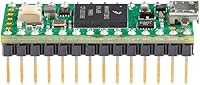
- Headers: Header pins come fully pre-soldered from the factory, allowing direct breadboard insertion without any soldering required.
- Form Factor: The board shares the exact same physical dimensions and footprint as the Teensy 3.2, preserving compatibility with existing shields and PCB layouts.
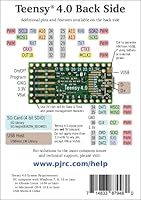
- Power Feature: An On/Off pin allows the 3.3V power supply to be completely cut by holding a connected pushbutton for 5 seconds, and restored with a brief press.
- Operating Voltage: The board operates at 3.3V logic levels, which should be taken into account when interfacing with 5V peripherals.
- IDE Compatibility: The board is fully supported by the Arduino IDE via the Teensyduino add-on, which enables standard sketch-based development workflows.
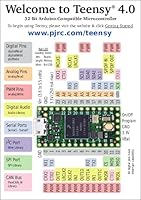
- USB Interface: A native USB port supports custom HID, MIDI, serial, and audio device profiles without requiring any additional hardware.
- Connectivity: The board is Bluetooth capable, enabling wireless communication when paired with appropriate external modules or configurations.
- Manufacturer: Designed and manufactured by PJRC, a US-based company specializing in high-performance microcontroller development hardware.
- Weight: The board weighs 0.352 ounces, making it suitable for weight-sensitive portable and wearable project builds.
- Package Dimensions: The retail package measures 5.98 x 4.21 x 0.79 inches, accommodating the board and supporting documentation.
- Color: The PCB is finished in black with the board model number TEENSY40_PINS printed for identification.
- CPU Brand: The processor core is designed by ARM, one of the most widely deployed CPU architectures in embedded and mobile computing.
- First Available: This board was first made available for purchase in November 2019 and has maintained continuous production since then.
Related Reviews
SounDigital 400.4 EVO 4-Channel Car Amplifier
Sabrent 1TB Rocket 4 Plus NVMe 4.0 SSD
TJCXELE USB 3.0 Switch Selector 4-Port for 4 Computers
SounDigital 800.4 EVO 4.0 4-Channel Car Amplifier
Sabrent Rocket 4 Plus 4TB NVMe SSD
PJRC Teensy 4.1 With Pins

SWEED Cloud Mascara, Black, 0.4 oz
Timetec HU-XI-201 1TB PCIe Gen4 NVMe SSD
Timetec MS47-B 2TB NVMe SSD