Overview

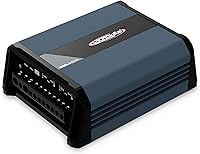
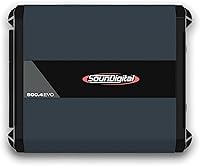
The SounDigital 800.4 EVO 4.0 4-Channel Car Amplifier comes from a Brazilian brand that has built a loyal following among serious car audio installers — and it is easy to understand why once you look at what is packed into that small chassis. It delivers 800 watts RMS across four channels using Class D topology, which keeps heat low and current draw in check. The aluminum heatsink housing and conformal-coated internals mean it can handle moisture and vibration without complaint. For the price, you are getting a lot of engineering credibility without paying flagship money — a compelling case for anyone who cares about build quality over brand prestige.
Features & Benefits

The Class D circuit design is arguably the most important practical advantage here, especially for motorcycle installs. Unlike older Class AB designs that run warm just sitting idle, this amp draws far less current and stays noticeably cooler under load — a real consideration when your battery is a fraction of a car's capacity. The four channels are bridgeable, so you can run a pair of full-range speakers up front and bridge the rear channels to a small sub if the space allows. Built-in crossover filters — both high-pass and low-pass — handle basic signal management without an outboard processor. Per-channel gain controls round out a surprisingly complete onboard toolkit.

Best For

This motorcycle-friendly amplifier makes the most sense for riders and builders working in genuinely constrained spaces — anyone who has struggled to fit a standard-sized amp under a seat or inside a saddlebag will immediately appreciate the compact form factor. It is also a strong choice for car audio enthusiasts building stealth under-dash installs where real estate is scarce. The onboard tuning controls make it accessible to intermediate DIYers who want flexibility without the complexity of a separate signal processor. If you need one amp to cover door speakers and a bridged subwoofer simultaneously, this compact 4-channel amp handles that job without requiring a second unit.

User Feedback

Owners consistently point to the compact dimensions as the standout quality, with many specifically noting successful installs in tight spots where no other amp would fit. Sound quality also draws positive comments, though a handful of buyers who measured output note that real-world wattage falls somewhat short of the rated spec — not unusual for this price tier, and worth factoring into expectations. The crossover filters get mixed reviews: useful for everyday tuning, but limited for builders with more exacting requirements. Durability in wet and outdoor conditions appears solid based on early owner reports. Feedback on warranty and support is limited but leans positive overall.

Pros

  • Exceptionally small footprint makes it viable for installs where almost no other amp will physically fit.
  • Class D design runs noticeably cooler than older amplifier classes, reducing thermal stress over long rides.
  • Conformal-coated internals provide genuine protection against moisture and vibration in outdoor environments.
  • Four bridgeable channels give real flexibility: run full-range speakers, bi-amp, or add a sub without a second unit.
  • Built-in high-pass and low-pass filters handle basic crossover duties without additional hardware.
  • Per-channel gain controls let you dial in sensitivity on-site without external tools.
  • SounDigital has a strong reputation in the car audio community, particularly for reliability relative to price.
  • Weighing under two pounds, this motorcycle-friendly amplifier adds almost nothing to a bike or ATV build.
  • Compatible with a wide range of vehicles including marine and powersport platforms, not just cars.
  • Mid-range pricing puts solid engineering within reach of buyers who cannot justify flagship amp costs.

Cons

  • Measured real-world output often falls below the rated 800 watts RMS, which matters for power-hungry speaker setups.
  • Onboard crossover filters lack the precision range that serious multi-way builds or audiophile installs require.
  • No 2-ohm stereo rating listed, limiting compatibility with certain lower-impedance speaker configurations.
  • Brand awareness outside the car audio enthusiast community is low, making local service or support harder to find.
  • Warranty and after-sales support experience is inconsistent based on owner reports, with limited visibility from the brand.
  • The freestanding mount design means you are responsible for fabricating or sourcing a secure mounting solution.
  • Input and output connection points may feel tight for installers working with thicker gauge wiring in confined spaces.
  • No remote bass control or level input included, which is a noticeable omission for users bridging channels to a subwoofer.

Ratings

The scores below reflect AI-assisted analysis of verified owner feedback for the SounDigital 800.4 EVO 4.0 4-Channel Car Amplifier, drawn from global reviews with spam, bot-generated, and incentivized submissions actively filtered out. Both the genuine strengths and the real frustrations buyers have encountered are factored into every category — nothing is glossed over. The result is an honest snapshot of where this compact 4-channel amp delivers and where it falls short.

Compact Form Factor
93%
Owners repeatedly call out the physical size as the single biggest reason they chose this amp over competitors. Motorcycle riders and stealth-build enthusiasts describe successful installs in spots where no standard-sized amp would fit — saddlebags, under fairings, and tight dashboard cavities included.
A small number of buyers note that the compact body makes terminal access tighter than expected, particularly when working with thicker power cables in already cramped mounting locations. For installers with large hands, the wiring process can feel fiddly.
Value for Money
81%
19%
For a mid-range price point, buyers consistently feel they are getting engineering quality that punches above its cost tier. The SounDigital brand carries credibility in the enthusiast community, which reduces the skepticism that often surrounds lesser-known compact amps at similar prices.
A portion of buyers feel the value proposition weakens slightly once they measure actual output and find it does not hit the full rated spec. When real-world power delivery falls short of expectations, the price starts to feel less like a bargain and more like a compromise.
Power Output Accuracy
61%
39%
For casual listening and street-level audio builds, the amp delivers more than enough volume and headroom to satisfy most users. Buyers running modest speaker systems report clean, controlled sound at volumes they are genuinely happy with day to day.
Measured output consistently lands below the 800 watt RMS rating in independent tests and owner accounts, which is a pattern common at this price tier but still a meaningful gap for power-focused builds. Buyers who need accurate wattage for speaker matching calculations should treat the spec as a guideline rather than a guarantee.
Thermal Management
78%
22%
The aluminum heatsink chassis does its job well under normal operating conditions, and most owners report the amp running warm but not hot during extended listening sessions. Class D efficiency helps here — the amp generates noticeably less heat than comparable Class AB units would in the same install location.
In fully enclosed installs with minimal airflow — common in tight motorcycle compartments — a handful of buyers report the amp getting uncomfortably warm over long rides on hot days. Thermal protection cuts in occasionally under those conditions, briefly dropping output until temperatures normalize.
Weather and Vibration Resistance
83%
Owners running this motorcycle-friendly amplifier in rain-exposed or high-vibration environments report strong durability over months of use. The conformal coating on internal components gives genuine confidence for marine and ATV builds where incidental moisture is unavoidable.
The amp is resistant, not waterproof, and a few marine installers note that prolonged humidity exposure in unsealed compartments eventually shows up as corrosion on the external terminals. Protecting the connector points with dielectric grease is worth doing at installation time.
Onboard Crossover Filters
67%
33%
For buyers building a basic two-way system or adding a single bridged subwoofer, the built-in high-pass and low-pass filters cover the essentials without requiring an extra component. DIYers setting up their first amplified system find them genuinely useful and accessible.
Experienced installers and audiophile-leaning buyers find the filter range and adjustment resolution too limited for precise multi-way builds. The crossovers work as a convenience feature, not a precision tool, which means anyone with specific tuning needs will still need an external DSP.
Ease of Installation
76%
24%
The gain controls, crossover adjustments, and bridging options are all accessible on the amp body without needing external software or tools, which most intermediate DIYers appreciate. The compact size also reduces the physical challenge of routing cables in tight spaces.
First-time amp installers occasionally find the terminal labeling on the unit less intuitive than expected, particularly when setting up a bridged channel configuration. A clearer installation guide or labeled diagram printed on the unit itself would reduce setup errors.
Build Quality
84%
The aluminum chassis feels solid and purposeful in hand, noticeably more substantial than plasticky budget amps at a lower price point. Owners who have handled multiple SounDigital products describe consistent fit and finish quality that holds up well after months of vibration exposure.
A small number of buyers note that the input RCA jacks feel slightly loose on arrival, which can become an intermittent signal issue if the amp is mounted in a high-vibration location without securing the cables properly. It is a minor point but worth checking at install time.
Channel Flexibility
86%
The ability to bridge channels opens up real configuration options — running full-range speakers on two channels while bridging the other two to a subwoofer is a setup many buyers describe as exactly what they needed from a single compact unit. It removes the need for a second amp in many builds.
The 4-ohm minimum bridged impedance rating limits subwoofer options for buyers with 2-ohm DVC drivers, which is a common sub configuration. Anyone planning a bridged sub setup needs to check driver impedance carefully before committing to this amp.
Current Draw Efficiency
89%
Motorcycle and small-vehicle owners specifically praise how little this amp taxes their electrical systems compared to older amplifier designs. Several buyers report no noticeable battery drain even after extended use with modest alternator setups, which is a real-world benefit that matters on bikes.
On very small or aging battery systems — particularly older motorcycles with stock charging — some buyers still notice slight voltage drop at high volume. Adding a small capacitor or upgrading the battery addresses the issue, but it is an extra cost not everyone anticipates.
Sound Quality
77%
23%
For a Class D amp at this price point, the audio output is clean and well-controlled at moderate volumes, with minimal audible distortion on properly gain-staged setups. Owners running quality component speakers describe the sound as detailed enough to justify the upgrade from a head-unit-only system.
At high volume levels with demanding speaker loads, some buyers detect a slight compression or harshness that more expensive amplifiers handle more gracefully. It is not a dealbreaker for most, but listeners with critical ears will notice the ceiling.
Gain Control Usability
74%
26%
Having independent gain adjustment per channel is a genuine advantage during installation, letting you balance levels between mismatched speakers or compensate for a head unit with unusually high or low preamp output voltage. It is a feature usually reserved for pricier amps.
The gain pots are small and closely spaced on the amp body, making fine adjustments difficult with anything other than a small flathead screwdriver. Without an oscilloscope or DMM to set gains objectively, it is easy to accidentally clip the signal during setup.
Brand Support and Warranty
59%
41%
Buyers who purchase through established US distributors report reasonably smooth warranty experiences when defects arise. SounDigital has a strong support network in its home Brazilian market, and that infrastructure does extend to authorized international channels.
For buyers outside South America purchasing through third-party sellers, warranty support can be slow and inconsistent. The brand's North American service presence is not as developed as domestic competitors, which adds uncertainty for buyers who value easy post-purchase support.
Mounting and Securing Options
62%
38%
The freestanding form factor does give installers full flexibility in orientation — the amp can be mounted horizontally, vertically, or on an angle depending on what the install space demands. That adaptability is genuinely useful in non-standard locations.
No mounting hardware or bracket is included in the box, which means buyers need to source or fabricate their own solution. For stealth builds in curved or irregular surfaces, this adds time and cost to what might otherwise be a straightforward install.

Suitable for:

The SounDigital 800.4 EVO 4.0 4-Channel Car Amplifier is purpose-built for anyone who needs real amplifier performance in a space that simply will not accommodate a standard-sized unit. Motorcycle riders are the most obvious beneficiaries — the combination of compact dimensions, moisture-resistant construction, and low current draw makes it one of the more practical options for saddlebag or under-seat installs without stressing a bike's electrical system. Car audio builders working on sleeper or stealth builds, where hiding all components is part of the goal, will also find the form factor genuinely useful rather than just a marketing angle. Powersport enthusiasts running ATVs, UTVs, or small boats can lean on the conformal coating for added peace of mind in wet and dusty conditions. Intermediate DIYers who want onboard crossover and gain controls — without buying a separate signal processor — will appreciate the self-contained tuning options this compact 4-channel amp provides.
Not suitable for:

The SounDigital 800.4 EVO 4.0 4-Channel Car Amplifier is not the right tool for every build, and being clear about that saves frustration later. Buyers expecting measured output to match the full rated wattage on the spec sheet will likely be disappointed — at this price tier, real-world power delivery typically falls short of the peak numbers, and anyone building a high-output competition system should look at more powerful, bench-tested alternatives. Audiophiles who want precise signal processing will find the onboard crossover filters functional but limited; a dedicated DSP or active crossover will always outperform what is built into an amp at this level. The 4-ohm impedance rating also means users planning to run 2-ohm loads need to verify compatibility carefully before purchasing. If your install does not have a space constraint, spending the same budget on a larger amp with more headroom is probably the more sensible call.
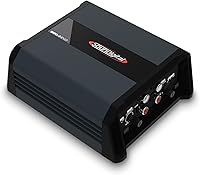
Specifications

  • Total RMS Power: The amplifier delivers a total of 800 watts RMS distributed across four channels at 4 ohms.
  • Channels: Four fully independent channels are included, each of which can be bridged for flexible speaker configuration.
  • Amplifier Class: Class D circuit architecture is used throughout, prioritizing energy efficiency and reduced heat output over raw current draw.
  • Impedance: The amp is rated for 4-ohm operation; users should verify compatibility before connecting lower-impedance loads.
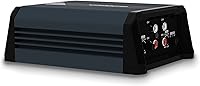
  • Dimensions: The unit measures 9.84 x 4.72 x 2.36 inches, making it one of the more compact 4-channel options in its power range.
  • Weight: At 1.74 pounds, the amplifier adds minimal mass to motorcycle, ATV, or compact vehicle builds.
  • Operating Voltage: Designed to run on a standard 12.6V DC automotive electrical system.
  • Housing Material: The chassis is constructed from aluminum with an integrated heatsink design to assist with passive thermal management.
  • Weather Resistance: Internal components are treated with conformal coating to resist moisture ingress and protect against vibration-induced damage.
  • Crossover Filters: Built-in adjustable high-pass and low-pass crossover filters are included, allowing basic signal routing without a separate processor.
  • Gain Control: Individual gain adjustment is available per channel, enabling input sensitivity tuning during installation.
  • Mounting Type: The amplifier uses a freestanding mount configuration; no proprietary bracket is included, so installers must source or fabricate their own.
  • Compatible Vehicles: Designed for use in cars, motorcycles, ATVs, UTVs, and marine environments where space and durability are primary concerns.
  • Brand Origin: SounDigital is a Brazilian manufacturer with an established presence in the enthusiast car audio market.
  • Model Number: The official model designation is 800.4 EVO 4.0, which identifies this specific generation and channel configuration within the SounDigital lineup.

Related Reviews
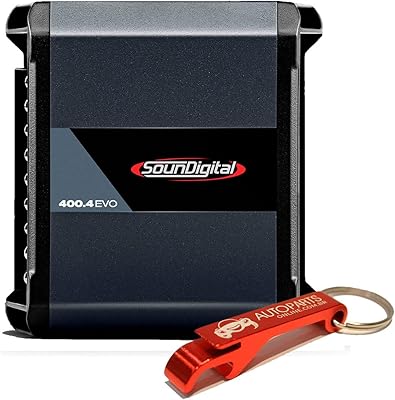
SounDigital 400.4 EVO 4-Channel Car Amplifier
80%
93%
Size-to-Power Ratio
88%
Build Quality
91%
Value for Money
84%
Sound Quality
62%
Heat Management
More
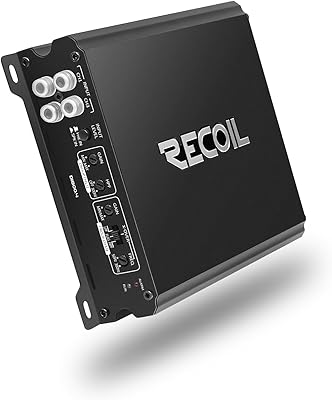
Recoil DI550.4 4-Channel Car Audio Amplifier
74%
91%
Value for Money
78%
Power Output
86%
Ease of Installation
74%
Sound Quality
67%
Build Quality
More
Planet Audio PL1600.4 4-Channel Car Amplifier
72%
88%
Value for Money
84%
Ease of Installation
74%
Sound Quality
58%
Power Output (Real-World)
61%
Build Quality
More
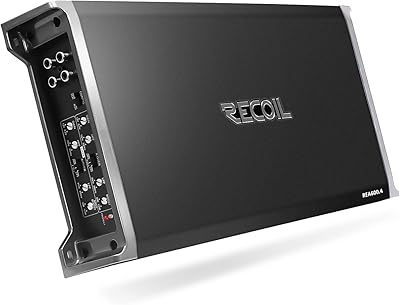
Recoil REA600.4 4-Channel Car Audio Amplifier
84%
89%
Audio Performance
91%
Ease of Installation
85%
Sound Quality at High Volumes
62%
Heat Management
90%
Power Output
More
Recoil DI800.4 4-Channel Car Audio Amplifier
83%
88%
Sound Quality
92%
Power Output
65%
Thermal Management
84%
Build Quality
91%
Ease of Installation
More
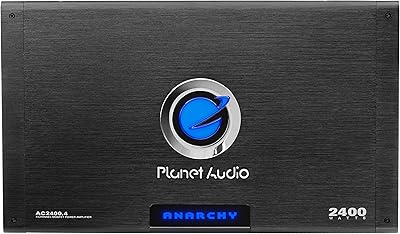
Planet Audio AC2400.4 4-Channel Car Amplifier
84%
95%
Power Output
89%
Sound Clarity
87%
Bass Performance
82%
Ease of Installation
65%
Thermals/Heat Management
More
Soundfy SA 400.4 4-Channel Car Amplifier
71%
78%
Value for Money
72%
Sound Quality
63%
Power Output
58%
Build Quality
81%
Thermal Management
More
Planet Audio AC1200.4 4-Channel Car Amplifier
73%
88%
Value for Money
67%
Power Output
83%
Installation Ease
74%
Sound Quality
61%
Build Quality
More
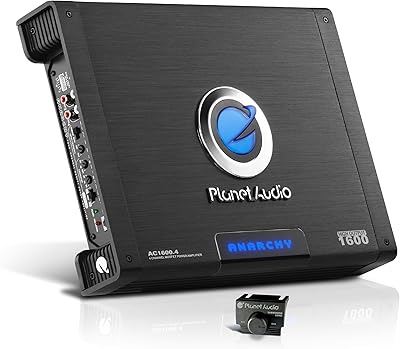
Planet Audio AC1600.4 Anarchy Series 4-Channel Car Amplifier
82%
94%
Power Output
88%
Sound Quality
70%
Ease of Installation
92%
Value for Money
85%
Build Quality
More
Stetsom HL 2000.4 2-Ohm 4-Channel Car Audio Amplifier
87%
93%
Power Output
85%
Cooling System Efficiency
88%
Sound Quality
91%
Ease of Installation
82%
Durability
More

FAQ

In most cases, yes. The footprint is genuinely small — under 10 inches long and just over 4.7 inches wide — which clears the available space in many cruiser and touring bike underseat compartments. That said, always measure your specific cavity before purchasing, since seat pan geometry varies significantly by model.

The 800 watts is listed as RMS, which is the more meaningful figure, but independent testing of amps in this price range often shows real-world output landing somewhat below the rated spec. Think of it as a strong 4-channel amp rather than a literal 200 watts per channel guarantee. For most street audio builds it is more than enough, but competitive or high-SPL setups should factor in that gap.

Yes, and that is one of the more practical use cases for this unit. You can run the front two channels to your door speakers in full-range mode and bridge the rear two channels together to drive a single subwoofer. Just make sure the sub you choose is compatible with the bridged output impedance before wiring it up.

Motorcycles have much smaller batteries and charging systems than cars, so current draw really matters. Class D amps are significantly more efficient than older Class AB designs, meaning less of your battery's energy is wasted as heat and more goes toward actual audio output. It also means the amp itself stays cooler, which matters when airflow around your install is limited.

For a straightforward build — door speakers plus a sub, or a basic front-stage setup — the onboard high-pass and low-pass filters are genuinely functional and save you the cost of an extra component. If you are building a more complex multi-way system or have specific tuning requirements, a dedicated DSP will give you more precision and flexibility than any amp-integrated crossover.

It is moisture resistant rather than fully waterproof. The conformal coating on the internal components handles splashes, humidity, and the kind of incidental moisture exposure common in marine or powersport environments. It is not designed to be submerged or to take direct heavy water spray for extended periods, so placement and shielding during installation still matter.

For an amp in this power range, 8-gauge power and ground wiring is typically the right call, paired with an appropriately rated inline fuse close to the battery. If you are running longer wire runs over about 15 feet, stepping up to 4-gauge helps reduce voltage drop and keeps the amp performing closer to its rated output.

Yes, bridging is supported across all four channels, giving you two higher-power bridged outputs if your install calls for it. This is useful if you are running a pair of high-demand component speakers and want to maximize power delivery to each one rather than splitting across four channels.

Almost any head unit with RCA preamp outputs will work fine. If your head unit only has speaker-level outputs and no RCA jacks, you will need a line output converter to step the signal down before it reaches the amp. This is a common and inexpensive fix, and the amp itself accepts the signal either way once the levels are set correctly via the gain controls.

Owner feedback on support is generally positive but not universally consistent. SounDigital has a more active service presence in South America where the brand originates, so response times for North American buyers can vary. If you are purchasing through an authorized US dealer or distributor, warranty claims tend to move more smoothly than going direct. Keep your purchase documentation in case you need it.

Where to Buy