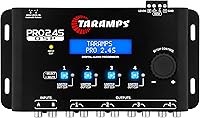
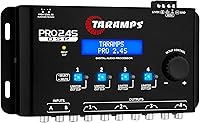
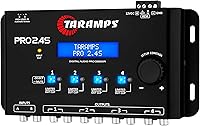
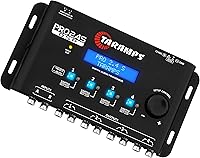
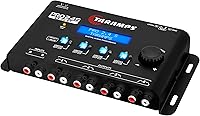
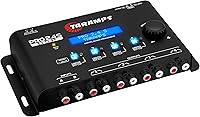
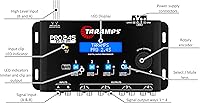
Overview
The Taramp's Pro 2.4S DSP Crossover Equalizer sits in an interesting spot in the car audio market — capable enough to satisfy enthusiasts who know their way around a signal chain, yet accessible enough that you don't need an engineering degree to get useful results. Taramp's is a Brazilian brand with a loyal following, particularly among builders who run competitive installs and want professional-grade tools without the flagship price tag. The unit takes two inputs and distributes the signal across four independent outputs, which slots neatly into most multi-amplifier setups. It's not a top-tier processor, but it delivers a surprisingly complete feature set for where it sits in the market.
Features & Benefits
The crossover section alone makes the Pro 2.4S worth a closer look. You can set independent high-pass or low-pass filters on each of the four outputs, choosing from Butterworth, Bessel, or Linkwitz-Riley alignments with slopes ranging from -6 all the way to -48dB per octave — that level of flexibility is rarely found at this price point. The 15-band graphic equalizer covers 25Hz to 16kHz at ISO-standard center frequencies, with up to 12dB of boost or cut per band. Twelve preset curves handle quick adjustments when you just need a starting point without dialing everything in manually. The unit also accepts high-level speaker inputs, which is a practical lifeline if you're working around a factory head unit.
Best For
This crossover unit makes the most sense for someone building out a multi-speaker car system — think dedicated tweeters, midrange drivers, and a subwoofer each running through their own amplifier channel. The per-output crossover control means you can dial in precise frequency splits without relying on whatever filtering your amplifiers happen to offer. It's also a strong pick for anyone stuck with a factory head unit, since the high-level inputs let you tap speaker outputs directly. Experienced installers working on active 2-way or 3-way setups will appreciate the filter type options, while newcomers can lean on the presets to get started. Budget-conscious buyers who want real DSP functionality without overspending will find this a practical choice.
User Feedback
Buyers who've installed the Pro 2.4S tend to land on a consistent theme: the improvement in audio clarity is hard to ignore, and most feel the price-to-feature ratio is difficult to beat in this category. Setup is straightforward for anyone with prior DSP experience, though several reviewers note that the menu navigation has a learning curve if you're approaching it cold — the documentation doesn't always bridge that gap well. Build quality draws mixed reactions; the chassis feels functional rather than premium. On the durability front, a number of longer-term owners report no issues after extended daily use, which is encouraging. Overall reception is genuinely positive, with most criticism pointing to the interface rather than core performance.
Pros
- Independent crossover control on all four outputs gives you real flexibility in multi-amp builds.
- Butterworth, Bessel, and Linkwitz-Riley filter options are rarely offered at this price point.
- High-level inputs make factory head unit integration straightforward without extra adapters.
- The 15-band EQ covers a wide frequency range with meaningful boost and cut depth per band.
- Twelve preset EQ curves speed up initial tuning for common music styles and use cases.
- Signal specs — including low distortion and a strong noise floor — hold up well for the price tier.
- Compact physical footprint makes it easy to tuck into tight installation spaces.
- Output gain range is wide enough to match levels across mismatched amplifier combinations.
- Taramp's has an established track record in the car audio community, which adds confidence in support and parts availability.
- Long-term owners report solid reliability with no significant failure patterns after extended daily use.
Cons
- The menu-driven interface has a noticeable learning curve for anyone new to DSP tuning.
- Included documentation is thin and doesn't adequately explain the more advanced parameter settings.
- The chassis feels functional but not premium — build quality is adequate rather than confidence-inspiring.
- No companion software or app means all adjustments happen through the front panel encoder, which gets tedious.
- Only four output channels limits usefulness if your install grows beyond a standard 2-way plus subwoofer layout.
- The single-band parametric EQ on the input side is fairly basic compared to what some competing units offer.
- Preset EQ curves are a useful starting point but can't substitute for proper manual calibration in demanding installs.
- No real-time measurement or analysis tools means you'll need a separate RTA or test setup to tune accurately.
Ratings
The scores below were generated by our AI engine after analyzing verified buyer reviews for the Taramp's Pro 2.4S DSP Crossover Equalizer from multiple global sources, with spam, bot activity, and incentivized submissions actively filtered out. Each category reflects the honest distribution of praise and frustration found across hundreds of real-world installation reports. Where buyers consistently disagreed, that tension is reflected in the score rather than smoothed over.
Value for Money
Crossover Performance
Ease of Setup
Signal Clarity
Build Quality
Documentation & Support
OEM Integration
EQ Flexibility
Preset EQ Usability
Gain Staging Control
Long-Term Reliability
Physical Footprint
Input Compatibility
Suitable for:
The Taramp's Pro 2.4S DSP Crossover Equalizer is built for car audio enthusiasts who are serious about how their system sounds but aren't looking to spend flagship money to get there. It's a natural fit for anyone running multiple amplifiers — say, one for a subwoofer and another for component speakers — where controlling crossover points per output is the difference between a clean install and a muddy one. Builders who are stuck with a factory head unit will appreciate the high-level input support, which lets them tap directly into speaker-level outputs without swapping out the OEM stereo. Competition installers will find the dedicated presets and precise gain staging genuinely useful during setup and tuning sessions. Experienced DIYers who understand what HPF, LPF, and filter slopes actually do will get the most out of this unit's depth of control.
Not suitable for:
If you're new to car audio and expecting a plug-and-play experience, the Pro 2.4S will likely frustrate you — the interface requires some patience, and the documentation isn't thorough enough to guide a complete beginner through a full setup. Audiophiles chasing the absolute limits of signal transparency or dynamic range should look at higher-tier DSP units, since this crossover unit operates at a functional rather than reference-grade level. It also isn't the right tool if you need more than four output channels, as the 2-in/4-out architecture is fixed. Buyers who want app-based tuning or PC software control will find the encoder-and-menu approach limiting compared to more modern competitors. If your install is genuinely simple — a single amp, no active crossover needs — the feature set here is overkill and the investment doesn't make sense.
Specifications
- Input Channels: The unit accepts two input channels, supporting both RCA line-level connections and high-level speaker wire inputs in parallel.
- Output Channels: Four independent output channels allow separate signal routing to different amplifiers or speaker groups within a car audio system.
- EQ Bands: A 15-band graphic equalizer covers ISO-standard center frequencies from 25Hz to 16kHz, with up to 12dB of boost or cut available per band.
- Parametric EQ: A single-band parametric equalizer with fully adjustable frequency, gain, and bandwidth parameters acts simultaneously on both input channels.
- Crossover Types: Each output supports independent high-pass or low-pass filtering using Butterworth, Bessel, or Linkwitz-Riley alignments across a cutoff range of 10Hz to 22kHz.
- Filter Slopes: Crossover filter slopes are selectable at -6, -12, -18, -24, -36, and -48dB per octave, giving precise control over roll-off steepness.
- Output Gain: Per-channel output gain is adjustable from -45dB of attenuation up to +15dB of boost, enabling accurate level matching across multiple amplifiers.
- Resolution: The internal DSP engine operates at 24-bit resolution with a 48kHz sampling rate, ensuring clean digital processing across the audible frequency range.
- Distortion: Total harmonic distortion is rated at 0.01%, which indicates a low-coloration signal path well suited for music reproduction at this price tier.
- Signal-to-Noise: The signal-to-noise ratio exceeds 90dB, meaning background noise introduced by the processor itself remains well below audible thresholds under normal use.
- Max Input Level: RCA inputs handle up to 5.9Vpp (2.1V RMS), while the high-level inputs can accept up to 28Vpp (10V RMS) from factory amplified outputs.
- Input Impedance: RCA input impedance is rated at 10k Ohm, and the high-level input impedance is 50 Ohm, compatible with standard head unit and OEM amplifier outputs.
- Output Impedance: Output impedance is 47 Ohm, which is appropriate for driving the RCA inputs of standard aftermarket car amplifiers.
- Preset EQ Modes: Twelve factory EQ presets are included — covering profiles such as Flat, Loudness, Bass Boost, Rock, Hip Hop, Pop, Vocal, and Competition — selectable via the front panel encoder.
- Frequency Response: Frequency response is rated at 10Hz to 22kHz within -1dB, covering the full audible spectrum and the upper range of subwoofer extension.
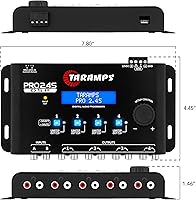
- Dimensions: The unit measures 7.80″ wide by 4.45″ deep by 1.42″ tall, making it compact enough to mount in a trunk, under a seat, or in a dashboard cavity.
- Weight: At 15.9 ounces, the processor is light enough that standard double-sided mounting tape or a small bracket is sufficient for most installation locations.
- Connectivity: All signal connections use RCA connectors for line-level I/O, with dedicated screw-terminal or wire inputs provided for high-level speaker-level signals.
- General Gain: The master input gain is adjustable from -80dB to 0dB, allowing precise control over the overall signal level entering the processor before any EQ or crossover processing.
- Brand Origin: The Pro 2.4S is manufactured by Taramp's, a Brazilian audio electronics brand with an established presence in the car audio and competition audio market.
Related Reviews
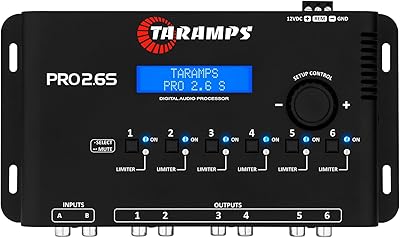
Taramp's Pro 2.6S Digital Signal Processor Equalizer
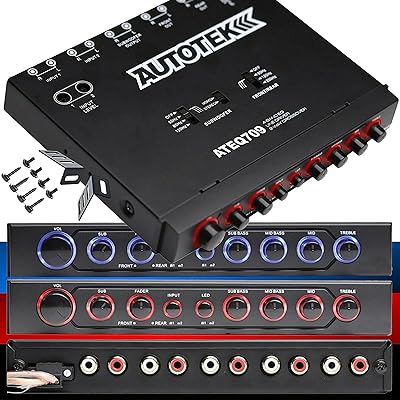
Autotek ATEQ709 4-Band Audio Equalizer with 2-Way Crossover
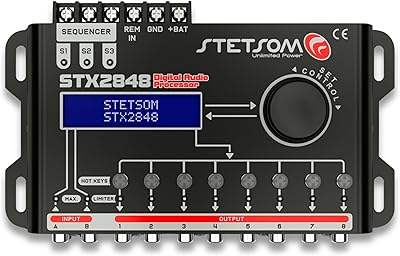
Stetsom STX 2848 8-Channel DSP Crossover Equalizer
Timetec TP01 1TB Portable External SSD
Asustor Drivestor 2 Pro Gen2 2-Bay NAS

Bliss Fab Foaming 2-in-1 Cleanser Exfoliator 17.2oz
PNY Pro Elite V2 1TB Flash Drive
PNY PRO Elite V3 2TB Flash Drive

Deeper PRO+ 2 Castable Fish Finder with GPS