Overview

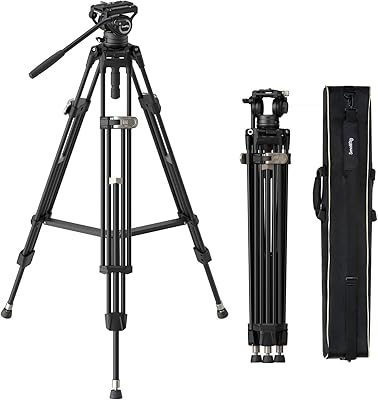
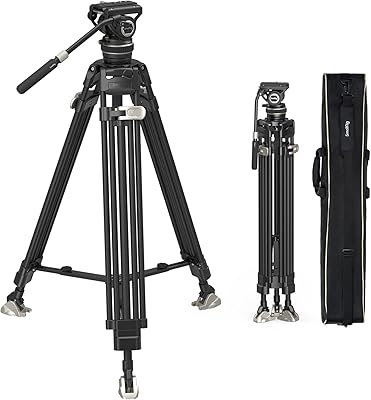
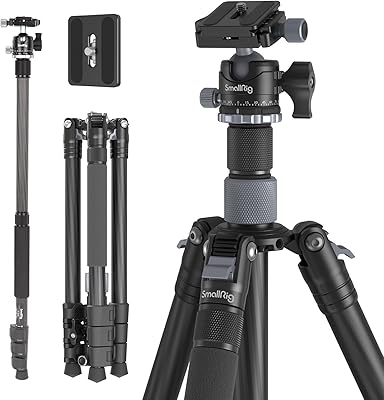
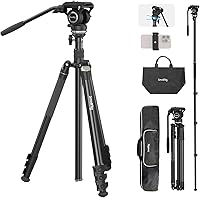
The SmallRig CT210 75″ Video Tripod is a mid-range aluminum field rig built for videographers who shoot outside a studio and need reliable support without hauling a heavy kit. What separates this field tripod from the crowd is one practical decision: a leg that detaches and doubles as a monopod, giving you two tools for the weight of one. The fluid head comes with an integrated leveling base, which matters more than people expect when you are planting legs on a hillside or cobblestone plaza. At its price point, this is a prosumer workhorse — capable and well-considered, but not a replacement for a cinema-grade head and sticks.
Features & Benefits

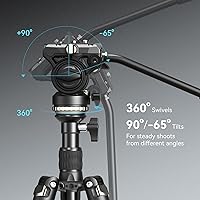
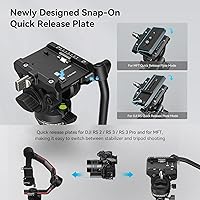
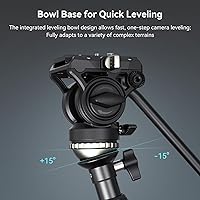
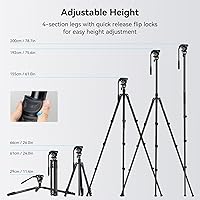
The four-section legs stretch from a low 11.5 inches to a full 75 inches, with quick-release twist locks that adjust fast in the field — no fumbling. Three preset leg angles let you adapt to tight or uneven terrain without much fuss. The fluid head handles full 360° pan and a generous tilt range, though the fixed damping offers no resistance adjustment for heavier glass. That leveling base — a ±15° range — lets you dial in a true horizon in seconds rather than wrestling each leg individually. A 1/4″-20 port accepts monitors or microphones, and the dual quick-release plate system works with DJI RS 2 and RS 3 series stabilizers for fast rig swaps.

Best For

This video tripod punches above its weight for solo videographers who want one piece of support gear covering multiple roles on a shoot. If you travel with a single bag and cannot justify separate tripod and monopod cases, the convertible leg design solves that practically. Hybrid shooters bouncing between a DJI gimbal and a static shot will appreciate the plate compatibility — swapping rigs takes seconds. Load capacity tops out at 13.2 lbs, making it best suited to DSLR or mirrorless setups with moderate lenses rather than heavy zooms. Outdoor and event shooters who work on uneven ground will find the leveling base genuinely useful, and the included carry bag makes transport straightforward.

User Feedback

Buyers consistently praise the CT210 for feeling solid and well-built relative to its price, with particular appreciation for how quickly the leveling base gets a horizon sorted on location. The monopod conversion earns real-world enthusiasm as a time-saver. Where feedback turns critical, the non-adjustable fluid damping draws the most complaints — shooters with heavier telephoto lenses find the resistance either too loose or too stiff with no way to compensate. A handful of users have raised questions about the long-term durability of the quick-release leg locks under repeated field use. The included carry bag gets mixed marks: functional enough for casual transport, but not confidence-inspiring for frequent travel or rough handling.

Pros

  • Detachable monopod leg is a genuinely practical two-in-one solution that saves space and weight on location.
  • Integrated leveling base handles uneven terrain in seconds, removing a frustrating step from outdoor setup.
  • Working height spans from ankle level to well above eye level, covering nearly every shooting position.
  • DJI RS 2 and RS 3 plate compatibility is a real time-saver for hybrid shooters switching rigs mid-shoot.
  • Fluid head delivers smooth 360° pan movement that holds up well with standard mirrorless and DSLR kits.
  • Three leg angle presets give useful flexibility when setting up in tight or awkward spaces.
  • Folds to 24 inches and includes a carry bag, making it practical for travel without a dedicated case.
  • The 1/4″-20 accessory port lets solo operators attach a monitor or microphone without extra rigging hardware.
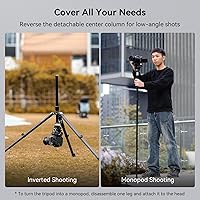
  • Reversible central column opens up low-angle and macro shooting options not possible on fixed-column designs.
  • At its price point, the overall feature set is hard to match from competing brands in the same tier.

Cons

  • Fixed fluid head damping cannot be adjusted, which is a real limitation when using heavier or longer lenses.
  • Quick-release leg locks have raised durability questions among users after extended field use.
  • The included carry bag is thinly padded and not reliable enough for checked luggage or rough transit.
  • Only one accessory port limits rig expansion for operators who need both a monitor and a microphone mounted.
  • Four-section legs introduce more potential flex points than three-section alternatives, noticeable at full height in wind.
  • The leveling base lock requires deliberate tightening to prevent slow drift during long static shots.
  • Reversing the central column is a multi-step process, too slow to do between shots on a live shoot.
  • The weight bag included for stability is small and requires deliberate attachment to have meaningful effect outdoors.
  • No wrist strap or rubber foot on the converted monopod, limiting its comfort and grip during extended handheld use.

Ratings

The SmallRig CT210 75″ Video Tripod has been rated by our AI system after analyzing hundreds of verified global buyer reviews, with spam, incentivized posts, and bot-generated feedback actively filtered out. Scores reflect the honest distribution of real-world praise and frustration across a wide range of shooting scenarios. Both the genuine strengths and the recurring pain points are factored in transparently, so you get an accurate picture before you buy.
Build Quality
78%
22%
Most buyers describe the aluminum construction as sturdy enough for regular outdoor use, noting that the legs feel solid when locked and do not wobble under a mid-weight mirrorless setup. For the price tier, the material finish and joint tolerances impressed users who were upgrading from budget plastic tripods.
A recurring concern is how the quick-release leg locks hold up after months of repeated field use — some buyers reported early loosening. The aluminum alloy, while decent, shows the cost-cutting decisions more clearly than premium-tier rivals when handled side by side.
Fluid Head Performance
72%
28%
The pan movement draws consistent praise for feeling smooth and controlled on standard camera and lens combinations, making it a reliable choice for slow tracking shots or interviews. The tilt range is generous enough that users rarely hit a frustrating physical limit during normal shooting.
The fixed damping is the most cited frustration in this category — shooters using heavier telephoto lenses find the resistance either too soft for controlled movement or too stiff for quick repositioning, with no dial to correct it. This is a real limitation for anyone building a more demanding video kit over time.
Leveling Base Convenience
91%
This feature earns some of the strongest praise in the entire review pool. Shooters working on grass, cobblestone, or sloped terrain report being able to achieve a true horizon in seconds rather than fighting each leg individually, which meaningfully speeds up setup on real locations.
The ±15° adjustment range covers most everyday uneven terrain, but buyers working on steeper slopes or extremely uneven ground occasionally find the range insufficient. A small number of users also noted the leveling lock knob requires deliberate tightening to prevent slow drift during long static shots.
Monopod Conversion
86%
The detachable leg design is frequently described as one of the smartest practical decisions on this rig. Event videographers and run-and-gun shooters appreciate being able to pull a leg free and keep moving without carrying separate support gear, especially during multi-hour shoots.
The converted monopod lacks a dedicated foot or wrist strap, which some users found limiting for extended handheld use. The transition process, while faster than carrying a second piece of gear, still requires a brief pause that can be disruptive during fast-moving shoots.
Height Range & Versatility
83%
Spanning from just under a foot to a full 75 inches, the working height range covers nearly every shooting position from ground-level to above-head angles. Users shooting in documentary and event contexts noted they rarely needed to reach for a second tripod or extension.
At maximum height, a small number of users noted minor flex in the upper leg sections under heavier camera bodies, particularly in windy outdoor conditions. The four-section design adds versatility but also introduces more potential flex points compared to a three-section leg.
Portability & Travel Friendliness
84%
Folding down to 24 inches and coming in at 5.5 lbs, this field tripod is compact enough for overhead bin storage and light enough that solo shooters do not feel it dragging on long hike-in shoots. The included carry bag makes transport to and from a car or transit straightforward.
The included carry bag is consistently described as just adequate — functional for casual transport but not padded or reinforced enough to inspire confidence during checked luggage travel or rough handling. Several buyers upgraded to a third-party bag after early use.
Quick-Release Plate System
74%
26%
The dual-plate compatibility with DJI RS 2 and RS 3 series stabilizers genuinely saves time for hybrid shooters who move between a gimbal and a static setup within a single shoot. Plate swaps are faster than wrestling with an adapter mid-shoot, and users running DJI rigs specifically called this out as a deciding factor.
Buyers not using DJI stabilizers get less value from the dual-system design, and a few noted the non-DJI plate felt slightly less secure under active use. There are also occasional reports that the locking mechanism requires extra attention to ensure full engagement before trusting it with an expensive camera body.
Setup Speed
81%
19%
The quick-release twist locks on the legs allow for fast height adjustment without the usual frustration of traditional flip locks, and users setting up in low-light conditions appreciated not needing to look down to feel when a section was locked. Most buyers report being fully set up in under two minutes.
The leveling base lock and central column adjustment each require separate tightening steps, which adds a few seconds of friction during rapid scene changes. Under time pressure — like a fast-moving event — those extra steps can feel disruptive compared to simpler designs.
Stability Under Load
76%
24%
For camera kits in the 8–11 lb range, the CT210 holds steady without noticeable drift or creep on flat and mildly uneven surfaces. Users shooting static interviews and product videos reported no issues with vibration transfer or leg slip during normal operation.
Approaching the upper end of the stated load capacity, stability becomes more conditional — particularly on soft ground like grass or gravel, where the rubber feet can shift under heavier rigs. A weight bag is included to help, though users noted it requires deliberate attachment to make a real difference.
Accessory Expandability
77%
23%
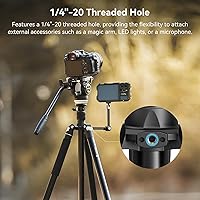
The 1/4″-20 expansion port is a practical addition that lets shooters bolt on a small monitor, microphone, or magic arm without rigging a clamp workaround. For solo operators trying to build a self-contained rig, even a single well-placed accessory port makes a meaningful difference to workflow.
There is only one accessory port, which limits how much you can expand without adding a cold shoe adapter or third-party plate. Users running a monitor and a microphone simultaneously found themselves wishing for at least one additional mounting point on the head or column.
Leg Angle Options
79%
21%
Three fixed leg angle presets give shooters practical options for adapting to tighter spaces or low-angle compositions without guesswork. Users shooting on staircases or cluttered indoor environments appreciated the ability to splay legs wider to stabilize around obstacles.
The preset system offers convenience but no true continuous adjustment, which bothers shooters who want precise intermediate angles. In a few edge-case scenarios — like shooting on a narrow ledge or between two close objects — none of the three presets lands at exactly the right spread.
Value for Money
88%
At its price point, the CT210 consistently earns high marks for packing in a fluid head, leveling base, monopod conversion, and DJI plate compatibility when most competitors at this tier offer only one or two of those features. Buyers upgrading from basic consumer tripods frequently describe it as a significant step up in capability per dollar spent.
Buyers coming down from professional-grade rigs may find the trade-offs — fixed damping, basic carry bag, non-adjustable leg locks — harder to accept, even at a lower price. The value equation holds well for the target buyer but can disappoint those expecting cinema-quality performance on a budget.
Included Accessories
67%
33%
The box includes a carry bag, smartphone holder, weight bag, and allen wrench — a more complete package than most competitors offer at this price. The smartphone holder is a genuinely useful bonus for solo creators who mix phone and camera footage.
The carry bag is the weakest inclusion: thin material, basic zipper, and no padding. The weight bag, while thoughtful in concept, is small enough that some users questioned how much real-world stabilization it provides in windy outdoor conditions.
Central Column Flexibility
73%
27%
The ability to detach and reverse the central column adds shooting angles that a fixed column would prevent, particularly for low macro or product shots where getting the camera close to the ground is essential. A handful of buyers specifically mentioned this as a feature that justified the purchase over similar-priced alternatives.
Reversing the column is a multi-step process that is not quick enough to do mid-shoot, making it more of a deliberate setup choice than an on-the-fly option. The column also lacks a geared adjustment, so precise height micro-corrections require loosening and re-locking the lock knob by feel.

Suitable for:

The SmallRig CT210 75″ Video Tripod is built for solo videographers and content creators who need one versatile support rig rather than a bag full of separate gear. If you shoot weddings, documentary work, YouTube content, or corporate events on location, the combination of a fluid head, quick leveling base, and detachable monopod leg covers most of what you will encounter in a typical shooting day. Travel creators who move through airports and public transit will appreciate that it folds to 24 inches and comes with a carry bag, making it genuinely pack-friendly without sacrificing working height. Hybrid shooters running a DJI RS 2 or RS 3 series gimbal alongside a static tripod setup will find the compatible quick-release plate system saves real time during transitions. Anyone regularly dealing with uneven ground — parks, cobblestone streets, hillside venues — will get consistent use out of the integrated leveling base, which removes one of the most tedious parts of outdoor setup.
Not suitable for:

The SmallRig CT210 75″ Video Tripod is not the right call if you are shooting with heavy telephoto lenses or cinema-style camera bodies, because the fixed fluid head damping cannot be tuned to match the extra weight and you will notice it immediately in your pan and tilt movements. Professionals who depend on precise, adjustable resistance for broadcast or commercial work should look at dedicated fluid heads in a higher price tier where damping control is standard. If long-term durability under daily professional abuse is a priority, the aluminum construction and quick-release leg locks at this price point carry real trade-offs that will show over time. Buyers hoping the included carry bag will serve as a proper travel case for checked luggage or rough transport will be disappointed — it is a basic sleeve, not a protective case. Finally, shooters building a multi-accessory rig with both a monitor and a microphone will quickly hit the limit of the single 1/4″-20 expansion port and need additional mounting solutions.
Specifications

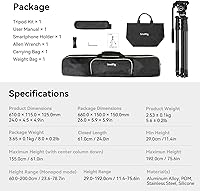
  • Main Material: Legs are constructed from aluminum alloy, providing a balance of rigidity and weight savings suited to field use.
  • Folded Length: The tripod folds down to 61 cm (24 in), compact enough for overhead bin storage or a standard camera backpack.
  • Working Height: Height adjusts from 29 cm (11.5 in) at its lowest to 192 cm (75 in) at full extension across four leg sections.
  • Net Weight: The complete rig weighs 2.5 kg (5.5 lb), light enough for solo operators carrying gear over longer distances.
  • Max Load Capacity: The tripod supports camera equipment up to 6 kg (13.2 lb), covering most DSLR and mirrorless setups with standard lenses.
  • Leg Sections: Four-section legs with quick-release twist locks allow fast height adjustment without tools or flip-lock fumbling.
  • Leg Angle Presets: Three fixed leg spread angles — 23°, 55°, and 80° — provide stable configurations for standard, wide, and low-angle placements.
  • Head Type: A fluid head with fixed pan and tilt damping enables controlled camera movement for video panning and tilting shots.
  • Tilt Range: The fluid head tilts from +90° (straight up) to -65° (angled downward), covering a broad range of vertical shooting angles.
  • Pan Rotation: Full 360° pan rotation allows continuous horizontal camera movement without repositioning the tripod body.
  • Leveling Base: An integrated leveling base offers ±15° of tilt adjustment to quickly establish a true horizon on uneven terrain.
  • Quick-Release Plates: The head accepts two quick-release plate types: one compatible with DJI RS 2 / RS 3 / RS 3 Pro stabilizers and one standard plate.
  • Accessory Port: A 1/4″-20 threaded expansion hole on the head allows attachment of monitors, microphones, magic arms, or other accessories.
  • Monopod Function: One leg detaches from the tripod body and can be used independently as a monopod for mobile or run-and-gun shooting.
  • Central Column: The central column can be detached and reversed to allow low-angle or inverted shooting perspectives not possible in standard position.
  • In the Box: Package includes the tripod, fluid head, carrying bag, smartphone holder, weight bag, allen wrench, and user manual.
  • Model Number: The official SmallRig model identifier for this tripod is CT210, listed under SmallRig product code 4475.

Related Reviews

SmallRig AD-80 FreeBlazer Video Tripod System
87%
93%
Stability & Smooth Operation
90%
Build Quality & Durability
88%
Ease of Setup & Adjustment
72%
Portability
91%
Compatibility with Camera Setups
More
SmallRig AD-100 FreeBlazer Carbon Fiber Video Tripod
84%
94%
Build Quality & Durability
91%
Stability & Support
89%
Fluid Head Performance
72%
Portability & Weight
88%
Ease of Setup & Adjustment
More
SmallRig CT200 Horizontal Overhead Tripod
84%
88%
Stability and Performance
72%
Portability/Weight
85%
Ease of Use
90%
Build Quality
89%
Versatility
More
SmallRig RM75 RGB Video Light
87%
91%
Portability
89%
Ease of Use
94%
Color Accuracy
83%
App Control Experience
73%
Battery Life
More
SmallRig P96L RGB Video Light
81%
91%
Build Quality
88%
Color Accuracy
61%
Brightness Output
79%
Battery Life
84%
RGB & Scene Modes
More
SmallRig RM120 RGB Video Light
89%
96%
Build Durability
94%
Battery Endurance
92%
Color Accuracy
88%
User Interface
85%
Mounting Stability
More
SmallRig AP-20 Carbon Fiber Tripod
78%
86%
Build Quality
92%
Weight & Portability
79%
Stability & Rigidity
74%
Ball Head Performance
88%
Ease of Setup & Height Adjustment
More
SmallRig Pix M160 (3157)
83%
94%
Build Durability
92%
Color Rendering Accuracy
89%
Light Intensity
86%
Battery Endurance
91%
Magnetic Versatility
More
SmallRig RC 60B
SmallRig RC 60B
82%
93%
Brightness Output
91%
Color Accuracy
58%
Battery Life
94%
Portability & Form Factor
79%
Build Quality
More
SMALLRIG Vibe P96 Pro LED Video Light
84%
91%
Portability & Weight
94%
Color Accuracy (CRI/TLCI)
68%
Battery Life at Full Brightness
85%
Brightness & Light Output
87%
Mounting Flexibility
More

FAQ

It genuinely works. One leg unclips from the spider and stands on its own as a usable monopod. It is not a premium dedicated monopod, but for quick mobility between static shots it is a real and practical option. Just keep in mind there is no wrist strap or dedicated rubber foot included for monopod mode, so you may want to add those separately if you use it often.

For standard mirrorless and DSLR setups with typical kit or prime lenses, the pan movement is smooth and controlled enough for interviews, event coverage, and YouTube-style content. The limitation kicks in with heavier telephoto lenses — the damping is fixed, so there is no resistance dial to compensate, and pans can feel either too loose or too stiff depending on your lens weight.

Shooters who work outdoors consistently rate this as one of the most useful features on the rig. Instead of adjusting each leg individually to level the head, you roughly plant the tripod, use the leveling base to dial in the horizon, and lock it off. On uneven surfaces like grass, gravel, or sloped walkways, this saves a meaningful amount of time per setup.

The SmallRig CT210 75″ Video Tripod includes a plate compatible with the DJI RS 2, RS 3, and RS 3 Pro. If you are running one of those gimbals and a standard mirrorless or DSLR camera, you can move the camera between the gimbal and the tripod head without swapping plates entirely. Verify compatibility if you are using a newer DJI RS series model, as the product line updates periodically.
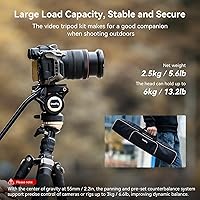
At moderate heights with a standard camera body, stability is reasonable for still and video work. At maximum height or with a heavier rig, you may notice some flex in the upper leg sections during stronger gusts. The included weight bag helps — hang it from the center column hook and it noticeably reduces vibration — but it is a small bag and not a complete fix in serious wind.

It is fine for car transport or carrying to a nearby shoot, but it is a basic sleeve without meaningful padding or reinforced zipper construction. If you plan to check it as luggage or throw it in the back of a van regularly, most users recommend picking up a padded bag separately to protect the head and legs from impact.

The head has a single 1/4″-20 expansion port, so you can mount one accessory directly without any additional hardware. For both a monitor and a microphone simultaneously, you would need a cold shoe adapter or a small magic arm clamp to create a second mounting point. It is a workable solution but adds a step and some extra cost.

With the legs splayed to their widest 80° preset and the central column shortened or reversed, you can get the camera quite close to the ground — the minimum height is around 11.5 inches in standard configuration, and lower with the column inverted. It is not a true ground-level spreader setup, but it covers most low-angle video needs without carrying a separate low-mode rig.

For occasional to moderate professional use — weekend shoots, events, travel content — the aluminum construction holds up well based on user feedback. For daily heavy professional use or work in demanding environments, a few users have reported wear on the quick-release leg locks over time. It is a prosumer tool priced accordingly, and setting that expectation honestly is important before buying.

Full extension reaches 192 cm (75 in), which puts the camera well above eye level for most shooters. At that height, the rig is stable enough for static shots but benefits from the weight bag being attached. For active panning or tilting at maximum height, especially with a heavier camera, you will notice more movement in the legs than at mid-range working heights.

Where to Buy