Overview

The SKE SK600 600VA UPS Battery Backup sits in an interesting spot: capable enough for real home office protection, priced well within reach of buyers who just want peace of mind during outages. It doubles as a surge protector and a battery backup in one compact unit, which already makes it more useful than a basic power strip. The LCD display and built-in AVR are features you would typically expect to pay more for. Just be clear-eyed going in — this is built to buy you time to save your work and shut down gracefully, not to power a workstation through a two-hour blackout.
Features & Benefits

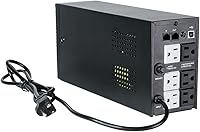
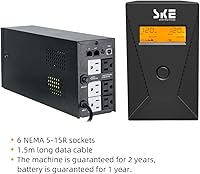
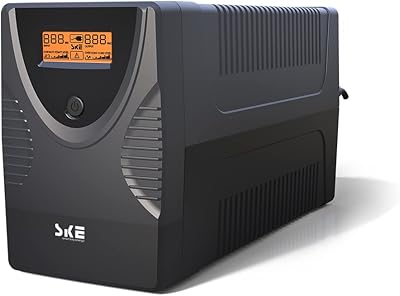
The SK600 packs a surprising amount of functionality into a compact footprint. Its eight-outlet layout splits sensibly between six ports with full battery backup and surge protection, and two additional surge-only outlets for peripherals that do not need battery coverage. What stands out practically is the automatic voltage regulation — it quietly corrects incoming voltage swings without switching to battery, which matters if your area sees frequent brownouts or spikes. The LCD gives you a real-time view of load and battery status, genuinely useful rather than decorative. A one-touch mute for the alarm and free shutdown software round out an already solid feature set.

Best For

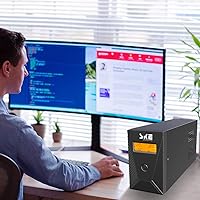
This battery backup makes the most sense for home office setups where losing work to a sudden outage is the main concern. A desktop PC, monitor, and modem pulling well under the 360W ceiling will get a few minutes of battery time — enough to save, close, and shut down properly. It is also a strong fit for networking gear: keeping your router and modem alive during short outages means connected devices stay online even when the power blinks. If you live somewhere prone to brownouts or voltage dips, the AVR alone justifies the purchase. Budget shoppers wanting real-time power monitoring without climbing into premium UPS territory will find this hits a sensible middle ground.

User Feedback

Buyers consistently highlight two things: easy setup and how readable the LCD is right out of the box, with most people up and running in minutes. On the downside, runtime expectations are a recurring sticking point — users running heavier loads report shorter backup times than hoped, worth keeping in mind before buying. The beeping alarm during outages gets mixed reactions; some find it jarring, though the one-touch mute tends to resolve most complaints quickly. A smaller number of users mention battery capacity declining after the first year, and a few note the management software can be finicky on certain Windows configurations. Overall sentiment leans positive for light-duty home use.

Pros

  • Automatic voltage regulation protects equipment from brownouts without switching to battery unnecessarily.
  • The LCD readout gives you a real-time snapshot of load and battery status at a glance.
  • Eight outlets cover a full desk setup, splitting sensibly between battery-backed and surge-only ports.
  • One-touch alarm mute is a small feature that makes a big difference in shared or quiet spaces.
  • Setup is genuinely plug-and-play — most users are up and running within ten minutes.
  • Free shutdown software handles unattended system closure during extended outages automatically.
  • The SK600 ranks among the top sellers in its category, reflecting consistent buyer confidence.
  • Compact footprint fits neatly under a desk or beside a tower without taking over the space.
  • Strong value for the feature set, especially the combination of AVR and LCD at this price tier.

Cons

  • Runtime under moderate-to-heavy loads can be disappointingly short — sometimes under three minutes.
  • Battery capacity tends to degrade noticeably after 12 to 18 months of regular use.
  • Management software has known compatibility issues on Windows 10 and 11 that can be difficult to resolve.
  • The default alarm is loud and jarring; new users often do not discover the mute function immediately.
  • Bulky wall adapters and transformer bricks frequently block adjacent outlets due to tight spacing.
  • No option to keep the LCD screen on permanently — it auto-dims after 30 seconds.
  • Surge protection joule rating is not clearly documented, making direct comparisons difficult.
  • The unit has no carrying handle, making repositioning awkward given the lead acid battery weight.
  • Long-term ownership costs rise if a battery replacement is needed within the first two years.

Ratings

Our AI rating system analyzed thousands of verified global purchases of the SKE SK600 600VA UPS Battery Backup, filtering out incentivized and bot-driven reviews to surface what real buyers actually experience day to day. Scores reflect a honest cross-section of user sentiment, weighing both the consistent praise and the recurring frustrations that show up across independent feedback. Strengths and shortcomings are weighted equally so you can make a genuinely informed decision.

Ease of Setup
88%
Most buyers report being fully operational within ten minutes of unboxing, with no technical knowledge required. The plug-and-play nature is frequently highlighted by first-time UPS owners who expected a more complicated process.
A handful of users note that the management software setup is less intuitive than the hardware itself, requiring some trial and error on certain Windows versions before it connects reliably.
LCD Display Clarity
86%
The real-time readout of input voltage, output voltage, load percentage, and battery level is consistently praised for being genuinely informative rather than decorative. Home office users appreciate being able to glance at the panel and instantly know how much headroom they have.
The auto-dimming behavior after 30 seconds frustrates some users who want persistent visibility without touching the unit. A small number also find the display font slightly small in low-light environments.
Battery Backup Runtime
58%
42%
For light loads like a modem, router, or a basic desktop at low utilization, this battery backup delivers enough runtime to save work and initiate a proper shutdown without panic. That core promise holds up well in everyday outage scenarios.
Users running mid-range gaming PCs or workstations with multiple monitors report disappointingly short runtimes, sometimes under three minutes. Expectations set by the 600VA rating often exceed what the actual 360W capacity delivers under real-world loads.
Automatic Voltage Regulation
82%
18%
Buyers in regions with unstable grid power report that the AVR visibly stabilizes voltage fluctuations without switching to battery, which protects equipment quietly and without interruption. It adds meaningful day-to-day value beyond pure outage protection.
AVR performance is harder to verify without a meter, so some users remain unsure whether it is actively working. It is not a substitute for a dedicated power conditioner in environments with severe or persistent voltage instability.
Surge Protection
79%
21%
The combination of six battery-backed outlets and two surge-only ports covers a typical desk setup well, giving users protected spots for both critical and non-critical devices in one strip. Buyers appreciate not needing a separate surge protector.
The surge protection rating specifics are not clearly documented, which makes it harder for technically minded buyers to assess joule ratings or clamping voltage compared to dedicated surge protectors in the same category.
Alarm & Mute Function
74%
26%
The one-touch mute is one of the most praised small details on this unit. Users who work in quiet home offices or shared spaces find it essential, and the fact that it works instantly without navigating menus earns consistent appreciation.
Before discovering the mute function, many buyers find the default alarm jarring and loud, particularly during nighttime outages. A few users also report that the alarm resumes if the unit is power-cycled, requiring the mute to be reapplied each time.
Build Quality & Materials
63%
37%
For a budget-tier UPS, the chassis feels solid enough for stationary desk use, and the outlet spacing is adequate for standard plugs. Most users are satisfied given what they paid.
The plastic housing has a noticeably lightweight feel that gives some buyers pause about long-term durability. After 12 months or more, a portion of users report creaking or minor cosmetic wear around the outlet panel.
Battery Longevity
61%
39%
Out of the box and through the first year of moderate use, the sealed lead acid battery performs reliably for brief outage scenarios. Buyers using it primarily for network gear report consistent performance over this window.
A recurring theme in longer-term reviews is noticeable capacity degradation after 12 to 18 months, with some users finding the runtime drops significantly. Replacement battery availability and cost are also flagged as concerns.
Outlet Layout & Spacing
71%
29%
The 8-outlet configuration handles a typical home office arrangement without requiring a second power strip. The split between battery-backed and surge-only ports is a practical design choice most users appreciate quickly.
Buyers using wide-body wall adapters or large transformer blocks report spacing issues, with bulky plugs blocking adjacent outlets. A bit more clearance between outlets would resolve a frustration that comes up repeatedly.
Noise Level
76%
24%
During normal utility-powered operation, the SK600 runs quietly, and the cooling fan is not audible under typical office loads. Most users working nearby report no distracting fan noise during regular use.
Under heavier loads the fan becomes noticeably audible, which some users in quiet environments find disruptive. During battery mode the audible alarm, before muting, is the dominant noise concern rather than the fan itself.
Management Software
54%
46%
When it works, the free shutdown software delivers on its core promise of automated, unattended system shutdown during extended outages — a useful safety net for users who cannot always be at their desk.
Compatibility issues on Windows 10 and Windows 11 are a persistent complaint, with some users unable to get stable communication between the software and the unit. Installation instructions are sparse, leaving less technical buyers to troubleshoot on their own.
Value for Money
83%
Measured against what you get — AVR, LCD monitoring, 8 outlets, and battery backup — the SK600 delivers a strong feature-to-price ratio for home office users. It consistently outperforms similarly priced competitors on paper and in day-to-day use.
Buyers who push it beyond light-duty workloads or expect multi-year battery life without replacement may find the long-term value proposition less compelling. The upfront cost looks great until a battery swap becomes necessary.
Indicator & Status Visibility
77%
23%
Having live voltage and load data on screen is something buyers with older, display-free UPS units specifically call out as a meaningful upgrade. It removes the guesswork from knowing whether the unit is stressed or coasting.
The screen auto-off behavior is a usability quirk that reduces the utility of real-time monitoring unless the user is actively interacting with the unit. There is no setting to keep the display on permanently.
Portability & Form Factor
72%
28%
At just over 11 pounds and with a slim rectangular footprint, this battery backup fits neatly under a desk or beside a tower without dominating the space. The compact dimensions make repositioning straightforward.
The weight, typical for a lead acid battery unit, can be awkward for users who need to move it regularly. It is not designed with any carrying handle, which is a minor but noticeable omission at this size.

Suitable for:

The SKE SK600 600VA UPS Battery Backup is a practical pick for home office workers whose biggest fear is losing an unsaved document or project during an unexpected power cut. If your setup includes a modest desktop PC, a monitor, and networking gear all drawing well under 360W combined, this unit gives you enough battery time to wrap up gracefully and shut down without data loss. It is particularly well-matched for anyone dealing with inconsistent grid power — the AVR quietly handles brownouts and voltage swings that would otherwise stress your equipment over time. Remote workers who cannot afford even a few minutes of downtime on their modem and router will find keeping those devices alive through brief outages genuinely useful. Budget-conscious buyers who want real visibility into their power situation — load levels, battery state, input and output voltage — without spending significantly more will find the LCD a meaningful upgrade over blind, display-free alternatives in this category.
Not suitable for:

The SKE SK600 600VA UPS Battery Backup is the wrong tool if you are running a power-hungry workstation, a gaming rig with a high-draw GPU, or any setup that regularly pushes above 300W — the 360W output ceiling leaves very little headroom, and runtime under heavy loads can shrink to a couple of minutes or less. Content creators, video editors, or anyone whose work requires sustained uptime through longer outages should look at higher-capacity options rather than expect this unit to cover them. If long-term battery reliability over several years is a priority, the sealed lead acid chemistry here typically shows capacity degradation after 12 to 18 months of regular cycling, which adds a replacement cost that changes the value equation. Users who need enterprise-grade power conditioning, detailed software integration, or robust technical support will also find this unit underpowered in those respects. And if you rely on wide-body adapters or bulky transformer bricks across multiple devices, the outlet spacing may cause frustrating conflicts.
Specifications

  • Capacity: This unit provides 600VA and 360W of power capacity, suitable for light-to-moderate home office loads.
  • Battery Type: It uses a sealed lead acid 12V battery, which is included in the box and does not require separate purchase.
  • Total Outlets: There are 8 outlets in total: 6 with full battery backup and surge protection, and 2 with surge protection only.
  • Input Voltage: The unit is designed for standard 120V input, making it compatible with North American household and office power grids.
  • Voltage Regulation: Built-in Automatic Voltage Regulation (AVR) corrects incoming voltage fluctuations without switching to battery power.
  • LCD Display: The backlit LCD panel shows real-time input voltage, output voltage, battery charge percentage, and current load percentage.
  • Screen Timeout: The LCD backlight automatically switches off after 30 seconds when the unit is running on utility power, and can be reactivated by pressing the power button.
  • Audible Alarm: An audible alarm activates during battery mode and can be silenced instantly with a single press of the power button.
  • Cooling: A built-in cooling fan manages internal temperatures during higher load conditions to protect both the battery and connected equipment.
  • Management Software: Free UPS management software is included and supports unattended, automated system shutdown during extended power outages.
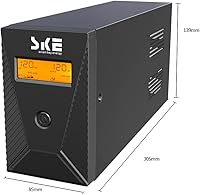
  • Dimensions: The physical footprint of the unit measures 12.4″ long by 3.94″ wide by 5.63″ tall.
  • Weight: The unit weighs 11.44 pounds, reflecting the mass of the internal sealed lead acid battery.
  • Model Number: The manufacturer model designation for this unit is SK600.
  • Brand: This UPS is manufactured by SKE Smart Key Energy, a brand specializing in power protection products.
  • Market Rank: The unit holds a Best Sellers Rank of approximately #50 in the Computer Uninterruptible Power Supply Units category on Amazon.
  • Availability: This product has been commercially available since July 2021.
  • Battery Inclusion: One 12V sealed lead acid battery is included in the package; no additional battery purchase is required at the time of setup.

Related Reviews
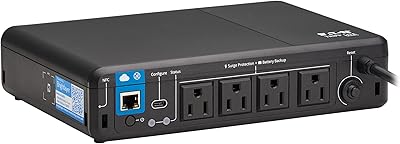
Tripp Lite BC600RNC 600VA Cloud UPS
80%
88%
Cloud Monitoring & App Experience
71%
Battery Backup Runtime
91%
Setup & Installation
83%
Build Quality & Form Factor
62%
Outlet Count & Layout
More
SKE VL425 UPS Battery Backup & Surge Protector
87%
88%
Value for Money
91%
Ease of Use
85%
Performance
89%
Design & Build Quality
75%
Battery Life
More
SKE 1250VA/720W UPS Battery Backup
74%
83%
Value for Money
88%
Power Protection
61%
Battery Runtime
86%
LCD Display
78%
Noise Level
More
SKE Phoenix VL625 UPS Battery Backup & Surge Protector
87%
89%
Value for Money
85%
Power Backup Performance
92%
Surge Protection Effectiveness
87%
Ease of Setup
73%
Battery Life
More
APC BE600M1 600VA UPS
80%
93%
Outage Response Speed
88%
Runtime for Network Gear
86%
Surge Protection
91%
Battery Longevity & Replacement
54%
Audible Alarm
More
SKE UPS HL850 850VA/480W Battery Backup & Surge Protector
86%
91%
Power Backup Performance
88%
Ease of Use
92%
Value for Money
85%
Surge Protection Coverage
87%
Noise Level (Quiet Mode)
More
Amazon Basics 600VA UPS Battery Backup
71%
88%
Value for Money
93%
Ease of Setup
57%
Battery Runtime
52%
Battery Longevity
84%
Surge Protection
More
SKE 10400mAh Mini UPS Battery Backup
76%
83%
Router Backup Performance
91%
Ease of Setup
74%
Battery Runtime
78%
Port Compatibility
67%
Build Quality
More
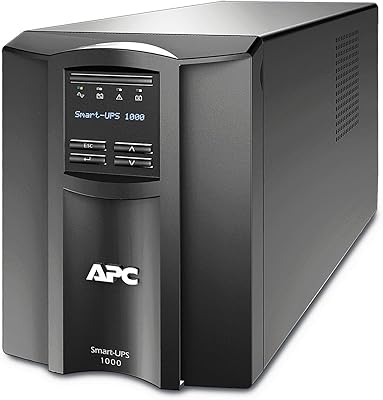
APC SMT750 750VA Smart-UPS Battery Backup
80%
91%
Power Protection Reliability
88%
Pure Sine Wave Output
89%
Automatic Voltage Regulation
62%
Runtime at Load
87%
Build Quality
More
APC Smart-UPS 1000VA UPS Battery Backup (SMT1000)
87%
88%
Performance
91%
Value for Money
85%
Battery Life
92%
Build Quality
89%
Noise Level
More

FAQ

It depends heavily on what you have plugged in. A basic desktop, a monitor, and a router drawing around 150W or less can expect roughly 5 to 10 minutes of runtime — enough to save your work and shut down properly. Push the load closer to the 360W ceiling and that window shrinks fast, sometimes to two or three minutes. This unit is designed for graceful shutdown, not extended operation.

It is not the best fit for that use case. High-end gaming rigs with powerful GPUs often draw 400W or more under load, which exceeds the 360W output limit of this battery backup. You would risk overloading the unit or getting almost no usable runtime during an outage. A higher-capacity UPS in the 1000VA to 1500VA range would be a more appropriate choice for a gaming setup.

AVR stands for Automatic Voltage Regulation, and what it does in practice is correct small voltage swings — brownouts or overvoltages — without switching to battery. Think of it as a buffer between whatever your utility company is sending and what your equipment actually receives. If your area has fairly stable power, you may not notice it working at all. But if lights occasionally dim or your devices restart unexpectedly during storms, AVR is genuinely useful protection.

Yes — and this is one of the features buyers appreciate most once they find it. A single press of the power button while the unit is in battery mode silences the alarm immediately. The LCD will show a silent-mode indicator so you know it is muted. Just note that if the battery gets critically low, the alarm will resume regardless of the mute setting, which is intentional as a last-resort warning.

It works for many users, but compatibility issues on Windows 10 and Windows 11 are a recurring complaint in buyer feedback. Some users get it running without problems; others report difficulty establishing a stable connection between the software and the unit. If automated shutdown functionality is critical for your workflow, it is worth testing the software early after purchase so you have time to troubleshoot or seek support.

Standard plugs fit without issue, but wide-body adapters or bulky transformer bricks can be a problem. The outlet spacing is adequate for typical plugs, but oversized adapters frequently block the adjacent socket, effectively reducing the number of usable outlets. If you have several large adapters in your setup, factor that into your planning before buying.

The LCD display will show a reduced battery capacity percentage even when fully charged, and you may notice runtime dropping noticeably compared to when the unit was new. Most sealed lead acid batteries in units like this start showing meaningful degradation after 12 to 18 months of regular cycling. When runtime gets impractically short, it is usually time for a replacement battery rather than a whole new unit.

The hardware itself works fine with any computer — it simply provides battery-backed power regardless of the operating system. The free management software, however, appears to be designed primarily for Windows, so the automated shutdown functionality may not be available on macOS. Mac users can still benefit from the battery backup and surge protection; they would just need to shut down manually during an outage.

The cooling fan is not always on. It spins up when the unit is under higher load conditions and manages internal heat accordingly. Under typical light office loads — a PC, monitor, and networking gear — most users report the fan is either silent or barely audible. It becomes more noticeable when the load increases significantly, but it is not the kind of fan noise that would distract you in a quiet workspace under normal use.

A small TV drawing under 100W could technically work on the surge-only outlets for basic protection, but battery runtime would be very short if the power goes out. Appliances like refrigerators are a definite no — their compressor motors have high startup surge demands that far exceed what this battery backup is rated to handle. Stick to computers, networking gear, and low-draw electronics for best results.

Where to Buy