Overview

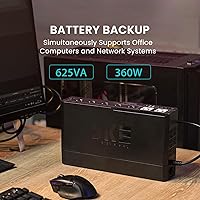
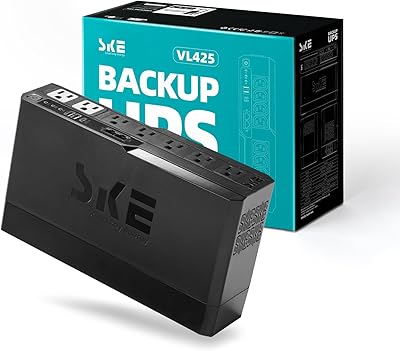
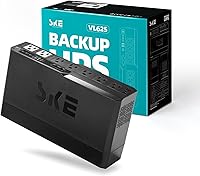
The SKE Phoenix VL625 625VA UPS entered the market in late 2024 and quickly climbed into the top 35 of its Amazon category — a strong early sign for a relatively unknown brand. At its core, this battery backup unit handles two jobs: it keeps your gear running during a power outage and provides surge protection around the clock. The 625VA/360W capacity is honest, mid-range territory — solid for a desktop PC and home network, but not built for power-hungry workstations. Worth noting early: it outputs a simulated sine wave, not a pure sine wave, which suits most modern electronics just fine but may be a consideration if you're running older or more sensitive equipment.
Features & Benefits

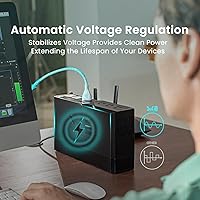
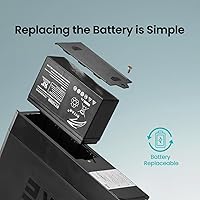
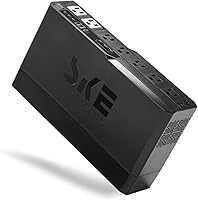
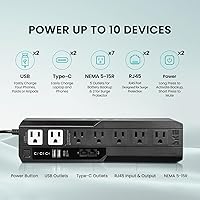
The outlet layout deserves more attention than it usually gets. Five of the seven outlets deliver both battery backup and surge protection — those are the ones you plug your PC and router into. The remaining two handle surge protection only, which is still useful for lamps or chargers but won't keep anything running during an outage. Beyond outlets, this compact UPS includes two USB-A ports and a USB-C port for phone or laptop top-ups, plus an RJ45 jack that protects your network line — a small detail that matters if a lightning strike has ever killed a modem. Automatic Voltage Regulation quietly smooths out sags and spikes without draining the battery, and replacing the internal SLA battery down the line takes nothing more than a Phillips screwdriver.

Best For

This compact UPS fits a specific niche well: the home office or small apartment where the priority is protecting a desktop computer, a router, and maybe a modem rather than powering a full workstation rig. If your main concern is keeping your internet connection alive during brief outages — or having a few minutes to save your work and shut down cleanly — it handles that job reliably. It also sits comfortably under a desk or on a shelf thanks to its flexible placement design. That said, skip it if you're running a gaming PC, multiple large monitors, or anything with a high sustained draw. The 360W output ceiling is real, and pushing past it will trip the overload protection fast.

User Feedback

With over 370 ratings and a 4.3-star average earned in roughly a year on the market, the Phoenix VL625 has built a solid early reputation. Buyers tend to praise the straightforward setup, the quiet day-to-day operation, and how little space it takes up. The criticism that surfaces most often centers on runtime — at this capacity, you're looking at minutes, not extended sessions, so managing expectations matters. Some users have noted the audible alarm can feel overly sensitive during minor fluctuations. Long-term reliability is still an open question since the product is relatively new and battery longevity data remains limited. For what it costs, though, the overall buyer sentiment lands clearly on the positive side.

Pros

  • Combines battery backup and surge protection in one compact unit, reducing clutter and cost.
  • The RJ45 network surge port protects your modem and router from line spikes — a feature many budget UPS units skip.
  • Automatic Voltage Regulation handles minor power fluctuations without burning battery cycles unnecessarily.
  • Seven outlets cover a full small-office setup, with five delivering full backup protection.
  • USB-C and dual USB-A ports make it genuinely useful as an everyday charging hub, not just emergency hardware.
  • The user-replaceable SLA battery means you can extend the product's lifespan without buying a whole new unit.
  • Fits vertically or horizontally, making it easy to tuck under a desk or onto a shelf in tight spaces.
  • At 9 pounds, the Phoenix VL625 is light enough to reposition without effort.
  • A 4.3-star average across 370-plus ratings is a credible early signal of consistent build quality.
  • Quiet enough during normal operation that most users report forgetting it is there.

Cons

  • Simulated sine wave output may not be compatible with older or particularly sensitive electronics that require pure sine wave power.
  • Runtime at realistic home office loads is short — expect minutes of backup time, not a meaningful work session.
  • The battery alarm can trigger during minor voltage fluctuations, which some users find disruptive in quiet environments.
  • As a brand that launched in late 2024, long-term reliability and battery degradation patterns are still largely unknown.
  • Only two of the seven outlets are surge-only, leaving less flexibility for non-critical devices that still need protection.
  • No software or USB monitoring port means no automated graceful shutdown integration with your operating system.
  • Outlet spacing may be tight for larger wall adapters, potentially blocking adjacent sockets.
  • The sealed lead-acid battery will eventually need replacement, adding a maintenance cost that budget buyers should factor in.

Ratings

The scores below reflect an AI-driven analysis of verified global user reviews for the SKE Phoenix VL625 625VA UPS, with spam, incentivized feedback, and bot-generated content actively filtered out before scoring. Each category captures both what real buyers consistently praised and the friction points that surfaced repeatedly across hundreds of submissions. The result is a transparent, balanced picture — not a highlight reel.

Value for Money
88%
Buyers repeatedly flag this compact UPS as one of the stronger budget options available for basic home office protection, noting that comparable units from established brands often cost noticeably more for similar capacity. The inclusion of AVR, USB-C charging, and an RJ45 network port at this price tier consistently surprises first-time buyers in a positive way.
A small number of reviewers feel the value proposition weakens slightly once you factor in the eventual battery replacement cost, which adds to the total ownership cost over time. Those who expected premium-tier runtime for a budget price were the most likely to feel let down.
Battery Backup Runtime
58%
42%
For users running a lightweight setup — a router, a modem, and a low-draw desktop — the Phoenix VL625 reliably provides enough runtime to save open work and initiate a clean shutdown before the battery depletes. That core promise holds up well under realistic loads within the unit's intended use case.
Runtime is the most frequently cited disappointment in user reviews. Anyone connecting a modern desktop with multiple peripherals finds the backup window uncomfortably short. The 625VA/360W ceiling is real, and buyers who underestimate their total wattage draw often feel the unit underperforms expectations.
Surge Protection
84%
The dual-layer outlet design — backup-plus-surge on five outlets, surge-only on two — gives users meaningful flexibility for prioritizing critical equipment. The RJ45 network surge port is frequently praised by users who have previously had modems damaged by line spikes during storms.
The two surge-only outlets feel limiting for users who want more flexibility to protect secondary devices like printers or external drives. A few buyers also noted they wished the surge joule rating was more prominently specified in the product documentation.
Ease of Setup
91%
Out-of-box setup consistently earns high marks — users describe plugging in the unit, connecting their devices, and having it operational in under five minutes with no manual required. The color-coded outlet system makes it immediately clear which ports offer full backup versus surge-only protection.
A handful of users noted that the initial battery charge cycle is not well communicated in the packaging, leading some to test the backup function before the battery had fully conditioned. Better first-use guidance in the box would address this minor but recurring complaint.
Build Quality
73%
27%
The housing feels solid enough for a budget-tier unit, and most users report no rattling, wobbling, or flex in the casing during normal handling. The overall fit of the panels and outlet bezel is tighter than some reviewers expected from an unfamiliar brand at this price.
Compared to established UPS brands, a portion of buyers describe the plastic finish as feeling slightly utilitarian. A few reviews mention that the unit shows minor scuff marks easily, which is a small but real trade-off in a product that typically sits in a visible home office space.
Noise Level
82%
18%
During normal standby and AVR correction, this battery backup unit runs quietly enough that users in home offices and bedrooms report not noticing it at all. The ability to silence the audible alarm with a single button press is frequently mentioned as a useful quality-of-life feature.
The battery alarm, while silenceable, can be triggered by relatively minor grid fluctuations in certain areas, which some users find disruptive in quiet working environments. A few reviewers in regions with less stable utility power noted the alarm triggered more often than they expected.
Automatic Voltage Regulation
79%
21%
Users in areas prone to minor voltage sags — common in older apartment buildings or during high-demand summer periods — report that AVR visibly smooths out brownout conditions without depleting the battery. This keeps connected equipment stable without triggering unnecessary battery switching.
The correction range of the AVR is not officially published, which makes it difficult for buyers to assess how well it will handle their specific grid conditions. Users in areas with more severe or frequent voltage instability may find the AVR reaches its limits more often than expected.
Waveform Compatibility
66%
34%
The simulated sine wave output works without issue for the majority of modern desktop PCs, network equipment, and USB-powered devices — which covers most of the target audience for this unit. Users with standard home office setups rarely encounter any compatibility friction.
Buyers running equipment with active power factor correction power supplies, certain older desktop PCs, or any device that explicitly recommends pure sine wave input may experience instability or fan noise under battery power. This is a genuine limitation that the product documentation does not always communicate clearly enough upfront.
USB Charging Performance
71%
29%
The inclusion of a USB-C port alongside two USB-A ports adds real everyday utility that buyers appreciate, particularly for keeping phones and tablets topped off at the same power strip that protects their computer. Users find it convenient not to need a separate charging brick occupying another outlet.
USB-C charging speed is not officially rated, and some reviewers note it charges phones at a slower rate than a dedicated fast charger. The USB ports are positioned in a way that works fine for lighter cables but can feel slightly awkward with thicker or less flexible charging cables.
Physical Design
83%
The ability to orient the unit vertically or horizontally is consistently praised by users in tight spaces, and the compact footprint makes it genuinely practical for under-desk placement or a small shelf. At 9 pounds, it is light enough to reposition without effort, which matters during initial setup.
Outlet spacing on some ports is tight enough that large wall adapters can partially block adjacent sockets. A small number of users also noted they would have preferred a slightly longer power cord than the one included.
Battery Replaceability
77%
23%
The user-serviceable battery design is a genuine long-term ownership advantage that differentiates this unit from cheaper sealed alternatives. Buyers who have replaced batteries in similar devices report the process is straightforward with just a Phillips screwdriver and a compatible SLA replacement.
Since the product launched in late 2024, very few real-world accounts of battery replacement exist yet, leaving some uncertainty about how smoothly the process goes in practice. Compatible replacement battery part numbers are also not clearly listed in the included documentation.
Brand Reliability
62%
38%
The early user sentiment is genuinely encouraging for a new market entrant — a 4.3-star average across 370-plus reviews within the first year suggests consistent unit quality rather than isolated good batches. Most buyers report their unit working exactly as described with no early failures.
SKE Smart Key Energy is still an unknown quantity for long-haul reliability, and there is simply not enough multi-year field data to assess how the battery and electronics hold up over time. Buyers who prioritize brand heritage and established warranty track records may remain hesitant.
Outlet Versatility
74%
26%
Seven outlets is a generous count for a unit at this capacity, and the split between backup and surge-only circuits gives users sensible options for organizing a home office power chain without needing a separate surge protector strip.
The two surge-only outlets feel like a missed opportunity for users who want broader backup coverage. Some buyers also noted the outlet arrangement makes cable management slightly awkward depending on which direction the unit is facing.
Documentation & Support
59%
41%
For basic setup, the included instructions are sufficient — most buyers are up and running quickly without needing to consult any external resources. The physical power button behavior and alarm controls are intuitive enough that most users figure them out independently.
Several reviewers flag gaps in the documentation around runtime estimates, AVR correction ranges, compatible replacement battery specifications, and behavior under different load conditions. As a newer brand, SKE also has limited community support resources online compared to established competitors.

Suitable for:

The SKE Phoenix VL625 625VA UPS is a practical fit for home office workers, remote employees, and students who need basic power protection for a desktop computer, router, modem, or NAS device. If your primary concern is buying enough time to save open files and shut down cleanly during an outage — rather than running equipment for extended periods — this battery backup unit covers that need without overcomplicating things. It works especially well in compact living situations like apartments or dorm rooms where a bulky tower-style UPS simply isn't practical. Anyone who has ever lost a router connection mid-call or had a modem fried by a voltage spike will appreciate the combination of battery backup, surge protection, and RJ45 network line protection in a single device. Budget-conscious buyers who want automatic voltage regulation without stepping up to a more expensive unit will find real value here.
Not suitable for:

The SKE Phoenix VL625 625VA UPS is not the right tool for anyone running a power-hungry workstation, a gaming PC with a mid-to-high-end GPU, or a setup with multiple large monitors — the 360W output ceiling will be reached quickly, and the unit will trip into overload protection rather than carry the load. The simulated sine wave output, while adequate for most modern electronics, is worth scrutinizing if you rely on older or particularly sensitive equipment that specifies a pure sine wave input. This compact UPS also should not be treated as a long-term generator substitute — at this capacity, realistic runtime on a typical home office load is measured in minutes, not hours. Buyers who need proven multi-year reliability data before committing should note that the product only launched in late 2024, so long-term battery longevity remains largely unverified in the field. If your power situation involves frequent or prolonged outages, a higher-capacity unit is the more sensible investment.

Specifications

  • Capacity: The unit is rated at 625VA and 360W, suitable for powering a desktop computer, router, and modem simultaneously at moderate load.
  • Outlets: Seven total US outlets are included: five provide both battery backup and surge protection, while two deliver surge protection only.
  • Waveform Type: Output is a simulated sine wave, which works reliably with most modern switching power supplies but is not a pure sine wave.
  • Voltage Regulation: Automatic Voltage Regulation (AVR) corrects minor input voltage sags and surges without switching to battery power.
  • Input Voltage: Designed for standard North American 120V AC mains power.
  • Battery Type: Uses an internal sealed lead-acid (SLA) battery that is user-replaceable with a standard Phillips screwdriver.
  • USB Ports: Two USB-A ports and one USB-C port are built in for charging phones, laptops, and other devices independently of the AC outlets.
  • Network Port: One RJ45 port is included for telephone or network line surge protection, helping shield connected modems and routers from line spikes.
  • Dimensions: The unit measures 11.7″ deep by 3″ wide by 6.7″ tall, allowing placement in tight spaces under a desk or on a shelf.
  • Weight: The unit weighs 9 pounds, making it easy to reposition without assistance.
  • Placement: Can be oriented either vertically or horizontally depending on available space and personal preference.
  • Color: Available in black with a two-tone outlet design — black outlets for backup circuits, white outlets for surge-only circuits.
  • Model Number: The official model identifier is VL625, as designated by the manufacturer SKE Smart Key Energy.
  • Brand: Manufactured by SKE Smart Key Energy, a brand that entered the North American UPS market in late 2024.
  • Market Rank: Holds a Best Sellers Rank of approximately #34 in the Amazon Computer Uninterruptible Power Supply Units category as of early 2025.
  • User Rating: Carries an average rating of 4.3 out of 5 stars based on over 370 customer ratings on Amazon.
  • Availability Date: First became available for purchase on October 8, 2024.
  • Noise Level: Operates quietly during normal use; the audible alarm triggered during outages or faults can be silenced by pressing the power button.

Related Reviews
SKE VL425 UPS Battery Backup Surge Protector
82%
71%
Battery Backup Runtime
88%
Surge Protection
85%
Outlet Layout & Versatility
83%
USB & Type-C Charging
81%
Network (RJ45) Protection
More
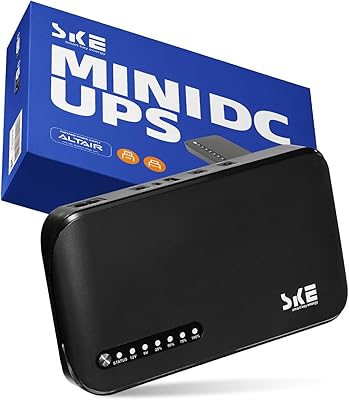
SKE DC20000 Plus Altair Mini UPS
78%
76%
Battery Life & Runtime
83%
Port Versatility & Compatibility
91%
Size & Portability
94%
Ease of Setup
58%
Recharge Speed
More
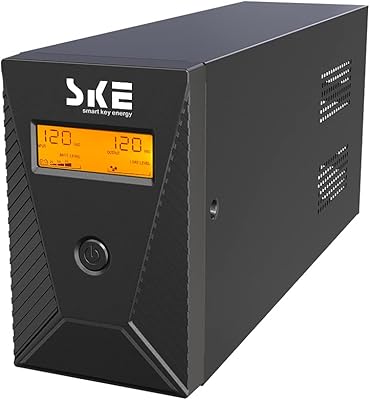
SKE SK600 600VA UPS Battery Backup
73%
88%
Ease of Setup
86%
LCD Display Clarity
58%
Battery Backup Runtime
82%
Automatic Voltage Regulation
79%
Surge Protection
More
SKE 1250VA/720W UPS Battery Backup
74%
83%
Value for Money
88%
Power Protection
61%
Battery Runtime
86%
LCD Display
78%
Noise Level
More
SKE UPS HL850 850VA/480W Battery Backup & Surge Protector
86%
91%
Power Backup Performance
88%
Ease of Use
92%
Value for Money
85%
Surge Protection Coverage
87%
Noise Level (Quiet Mode)
More
SKE 10400mAh Mini UPS Battery Backup
76%
83%
Router Backup Performance
91%
Ease of Setup
74%
Battery Runtime
78%
Port Compatibility
67%
Build Quality
More
APC SMT750 750VA Smart-UPS Battery Backup

80%
91%
Power Protection Reliability
88%
Pure Sine Wave Output
89%
Automatic Voltage Regulation
62%
Runtime at Load
87%
Build Quality
More
APC Smart-UPS SMT1000 1000VA Battery Backup
80%
93%
Build Quality
91%
Power Protection
89%
Voltage Regulation
82%
Runtime & Capacity
67%
Value for Money
More
APC SCL500RM1UC 500VA Lithium Ion Rackmount UPS
79%
88%
Build Quality
83%
Battery Life & Longevity
67%
Runtime at Real-World Loads
91%
Installation & Setup
93%
Weight & Physical Footprint
More
APC Smart-UPS SRT3000RMXLA 3000VA Rack UPS
77%
94%
Reliability & Uptime Protection
92%
Power Quality & Output
76%
Battery Performance
51%
Battery Replacement Cost
91%
Build Quality & Construction
More

FAQ

Runtime depends heavily on how much load is connected. With a typical home office setup — a mid-range desktop, a router, and a modem drawing around 150 to 200W combined — you can expect somewhere between 5 and 12 minutes of backup time. That is generally enough to save your work and shut down cleanly, but do not count on it for extended outages. The more devices you plug in, the shorter the runtime.

It depends on your system's power draw, but most modern gaming PCs with a dedicated GPU will push well past the 360W output limit, especially under load. This battery backup unit is designed for moderate office-type workloads, not high-performance gaming rigs. If you try to run an overloaded system through it, the overload protection will kick in and cut power, which is worse than not having a UPS at all.

The five black outlets provide both battery backup and surge protection — these are the ones to use for your most critical devices like your computer and network gear. The two white outlets offer surge protection only, meaning connected devices will lose power during an outage. They are fine for things like a desk lamp or phone charger that do not need to stay on.

Yes, it is a reasonable match for a single-bay or small NAS device, particularly when paired with a router and modem on the backup outlets. The combination typically stays well within the 360W ceiling. Just confirm your NAS power supply accepts a simulated sine wave, as most modern units do — but it is worth double-checking the manufacturer specs if your NAS is older.

The output is a simulated sine wave, not a pure sine wave. For the vast majority of modern electronics — desktop PCs, network equipment, monitors, and USB devices — this works perfectly fine. Pure sine wave matters most for certain older devices, active power factor correction (PFC) power supplies, or sensitive lab equipment. If your gear does not specifically require pure sine wave input, you will not notice a difference.

Battery replacement is designed to be user-friendly. You remove a panel on the unit using a Phillips screwdriver, swap in a compatible sealed lead-acid battery, and reassemble. No special tools or technical knowledge are required. Replacement SLA batteries are a standard size and are widely available online, which keeps the long-term cost of ownership reasonable.

Some users do report that the alarm is a bit sensitive, particularly in areas with slightly unstable grid power. The alarm is designed to alert you when the unit switches to battery or detects a fault, and pressing the power button will silence it. If it is triggering frequently during minor fluctuations, the AVR may be at the edge of its correction range — worth checking that your input voltage is within normal bounds.

Yes, the unit supports both vertical and horizontal placement, which is one of its more practical design touches. The footprint is compact enough at roughly 11.7 by 3 inches that it fits under many monitor stands or along the back edge of a desk. Just make sure airflow around the unit is not completely blocked, as the battery and electronics do generate a small amount of heat.

No, this compact UPS does not include a USB data or serial monitoring port, so it cannot communicate with your computer to trigger an automated graceful shutdown when the battery gets low. The USB ports on the unit are for charging devices only. If automated OS-level shutdown integration is important to your workflow, you would need to look at a unit that includes a dedicated management interface.

SKE Smart Key Energy is a newer entrant to the North American UPS market, having launched this line in late 2024. The early sales volume and user ratings are encouraging — over 370 ratings at 4.3 stars in under a year is a solid start. That said, long-term data on battery longevity and product durability is still thin simply because the product has not been in the field long enough. It is a reasonable calculated bet at this price point, but buyers who need proven multi-year reliability might prefer a more established brand.