Overview

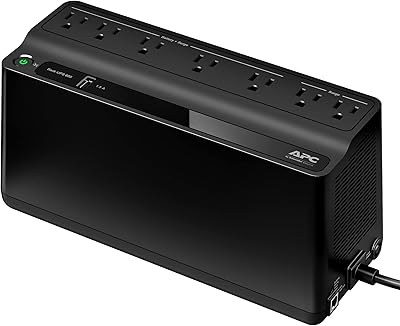
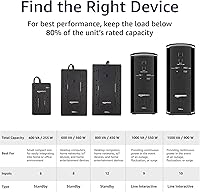
The Amazon Basics 600VA UPS Battery Backup is a no-frills standby UPS built for home networks and small office setups — not demanding workstations or server racks. Before buying, it helps to know what standby actually means: the unit runs your devices on wall power normally, then switches to battery only when it detects an outage. That's different from line-interactive models, which also regulate voltage fluctuations. This one keeps things simple and affordable. It's compact enough to tuck behind a router shelf or sit flat under a desk, and being an Amazon house-brand product, it trades premium support infrastructure for a notably accessible price point.

Features & Benefits

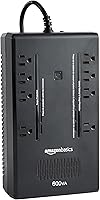
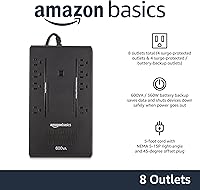
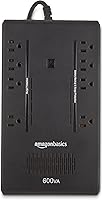
The capacity sits at 600VA / 360W — enough for light loads, but not a media editing station. The 8 outlets split into two groups: four are battery-backed and surge-protected, while the other four offer surge protection only, which is handy for peripherals like lamps or phone chargers. At half load, you get roughly 9 minutes of runtime — enough time to save your work and shut things down properly. The sealed lead-acid battery needs no maintenance and can be swapped when it eventually fades. A 5-foot cord with a right-angle plug helps in tight spots, and downloadable power management software can automate a safe shutdown if you happen to be away from your desk.

Best For

This battery backup is an especially natural fit for home network gear — routers, modems, and mesh Wi-Fi nodes that just need a few extra minutes to stay online or restart gracefully after a brief outage. Smart home hubs, IoT controllers, and low-draw NAS drives also benefit from that short window of protected power. If you're putting together a basic home office and the idea of a bulky rack-mount UPS sounds excessive, this unit hits a practical middle ground. It's also well-suited to renters who deal with occasional brownouts or flickers and want some peace of mind without investing in more hardware than the situation actually warrants.

User Feedback

With over 14,000 ratings and a 4.1-star average, the Amazon Basics standby UPS earns generally solid marks — but the picture is nuanced. Most buyers appreciate how quick and quiet setup is, and many report that surge protection works reliably over time. Where things get more complicated is longevity: a recurring theme among lower-rated reviews is battery degradation after two to three years, and some users found replacement batteries tricky to source. The audible alarm during outages does its job, but in a quiet room at night it can feel jarring. A handful of reviews also flag unit failures shortly after the warranty window closes, which is worth factoring into your decision.

Pros

  • Setup takes only a few minutes out of the box — no technical experience needed.
  • Eight outlets cover both battery-backed and surge-only needs without requiring a separate power strip.
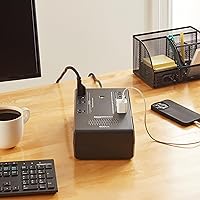
  • The compact footprint fits neatly behind a router shelf, on a desk, or inside a media cabinet.
  • Quiet during normal operation; most users report it runs without any noticeable hum or fan noise.
  • The right-angle cord plug is a small but genuinely useful detail in tight cable management situations.
  • Free downloadable software enables automated safe shutdowns when you are away from your desk.
  • The sealed lead-acid battery is maintenance-free and can be replaced when it eventually degrades.
  • Surge protection is consistently rated as reliable across a large base of long-term user reviews.
  • Lightweight at under seven pounds, making it easy to reposition or take with you if you move.

Cons

  • Battery lifespan commonly drops off after two to three years of regular use, adding a replacement cost.
  • Sourcing a compatible replacement battery is not always easy, and Amazon Basics offers limited guidance.
  • The audible alarm during outages is loud enough to be genuinely jarring in quiet home environments.
  • Several long-term reviewers report unit failures that occur just after the warranty period expires.
  • No voltage regulation means this UPS unit offers no protection against brownouts or overvoltage swings.
  • At full load, runtime is only around two minutes — barely enough for anything beyond an immediate shutdown.
  • The four surge-only outlets provide no battery backup, which can catch buyers off guard if not read carefully.
  • Customer support for Amazon Basics products tends to be less specialized than dedicated UPS brands.
  • No front-panel display or indicator to show current load percentage or battery health at a glance.

Ratings

The scores below reflect an AI-driven analysis of verified global user reviews for the Amazon Basics 600VA UPS Battery Backup, with spam, bot activity, and incentivized feedback actively filtered out before scoring. Each category captures the real pattern of praise and frustration across thousands of honest buyer experiences — not just the highlights. Both what this battery backup does well and where it genuinely falls short are represented without bias.

Value for Money
88%
For a first UPS purchase aimed at protecting a home router, modem, or smart home hub, buyers consistently feel they got more than they paid for. The combination of surge protection and battery backup at this price tier is hard to match without moving to a significantly pricier brand.
The value perception erodes somewhat once battery replacement costs and the possibility of early unit failure are factored in. Buyers who need to replace the battery within two to three years start to question the long-term economics compared to investing in a more durable unit upfront.
Ease of Setup
93%
Plug it in, let it charge overnight, and it is ready — that is genuinely the setup experience most buyers describe. There are no configuration steps required for basic use, and the outlet labeling makes it immediately clear which sockets provide battery backup versus surge-only protection.
Users who want to take advantage of the downloadable power management software hit a steeper learning curve, particularly on non-Windows systems where compatibility is limited. The software installation process is not well-documented within the box itself, leaving some buyers hunting for the right download link.
Battery Runtime
57%
43%
For the specific use case this unit targets — keeping a router and modem alive through a two- to five-minute grid hiccup, or allowing a graceful shutdown — the available runtime is adequate. Light loads benefit most, and users who understand the capacity going in rarely feel let down.
Anyone connecting more than a couple of low-draw devices quickly discovers how short the window really is. At or near full load, two minutes is barely enough to save an open file and power down safely, let alone wait out an outage, and this is the single most common source of disappointment in lower-rated reviews.
Battery Longevity
52%
48%
Under light, consistent use with infrequent deep discharge cycles, some buyers report the battery holding adequate capacity beyond the two-year mark. Keeping the unit in a cool, well-ventilated location appears to extend useful battery life noticeably.
The recurring pattern across critical reviews is a battery that begins losing runtime capacity within two to three years, sometimes sooner in warmer environments or regions with frequent power interruptions. Lead-acid chemistry degrades with each discharge cycle, and this unit is no exception to that physical reality.
Surge Protection
84%
Long-term owners frequently credit this battery backup with protecting networking equipment and home office gear through multiple surge events without any device damage. The surge protection performance on all eight outlets is viewed as one of the unit's most consistently dependable features.
Because this is a standby-topology unit, it offers no active voltage regulation — meaning sags and brownouts pass through to connected devices unfiltered. Users in areas with unstable grid power report that surge protection alone is not enough to prevent occasional equipment instability.
Build Quality
67%
33%
The casing feels solid enough for a unit that sits stationary on a shelf, and the overall construction is competent for its price tier. The right-angle plug is a thoughtful practical detail that helps with cable management in confined spaces behind desks or entertainment centers.
It does not feel or look like a premium product, and some buyers note that the plastic housing has a slightly hollow quality when handled. A subset of reviewers report that units failed entirely — not just the battery — within a few years, suggesting build consistency may vary across production batches.
Noise Level
71%
29%
During normal operation on wall power, this UPS unit is essentially silent — no fan, no hum, nothing to notice if it is sitting under a desk or inside a media shelf. Buyers who use it in bedroom offices or quiet home environments are generally pleasantly surprised by how unobtrusive it is day-to-day.
The outage alarm is a different story. It emits a loud, repeating beep during any power disruption, and multiple buyers describe it as startling — particularly at night. There is no way to reduce the volume or silence it short of restoring power, which is a real drawback in noise-sensitive living situations.
Outlet Layout
76%
24%
Eight outlets in a compact unit is genuinely useful, and the clear physical separation between battery-backed and surge-only ports makes it easy to prioritize what gets protected. For home networking setups with a router, modem, and a switch, the layout covers the essentials without requiring an extra power strip.
The outlet spacing can be tight with bulkier wall adapters, and some buyers find that transformer-style plugs block adjacent sockets. The four surge-only outlets also occasionally catch buyers off guard who assumed all eight were battery-backed — something that better packaging communication could prevent.
Battery Replaceability
48%
52%
The sealed lead-acid battery is technically user-replaceable, and a segment of technically comfortable buyers have successfully extended the unit's life by swapping in a compatible SLA cell after the original degrades. The process is doable without specialized tools for those willing to research it.
Amazon Basics provides no official replacement battery, no sourcing guidance, and no step-by-step instructions for the swap. Finding a dimensionally and electrically compatible third-party battery requires research, and some buyers simply discard the entire unit when the battery fails rather than navigating the process.
Compatibility
81%
19%
The standard NEMA 5-15R outlets mean it works with virtually any North American device without adapters. Buyers consistently use it successfully with routers, modems, mesh Wi-Fi nodes, smart home hubs, streaming boxes, and small NAS drives — the core use cases it was designed around.
It is strictly a 120V North American product and will not function in regions with different voltage standards without a transformer, which largely defeats the purpose. Buyers expecting to use it internationally or with higher-voltage equipment will find it incompatible out of the box.
Power Management Software
61%
39%
For Windows users who take the time to download and configure it, the software adds genuine practical value — particularly the ability to trigger an automated safe shutdown when an outage outlasts the battery. It works reasonably well for basic home office protection scenarios.
Mac and Linux support is effectively absent, and even on Windows the software feels dated in terms of interface and documentation. Many buyers never use it at all because it requires a separate download step that is not prominently communicated, and customer support for software issues is minimal.
Warranty & Support
53%
47%
Being sold and fulfilled by Amazon means returns and initial exchanges tend to be straightforward within the standard return window. Buyers who experience issues early in ownership generally find resolution through Amazon's standard customer service channels without major friction.
Post-warranty support is where confidence drops sharply. Amazon Basics is a house brand without the dedicated technical support infrastructure of established UPS manufacturers, and several reviewers note that unit failures occurring just after the warranty period expired left them with no meaningful recourse.
Form Factor & Portability
86%
At under seven pounds and with dimensions that fit comfortably on a standard shelf, this battery backup integrates into home environments without dominating the space. Buyers who move it between rooms or take it to a second location appreciate how manageable it is compared to larger UPS units.
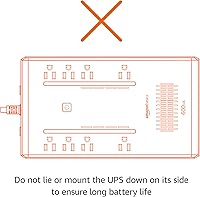
The horizontal form factor works well on flat surfaces but does not include mounting options, so vertical installation or rack integration is not possible. A minority of buyers also note that the matte black finish shows dust more than expected in low-light setups.

Suitable for:

The Amazon Basics 600VA UPS Battery Backup is a strong fit for anyone who wants reliable protection for low-power home network equipment without overcomplicating the setup. If your main concern is keeping your router, modem, or mesh Wi-Fi system alive through a brief outage — or at least powered long enough to shut down cleanly — this unit handles that job well. Smart home enthusiasts with hubs, IoT controllers, or a small NAS drive will also find it a practical safeguard against unexpected power interruptions. It works equally well for renters or apartment dwellers who experience occasional brownouts and want a first layer of both surge protection and battery backup without committing to a larger, more expensive system. If you're building out a basic home office and simply need peace of mind that your equipment won't lose power mid-task during a short outage, this battery backup punches at a fair level for what it costs.

Not suitable for:

Anyone expecting to run a desktop PC, a gaming rig, or any power-hungry workstation through an extended outage should look elsewhere — this UPS unit was never designed for that kind of sustained load. The Amazon Basics 600VA UPS Battery Backup operates on a standby topology, meaning it does not regulate voltage fluctuations the way a line-interactive model does, which matters in areas with frequent undervoltage or overvoltage issues. Users who need more than a couple of minutes of full-load runtime — say, to keep a workstation or home server running through a longer grid event — will find the capacity limiting. Buyers who prioritize long-term ownership and easy maintenance should also weigh the battery replacement process carefully, as sourcing compatible replacement cells is not always straightforward. And if you work in a noise-sensitive environment like a bedroom office or recording space, the audible alarm this unit triggers during outages may be more disruptive than expected.

Specifications

  • Capacity: This unit is rated at 600VA and 360W, suitable for light loads such as networking equipment and small home office devices.
  • UPS Topology: It uses a standby (offline) design, meaning it switches to battery power only when it detects a disruption in the main supply.
  • Total Outlets: Eight NEMA 5-15R outlets are included, split into two functional groups for different levels of protection.
  • Battery Outlets: Four outlets provide both surge protection and battery backup, keeping connected devices powered during a brief outage.
  • Surge Outlets: The remaining four outlets offer surge protection only, with no battery backup, suited for non-critical peripherals.
  • Battery Type: The internal battery is a sealed lead-acid (SLA) cell, which is maintenance-free under normal operating conditions.
  • Runtime: At half load (180W), the unit provides approximately 9 minutes of backup; at full load (360W), runtime drops to roughly 2 minutes.
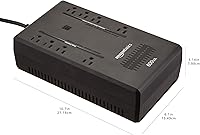
  • Dimensions: The unit measures 10.7″ wide, 6.1″ deep, and 3.14″ tall, fitting easily on a shelf or under a desk.
  • Weight: At 6.54 pounds, this battery backup is light enough to reposition without assistance or special mounting hardware.
  • Input Voltage: Designed for standard North American outlets, it accepts 120V input at both 50Hz and 60Hz frequencies.
  • Cord Length: The 5-foot power cord features a right-angle NEMA 5-15P plug with a 45-degree offset to ease routing in tight spaces.
  • Software: Free power management software is available for download via the product page, enabling automated shutdown during extended outages.
  • Color & Brand: Available in black and sold under the Amazon Basics house brand, manufactured by Amazon.
  • Replaceability: The internal battery is field-replaceable, allowing users to extend the unit's usable life without discarding the entire enclosure.
  • Model Number: The official model identifier is Amazon Basics UPS - 600 VA, with ASIN B073Q48YGF for reference when ordering accessories.

Related Reviews
Amazon Basics UPS 400VA Battery Backup & Surge Protector
83%
92%
Value for Money
85%
Performance during Power Outages
88%
Surge Protection Effectiveness
80%
Ease of Use & Setup
65%
Backup Time at Full Load
More
Tripp Lite BC600RNC 600VA Cloud UPS
80%
88%
Cloud Monitoring & App Experience
71%
Battery Backup Runtime
91%
Setup & Installation
83%
Build Quality & Form Factor
62%
Outlet Count & Layout
More
SKE SK600 600VA UPS Battery Backup
73%
88%
Ease of Setup
86%
LCD Display Clarity
58%
Battery Backup Runtime
82%
Automatic Voltage Regulation
79%
Surge Protection
More
APC BE600M1 600VA UPS
80%
93%
Outage Response Speed
88%
Runtime for Network Gear
86%
Surge Protection
91%
Battery Longevity & Replacement
54%
Audible Alarm
More
APC SMT750 750VA Smart-UPS Battery Backup
80%
91%
Power Protection Reliability
88%
Pure Sine Wave Output
89%
Automatic Voltage Regulation
62%
Runtime at Load
87%
Build Quality
More
APC Smart-UPS SMT1000 1000VA Battery Backup
80%
93%
Build Quality
91%
Power Protection
89%
Voltage Regulation
82%
Runtime & Capacity
67%
Value for Money
More
APC Back-UPS Pro 1000VA UPS Battery Backup BX1000M
83%
92%
Reliability during Power Outages
88%
Ease of Setup
85%
Build Quality
90%
Surge Protection
80%
Energy Efficiency
More
APC SMC1500C 1500VA Line Interactive UPS
81%
93%
Power Protection Reliability
91%
Pure Sine Wave Output Quality
88%
Automatic Voltage Regulation
71%
Battery Runtime
74%
SmartConnect Remote Monitoring
More
APC Back-UPS Pro BX1500M 1500VA
79%
83%
Battery Runtime
91%
Voltage Regulation (AVR)
78%
Build Quality & Durability
88%
Ease of Setup
86%
LCD Display & Monitoring
More
CyberPower CP825AVRLCD 825VA UPS Battery Backup
74%
91%
Voltage Protection
47%
Battery Runtime
83%
Surge Protection
88%
LCD Display
93%
Setup & Ease of Use
More

FAQ

Yes, that is exactly the kind of load it handles well. A typical home router and modem together draw well under 50W, which means this battery backup could keep them running for considerably longer than the rated half-load window. You should have plenty of time to wait out a brief outage or shut things down cleanly.

It depends on your desktop's power draw. A modern mid-range or gaming PC can easily exceed 300W under load, which would push this unit to or beyond its rated capacity and leave you with only a minute or two of runtime. For a basic office PC with a small monitor, it might work in a pinch, but a higher-capacity UPS would be a more appropriate fit.

Loud enough to notice from another room. It is a repeating beep designed to alert you, and in a quiet bedroom or home studio environment, many users find it more jarring than expected. There is no option to mute or adjust the alarm volume on this unit, so keep that in mind if noise sensitivity matters to you.

Most sealed lead-acid batteries in units like this one begin to degrade noticeably after two to three years of regular use, especially if they cycle through outages frequently or operate in a warm environment. You may notice shorter runtime before the battery fails entirely. Replacement batteries are available, though sourcing the correct size can take some research.

The battery is technically user-replaceable, but the process is not as simple as swapping out a AA. You will need to open the casing and identify a compatible SLA battery with the correct voltage and amp-hour rating. Several users have done it successfully, but Amazon Basics does not provide step-by-step instructions, so you may need to look up a third-party guide.

A standby UPS, which is what the Amazon Basics 600VA UPS Battery Backup is, sits idle on wall power and only kicks in when an outage is detected. A line-interactive model does that too, but it also actively corrects voltage fluctuations — like sags or swells — before they reach your equipment. If you live somewhere with frequent brownouts or unstable power, a line-interactive unit offers meaningfully better protection.

The software is primarily designed for Windows systems. Mac compatibility is limited and not officially supported by Amazon Basics for this model. If automated shutdown on a Mac is important to you, you may need to explore third-party UPS management tools or choose a UPS brand with broader software support.

No. Only four of the eight outlets are connected to the battery. The other four provide surge protection only and will lose power the moment the grid goes down. Check which outlets are which before plugging in anything you need to stay on during an outage — the labeling on the unit makes the distinction clear.

It is generally recommended to let it charge for at least 8 hours before relying on it during an actual outage. The battery ships partially charged but needs a full initial charge cycle to perform at its rated capacity. Plugging it in and letting it sit overnight before testing is the safest approach.

For a low-power NAS — the kind used for media streaming or basic file sharing — this battery backup works well as a protective measure. Pair it with the downloadable power management software and you can configure an automated shutdown if an outage runs longer than the battery can support. Just verify your NAS power draw stays well within the 360W limit to ensure a comfortable runtime buffer.

Where to Buy