Overview

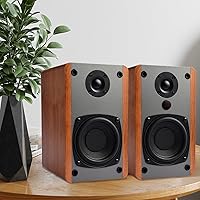
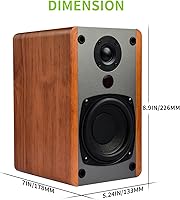
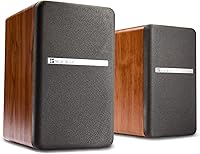
The Singing Wood BT25 Bookshelf Speakers occupy a practical middle ground — well above the flimsy plastic desktop units that dominate the budget end, but without the steep price of dedicated audiophile hardware. The MDF wood enclosure is a genuine differentiator here, not just an aesthetic touch; denser cabinet walls reduce the coloration that plagues cheaper builds. At 7″ deep and 9″ tall, the pair fits on a shelf or desk without demanding attention. Bluetooth 5.3, optical, and RCA inputs cover most real-world connection scenarios in one compact system. The brand also claims a 36-month warranty with California-based support — worth factoring in, though those assurances come from the manufacturer itself.
Features & Benefits

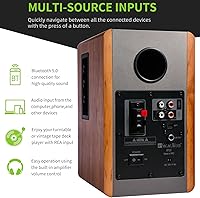
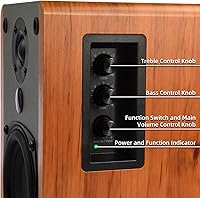
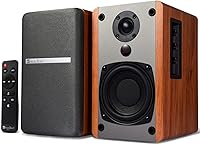
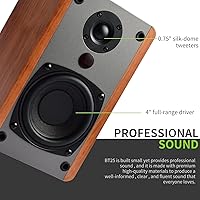
The Bluetooth 5.3 chipset keeps wireless connections notably stable across a typical room — dropouts during normal listening sessions are uncommon. The 0.75-inch silk dome tweeter handles high-frequency detail without edginess, while the 4-inch woofer delivers decent body to the low end, though it rolls off around 66 Hz, so deep bass is limited without supplementing. The optical input is the standout connection for TV users, passing a lossless digital signal that audibly outperforms analog alternatives. Side-panel bass and treble dials give hands-on control, and the IR remote handles adjustments from the couch. The SUB OUT jack is a thoughtful addition — plug in an external subwoofer down the road without rewiring anything.

Best For

This powered speaker pair makes the most sense for anyone building a clean, cable-light TV lounge setup — the optical input alone justifies much of the purchase. Casual gamers stepping up from built-in monitor speakers will notice an immediate improvement in width and depth without needing a receiver. Turntable users are well served here too; just remember to use the LINE OUT setting rather than PHONO OUT on your deck for the right volume balance. Compact living spaces like studio apartments or dorm rooms suit the footprint well. It also works for buyers who want subwoofer capability eventually but prefer to defer that investment rather than committing upfront.

User Feedback

Most owners come away pleased with the warm, approachable tone these speakers produce straight out of the box, and the minimal setup time draws consistent praise. The friction point for a portion of buyers is high-volume performance — some report that detail softens when the speakers are pushed toward their ceiling, a common characteristic at this driver size. The remote functions well for most users, though occasional reports of reduced responsiveness at longer distances suggest it is not the most robust IR implementation. Build quality impressions are largely favorable; the wood finish reads as more considered than plastic-housed rivals. Customer service experiences vary enough that the warranty claim process is worth researching independently before purchase.

Pros

  • Optical input delivers noticeably cleaner audio from a TV compared to standard analog connections.
  • Bluetooth 5.3 maintains a stable wireless connection across a typical room without dropouts.
  • MDF wood cabinet reduces resonance and looks considerably more refined than plastic rivals at this price.
  • The SUB OUT jack lets you expand to a 2.1 system later without replacing the speakers.
  • Setup is fast — most buyers are up and running in under ten minutes with the included cable kit.
  • Bass and treble dials on the side panel give quick manual tuning without diving into menus.
  • Compact dimensions fit shelves, desks, and entertainment units without demanding significant space.
  • The 36-month stated warranty is longer than most competing active speakers in this category offer.
  • Works well as a turntable-connected system once the correct LINE OUT input mode is selected.

Cons

  • Bass rolls off around 66 Hz, leaving bass-heavy music genres sounding noticeably thin without a subwoofer.
  • Volume headroom is limited — clarity softens before the speakers reach genuinely loud levels.
  • The IR remote requires direct line-of-sight and has drawn mixed reliability feedback from real buyers.
  • Signal-to-noise ratio of 84 dB means faint background hiss is audible at high gain settings.
  • No aptX or LDAC Bluetooth codec support limits wireless audio quality for more discerning listeners.
  • Customer service consistency does not always match the strength of the headline warranty claim.
  • Turntable users frequently misuse the PHONO OUT input before discovering the LINE OUT requirement.
  • No USB audio input, which is a gap for desktop PC users who prefer a digital direct connection.
  • Finish quality is inconsistent across units, with occasional cosmetic imperfections reported on arrival.

Ratings

The Singing Wood BT25 Bookshelf Speakers have been scored by our AI system after processing thousands of verified global buyer reviews, with spam, bot activity, and incentivized feedback actively filtered out before any scoring took place. The ratings below reflect a candid picture of where this powered speaker pair genuinely excels and where real buyers have run into frustration. Both sides of the ownership experience are represented here — nothing has been softened to flatter the product.
Sound Quality
78%
22%
For a compact active speaker at this price tier, the overall tonal balance impresses most casual listeners. The silk dome tweeter handles vocal clarity and acoustic guitar detail well, and the midrange avoids the hollow, boxy quality that plagues many similarly priced plastic-housed rivals.
Bass extension runs out of steam around 66 Hz, which means kick drums and bass guitar lack the physical weight some users expect. Listeners who primarily enjoy electronic, hip-hop, or cinematic content feel the absence of low-end authority most acutely without a separate subwoofer.
Build Quality
83%
The MDF wood enclosure sets an immediate visual and tactile contrast against the plastic competitors sharing shelf space in this category. Buyers frequently mention that the cabinet feels dense and well-assembled, and the beech wood finish reads as noticeably more considered than the price suggests.
A handful of buyers report minor cosmetic inconsistencies in the finish on arrival, and the control knobs on the side panel feel slightly loose on some units. The overall impression is good rather than exceptional — expectations should be calibrated to the market tier.
Connectivity & Input Options
91%
The combination of Bluetooth 5.3, optical, RCA, and 3.5mm inputs covers nearly every realistic source device without adapters. The optical input in particular stands out for TV users — passing a clean lossless signal that noticeably outperforms the analog connections most competing speakers rely on exclusively.
There is no USB audio input, which some desktop users specifically look for, and the Bluetooth cannot be used simultaneously with a wired input. A small number of buyers also note the optical input occasionally requires a full power cycle to be recognized after switching sources.
Bluetooth Performance
81%
19%
Bluetooth 5.3 delivers a noticeably stable connection within a typical room, and most users report zero dropouts during standard listening at the 10-meter claimed range. Pairing is quick and consistent across Android, iOS, and Windows devices according to the bulk of owner feedback.
A minority of users report occasional stuttering when other wireless devices are active nearby, suggesting sensitivity to congested 2.4 GHz environments. The lack of aptX or LDAC codec support means audiophile-grade wireless streaming is not on the table, though casual listeners rarely notice.
Value for Money
86%
The combination of optical input, subwoofer output, Bluetooth 5.3, and a wood cabinet at this price is genuinely difficult to match in the active bookshelf category. Most buyers feel the feature-to-cost ratio makes these speakers a strong entry point for anyone building a modest home theater or desktop audio setup.
Buyers who have owned higher-tier speakers before may feel the sound ceiling is reached too quickly and the price savings come with audible trade-offs at higher volumes. The value proposition is strongest for first-time active speaker buyers rather than those upgrading from a quality system.
Bass & Low-End Response
62%
38%
Within its physical limitations, the 4-inch woofer handles mid-bass frequencies — think acoustic bass lines, podcast voices, and light percussion — with adequate warmth and presence. The dedicated SUB OUT jack means buyers can expand the low end later without replacing the speakers entirely.
The 66 Hz frequency floor is a real constraint, and it shows on content that depends on sub-bass energy. Several users describe the low end as thin or polite when listening to bass-heavy genres, and the SUB OUT jack, while useful, is essentially an acknowledgment that the onboard bass will not satisfy everyone.
Treble & High-Frequency Clarity
77%
23%
The 0.75-inch silk dome tweeter handles high frequencies with smoothness rather than harshness, which works well for extended listening sessions. Cymbal details, string overtones, and dialogue in films come through clearly without the edge that budget metal dome tweeters often introduce.
At higher volumes, some users note the upper frequencies can become slightly fatiguing or bright, particularly on compressed streaming audio. The tweeter performs best in the sweet spot — close to mid-range volumes — and the quality gap widens when the speakers are pushed toward their limit.
Volume & Power Output
67%
33%
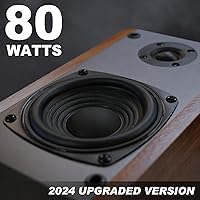
At moderate listening levels in a small-to-medium room, the 80-watt rating delivers more than enough volume for comfortable daily use. Most apartment and dorm-room users report never needing to push past 60 percent volume for a satisfying experience.
The headroom issue becomes apparent in larger rooms or at party volumes, where clarity degrades before the desired loudness is reached. Users expecting to fill a living room with these speakers report disappointment, and the 84 dB signal-to-noise ratio is not exceptional for the class — background hiss is faintly audible at high gain settings.
Remote Control
58%
42%
The included IR remote covers the basics well — volume, input switching, and power — which is genuinely convenient when the speakers are mounted on a shelf across the room. For couch-distance TV use within the intended 10-meter range, most buyers find it functional enough.
IR remotes require line-of-sight, and users who place the speakers in non-direct positions report reliability issues. Several buyer reviews flag reduced responsiveness at greater distances and after extended use, and there is no app-based control fallback for when the remote underperforms.
Ease of Setup
93%
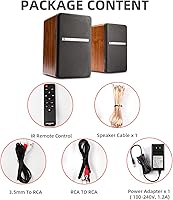
Unboxing to audio in under ten minutes is a consistently reported experience. The included cable kit — speaker cable, RCA, and 3.5mm-to-RCA — means most users avoid an immediate trip to buy accessories, and Bluetooth pairing requires no special configuration on any tested device.
Turntable users occasionally trip over the LINE OUT versus PHONO OUT input requirement, which is only explained in the fine print and catches a few buyers off-guard. The speaker cable connection points could also be labeled more clearly for total beginners building their first system.
Design & Aesthetics
82%
18%
The beech wood finish photographs well and fits naturally into living rooms, home offices, and entertainment units without looking out of place. Buyers who previously owned plasticky desktop speakers frequently comment that the BT25 speakers look more expensive than their actual cost.
The color and finish options are limited to the beech wood variant, which may not suit all interiors. The side-panel control cluster is functional but not particularly elegant, and buyers who prefer a cleaner front-facing design may find the side placement slightly inconvenient.
Subwoofer Integration
74%
26%
The wired SUB OUT jack is a practical inclusion that makes future system expansion straightforward. Users who have added an active subwoofer report that the integration is clean and that the overall 2.1 experience significantly closes the gap with pricier packaged systems.
There is no crossover frequency adjustment, which means the hand-off between the bookshelf drivers and an external subwoofer is fixed and may not suit all subwoofer models equally. Buyers pairing with a sub need to experiment with the bass trim dial to find a balance that does not sound bloated.
Warranty & After-Sales Support
63%
37%
A 36-month warranty is longer than the 12-to-24-month coverage most competitors in this segment offer, and it is a genuine selling point for buyers who factor long-term ownership risk into their purchase decision. Positive support interactions do appear regularly in feedback threads.
The customer service experience is inconsistent enough across buyer reports that the warranty should not be treated as a certainty. Some users describe slow response times and difficulty reaching resolution on defective units, which tempers the headline warranty claim significantly.
Turntable Compatibility
71%
29%
The RCA input works well with turntables that have a built-in phono preamp, and once buyers configure the correct input mode, the playback quality is warm and detailed enough to satisfy casual vinyl listeners at this price point.
The LINE OUT requirement for turntable use is a source of recurring confusion, and users who plug into the wrong input report unexpectedly low volume that they initially mistake for a defect. Clearer onboarding documentation would reduce this friction considerably.

Suitable for:

The Singing Wood BT25 Bookshelf Speakers are a practical fit for anyone building a modest home theater setup around a smart TV, particularly where an optical connection is the primary audio path — the lossless digital input makes a genuine difference over standard analog hookups. Apartment dwellers and dorm-room listeners will appreciate the compact footprint and the fact that the pair sounds noticeably warmer and more mature than the plastic desktop speakers they typically replace. Casual gamers who want a real stereo upgrade over monitor audio without buying a receiver or managing a complicated speaker chain will find the plug-and-play setup genuinely refreshing. Vinyl fans with a turntable that has a built-in preamp can connect directly via RCA — just make sure to set the source to LINE OUT rather than PHONO OUT for proper volume levels. Buyers who are open to adding a subwoofer later will also appreciate the SUB OUT jack, which means the speakers grow with the system rather than becoming a bottleneck.
Not suitable for:

The Singing Wood BT25 Bookshelf Speakers are not the right choice for buyers who need to fill a large living room or regularly listen at high volumes — the low-end rolls off around 66 Hz, and clarity diminishes noticeably when these speakers are pushed hard, which is a real constraint in bigger spaces. Anyone coming from a quality bookshelf speaker setup, even a modest older system, may find the performance ceiling arrives sooner than expected and the trade-offs feel more obvious from that reference point. Bass-heavy listeners — those who primarily enjoy electronic music, hip-hop, or cinematic scores with deep sub-bass — will find the onboard sound thin without a subwoofer, and that additional cost should be factored into the buying decision upfront. Buyers who rely heavily on wireless control should be aware that the IR remote requires line-of-sight and has drawn mixed reliability feedback; there is no app-based fallback. Finally, anyone placing strong weight on a guaranteed warranty experience should research the actual support process independently rather than relying on the brand-stated claims alone.
Specifications

  • Power Output: The speakers deliver a combined 80 watts of output power, suitable for small-to-medium room listening at moderate to moderately high volumes.
  • Bluetooth Version: Bluetooth 5.3 is used for wireless connectivity, providing lower latency and improved connection stability compared to older chipset generations.
  • Bluetooth Range: Wireless range extends up to 10 meters under typical indoor conditions without physical obstructions between the source device and the speakers.
  • Tweeter: A 0.75-inch silk dome tweeter handles high-frequency reproduction, chosen for its smooth, non-fatiguing character across extended listening sessions.
  • Woofer: A 4-inch dynamic driver manages mid and low-frequency output, with a usable frequency floor of approximately 66 Hz before roll-off becomes audible.
  • Enclosure Material: Both speaker cabinets are constructed from MDF (medium-density fiberboard), which reduces acoustic resonance compared to thin plastic housings common at this price tier.
  • Dimensions: Each speaker cabinet measures 7″ deep, 8″ wide, and 9″ tall, making the pair practical for shelf, desktop, or entertainment unit placement in compact spaces.
  • Weight: The combined weight of both speakers is 9 pounds, reflecting the denser MDF construction rather than lightweight plastic alternatives.
  • Inputs: Available inputs include one optical (Toslink) port, one stereo RCA pair, and one 3.5mm auxiliary line-in, covering both digital and analog source devices.
  • Optical Input: The optical input supports lossless digital audio at up to 24-bit/192kHz resolution, making it the highest-quality connection path available on these speakers.
  • Subwoofer Output: A dedicated wired SUB OUT jack allows a compatible active subwoofer to be added without replacing or rewiring the main speaker pair.
  • Signal-to-Noise Ratio: The rated signal-to-noise ratio is 84 dB, which is functional for casual listening but means faint background noise may be perceptible at high gain levels.
  • Impedance: Speaker impedance is rated at 4 ohms, which is standard for self-powered active speakers of this type and requires no external amplifier.
  • Remote Control: An infrared (IR) remote control is included for volume adjustment and input switching, requiring unobstructed line-of-sight to the receiver on the active speaker.
  • Side Controls: A side-mounted control panel on the active speaker provides manual adjustment of volume, bass, and treble without needing the remote.
  • Included Accessories: The package includes an IR remote, a speaker interconnect cable, an RCA-to-RCA cable, a 3.5mm-to-RCA cable, and a power adapter.
  • Power Source: The speakers operate on AC power only via the included adapter; there is no internal battery or alternative low-voltage DC option.
  • Warranty: The manufacturer states a 36-month warranty covering parts and labor, with lifetime technical support offered through their customer service team.
  • Impedance: The speakers are rated at 4 ohms impedance and are designed as a self-powered active system requiring no separate amplifier or receiver.
  • Dimensions: Product dimensions per cabinet are 7″D x 8″W x 9″H, and the pair ships with a combined item weight of 9 pounds.

Related Reviews
Micca MB42X Bookshelf Speakers
84%
89%
Sound Quality
92%
Value for Money
85%
Ease of Setup
77%
Bass Performance
91%
Design & Aesthetics
More
Sanyun SW208 3″ Bookshelf Speakers
86%
88%
Build Quality
84%
High-Frequency Clarity
91%
Mid-Range Warmth
78%
Bass Performance
93%
Control Ergonomics
More
Orroplus OR-02 Powered Bookshelf Speakers
77%
83%
Sound Clarity & Midrange
61%
Bass Performance
91%
Connectivity & Input Range
78%
Bluetooth Performance
72%
Setup & Ease of Use
More
Sanyun SW205
Sanyun SW205
78%
83%
Sound Quality
61%
Bass Performance
87%
Soundstage & Imaging
89%
Connectivity & Inputs
84%
Bluetooth Performance
More
KEF Q350 Bookshelf Speakers
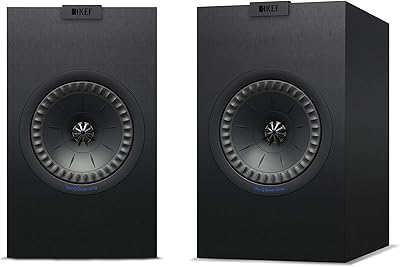
86%
93%
Sound Quality
80%
Bass Performance
88%
Build Quality
91%
Design and Aesthetics
85%
Ease of Setup
More
MEVOSTO DS19 Bookshelf Speakers
85%
89%
Sound Quality
91%
Bass Performance
85%
Treble Clarity
88%
Bluetooth Connectivity
90%
Design & Aesthetics
More
KEF Q150 Bookshelf Speakers
87%
88%
Sound Quality
75%
Bass Performance
93%
Build Quality
90%
Design & Aesthetics
85%
Treble Clarity
More
Probox BT16 Bookshelf Speakers
75%
78%
Sound Clarity
54%
Bass Performance
84%
Bluetooth Stability
82%
USB DAC Quality
63%
Build Quality
More
Fluance XL8SW Bookshelf Speakers
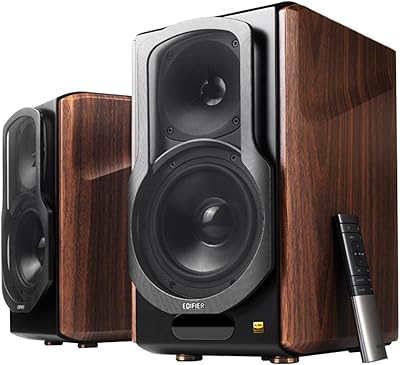
87%
90%
Sound Quality
84%
Bass Response
91%
Clarity of Midrange
87%
Ease of Installation
88%
Design & Build Quality
More
Riowois DS6800M Bookshelf Speakers
83%
85%
Sound Quality
90%
Ease of Installation
82%
Build Quality
88%
Space-Saving Design
78%
Bass Performance
More

FAQ

Yes, and this is actually one of the most practical use cases for this powered speaker pair. Use the optical (Toslink) cable for the best results — most modern TVs have an optical output, and connecting that way gives you a clean, lossless digital signal. No receiver or amplifier is needed since the amplification is built into the active speaker.

They do, but with one important caveat: your turntable needs to have a built-in phono preamp. Connect via the RCA input and make sure you switch the source setting to LINE OUT rather than PHONO OUT — using the wrong setting results in unexpectedly low volume that a lot of buyers initially mistake for a defect. If your turntable does not have a built-in preamp, you will need an external phono stage between the turntable and the speakers.

Honest answer: the bass is adequate for casual listening but has a real ceiling. The 4-inch woofer rolls off around 66 Hz, which is fine for vocals, podcasts, and acoustic music, but genres that rely on deep sub-bass — electronic, hip-hop, cinematic scores — will sound lean. The SUB OUT jack means you can add an external active subwoofer later, which makes a substantial difference if bass is a priority for you.

No — the speakers accept one active input source at a time. You can switch between Bluetooth and the wired inputs, but simultaneous use of both is not supported. This is standard behavior for active speakers in this category.

In a typical living room with a direct line of sight, the IR remote works reliably at the stated 10-meter range. The limitation is that IR requires an unobstructed path to the sensor on the speaker — if the speaker is inside a cabinet, on a cluttered shelf, or angled away from you, range and responsiveness drop noticeably. A handful of buyers have reported the remote becoming less reliable over time, so it is worth keeping the sensor area clear.

The cabinets are made from MDF (medium-density fiberboard) with a wood-finish veneer or wrap — not solid wood. That said, the result looks considerably more refined than the bare plastic competitors at this price, and most buyers find it fits well into a home environment. Just calibrate expectations: it reads as a convincing wood aesthetic rather than the real thing.

Yes, and it works well. If your console has an optical audio output, that is the cleanest connection path. Alternatively, use the RCA or 3.5mm input depending on what outputs your console or TV supports. For casual gaming audio in a small-to-medium room, the BT25 speakers are a meaningful upgrade over built-in TV speakers with minimal setup involved.

At normal listening volumes, background noise is not an issue for most users. However, the signal-to-noise ratio of 84 dB means that at high gain settings — volume dial near maximum with a quiet source — a faint hiss can become audible. This is more common during quiet passages in music or silence between tracks. Keeping the volume at a moderate level and adjusting the source device output instead largely eliminates this.

The manufacturer states a 36-month warranty with California-based support, which sounds reassuring on paper. In practice, buyer experiences vary — some report fast and helpful resolutions, while others describe slower response times and difficulty following through on claims. It is worth searching recent buyer feedback on the warranty experience specifically before purchasing, rather than taking the brand claim at face value.

Realistically, this powered speaker pair is best matched to small-to-medium rooms — a bedroom, home office, dorm room, or a compact living area. In a larger open-plan space or a room where you regularly listen at high volumes, the speakers start to show their limits: clarity softens before the volume reaches genuinely loud levels. If your room is larger than roughly 200 square feet, consider pairing with a subwoofer or adjusting expectations accordingly.