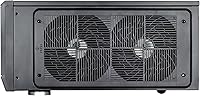
Overview

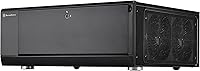
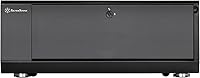
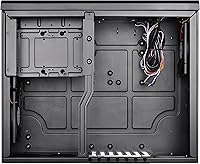
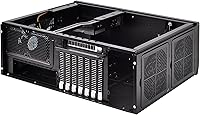
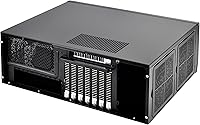
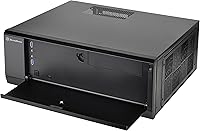
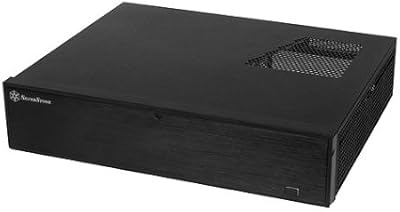
The SilverStone GD10B ATX HTPC Case is built for one specific job: housing a full-sized desktop build inside a home theater cabinet without looking out of place next to your AV receiver. SilverStone launched this chassis back in 2014, and the fact that it’s still actively sold says something about how well it fills that niche. The horizontal form factor and aluminum front door give it the clean, understated look of proper AV equipment rather than a gaming rig. That said, come in with clear expectations — this is a purpose-built enclosure, not a jack-of-all-trades tower, and every design decision reflects that focused intent.

Features & Benefits

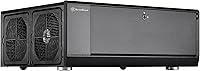
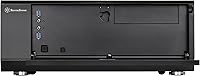
The GD10B packs a lot of thoughtful engineering into a compact horizontal shell. The lockable aluminum door is a genuine standout — it keeps drives secure and maintains that living room-ready aesthetic, closing with a satisfying, solid feel. Depth is the headline spec: at just over 14 inches, it slips into most standard media cabinets where deeper cases simply won’t go. Three included 120mm fans running in a positive air pressure setup push dust out rather than letting it accumulate, and quick-access filters make maintenance painless. Full ATX motherboards and GPUs up to 12.2 inches are supported, and three front USB 3.0 ports handle day-to-day connectivity without hassle.

Best For

SilverStone’s living room chassis is a strong fit for anyone building a home theater PC around a full ATX or Micro-ATX board — especially those who need room for a longer discrete GPU. If you want a machine that sits on a shelf next to a soundbar and doesn’t scream ‘gaming setup,’ the understated horizontal design does that job well. It also suits small offices or media rooms where locking the front panel provides real peace of mind. One honest caveat: buyers planning a tall CPU air cooler will need to look at low-profile alternatives, since clearance tops out at 88mm when an optical drive is installed.

User Feedback

Across nearly 400 reviews, this HTPC case holds a 4.2 out of 5 rating — solid overall, though not without legitimate gripes. Owners consistently highlight the cable management options and the noticeably quiet operation in a living room setting (composed enough not to distract, though not whisper-silent under a full workload). The depth, while compact for ATX, can still be tight in shallower entertainment units, so measuring your cabinet before ordering is genuinely worthwhile. The most repeated frustration is the CPU cooler restriction — 88mm with an optical drive in place is limiting, and seasoned builders almost universally advise pairing this case with a dedicated low-profile cooler from day one.

Pros

  • Fits inside most standard media cabinets thanks to a depth of just over 14 inches.
  • The aluminum front door looks at home next to real AV equipment, not like a PC tower.
  • Supports full ATX motherboards, giving builders far more platform flexibility than Mini-ITX alternatives.
  • GPU clearance of up to 12.2 inches accommodates most mid-range and upper-mid-range graphics cards.
  • Positive air pressure cooling keeps dust accumulation noticeably lower than in typical cases.
  • Three included 120mm fans mean you do not need to budget for additional cooling hardware right away.
  • Quick-access dust filters can be cleaned without opening the chassis, which is a genuine convenience.
  • The lockable door is a practical feature in shared spaces, not just a marketing bullet point.
  • Cable management is well thought out for a horizontal chassis, earning consistent praise from builders.
  • A long production run since 2014 means community knowledge, compatibility notes, and build guides are widely available.

Cons

  • CPU cooler height tops out at 88mm with an optical drive installed, ruling out most tower-style air coolers.
  • Even without an optical drive, the 138mm cooler limit restricts options for high-TDP processor builds.
  • The depth, though compact for ATX, is still tight or unusable in shallower TV stands and low-profile cabinets.
  • The price sits at a premium tier, which is hard to justify if the horizontal form factor is not a strict requirement.
  • PSU length is capped at 220mm, and drops to 150mm if you want to use the adjacent fan slot.
  • Front panel audio is limited to a single output port, which may frustrate users with more complex audio setups.
  • The GD10B ships with no window or interior lighting, which is a non-issue for HTPC use but a dealbreaker for showpiece builds.
  • Drive bay count is modest — heavy storage users may find themselves hunting for workarounds quickly.
  • Thermal headroom under sustained full load is adequate but not generous, so high-wattage configurations need careful planning.

Ratings

The SilverStone GD10B ATX HTPC Case scores below are generated by AI after analyzing verified buyer reviews from global markets, with spam, bot activity, and incentivized feedback actively filtered out. The result is an honest, data-driven snapshot that reflects both what this chassis genuinely excels at and the real frustrations that show up repeatedly across hundreds of builds. Strengths and pain points are weighted equally so you get the full picture before committing.

Build Quality
88%
The aluminum front door is consistently singled out by builders as feeling premium and solid, especially compared to the all-plastic panels common on similarly priced horizontal cases. The overall chassis rigidity holds up well during component installation, with minimal flex reported even when working with heavier ATX boards and full-length GPUs.
The rear and side panels are steel rather than aluminum, and a few buyers noted that the finish on the plastic portions of the front panel can show light scratches over time. It is not a weak build by any measure, but the mixed material quality does mean it falls just short of feeling fully premium throughout.
Cabinet Fit
83%
At roughly 14.25 inches deep, the GD10B slides into the vast majority of standard media cabinets and AV shelving units without issue, which is genuinely the core reason most buyers choose it. Builders consistently report it sitting flush and unobtrusive alongside receivers and Blu-ray players, exactly as intended.
Shallower entertainment units and low-profile TV stands can still be too tight, and a handful of buyers were caught off guard by this after assuming any HTPC case would fit their setup. Measuring actual cabinet depth before ordering is strongly advised, since the listed dimensions do not account for cable clearance at the rear.
Cooling Performance
77%
23%
The positive air pressure approach with three included 120mm fans does a solid job keeping components at manageable temperatures for typical HTPC workloads like streaming, light gaming, and media playback. Dust accumulation inside the case is noticeably reduced compared to neutral or negative pressure designs, which users in dusty rooms particularly appreciate.
Under sustained heavy loads, thermal headroom becomes a real concern, and builders running high-TDP processors or demanding GPUs have reported temperatures creeping toward uncomfortable territory. The horizontal layout inherently limits convective airflow, so this case rewards careful component selection rather than brute-force builds.
CPU Cooler Compatibility
52%
48%
Builders who plan ahead and pair the chassis with a dedicated low-profile cooler report no issues, and the 138mm clearance available without an optical drive does open up a reasonable selection of quality low-profile options. For a purely solid-state, optical-drive-free build, the constraint is manageable.
The 88mm ceiling with an optical drive installed is the single most complained-about limitation in user reviews, and it catches a significant number of buyers off guard. Most mainstream tower air coolers exceed that height, meaning anyone who did not budget for a specialty low-profile unit faces an unplanned additional purchase or a compromise on cooling performance.
Aesthetic Design
86%
The horizontal profile and aluminum-accented front door give this HTPC case a clean, understated look that genuinely blends with AV stacks rather than clashing against them. Buyers frequently mention that guests do not immediately recognize it as a PC, which is exactly the point for a living room build.
There is no window, no RGB, and no interior lighting of any kind, which is by design but still worth flagging for anyone who wants some visual personality from their build. The color option is limited, so buyers with warm-toned or wood-finish media furniture may find the dark industrial look a minor mismatch.
GPU Clearance
81%
19%
Supporting cards up to 12.2 inches long is a meaningful advantage in this form factor, allowing builders to install genuine mid-range and upper-mid-range GPUs rather than being restricted to short low-profile cards. Most current gaming and media-focused graphics cards fit without modification.
Some of the latest high-end triple-fan cards exceed that length, so builders eyeing flagship GPUs will need to verify dimensions carefully. The seven expansion slot layout is generous on paper, but physical cable routing around a long GPU inside a horizontal chassis can get tight in practice.
Dust Management
84%
Quick-access filters that detach without tools are a practical convenience that living room builders genuinely use, and the positive pressure system means less dust reaches the filters in the first place. Users in households with pets or carpeted floors specifically call this out as a meaningful quality-of-life feature.
Filter coverage is not exhaustive across every potential ingress point, and builders in very dusty environments still report needing to clean inside the chassis occasionally. The filters themselves are functional rather than fine-mesh, so ultrafine particles do make it through over time.
Noise Levels
74%
26%
At idle and during light media playback, the GD10B is quiet enough that it recedes into the background of a typical living room without drawing attention. The three included fans are not the loudest in their class, and the closed aluminum door does help muffle drive and fan noise somewhat.
Under any meaningful sustained load, fan noise increases to a level that is noticeable in a quiet room. It is not objectively loud by PC standards, but buyers expecting near-silent operation at all times will find it falls short of that bar, particularly compared to passively cooled or fanless HTPC alternatives.
Front Panel Connectivity
79%
21%
Three USB 3.0 ports on the front panel is a practical and adequate count for a living room PC, covering a keyboard dongle, external drive, and one spare without forcing buyers to reach around the back. The placement behind the lockable door keeps the fascia clean when ports are not in use.
There is only a single audio-out port, which limits options for users with more complex front-panel audio needs or those running multiple headsets. USB-C is absent entirely, which is increasingly noticeable given how many current peripherals and devices rely on it.
Drive Bay Options
63%
37%
The included drive cage design with multi-purpose mounts is thoughtfully executed, eliminating the need for size adapters when mixing 2.5-inch and 3.5-inch drives. For a lean HTPC build centered on one or two storage drives and an SSD, the available bays cover the essentials.
Heavy storage users will feel the limitation quickly, as the total bay count is modest for a full ATX chassis. Builders planning NAS-style media storage or large multi-drive arrays will need external storage solutions, which somewhat undermines the case for choosing a larger ATX form factor in the first place.
Cable Management
78%
22%
For a horizontal chassis, routing options are better than expected, and experienced builders consistently note that the layout rewards careful planning during assembly. The drive cage positioning and available tie-down points help keep airflow lanes reasonably clear once everything is in place.
Tight interior dimensions mean that cable management requires more patience than in a spacious mid-tower, and thicker modular PSU cable sets can create congestion near the motherboard area. First-time builders or those using non-modular power supplies may find the process genuinely frustrating.
PSU Compatibility
69%
31%
Standard ATX PSUs up to 220mm fit without issue, which covers the overwhelming majority of mainstream power supply options at sensible wattages for an HTPC build. Builders using compact or SFX units have even more flexibility with rear cable routing.
The 150mm restriction that kicks in when the adjacent fan slot is occupied significantly narrows the field, essentially requiring a short SFX-to-ATX adapter or a specifically sized unit. It is a real constraint that forces extra research during the build planning stage and can add unexpected cost.
Value for Money
67%
33%
For builders who genuinely need a full ATX horizontal chassis with a quality aluminum door and a mature, well-documented design, the GD10B delivers meaningfully on its promises and the premium is justifiable. The inclusion of three 120mm fans and quick-access filters adds tangible out-of-box value.
At its price point, the cost-per-feature ratio is harder to defend for anyone who does not specifically need the horizontal ATX form factor. Budget-conscious builders who could work with a smaller form factor or a tower layout will find more case for their money elsewhere without much sacrifice.

Suitable for:

The SilverStone GD10B ATX HTPC Case was designed with a very specific builder in mind, and if you fit that profile, it delivers well on its promises. It is the right choice for home theater enthusiasts who want to run a full ATX or Micro-ATX platform inside a media cabinet without resorting to a cramped Mini-ITX compromise. At just over 14 inches deep, it will slide into most standard entertainment units where conventional mid-towers simply cannot go, making it genuinely practical for living room builds. Buyers who need room for a longer discrete GPU — say, a mid-range to upper-mid-range card for 4K playback or light gaming — will appreciate the 12.2-inch expansion card clearance, which is generous for this form factor. The lockable front door also makes this a sensible pick for shared media rooms, small offices, or any setting where keeping hands off the drives matters.

Not suitable for:

The SilverStone GD10B ATX HTPC Case is not the right fit for every builder, and it is worth being honest about where it falls short. If you are planning to use a tower-style CPU air cooler, the 88mm height ceiling with an optical drive installed will force a rethink — you will need a dedicated low-profile cooler, which adds cost and may limit cooling headroom for higher-TDP processors. Buyers working with very shallow entertainment units should measure carefully before ordering, as the 14.25-inch depth, while compact for ATX, is still too deep for some slimline TV stands. At its price point, this is also a premium commitment, so budget-conscious builders who do not specifically need the horizontal layout or aluminum door would find better value elsewhere. Finally, anyone expecting a silent PC under load will be disappointed — it is quiet enough for a living room at idle, but it is not an acoustic-focused case by design.

Specifications

  • Form Factor: Horizontal HTPC chassis compatible with full ATX and Micro-ATX motherboards.
  • Dimensions: Measures 17.4″ wide, 6.73″ tall, and 14.25″ deep, making it compact enough for most standard media cabinets.
  • Weight: Ships at 10.58 pounds without components installed.
  • Front Panel: Features a lockable aluminum door over a plastic front panel for a clean, AV-style finish.
  • Included Fans: Comes with three 120mm fans pre-installed to support positive air pressure cooling out of the box.
  • Fan Slots: Accommodates up to two 80mm and three 120mm fans across available mounting positions.
  • Cooling Method: Uses a positive air pressure design to reduce dust ingress and maintain manageable internal temperatures.
  • GPU Clearance: Supports expansion cards up to 12.2 inches in length, covering most mid-range and upper-mid-range graphics cards.
  • CPU Cooler Limit: Maximum CPU cooler height is 88mm with an optical drive installed, or 138mm without one.
  • Drive Bays: Includes one 5.25-inch bay, two 3.5-inch bays (one convertible to 2.5-inch), and one dedicated 2.5-inch bay.
  • PSU Support: Accepts power supply units up to 220mm in length, reduced to 150mm when the adjacent fan slot is in use.
  • Front USB Ports: Provides three USB 3.0 ports on the front panel for convenient peripheral access.
  • Audio Output: Includes one front-panel audio-out port for headphone or speaker connections.
  • Dust Filters: Quick-access dust filters are included and can be removed for cleaning without opening the chassis.
  • Lockable Door: The front door includes a physical lock to restrict access to drives and internal bays.
  • Motherboard Support: Officially compatible with standard ATX and Micro-ATX form factor motherboards.
  • Availability: Originally released in July 2014 and remains in active production as of the current date.

Related Reviews
SilverStone CS380 ATX Tower Case
79%
90%
Build quality
94%
Drive bay system
68%
Thermal performance
72%
Noise levels
88%
Ease of maintenance
More
SilverStone Tek TJ08B-E Micro-ATX Case
86%
88%
Build Quality
91%
Airflow & Cooling
85%
Ease of Setup
80%
Storage Flexibility
83%
Cable Management
More
Silverstone SST-PS15W-G Micro ATX Case
85%
89%
Cooling Performance
91%
Build Quality
87%
Ease of Assembly
82%
Compatibility with Components
93%
Aesthetics & Design
More
SilverStone FARA R1 V2 Mid-Tower ATX Case
84%
88%
Build Quality
91%
Airflow and Cooling Efficiency
85%
Ease of Maintenance
65%
Cable Management
87%
Design and Aesthetics
More
SilverStone FARA H1M Mid-Tower Micro-ATX Case
82%
91%
Airflow Performance
88%
Build Quality
85%
Cooling Options
65%
Cable Management
82%
Aesthetics
More
SilverStone ML04B Micro ATX HTPC Case
71%
86%
Build Quality
68%
Thermal Performance
61%
Acoustic Performance
63%
Internal Space & Layout
59%
Component Compatibility
More
MUSETEX NN8 Mid-Tower ATX PC Case
78%
88%
Value for Money
79%
Airflow Performance
93%
Side Panel Design
84%
ARGB Lighting Quality
71%
Build Quality & Finish
More
KEDIERS H3 Mid Tower ATX PC Case
76%
88%
Aesthetic Design
71%
Build Quality
74%
Cooling Performance
67%
Fan Noise Level
59%
Cable Management
More
GIM GM4-B Mid Tower PC Case
79%
83%
Build Quality & Materials
88%
Tempered Glass Panels
79%
Cooling Potential & Airflow
81%
Cable Management
86%
Value for Money
More
AsiaHorse Perseus Mid-Tower ATX PC Case
75%
94%
Aesthetic Design
91%
Component Visibility
83%
Build Quality
86%
GPU Compatibility
82%
Interior Spaciousness
More

FAQ

It depends on your specific cabinet. The GD10B is 14.25 inches deep and 6.73 inches tall, which fits comfortably in most standard entertainment units designed for AV components. That said, shallower or tighter cabinets can be a problem, so it is worth measuring your available shelf space before ordering rather than assuming it will fit.

Not really. With an optical drive installed, you are limited to 88mm of CPU cooler height, and even without one the cap is 138mm. Most popular tower air coolers exceed that, so you will want to plan around a low-profile cooler like the Noctua NH-L9i or similar. It is one of the real trade-offs of going horizontal with a full ATX build.

The case was not designed with AIO liquid cooling as a primary use case, and the low internal height makes radiator mounting awkward or impossible depending on the configuration. Most builders stick with low-profile air coolers. If liquid cooling is a hard requirement, this chassis is likely not the best starting point.

Cards up to 12.2 inches long are supported, which covers a wide range of current mid-range and upper-mid-range GPUs. Just double-check your specific card’s length against that figure before buying, since some higher-end triple-fan cards can exceed it.

At idle and under light loads, yes — the positive air pressure setup and included fans keep things subdued enough that it will not distract from a movie. Under sustained heavy load, fan noise increases like any actively cooled case. It is well-suited for a living room environment, but calling it silent would not be accurate.

The lock prevents the front door from being opened without the key, which keeps curious hands away from optical drives and front-accessible drive bays. It is practical in shared spaces like a family media room, a small office, or any environment where you want to limit physical access to the system.

Better than most. The positive air pressure design means fans push more air in than out, which reduces dust from settling on components. The included quick-access filters intercept most of what does come in, and you can pop them out and clean them without tools or opening the chassis. Regular filter cleaning every few weeks in a dusty room keeps things running well.

For a typical HTPC build focused on media playback or light gaming, the three included 120mm fans are sufficient. If you are pushing a high-TDP processor or a power-hungry GPU, you may want to evaluate thermals after build completion and add fans as needed — the case does have additional fan slot capacity.

Standard ATX PSUs up to 220mm long will fit. However, if you want to use the fan slot adjacent to the PSU bay, you are limited to 150mm, which narrows your choices considerably. Short SFX-to-ATX bracket adapters are a popular workaround among builders who want both a compact PSU and full fan coverage.

For its intended purpose, yes. The HTPC horizontal ATX segment is a small market, and there are very few cases that offer this combination of depth, ATX support, and living room aesthetics. The design has not aged poorly because the use case has not fundamentally changed. The main thing to factor in is the price — it is a premium product, and the value calculation only really works if the horizontal ATX form factor is a genuine requirement for your build.

Where to Buy