Overview

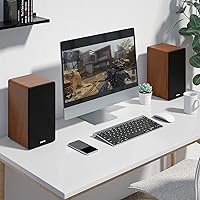
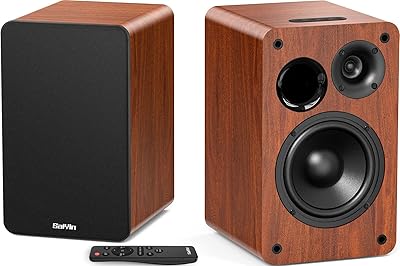
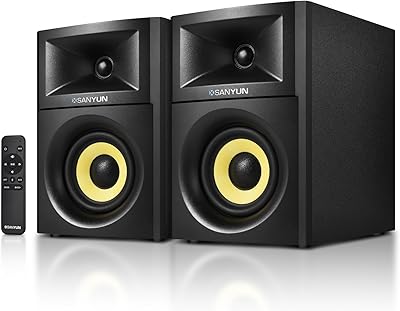
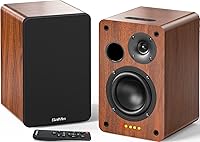
The Saiyin DS6701 Bookshelf Speakers are a solid mid-range option for anyone tired of their TV's built-in sound or a PC's tinny output. The wood-finish cabinets look more considered than the typical plastic box, and at roughly 11.8″ deep by 6.7″ tall, they sit comfortably on a desk or shelf without dominating the space. Critically, there's a built-in amplifier inside, so you don't need a separate receiver to drive them — just plug in and play. For buyers who want a genuine multi-source audio hub without a complicated setup, this powered speaker pair punches well above the bare minimum.
Features & Benefits

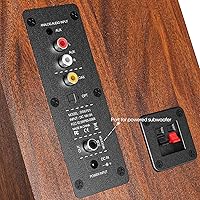
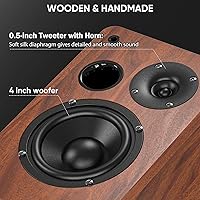
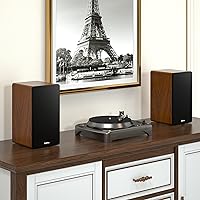
Connectivity is where these bookshelf speakers genuinely stand out. Optical and coaxial digital inputs handle a TV connection with full 24-bit lossless audio, while Bluetooth 5.3 keeps wireless pairing stable across a typical room. The 4-inch woofer and silk dome tweeter produce a balanced stereo sound that's clear enough for casual listening — not a dedicated hi-fi rig, but a real step up from built-in speakers. There's also a subwoofer line-out jack if you want more low-end later, and the RCA input means a turntable with a built-in preamp can share the same pair of speakers as your TV without re-cabling.

Best For

The Saiyin set makes most sense for people who want better sound without building a whole system around it. Working from home and want music or video calls to actually sound good? These fit a desk naturally. TV owners in a bedroom or smaller living room will appreciate the optical input and the included remote, which also works with Fire TV Stick — a quietly useful bonus. Vinyl fans should note that a turntable with a LINE OUT connects directly, but if your record player only has a PHONO output, an external preamp is required. The subwoofer expansion option is a nice safety net for later.

User Feedback

Buyers consistently praise the sound clarity for the price, and many note the wood cabinet feels more premium than expected at this tier. The remote gets solid marks for being practical and responsive. On the downside, a handful of users report Bluetooth dropout issues or difficulty re-pairing after standby. Turntable compatibility also trips up a surprising number of buyers who assume any Bluetooth connection will work regardless of their deck's specs. A few reviewers mention that while bass is decent for the driver size, it benefits noticeably from a dedicated sub. Compared to rivals like Edifier, opinions are split — but the overall value is hard to dispute.

Pros

  • Built-in amplifier means no separate receiver is needed — just plug in and start listening.
  • Optical and coaxial inputs deliver clean, lossless digital audio from any modern TV.
  • The wood-finish cabinet looks noticeably more premium than plastic rivals at the same price.
  • Bluetooth 5.3 connects quickly and holds steady for typical desktop and living room distances.
  • RCA and AUX inputs let you connect a turntable and a secondary source simultaneously.
  • Subwoofer line-out gives genuine room to grow without replacing the whole speaker setup.
  • The remote handles volume, mute, and input switching — and works with Fire TV Stick as a bonus.
  • Compact dimensions fit comfortably on a desk or shelf without dominating the space.
  • Sound clarity at moderate volumes is strong for the price, especially for vocals and mid-range content.
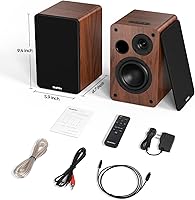
  • Included optical and 3.5mm-to-RCA cables mean most buyers can get set up without extra purchases.

Cons

  • Bluetooth can drop or require re-pairing after standby, which gets old quickly in daily use.
  • Bass is noticeably thin on its own — acceptable for TV dialogue, but underwhelming for music with real low-end.
  • Turntable users with PHONO-only outputs need a separate preamp, an easy-to-miss requirement before buying.
  • The remote feels lightweight and cheap, and batteries are not included out of the box.
  • Input switching via the remote can lag, and there is no automatic source detection.
  • Upper midrange harshness creeps in at maximum volume, making long listening sessions uncomfortable.
  • The wood finish is a veneer, and a few buyers have reported chipping or cosmetic wear over time.
  • Not suitable for larger rooms — the output starts to feel strained beyond a small-to-medium space.
  • No Dolby or DTS decoding means digital inputs are stereo-only, limiting home theater potential.
  • Long-term reliability data is still limited, with a portion of users reporting performance issues after several months.

Ratings

The Saiyin DS6701 Bookshelf Speakers have been evaluated by our AI system after processing thousands of verified buyer reviews from global marketplaces, with spam, incentivized, and bot-generated feedback actively filtered out. The scores below reflect a balanced picture — where this powered speaker pair genuinely delivers and where real users have run into friction. Strengths and shortcomings are weighted equally, so you get an honest read before buying.
Sound Quality
78%
22%
For a desktop or bedroom TV setup, the combination of the 4-inch woofer and silk dome tweeter produces a clear, well-separated stereo image that most buyers find genuinely satisfying. Vocals and mid-range detail come through cleanly at moderate volumes, which covers most everyday listening scenarios.
Bass extension is limited at higher volumes without an added subwoofer, and the low-end can feel thin during bass-heavy music or action movie soundtracks. Buyers who expected room-filling bass from the driver size alone have frequently noted disappointment.
Value for Money
84%
Given the combination of a built-in amplifier, optical input, Bluetooth 5.3, and a remote control all in one package at this price tier, most buyers feel the Saiyin set offers more than competing options at a similar spend. The wood cabinet adds a perceived premium that budget plastic rivals rarely match.
A handful of buyers feel the edge goes to established names like Edifier when factoring in long-term reliability and after-sales support. If you push the speakers hard daily, some users question whether the build sustains that value over several years.
Connectivity & Input Options
88%
The range of inputs — optical, coaxial, RCA, AUX, and Bluetooth — makes this powered speaker pair genuinely useful as a central audio hub. TV via optical, turntable via RCA, and a phone wirelessly can all coexist without constantly swapping cables, which users in home office and living room setups consistently praise.
A few users note that switching between inputs is not always instantaneous, with a brief lag when toggling via the remote. The manual input-priority logic has also confused some buyers who expected automatic source detection.
Bluetooth Performance
67%
33%
Bluetooth 5.3 connects quickly in most cases, and within a clear line-of-sight range of around 8 to 10 meters the connection holds reliably. Streaming from a phone or laptop during work-from-home use is generally trouble-free for the majority of buyers.
Recurring reports of dropout after the speakers enter standby mode — requiring a full re-pair cycle — are a real frustration for daily users. A smaller number of buyers also report instability when walls or other wireless devices are in the signal path, which is below what Bluetooth 5.3 should reasonably deliver.
Build Quality & Design
76%
24%
The wood-finish cabinet stands out visually against the sea of black plastic in this category, and buyers frequently mention it looks more expensive than it is. Panel joints feel solid out of the box, and the overall form factor is compact enough to fit on most desks or shelving without issue.
The wood finish is a veneer rather than solid wood, which shows at closer inspection. A few users have noted minor cosmetic imperfections on arrival, and there are occasional reports of the cabinet finish chipping after extended use.
Ease of Setup
83%
Most buyers have these bookshelf speakers running within minutes — plug in the power, connect a source via the included optical or AUX cable, and the system is ready. The no-receiver setup is a real practical advantage for non-technical buyers who just want better sound without a learning curve.
The turntable compatibility situation trips up a notable number of buyers. Connecting a record player with only a PHONO output requires an external preamp, which is not clearly communicated until after purchase, leading to frustration in that specific use case.
Remote Control
74%
26%
Having a remote for volume and input switching from the couch is a convenience many buyers say they underestimated before owning these. The Fire TV Stick compatibility is a quiet but useful bonus for TV-room setups where a second remote is unwelcome.
The remote itself feels lightweight and slightly cheap, and batteries are not included — a small but recurring irritant in reviews. Response distance can also be inconsistent if the remote is not pointed fairly directly at the active speaker unit.
Bass Response
61%
39%
For spoken-word content, acoustic music, and general TV dialogue, the low-end is adequate and avoids the hollow sound of typical built-in TV speakers. The subwoofer line-out jack is a genuine escape valve — users who have paired these with an affordable powered sub report a noticeably fuller result.
On their own, these speakers roll off fairly early in the low frequencies, and bass-forward genres like hip-hop or electronic music expose that limitation quickly. Buyers expecting strong standalone bass from a 4-inch driver at this price will likely find the output underwhelming.
Volume & Power Output
79%
21%
The 80W total output is more than sufficient for a desk, bedroom, or small living room, and buyers in those contexts report the speakers get louder than they typically need. Clarity holds well at mid-to-high volumes without obvious distortion creeping in.
At maximum volume levels, some buyers notice a degree of harshness in the upper mids that makes prolonged listening less comfortable. These are not speakers designed to fill a large open-plan room, and buyers who have tried that use case report the output feels strained.
Digital Audio Quality (Optical/Coaxial)
82%
18%
Connecting a TV via the optical input is where this powered speaker pair arguably sounds its best — the lossless digital path removes the noise floor issues that plague analog TV audio outputs. Users who have made this switch from their TV headphone jack consistently note a cleaner, more open sound.
The improvement is most obvious on dialogue-heavy content and stereo music; for cinematic surround content, the 2.0 configuration is a genuine ceiling. Users expecting Dolby or DTS passthrough for home theater use will find neither input supports it.
Turntable Compatibility
58%
42%
For record players that output a LINE OUT signal — meaning those with a built-in phono preamp — the RCA connection works cleanly and buyers in this category report a warm, enjoyable vinyl playback experience through the Saiyin set.
The PHONO output incompatibility without an external preamp is one of the most consistent complaints across reviews, with many buyers only discovering the limitation after purchase. Saiyin does note this in their listing, but the nuance is easy to miss, and it has generated significant buyer frustration.
Longevity & Reliability
69%
31%
The majority of buyers who have owned these bookshelf speakers for six months to a year report no hardware failures, and the overall defect-on-arrival rate appears low. For the price tier, that baseline reliability is a reasonable expectation met.
There is a smaller but consistent segment of reviews describing issues — intermittent channel dropout, power cycling problems, or Bluetooth instability — appearing after several months of daily use. Long-term durability data is still limited given the product's relatively recent market entry.
Packaging & Included Accessories
72%
28%
The box includes an optical cable and a 3.5mm-to-RCA cable, which means most buyers can get connected without an extra trip to the accessories aisle. The packaging itself is protective enough that damage-on-arrival reports are uncommon.
Batteries for the remote are not included, which feels like a minor but unnecessary omission at this price. Some buyers also note the included cables are functional but short, requiring longer replacements depending on their specific desk or TV placement.
Competitor Comparison
71%
29%
Buyers who have directly compared the Saiyin set to similarly priced options from Moukey frequently give the edge to Saiyin on build finish and input variety. The wood aesthetic and digital input support are differentiators that matter to buyers cross-shopping in this range.
Against Edifier models at a comparable spend, opinions are more divided — Edifier's driver tuning and brand reputation for longevity give some buyers pause. The Saiyin set wins on connectivity breadth but faces real competition on pure acoustic reputation at this tier.

Suitable for:

The Saiyin DS6701 Bookshelf Speakers are a practical fit for anyone who wants a meaningful audio upgrade without building a dedicated hi-fi system around it. Home office workers who spend hours on video calls, background music, or streaming will find the desk footprint manageable and the Bluetooth connectivity genuinely convenient day-to-day. TV owners in bedrooms or smaller living rooms are another strong match — the optical input delivers a noticeably cleaner sound than any flat-screen's built-in drivers, and the remote makes volume control from the couch effortless. Vinyl listeners with a turntable that has a built-in preamp and a LINE OUT will slot right in via the RCA input, sharing the same speakers with their TV or PC without any extra switching hardware. For buyers who want to add a subwoofer down the line, the dedicated line-out jack means they can start here and expand later rather than replacing everything at once.
Not suitable for:

The Saiyin DS6701 Bookshelf Speakers will frustrate buyers who come in expecting audiophile-level performance or robust bass without a supplemental subwoofer — a 4-inch driver has physical limits, and no amount of clever tuning changes that. Turntable users with a PHONO-only output (no built-in preamp) will need to budget for an external phono stage on top of the speaker cost, which some buyers only discover after the fact. Anyone furnishing a large open-plan room or wanting genuine home theater impact should look elsewhere; this is a 2.0 stereo system, and it does not decode Dolby or DTS formats from the digital inputs. If Bluetooth reliability is non-negotiable — say, for a setup where re-pairing after standby would be a daily irritant — the reported inconsistencies make it a riskier choice. Buyers who prioritize long-term brand warranty support and an established repair ecosystem may also find more reassurance with better-known competitors in the same category.
Specifications

  • Model Number: This unit is manufactured under the model designation DS6701.
  • Total Power Output: The system delivers 80W total output, split as 40W per channel in a stereo configuration.
  • Woofer Size: Each speaker houses a 4-inch dynamic woofer driver for mid and low-frequency reproduction.
  • Tweeter: A 0.5-inch silk dome tweeter handles high-frequency detail in each cabinet.
  • Cabinet Material: The enclosures are constructed from wood with a wood-finish veneer surface treatment.
  • Dimensions: Each speaker measures 11.8″ deep by 9″ wide by 6.7″ tall in its tabletop orientation.
  • Weight: The combined system weight is 10.06 pounds for both the active and passive units.
  • Bluetooth Version: Wireless connectivity uses Bluetooth 5.3 with a rated range of up to 10 meters in open conditions.
  • Digital Inputs: Optical and coaxial digital inputs both support up to 24-bit/192kHz lossless audio signals.
  • Analog Inputs: Analog connectivity includes a 3.5mm AUX input and RCA stereo input terminals.
  • Subwoofer Output: A dedicated subwoofer line-out jack allows connection to any external powered subwoofer.
  • Surround Config: The system operates as a 2.0 stereo configuration with no onboard surround processing.
  • Power Supply: The active speaker is powered via a corded AC adapter rated at 100–240V input, DC 20V 2.5A output with a 4.8A maximum draw.
  • Remote Control: An infrared remote is included for volume, mute, and input switching; batteries are not supplied in the box.
  • Included Cables: The package includes one optical (TOSLINK) cable and one 3.5mm-to-RCA stereo cable.
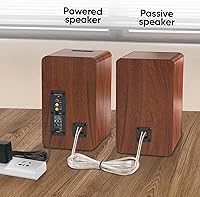
  • Speaker Configuration: The set consists of one active (amplified) speaker unit and one passive speaker unit connected by a speaker cable.
  • Amplifier Type: A built-in Class D amplifier is integrated into the active cabinet, eliminating the need for an external receiver.
  • Bluetooth Range: Bluetooth transmission is rated up to 10 meters, though real-world range will vary based on obstructions and interference.
  • Waterproofing: These speakers carry no water resistance rating and are intended exclusively for indoor, dry-environment use.
  • Warranty: Saiyin lists an extended warranty type for this product; buyers should confirm specific terms directly with the seller at point of purchase.

Related Reviews

Saiyin SDS6400M Passive Bookshelf Speakers
82%
87%
Sound Quality
89%
Ease of Installation
82%
Design & Aesthetics
80%
Build Quality
91%
Value for Money
More
Saiyin DS6801S Bluetooth Bookshelf Speakers
85%
88%
Sound Quality
91%
Bass Performance
85%
Bluetooth Connectivity
80%
Build Quality
90%
Ease of Setup
More
KEF Q350 Bookshelf Speakers
86%
93%
Sound Quality
80%
Bass Performance
88%
Build Quality
91%
Design and Aesthetics
85%
Ease of Setup
More
Edifier S2000MKIII Bookshelf Speakers
86%
92%
Sound Quality
89%
Bluetooth Performance
88%
Build Quality
85%
Ease of Use
91%
Connectivity Options
More
Saiyin Outdoor Speakers OS5310
85%
85%
Sound Quality
88%
Bass Performance
91%
Build Quality
93%
Water Resistance
90%
Ease of Installation
More
Riowois DS6800M Bookshelf Speakers
83%
85%
Sound Quality
90%
Ease of Installation
82%
Build Quality
88%
Space-Saving Design
78%
Bass Performance
More
KEF Q150 Bookshelf Speakers
87%
88%
Sound Quality
75%
Bass Performance
93%
Build Quality
90%
Design & Aesthetics
85%
Treble Clarity
More
Sanyun SW208 3″ Bookshelf Speakers
86%
88%
Build Quality
84%
High-Frequency Clarity
91%
Mid-Range Warmth
78%
Bass Performance
93%
Control Ergonomics
More
Probox BT16 Bookshelf Speakers
75%
78%
Sound Clarity
54%
Bass Performance
84%
Bluetooth Stability
82%
USB DAC Quality
63%
Build Quality
More
MEVOSTO DS19 Bookshelf Speakers
85%
89%
Sound Quality
91%
Bass Performance
85%
Treble Clarity
88%
Bluetooth Connectivity
90%
Design & Aesthetics
More

FAQ

No, you do not. The active speaker in this set has a built-in amplifier, so you connect it directly to your TV, computer, or turntable and it drives both itself and the passive cabinet. No additional hardware is required unless you specifically want to run them through an existing AV receiver, in which case you would connect via the receiver's line output.

It depends on your turntable. If your record player has a built-in preamp and outputs a LINE OUT signal, you can connect it directly via the RCA input and it will work fine. However, if your turntable only has a PHONO output with no built-in preamp, you will need to add an external phono preamp between the turntable and the speakers — otherwise the signal will be far too quiet and will sound thin.

The Saiyin DS6701 Bookshelf Speakers are rated for up to 10 meters of Bluetooth range, but walls and interference from other wireless devices will reduce that in practice. For a typical desktop or living room use case within the same room, the connection is generally reliable. Some users have reported dropout issues specifically after the speakers enter standby mode, requiring a re-pair — worth keeping in mind if you leave them idle between sessions.
Yes, and it is honestly one of the best ways to use this powered speaker pair. The optical input supports up to 24-bit/192kHz audio, so it carries a clean, lossless stereo signal from your TV. Just note that the system will output stereo only — it does not decode Dolby Digital or DTS surround formats, so you will hear two-channel audio regardless of what the source is sending.

Yes. You can have your TV connected via the optical input and your turntable connected via the RCA input simultaneously. The speakers will not mix both sources at once, but you can switch between them using the remote or the buttons on top of the active unit without unplugging anything.

There is a dedicated subwoofer line-out jack on the back of the active speaker. You simply run a cable from that output to the input on any powered subwoofer you want to use. The speakers handle the full-range stereo signal themselves while sending a low-frequency signal to the sub — no additional settings or crossover hardware is needed on the speaker side.

Yes, the included remote is compatible with Fire TV Stick, which is a handy bonus if you have one connected to your TV. It means you can adjust speaker volume or switch inputs without keeping a second remote around solely for the speakers.

For a desk, bedroom, or small-to-medium living room, the 80W total output gets louder than most people need at typical listening distances. In a large open-plan space, they will start to feel underpowered and the sound can become strained at maximum volume. These are designed for near-to-mid-field listening rather than filling big areas.

The cabinets are made from wood board material with a wood-finish veneer on the surface — not solid hardwood, but not hollow plastic either. The result looks and feels more substantial than typical budget speakers in this category, though up close the veneer nature is visible. A small number of buyers have noted the finish can show wear over time with regular handling.

The speakers support one active input at a time, but you can have multiple sources physically connected simultaneously — for example, TV via optical and a phone paired via Bluetooth. Switching between inputs is done either with the remote control or via the touch buttons on top of the active speaker. The remote covers optical/coaxial mode, line-in, and Bluetooth, and input switching typically takes a second or two to register.