Overview

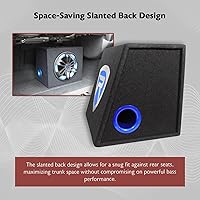
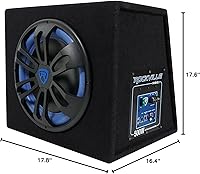
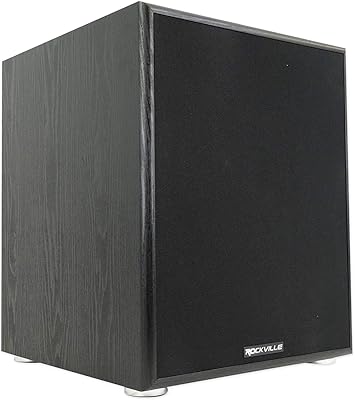
The Rockville RVB12.1A 12-Inch Powered Subwoofer Enclosure is built for one specific kind of buyer: someone who wants real bass in their car without spending a weekend routing wires and mounting a separate amplifier. Rockville sits comfortably in the budget-to-mid-range car audio space, and this all-in-one car subwoofer reflects that positioning honestly. The amplifier, driver, and enclosure arrive as a single unit ready to drop into your cargo area. That angled, hatchback-style cabinet is designed to lean against the rear seat rather than consume your entire trunk. Plug-and-play convenience is the pitch here — not raw competition output.
Features & Benefits

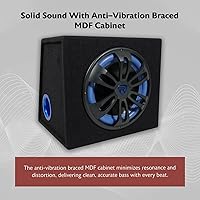
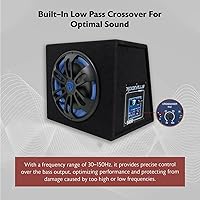
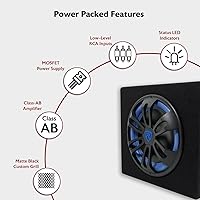
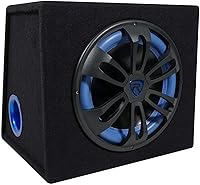
The built-in Class AB amplifier is what separates this powered sub enclosure from a passive box-and-driver combo. Running 300W RMS continuously through a MOSFET power supply, it delivers clean, stable output without the cost or complexity of a standalone amp. The low-pass crossover sweeps from 30Hz all the way to 150Hz, so you can tune the blend to your head unit rather than guessing. A bass boost EQ sits alongside that control for dialing in extra punch when you want it. The MDF cabinet uses anti-vibration bracing to keep things tight at higher volumes, and the ported enclosure design helps the driver reach those low 30Hz notes with real authority.

Best For

This all-in-one car subwoofer makes the most sense for daily commuter upgrades — specifically for drivers in hatchbacks, SUVs, or wagons where the angled back panel fits naturally against the rear seat. If you have never wired a subwoofer before, the RCA input means you connect it the same way you would hook up any line-level device; no crossover to build, no amp to mount, no mystery. Budget-conscious buyers stuck between stock audio and a full custom build will find this a practical middle ground. If you want to fill an entire trunk or hit competition SPL numbers, though, look elsewhere — this unit was not designed for that mission.

User Feedback

Buyers consistently point to easy installation as the standout win — most report getting everything connected and running in under an hour, which is essentially unheard of with separate component builds. The improvement over stock audio is described as dramatic even at modest volume settings. That said, a recurring theme among more experienced listeners is that the output ceiling becomes apparent when pushing the unit hard for extended sessions. Some owners in larger vehicles note the enclosure does not sit quite as flush as expected. Long-term reliability feedback is mixed — many report years of solid use, while a smaller group flags amplifier trouble after sustained high-gain listening.

Pros

  • Everything arrives in one box — amp, enclosure, and driver — so there is nothing extra to source or buy.
  • Installation typically takes under an hour, even for first-timers with basic wiring knowledge.
  • The bass improvement over factory speakers is immediately noticeable at normal listening volumes.
  • Adjustable crossover from 30Hz to 150Hz gives you enough range to match most head unit outputs cleanly.
  • The MDF cabinet with anti-vibration bracing keeps the box quiet and rattle-free at moderate volumes.
  • RCA connectivity works straight out of the box with virtually every aftermarket and most factory head units.
  • The angled hatchback-style design fits neatly in SUV and wagon cargo areas without sacrificing usable space.
  • Build quality feels solid and intentional for the mid-range price tier — not a cheap-feeling plastic shell.
  • The ported enclosure helps the driver reach genuinely low frequencies that a sealed budget box often cannot.

Cons

  • Output ceiling becomes obvious when pushing the unit hard — it runs out of headroom faster than a separate amp setup would.
  • The integrated amplifier has drawn reliability concerns from a subset of owners after extended high-volume use.
  • Fitment against rear seats is not always as flush as the product description implies, especially in smaller vehicles.
  • The bass boost EQ and crossover controls are functional but basic compared to what a standalone amp provides.
  • At 29 pounds, the enclosure is heavy enough that single-person installation in a tight cargo area can be awkward.
  • No phase control or subsonic filter means less protection against over-excursion at extreme low frequencies.
  • Buyers in sedans or coupes may find the enclosure shape poorly suited to their trunk geometry.
  • Long-term amplifier longevity appears inconsistent across units, with some owners reporting early failure under sustained use.

Ratings

The scores below reflect our AI-driven analysis of verified buyer reviews for the Rockville RVB12.1A 12-Inch Powered Subwoofer Enclosure, sourced globally and filtered to remove incentivized, duplicate, and bot-generated feedback. Each category has been scored to reflect the real distribution of sentiment — not a polished average — so genuine strengths and recurring frustrations both show up clearly. Where this powered sub enclosure earns high marks and where it falls short are represented with equal transparency.

Ease of Installation
91%
This is consistently the most praised aspect across buyer reviews. Drivers with zero prior car audio experience report completing the full installation in under an hour, crediting the straightforward four-wire connection and standard RCA input. For daily commuters who just want bass without booking a shop appointment, this is a genuine differentiator.
A small number of buyers without line-level RCA outputs on their factory head units discovered they needed a separate line output converter, which added unexpected cost and complexity. The wiring instructions included in the box could also be clearer for complete beginners.
Bass Performance
78%
22%
At normal to moderate-high listening volumes, the improvement over any factory speaker system is immediate and obvious. The ported enclosure lets the 12-inch driver dig into genuinely low frequencies, and daily commuters using it for hip-hop, EDM, and pop consistently describe the bass as punchy and satisfying during real-world driving sessions.
The output ceiling becomes a real limitation when pushed hard. Buyers who expected competition-level SPL or wanted to fill a larger cabin at maximum volume found the integrated amplifier running short of headroom, producing a strained character rather than clean, effortless bass.
Value for Money
84%
Buyers repeatedly note that getting a driver, enclosure, and amplifier in a single package at this price tier would cost significantly more if sourced separately. For someone transitioning from stock audio without a large budget, the all-in-one format represents a practical and cost-effective entry point into aftermarket bass.
Buyers who have previously owned separate component setups tend to rate this lower on value, noting that the integrated amp's performance and tuning depth do not match what a dedicated external amplifier in a similar budget range can deliver when paired with a quality standalone sub.
Build Quality
76%
24%
The MDF cabinet feels dense and intentional rather than hollow or flimsy, and the aviation-grade tweed carpet finish gives it a finished appearance that does not look out of place in a clean vehicle interior. The anti-vibration bracing inside the cabinet keeps panel resonance noticeably under control at moderate volumes.
Some owners report that at sustained high volume levels, minor rattles develop around the amplifier plate mounting area over time. The carpet finish, while presentable, shows wear faster than harder surface alternatives when the enclosure is subject to regular cargo contact or sliding.
Amplifier Reliability
63%
37%
The majority of buyers who use this all-in-one car subwoofer at moderate, daily-use volume levels report trouble-free operation over extended ownership periods. The Class AB design runs cooler than Class D alternatives in some conditions, and buyers who respect the gain structure tend to have positive long-term experiences.
A recurring concern in longer-term reviews is amplifier failure after sustained high-gain use, particularly in warmer climates or enclosed cargo spaces with limited airflow. This is the single most reported durability issue, and it disproportionately affects buyers who habitually push the unit near its limits.
Enclosure Fit & Placement
71%
29%
For hatchbacks, crossovers, and wagons, the angled rear panel genuinely does work as intended — it sits against the rear seat without consuming the entire cargo floor, and owners of compact SUVs frequently mention how well it tucks away. The compact footprint relative to a 12-inch sub enclosure is a legitimate convenience win.
Sedan owners and those with non-standard cargo configurations report that the angled design does not translate well to flat trunk floors, leaving the unit prone to shifting. The fit is also not universally flush across all hatchback models, with some owners noting noticeable gaps depending on seat angle.
Sound Tuning Controls
67%
33%
Having an adjustable crossover that spans all the way from 30Hz to 150Hz gives buyers a real range to work with when matching the sub to their existing speakers. The bass boost EQ is appreciated by users who want extra punch for specific genres without needing to adjust the head unit every time.
Experienced listeners note the absence of a subsonic filter, phase control, and variable gain as meaningful gaps compared to what even a budget external amplifier typically offers. The controls present are functional but narrow, leaving buyers who like precise tuning feeling constrained.
Low-Frequency Extension
82%
18%
The ported enclosure design tuned to a 30Hz lower limit means this sub can reproduce the kind of deep, sub-bass frequencies that sealed budget boxes often struggle with. Listeners who play music with genuine low-end content — electronic, orchestral bass lines, or modern hip-hop — notice the depth advantage in real listening situations.
At the very bottom of the frequency range, the driver can sound loose rather than tight when the bass boost is engaged simultaneously, particularly on tracks with dense low-frequency content. A subsonic filter would help manage this, but that control is not available on this unit.
Noise & Rattle Resistance
74%
26%
The anti-vibration internal bracing does a credible job keeping the cabinet itself quiet, and most buyers report a clean, resonance-free presentation at everyday listening levels. For a commuter sub that sits in the cargo area of an SUV on city roads, that structural stability matters more than it might seem.
At higher volume settings, a portion of owners observe that vibration migrates to adjacent cargo area surfaces and trim panels rather than the enclosure itself. This is partly a vehicle-specific issue, but the enclosure's weight means it can also transmit more road vibration than a lighter sealed design.
Appearance & Finish
79%
21%
The blue and black tweed carpet with the embroidered logo reads as a deliberate aesthetic rather than a generic afterthought. Buyers who care about their vehicle's interior presentation appreciate that the unit does not look like a bare DIY box sitting in the back of their car.
Tweed carpet shows dust and light debris more readily than a solid rubberized or vinyl finish would. A handful of buyers also note that the embroidered logo placement feels slightly dated in styling compared to more modern competing enclosures in the same price tier.
Package Completeness
69%
31%
Everything needed to run the subwoofer — driver, enclosure, and amplifier — ships together, which eliminates the compatibility guesswork that typically comes with building a sub system from individual components. For buyers who are not confident sourcing matched parts, that completeness has real practical value.
The package does not include a wiring harness, power cable, or RCA cables, meaning buyers still need to purchase a wiring kit separately before they can complete the install. Some buyers, especially first-timers, are caught off guard by this gap when the box arrives.
Connectivity Compatibility
86%
RCA line-level inputs are as close to a universal standard as car audio gets — virtually every aftermarket head unit and a large share of factory units with upgraded audio packages include them. This makes the connection process genuinely plug-and-play for the majority of buyers without any adapter hardware.
Factory base-model head units that output only speaker-level signals will require a line output converter, which the product does not include or clearly foreground in its marketing. This creates a genuine compatibility gap that catches a meaningful segment of buyers unprepared.
Weight & Portability
58%
42%
For what it contains — a full MDF enclosure, driver, and amplifier plate — 29 pounds is not unreasonable, and owners who install it once and leave it in place rarely mention weight as an issue in their day-to-day experience.
Single-person installation in a cramped cargo area is physically awkward at 29 pounds, particularly when trying to position the angled panel against the rear seat while simultaneously managing wiring. Buyers who move the unit between vehicles or remove it frequently find the weight a consistent inconvenience.

Suitable for:

The Rockville RVB12.1A 12-Inch Powered Subwoofer Enclosure was essentially designed for the driver who is tired of flat, lifeless stock audio but has no interest in spending a full weekend sourcing, mounting, and wiring a multi-component setup. It fits that sweet spot perfectly for hatchback, SUV, and wagon owners, where the angled rear panel slots naturally against the back seat without turning the cargo area into a dedicated audio cabinet. Car audio beginners will appreciate that the RCA input keeps the connection process familiar and approachable — if you can hook up a head unit, you can install this. Daily commuters who want noticeably better bass for music, podcasts, or long highway drives without a steep learning curve will get genuine value here. It also makes solid sense as a first upgrade for someone who has never owned an aftermarket subwoofer and wants to understand what powered bass actually sounds like before committing to a more serious build.
Not suitable for:

The Rockville RVB12.1A 12-Inch Powered Subwoofer Enclosure is not the right call for anyone chasing serious output levels or competing in SPL events — the built-in amplifier simply was not engineered for that kind of sustained, high-gain punishment. Experienced car audio enthusiasts who already own quality separates will likely find the integrated amp a step down from what a dedicated external unit can deliver in terms of headroom and fine-tuned control. Sedan owners with shallow trunks may also struggle with fitment, since the enclosure was clearly optimized for cargo-area vehicles rather than traditional trunk configurations. If your priority is filling a large space with wall-to-wall bass, this powered sub enclosure will hit a ceiling before you do. And buyers who like deep, granular amplifier tuning — adjustable gain stages, subsonic filters, phase control — will find the onboard controls limited compared to what a standalone amp setup can offer.
Specifications

  • Brand: Manufactured by Rockville, a brand distributed under Audiosavings, positioned in the budget-to-mid-range car audio market.
  • Model: The unit carries the model designation RVB12.1A, identifying this specific powered enclosure variant in the Rockville lineup.
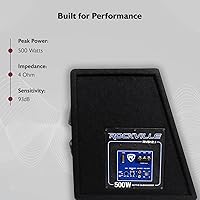
  • Peak Power: The built-in amplifier is rated at 500W peak output, representing the maximum short-term power handling capacity.
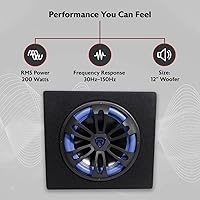
  • RMS Power: Continuous RMS output is rated at 300W, reflecting the sustained power the amplifier delivers under normal listening conditions.
  • Amplifier Class: The integrated amplifier operates in Class AB configuration, balancing efficiency and audio clarity with a high-speed MOSFET power supply.
  • Driver Size: The subwoofer uses a 12-inch dynamic driver optimized for low-frequency reproduction within the ported enclosure.
  • Frequency Response: The enclosure and driver combination supports a frequency response down to 30Hz, allowing deep, low-end bass extension.
  • Crossover Range: An adjustable low-pass crossover sweeps from 30Hz to 150Hz, letting users blend the sub output with their existing speakers.
  • Connectivity: Input connectivity is handled via RCA line-level inputs, compatible with the vast majority of aftermarket and factory head units.
  • Enclosure Material: The cabinet is constructed from MDF with internal anti-vibration bracing to minimize resonance and panel flex at higher volumes.
  • Enclosure Style: The chassis uses a ported design with a hatchback-style angled rear panel intended to sit flush against a vehicle rear seat.
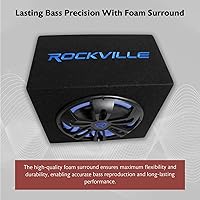
  • Finish: Exterior surfaces are wrapped in aviation-grade tweed carpet in a blue and black color scheme with an embroidered Rockville logo.
  • Dimensions: The enclosure measures 17.2″ x 15.2″ x 14.5″, making it a compact but substantial unit suited to cargo-area placement.
  • Unit Weight: The complete powered enclosure, including the integrated amplifier plate, weighs 29 pounds.
  • Audio Driver Type: The driver uses a dynamic transducer design, which is standard for automotive subwoofer applications in this power and size class.
  • ASIN: This product is listed on Amazon under ASIN B00CW4U5CU and was first made available in May 2013.

Related Reviews
Rockville REC97 12-Inch 2-Hole Vented Subwoofer Enclosure
83%
92%
Bass Performance
89%
Build Quality
86%
Ease of Installation
90%
Durability
88%
Value for Money
More
QPower QBOMB12VL 12-inch Vented Subwoofer Enclosure
78%
88%
Value for Money
82%
Build Quality
76%
Bass Performance
91%
Ease of Installation
84%
Exterior Finish
More
Q Power HD112VL 12-Inch Ported Subwoofer Enclosure
75%
88%
Value for Money
79%
Bass Performance
67%
Build Quality
86%
Fitment & Compatibility
71%
Port Design & Tuning
More
Q Power Shallow Single 12-Inch Sealed MDF Truck Subwoofer Enclosure Box
86%
85%
Bass Performance
90%
Build Quality
88%
Durability
93%
Ease of Installation
91%
Space Efficiency
More
Acoustic Audio PSW500-12 12-Inch Powered Subwoofer
73%
83%
Bass Output for Price
88%
Ease of Setup
86%
Value for Money
67%
Build Quality
71%
Sound Quality
More
Rockville RTB12A 12-Inch Powered Car Subwoofer
72%
78%
Bass Impact
86%
Ease of Installation
81%
Value for Money
61%
Build Quality
63%
Sound Quality
More
Rockville RWS12CA 12-inch Powered Car Subwoofer
78%
91%
Ease of Installation
78%
Bass Quality
83%
Value for Money
74%
Build Quality
58%
Thermal Management
More
Klipsch SPL-120 12-inch Powered Subwoofer
80%
91%
Bass Performance
88%
Build Quality
89%
Amplifier Headroom
87%
System Integration
83%
Value for Money
More
Rockville RW10CA 10-inch Powered Car Subwoofer
77%
88%
Ease of Installation
74%
Bass Output Quality
91%
Low-Profile Fit
69%
Built-in Amplifier Performance
86%
Remote Bass Knob
More
Rockville Rock Shaker 12 Powered Subwoofer
78%
88%
Bass Output
91%
Value for Money
83%
Build Quality
79%
Ease of Setup
86%
Crossover Flexibility
More

FAQ

No, the amplifier is already built into the enclosure. You simply run power, ground, a remote turn-on wire, and RCA cables from your head unit — there is no external amp to source, mount, or configure.

That is exactly what the angled enclosure design is intended for. The slanted rear panel is shaped to lean against the back seat in hatchbacks, crossovers, and wagons, keeping the bulk of your cargo floor usable. That said, fitment varies by vehicle, so it is worth measuring your cargo area against the 17.2″ x 15.2″ x 14.5″ footprint before ordering.

This is a common concern. The unit requires a line-level RCA input signal, so if your factory head unit lacks RCA outputs, you would need a line output converter (LOC) to tap the speaker wires and convert the signal. These are inexpensive and widely available, but it is an additional step worth planning for.

Most beginners find this all-in-one car subwoofer manageable in under an hour. The wiring is limited to four connections — power, ground, remote, and RCA — which is about as simple as car audio wiring gets. A basic wiring kit with the correct gauge power wire is the only additional item you will likely need.

At moderate to moderately high volume levels, yes — most owners report satisfying bass that significantly outperforms any factory setup. Where it starts to feel limited is at sustained high volumes in larger cabin spaces, so if you are expecting to rattle windows in a full-size truck or van, you may want to look at a higher-powered separate component setup instead.

The bass boost EQ allows you to add a shelf of extra low-frequency emphasis on top of the standard output, which can be useful if your head unit has limited bass control or if you simply want more punch at lower volume settings. Use it conservatively — cranking it fully tends to stress the driver and can muddy the overall sound rather than improve it.

The aviation-grade tweed carpet is reasonably durable for everyday cargo-area use, holding up well against normal sliding and contact. It is not impervious to sharp objects or heavy abrasion, so if your cargo area sees rough daily use, a rubber mat underneath is a practical precaution.

Technically yes, but the angled hatchback-style design does not translate as naturally to a flat trunk floor. You may find the unit sits awkwardly or does not brace against anything, which can cause it to shift while driving. Some sedan owners make it work with strapping or cargo nets, but it was clearly optimized for open cargo-area vehicles.

The listed controls include the adjustable low-pass crossover and a bass boost EQ, but no dedicated subsonic filter is specified for this unit. If you tend to run the bass boost high or listen to music with very deep sub-bass content frequently, exercising some restraint on the gain and boost controls is the best way to protect the driver over the long term.

Rockville typically offers a one-year warranty on their powered products, though it is always worth confirming current warranty terms directly with the seller or on Rockville's official site at the time of purchase. Customer support experiences reported by buyers tend to vary, so keeping your purchase receipt and registering the product promptly is advisable if warranty coverage matters to you.

Where to Buy