
Overview

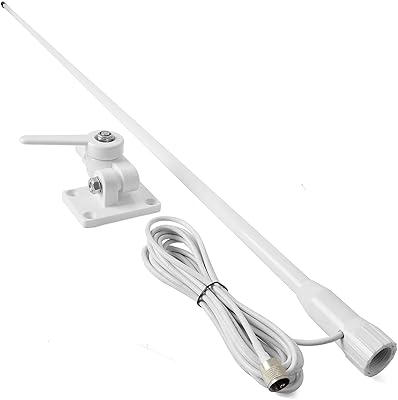
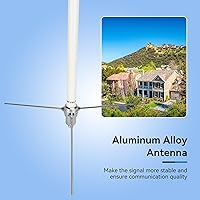
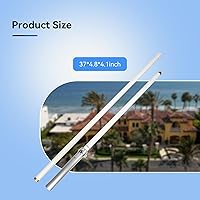
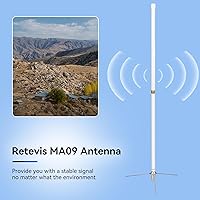
The Retevis MA02 7.2dBi GMRS Base Antenna is a solid mid-range option for anyone building out a GMRS repeater station at home or in the field. Unlike the flimsy whip antennas bundled with most repeaters, this GMRS base antenna uses a 3-section fiberglass radome with an internal copper rod conductor — a construction choice that reduces signal loss compared to cheaper alternatives. At nearly 5.3 feet long, it needs a proper mast or mounting point, so plan your installation accordingly. It works with a wide range of popular GMRS radios and repeaters, including the RT97, BTECH, Midland, Motorola, and Wouxun units. Just keep in mind: open-sky placement matters — install it near heavy metal structures and you will notice the difference.

Features & Benefits

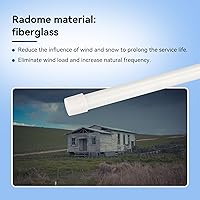
What sets this repeater antenna apart is its 7.2dBi gain across the UHF GMRS band — which in practical terms means your signal travels noticeably farther than it would off a stock antenna. The VSWR rating stays below 1.5, which tells you that very little of your transmitter's power is being wasted as reflected energy. That efficiency matters even more when you factor in the 200-watt power handling capacity; this antenna is built for serious repeater duty, not just casual handheld use. The standard PL-259 connector makes coax hookup straightforward, and the omnidirectional beam pattern means coverage fans out equally in all directions without any aiming required. The fiberglass housing holds up reliably against sun, rain, and extended outdoor exposure.

Best For

This GMRS base antenna is squarely aimed at licensed GMRS users — if you do not yet hold an FCC GMRS license, that is your first step before any of this matters. It suits rural property owners and off-grid households where stock antennas simply do not cut it for reliable coverage across large distances. Emergency preparedness enthusiasts and community repeater operators will also find it a practical fit. Owners of the Retevis RT97 in particular tend to reach for this as a direct stock upgrade. It also works well as a replacement if an older base antenna has failed or degraded after years of outdoor use.

User Feedback

Across its 113 ratings, the Retevis fiberglass antenna holds a 4.4-star average — generally well-received, but with some honest caveats worth knowing. Most buyers who set it up correctly report a clear range improvement over what came with their repeater out of the box. Where things get more nuanced: several reviewers stress that coax quality and proper grounding make a significant difference in real-world results, and that this antenna alone cannot compensate for a poorly-planned installation. Assembly is manageable, though the connector sections deserve careful handling during setup. A handful of users also flag that placement near metal buildings visibly hurts performance — a limitation the manufacturer itself acknowledges.

Pros

  • Noticeable range improvement over stock antennas that come bundled with most GMRS repeaters.
  • 7.2dBi gain on the UHF GMRS band delivers real-world performance without requiring complicated tuning.
  • Handles up to 200 watts, making it genuinely suitable for full-power repeater station duty.
  • VSWR below 1.5 means your transmitter power is going into the air, not bouncing back as heat.
  • The standard PL-259 connector plays nicely with a wide range of coax cables and adapters.
  • Omnidirectional coverage means you get 360-degree signal spread without ever having to point it.
  • Fiberglass construction holds up well outdoors against UV exposure, rain, and temperature swings.
  • Broad compatibility spans Retevis, BTECH, Midland, Motorola, and Wouxun GMRS systems.
  • Comes with mounting hardware included, so you are not scrambling for rings and screws separately.
  • One-year warranty with responsive after-sale support adds a reasonable safety net for the investment.

Cons

  • Performance drops noticeably when installed near metal structures, buildings, or rooftop clutter.
  • At nearly 5.3 feet long, it demands a proper mast and mounting plan — not a casual install.
  • Coax cable quality has a major impact on results, and no cable is included in the box.
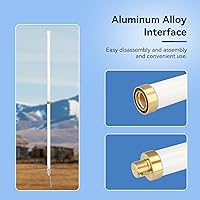
  • Connector sections require careful handling during assembly; rushing it risks poor contact or damage.
  • Not ideal for urban environments where obstructions undercut the antenna's open-sky design assumptions.
  • Buyers without an FCC GMRS license cannot legally operate this antenna on any compatible radio.
  • The 3-section design means one more point of potential failure compared to a single-piece antenna.
  • Weight of nearly 3 pounds combined with the length puts real stress on lightweight or improvised mounts.

Ratings

The Retevis MA02 7.2dBi GMRS Base Antenna has been evaluated by our AI rating engine after analyzing verified purchaser reviews from global marketplaces, with spam, bot-generated, and incentivized submissions actively filtered out before scoring. What you see below reflects a honest composite of real-world experiences from GMRS hobbyists, repeater station builders, and rural communications users — covering both what this antenna does well and where it falls short. Every score is calibrated to surface the trade-offs that actually matter when you are deciding whether this repeater antenna fits your setup.

Signal Performance
83%
Most buyers running this antenna on an RT97 or similar GMRS repeater report a clear and noticeable improvement in usable range compared to the stock antenna that shipped with their unit. In open terrain — rural properties, farms, hilltop installs — the 7.2dBi gain does meaningful work.
Performance is highly dependent on placement and coax quality, and users in suburban or semi-urban environments with metal rooftops or nearby structures report inconsistent gains. The antenna cannot compensate for a poorly planned installation, which catches some buyers off guard.
Build Quality
78%
22%
The three-section fiberglass radome feels solid and handles outdoor conditions well — UV exposure, rain, and moderate wind loads do not seem to cause visible deterioration over time. The alloy connector and internal copper rod are a step above what cheaper whip-style antennas typically offer at this price tier.
The multi-section design introduces connector joints that require care during assembly and over time. A small number of users have reported that joints can work loose after repeated thermal cycling, and the connector threads feel adequate rather than premium when compared to higher-end antenna hardware.
Ease of Assembly
74%
26%
The three sections thread together in a logical sequence, and most users manage a complete assembly in under fifteen minutes without needing any specialized tools. The included fixing rings and screws are a practical touch that removes one purchasing step for first-time installers.
The connector junctions between sections need to be seated carefully and fully tightened — it is easy to rush this step and end up with a marginal connection that quietly degrades your VSWR. The assembly instructions are minimal, which leaves newer GMRS users guessing on correct torque and sealing practices.
Compatibility
89%
This GMRS base antenna covers a wide ecosystem of popular repeaters and radios — Retevis RT97, BTECH, Midland, Motorola, and Wouxun KG-935G units all connect without adapter complications thanks to the standard PL-259 connector. Buyers upgrading from multiple brands rarely encounter hardware mismatch issues.
While the connector type is universal, the coaxial cable still needs to be sourced separately, and some users with older equipment needed an SO-239 to SL16 adapter that was not immediately obvious from the listing. International buyers outside the US should also verify local GMRS frequency regulations before purchasing.
Weather Resistance
76%
24%
Long-term outdoor users report that the fiberglass housing holds its color and structural integrity well through seasons, even in climates with significant rainfall or temperature swings. The antenna shows no meaningful UV fading or cracking after extended rooftop exposure in most reported use cases.
The connector end is the weak point in wet conditions — several users recommend applying self-amalgamating tape or weatherproof sealant around the base connection to prevent moisture ingress, which is not mentioned anywhere in the packaging. Without this precaution, connector corrosion over a year or two is a realistic risk.
Value for Money
71%
29%
For a fiberglass GMRS base antenna with genuine copper internals, 200-watt handling, and broad repeater compatibility, the pricing sits comfortably in the mid-range — representing fair value for users who are serious about their GMRS setup rather than experimenting casually.
The total cost of ownership is higher than the antenna price alone once you factor in quality coax, proper mounting hardware, and any weatherproofing materials. Budget-minded buyers who expected the antenna alone to transform their coverage without those additional investments have left more critical reviews.
Mounting Practicality
63%
37%
The fixing rings and screws are included and work reliably with standard 1-inch to 1.5-inch diameter masts, which covers the most common mounting scenarios for home repeater stations. The antenna is not excessively heavy for its size, making solo installation on a rooftop mast manageable.
At nearly 5.3 feet long, the antenna demands a real mast solution — improvised or lightweight mounts frequently struggle with wind loading. Several users underestimated the footprint and had to delay or redo their install after realizing their existing bracket was inadequate for the size and weight combination.
VSWR Accuracy
81%
19%
Users who measured VSWR with an antenna analyzer generally confirm that the sub-1.5 rating holds in clean outdoor installations, which is a reassuring sign that the antenna is properly tuned for the GMRS band and not just a spec claim on paper.
VSWR climbs noticeably when the antenna is installed near metal surfaces, inside attics, or in environments with significant RF obstructions — a real-world constraint that the manufacturer acknowledges but that still catches buyers who did not read the installation guidance carefully.
Omnidirectional Coverage
86%
The 360-degree horizontal beam pattern is a genuine practical advantage for repeater base station use — signals from handhelds approaching from any direction are picked up without any need to rotate or aim the antenna. Rural users covering properties in multiple directions benefit the most from this characteristic.
The omnidirectional pattern also means the antenna has no ability to focus signal in a specific direction when that would be useful, such as point-to-point links. Users trying to bridge two distant fixed locations may find a directional Yagi-style antenna more effective for that specific scenario.
Power Handling
91%
A 200-watt continuous power rating is well above what most GMRS repeaters actually output, giving solid headroom and ensuring the antenna is not a limiting factor even when running at full legal power. This overhead also contributes to long-term reliability during extended transmit sessions.
For the average home GMRS user running low-power equipment, the 200-watt rating is more marketing assurance than a feature they will ever practically use. It does not hurt, but buyers should not choose this antenna over a competing option solely on the basis of power handling they will never approach.
Packaging & First Impression
67%
33%
The antenna arrives in adequately protective packaging and the sections are individually wrapped, reducing the risk of shipping damage to the fiberglass radome or connector threads. Most buyers report the antenna arriving in good condition with no visible defects.
The documentation included in the box is sparse — a bare-minimum instruction sheet that offers little guidance on grounding, coax selection, or connector weatherproofing. First-time antenna installers are essentially left to research best practices on their own, which has led to suboptimal setups and some undeserved negative reviews.
Warranty & Support
72%
28%
A one-year warranty is standard and reasonable for this category, and Retevis has a reputation for responding to Amazon messages within a business day. The offer of continued paid maintenance after the warranty window is an uncommon touch that signals the brand is not completely abandoning buyers post-purchase.
The warranty terms note that post-warranty service costs are borne by the buyer, which is fair but not always clearly communicated upfront. A handful of users also noted some language barrier friction when describing technical issues through Amazon messaging, which added friction to what should have been a quick support interaction.

Suitable for:

The Retevis MA02 7.2dBi GMRS Base Antenna is built for serious GMRS hobbyists and licensed operators who want reliable, extended coverage from a fixed base or repeater station. It hits its stride when mounted outdoors with a clear view of the sky — think rural homesteads, farms, off-grid cabins, or community preparedness networks where a stock antenna simply cannot cover the ground you need. If you are running a Retevis RT97, a BTECH repeater, or a similar unit and the factory antenna has been leaving you with weak or spotty coverage, this is a natural and well-matched upgrade. Emergency communications volunteers and prepper communities building out a dependable comms infrastructure will also find the 200-watt power handling and omnidirectional beam pattern genuinely useful. The broad compatibility with Midland, Motorola, and Wouxun equipment means most GMRS users will not face adapter headaches.

Not suitable for:

The Retevis MA02 7.2dBi GMRS Base Antenna is not the right pick if you are unlicensed — GMRS operation in the US requires a valid FCC license, so that has to come first regardless of which antenna you choose. It is also a poor fit for urban or suburban rooftop installs surrounded by metal HVAC equipment, steel structures, or dense buildings, since those environments can noticeably degrade the antenna's performance despite its otherwise solid specs. At nearly 5.3 feet long, this repeater antenna needs a proper mast or mounting solution — it is not something you can lean against a wall or perch on a windowsill. Buyers expecting plug-and-play range miracles without also investing in quality coaxial cable and proper grounding will likely be disappointed. If your use case is casual handheld radio use around a neighborhood or campsite, a simpler and far less expensive solution would serve you better.

Specifications

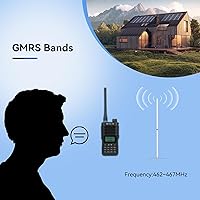
  • Frequency Range: Covers 462–467MHz, which is the full UHF GMRS band used in the United States.
  • Gain: Rated at 7.2dBi on UHF and 4.5dBi on VHF, giving a meaningful signal boost over standard stock antennas.
  • VSWR: VSWR is rated below 1.5, indicating efficient power transfer with minimal signal reflection back toward the radio.
  • Impedance: Standard 50-ohm impedance, compatible with virtually all GMRS radios, repeaters, and coaxial cable setups.
  • Max Power Input: Handles up to 200 watts of continuous input power, making it suitable for full-duty repeater station operation.
  • Connector Type: Uses an SL16-K connector (also known as PL-259), which is an industry-standard fitting widely available in adapter and coax configurations.
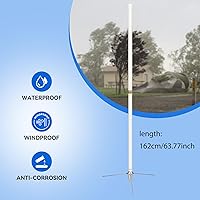
  • Radome Material: The outer housing is constructed from three sections of white fiberglass, chosen for its durability and resistance to UV exposure and weathering.
  • Internal Conductor: An internal copper rod connects the three fiberglass sections, reducing resistive power loss compared to lower-grade conductor materials.
  • Beam Pattern: Omnidirectional with a full 360-degree horizontal beam width, broadcasting and receiving signal equally in all directions.
  • Length: Assembled antenna measures 63.77 inches (approximately 5.3 feet), requiring a dedicated mast or mounting pole for proper installation.
  • Weight: Weighs approximately 2.84 lbs, which should be factored into the load rating of any mast or bracket used for mounting.
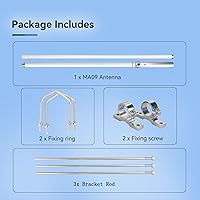
  • Mounting Hardware: Package includes two fixing rings and two fixing screws to secure the antenna to a standard mast or pole.
  • Compatibility: Confirmed compatible with Retevis RT97, BTECH, Midland, Motorola, and Wouxun KG-935G GMRS radios and repeater base stations.
  • Warranty: Covered by a one-year manufacturer warranty, with a 30-day no-questions return window and ongoing paid maintenance support after the warranty period.
  • Package Contents: Box includes one MA02 antenna, two fixing rings, and two fixing screws — coaxial cable and mast are not included.

Related Reviews
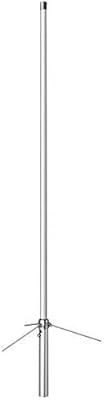
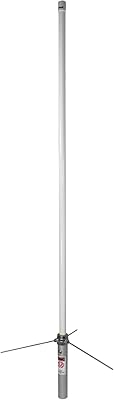
Diamond Antenna X30A Dual-Band Base Antenna
80%
91%
Signal Performance
88%
Build Quality
86%
Weatherproofing
84%
Ease of Installation
89%
SWR Consistency
More
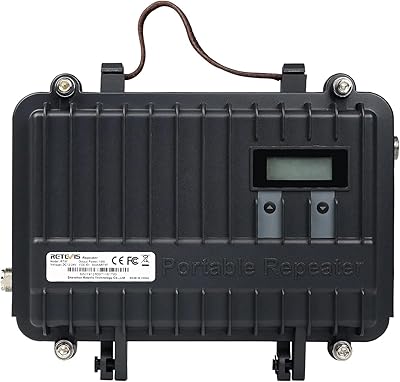
Retevis RT97 GMRS Radio Repeater
76%
83%
Range Extension Performance
76%
Ease of Setup
88%
Build Quality & Durability
91%
Full-Duplex Operation
71%
LCD Display Usability
More
Retevis RA86 GMRS Mobile Radio
85%
88%
Performance
91%
Audio Clarity
85%
Ease of Use
93%
NOAA Weather Alerts
65%
Installation Complexity
More
Retevis RA25 GMRS Mobile Radio
82%
91%
Audio Clarity
89%
Transmission Range
87%
Channel Versatility
84%
Ease of Installation
79%
Build Quality
More
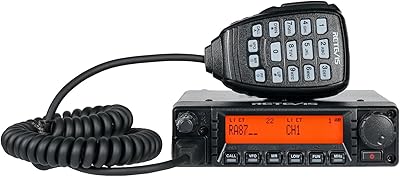
Retevis RA87 GMRS Mobile Radio
78%
88%
Transmit Power
84%
Repeater Channel Support
86%
Audio Clarity
83%
Ease of Installation
81%
CHIRP Compatibility
More
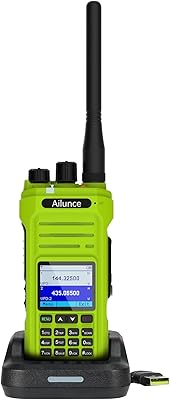
Retevis HA1G GMRS Handheld Radio
79%
83%
Build Quality
88%
Waterproofing
86%
Battery Life
81%
Range & Repeater Performance
71%
Audio Clarity
More
UAYESOK UA-CB6200 20ft CB Base Station Antenna
74%
83%
Signal Performance
78%
SWR & Tuning
74%
Build Quality
86%
Ease of Installation
81%
Weather Resilience
More
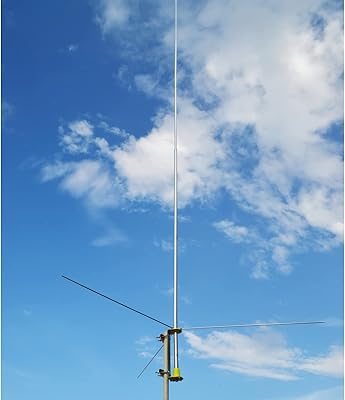
Tram 1477 Dual-Band VHF/UHF Base Antenna
79%
91%
Ease of Setup
78%
RF Performance
83%
Build Quality
86%
Value for Money
67%
Connector Quality
More
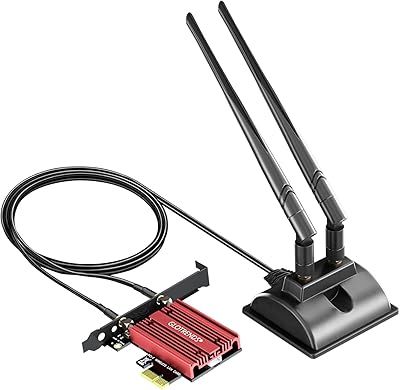
GLOTRENDS BE200 Wi-Fi 7 PCIe Card
77%
88%
Wireless Performance
76%
Installation Ease
53%
Compatibility Clarity
91%
Antenna Design
74%
Bluetooth Reliability
More
UAYESOK VHF Marine Base Antenna 48 Inch
87%
87%
Performance at Sea
92%
Durability in Harsh Conditions
91%
Installation Ease
89%
Signal Range and Clarity
85%
Compatibility with Marine Radios
More

FAQ

Yes. GMRS frequencies in the United States require an FCC GMRS license, which covers your entire household. The antenna itself is just hardware, but the radio equipment it connects to cannot be legally operated on GMRS frequencies without that license in place. The good news is the FCC license is straightforward to obtain and does not require a test.

Yes, it is a direct and well-matched fit for the RT97. The SL16-K connector is compatible, the frequency range lines up perfectly with GMRS channels, and numerous RT97 owners have used it as a stock antenna upgrade. You will still need a quality coaxial cable to connect the two, which is sold separately.

Because the assembled antenna is just under 5.3 feet long and weighs nearly 3 pounds, you really need a solid mast or pipe mount — not a lightweight camera tripod or improvised bracket. A standard 1-inch to 1.5-inch diameter mast works well with the included fixing rings. The higher you can safely mount it with a clear sky view, the better your coverage will be.

No, coaxial cable is not included. You will need to source your own cable with PL-259 (UHF) connectors on both ends. Cable quality matters here — low-loss coax like LMR-400 is worth the investment for a permanent outdoor installation, since a cheap cable can quietly eat up a significant portion of your signal before it ever reaches the antenna.

The Retevis MA02 7.2dBi GMRS Base Antenna focuses your signal toward the horizon rather than wasting it toward the sky or ground, which is what higher dBi gain actually means in practice. Most users report a noticeable improvement in how far their repeater can reliably reach, though the exact gain depends heavily on terrain, elevation, and what you are running on the other end of the link. It is not a magic fix — a good installation location matters just as much as the antenna itself.

Technically you can, but you will give up a lot of its potential. Building materials, metal roof components, and nearby walls all absorb and scatter UHF signals. The manufacturer specifically notes that metal-rich environments negatively affect the antenna's standing wave ratio. For best results, an outdoor rooftop or elevated pole mount in open air is strongly recommended.

Assembly is straightforward and most users do not report issues. That said, the connector joints between sections do need to be properly seated and tightened during setup. A poorly made connection at any joint can introduce signal loss or a degraded VSWR reading. Take your time during initial assembly and you should have no ongoing problems.

In simple terms, it means the antenna is well-matched to your radio or repeater, so most of the power your transmitter puts out actually gets radiated into the air rather than being reflected back. High VSWR can cause heat buildup in your radio and reduced range. A rating below 1.5 is considered good for this type of antenna and frequency range.

Yes, this repeater antenna is compatible with BTECH GMRS equipment. The frequency range, impedance, and connector type all align with what BTECH units require. Many BTECH users buy this as an upgrade over the included antenna when they want more coverage from their base station setup.

Retevis states that they continue to offer maintenance support beyond the warranty window, though repair costs after that point fall on the buyer. For most users, the fiberglass construction is durable enough that long-term failure is not a common complaint. That said, keeping the connector sealed and protected from moisture is the most important thing you can do to extend the antenna's working life outdoors.