Overview

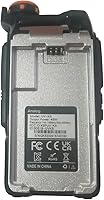
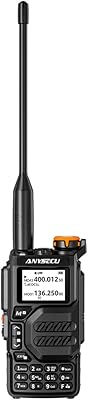
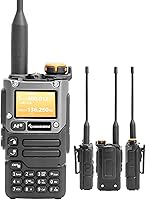
The Quansheng UV-K5(8) Dual-Band Walkie-Talkie arrived in 2023 and quickly built a reputation as something far more interesting than a basic two-way radio — it's a surprisingly capable amateur radio packed into a 7 oz shell. This Quansheng handheld radio charges via Type-C, which feels like a genuine quality-of-life upgrade at this price point. Firmware updates are actively supported, and a thriving open-source community has wrapped CHIRP compatibility around it, unlocking a level of customization that most budget radios can't touch. That said, go in with honest expectations: this rewards users who are comfortable programming channels and reading a manual, not those looking for a plug-and-play FRS walkie-talkie.
Features & Benefits

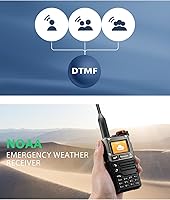
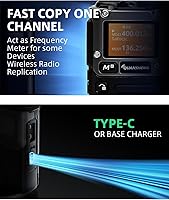
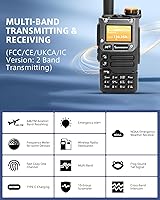
What separates the UV-K5(8) from most budget handhelds is raw frequency coverage. It receives across the AM aviation band, pulls in FM broadcast stations, and handles VHF/UHF two-way comms — all in one device you can palm in one hand. NOAA weather alerts are built in, which matters when you're deep on a trail and a storm rolls in without warning. The 200-channel memory and one-touch flash replication let you copy a frequency off the air on the spot, skipping tedious manual entry. DTMF signaling supports repeater operation, and the dual-watch LCD keeps two frequencies visible simultaneously. Boot password protection rounds out a spec sheet that punches well above what this price tier usually offers.

Best For

This dual-band transceiver really shines in the hands of licensed amateur radio operators and curious hobbyists who enjoy pushing hardware beyond its defaults — CHIRP compatibility makes that easier than you'd expect. Hikers, campers, and cyclists who want live NOAA weather updates alongside two-way communication will find real utility here. Preppers stocking a go-bag also get solid value for the investment. Beginners are welcome, but plan for a learning curve: channel programming without CHIRP takes real patience. Two honest caveats: this radio has zero water resistance, so wet conditions are genuinely risky, and transmitting on most frequencies requires a valid amateur license. It's not built for unlicensed FRS/GMRS use, and that distinction matters legally.

User Feedback

Sitting at 4.5 stars across more than 650 ratings, this Quansheng handheld radio earns its marks — buyers consistently highlight audio clarity and the remarkably broad receive coverage as standout qualities. The included earphones and Type-C charging cable also draw praise as useful inclusions that don't feel like afterthoughts. The criticisms are fair and worth noting: channel programming is the most common frustration, particularly for buyers who skip CHIRP and attempt manual entry. Water resistance — or rather its total absence — surfaces regularly in outdoor-use reviews, which is a legitimate concern. A small but notable segment also flag the licensing requirement for transmitting; operating on ham frequencies without an amateur license isn't just inadvisable, it's illegal. Know the rules before you key up.

Pros

  • Exceptionally broad frequency reception — AM aviation, FM broadcast, and VHF/UHF two-way all in one compact unit.
  • Built-in NOAA weather alerts add real safety value for hikers and campers with no extra cost or hardware.
  • CHIRP-compatible firmware makes channel programming far less painful than manual entry, especially for new users.
  • Active firmware update support means the UV-K5(8) keeps improving after purchase, unlike most budget radios.
  • 200-channel memory with one-touch flash replication speeds up field programming significantly.
  • Type-C charging is a practical modern convenience that competing budget handhelds still often skip.
  • DTMF signaling and dual-watch LCD give it repeater-compatible functionality well above its price tier.
  • Strong open-source community means tutorials, firmware builds, and troubleshooting help are widely available.
  • Earphones and charger included out of the box — genuinely useful accessories, not filler.
  • Boot password protection adds a basic but thoughtful layer of security absent on most rival budget units.

Cons

  • No water resistance whatsoever — a real liability for a radio sold as an outdoor companion.
  • Transmitting legally on most supported frequencies requires an FCC amateur license; unlicensed use carries regulatory risk.
  • Manual channel programming without CHIRP is tedious and error-prone, especially for first-time buyers.
  • Advertised 10 km range is a best-case figure; real-world performance in forests or urban areas is considerably shorter.
  • The sheer number of menu settings and function options can overwhelm users who just want to communicate quickly.
  • No FRS or GMRS pre-programmed channels means this dual-band transceiver is not a drop-in replacement for consumer walkie-talkies.
  • Build quality, while acceptable, lacks the tactile confidence of mid-range units costing significantly more.
  • Antenna performance at the stock level is modest; serious users often find an aftermarket antenna necessary for better range.

Ratings

Our AI rating engine analyzed hundreds of verified global purchases of the Quansheng UV-K5(8) Dual-Band Walkie-Talkie, actively filtering out incentivized, bot-generated, and outlier reviews to surface what genuine buyers actually experienced. Scores below reflect a balanced picture — standout strengths and real frustrations weighted equally — so you can make a confident, eyes-open decision before buying.

Value for Money
93%
Few radios at this price point come close to matching the raw feature density the UV-K5(8) delivers. Buyers consistently express genuine surprise at what they get — wide-band receive, DTMF, 200 channels, NOAA, and Type-C charging all bundled together. For amateur radio hobbyists and preppers on a tight budget, the value calculus is hard to argue with.
The value equation shifts if you factor in the hidden costs some buyers encounter — a dedicated programming cable, a better aftermarket antenna, or time spent troubleshooting firmware. Users who need a licensed exam before they can legally transmit also face an additional cost and effort barrier that the sticker price does not reflect.
Frequency Coverage
91%
The breadth of what this dual-band transceiver can receive is genuinely uncommon at this tier — AM aviation, wideband FM broadcast, VHF/UHF two-way, and NOAA weather all in a single unit. Aviation enthusiasts and scanner hobbyists in particular call this out as a major draw, appreciating that they can monitor airport traffic passively while hiking or camping.
Wide receive coverage does not equal wide transmit legality. Several buyers discovered after purchase that most of the TX-capable frequencies require an FCC amateur license, which came as an unwelcome surprise. The radio itself imposes no technical limits on what it can transmit, which puts the compliance burden entirely on the user.
Firmware & Software Support
88%
Active firmware development is one of the strongest differentiators this Quansheng handheld radio has over similarly priced competitors. Community-built firmware versions have added meaningful functionality improvements, bug fixes, and new receive modes well after the factory release. CHIRP compatibility means channel management is handled through a familiar, well-documented open-source tool rather than a proprietary app.
Firmware updates are not beginner-friendly — flashing requires the right cable, the right software version, and careful attention to community-specific instructions. A small number of users reported bricking their unit by following outdated guides, which is a real risk for anyone who rushes the process without verifying they are using current, model-specific documentation.
Ease of Setup
44%
56%
Buyers who arrive with some prior experience from radios like the Baofeng UV-5R typically find the UV-K5(8) familiar enough to navigate quickly. The one-touch flash replication feature is a genuine time-saver for copying frequencies in the field, and CHIRP dramatically reduces the pain of bulk channel entry once the software connection is established.
Manual programming through the keypad alone is genuinely painful — the menu structure is dense, abbreviations are cryptic, and the included user manual is not well-translated or comprehensive. First-time radio buyers without prior ham experience consistently rank setup as their biggest frustration, and several reviewers noted it took multiple evenings before the radio felt usable.
Audio Quality
77%
23%
Voice clarity during two-way communication draws consistent praise, particularly for buyers using the radio on hiking trails and at campsites where crisp audio matters for safety. The receive audio is described as loud and clean enough to hear through wind noise, which is more than can be said for many budget handhelds in this category.
The stock speaker volume can distort slightly at maximum output, which a handful of users noticed in quiet indoor environments. Audio quality during FM broadcast reception is serviceable but noticeably compressed compared to dedicated portable FM radios, so buyers expecting hi-fi listening will be underwhelmed on that front.
Build Quality
66%
34%
The physical build is sturdy enough for typical outdoor use — the chassis feels reasonably solid in hand, and the buttons have a satisfying tactile click without feeling cheap. For the price, most buyers consider the construction acceptable, and the compact dimensions make it easy to carry clipped to a pack strap or belt.
Compared to mid-range alternatives costing two or three times more, the plastic shell feels noticeably lightweight and the antenna connection can develop minor play with heavy use. There are no gaskets or reinforced seals anywhere on the unit, so even light rain exposure carries real risk of internal damage over time.
Battery Life
73%
27%
Under typical mixed use — some transmitting, mostly scanning and receive — the included lithium-ion pack comfortably gets most users through a full day in the field. Hikers on day trips and preppers running occasional radio checks report rarely needing a mid-day charge, which is solid performance for a 7.1V pack at this price.
Heavy transmit use drains the battery noticeably faster, and buyers who use the radio for extended two-way communications during events or emergencies report needing a recharge before the day is out. The battery is a proprietary form factor, so carrying a spare requires sourcing a Quansheng-specific replacement rather than a standard cell.
NOAA Weather Reception
83%
NOAA reception performs reliably across all seven standard weather frequencies, and buyers who use the radio for backcountry hiking and camping consistently cite this as a feature they actually use, not just a checkbox. The ability to save a local NOAA frequency as a dedicated channel makes it immediately accessible without manual tuning each time.
Reception quality in low-signal areas — deep valleys, dense urban environments, or locations far from a NOAA transmitter — can be inconsistent. A few users in rural areas noted that the stock antenna struggled to pull in a clean weather signal and that an upgraded antenna improved reliability meaningfully.
Range Performance
58%
42%
In open, unobstructed environments — flat fields, open water, or elevated terrain — the UV-K5(8) performs respectably at 5W output and can achieve distances that satisfy most outdoor recreational users. Buyers who use repeater infrastructure also report significantly extended effective range, which is a practical option for licensed operators in areas with repeater coverage.
The advertised 10 km range is a theoretical ceiling that real-world conditions almost never replicate. In forests, hilly terrain, and urban areas, users routinely report reliable range of 1–2 km at best with the stock antenna. This is not unusual for a 5W handheld, but the gap between marketing claims and field reality frustrates buyers who take the spec at face value.
Display & Interface
71%
29%
The LCD dual-watch display is functional and readable in most lighting conditions, giving users a clear view of both active frequencies simultaneously. Buyers who use the radio during outdoor activities appreciate being able to monitor a calling frequency and a NOAA channel at the same time without menu-diving.
The display is not backlit brightly enough for easy reading in direct sunlight, and the overall UI logic takes time to internalize. Menu navigation requires memorizing a non-intuitive sequence of button presses, and the lack of a rotary encoder — common on pricier radios — makes frequency adjustment slower than it needs to be.
Portability
86%
At 7 oz and with a compact footprint, the UV-K5(8) is genuinely easy to carry for extended periods. Hikers and cyclists report that it clips securely to a shoulder strap or backpack hip belt without adding noticeable weight or bulk, which makes it a practical companion on longer trips where gear weight is a real consideration.
The included belt clip, while functional, feels plasticky and a few users report it loosening over time with regular attachment and removal. There is no built-in carabiner loop or soft holster in the box, so buyers who want more secure carry options will need to source third-party solutions.
Accessory Quality
68%
32%
Quansheng includes a more complete accessory kit than most competitors at this price — earphones, belt clip, both a Type-C cable and a dedicated charger, and a manual are all in the box. The earphones in particular receive positive mentions for being genuinely usable rather than the throwaway quality common with budget radio bundles.
The stock antenna is the most commonly upgraded accessory for a reason — it performs adequately but leaves real receive and transmit performance gains on the table. The battery charger is basic and slow compared to faster third-party options, and the user manual is a bare-minimum translation that leaves many functions underdocumented.
Water Resistance
11%
89%
There is very little to say positively here — the radio does have a sealed battery compartment that provides minimal incidental protection against dust, and buyers who store it carefully in a waterproof pouch report no weather-related failures during outdoor use.
The UV-K5(8) has zero official water or weather resistance rating, full stop. For a radio positioned as a hiking and camping companion, this is a meaningful gap. Multiple reviewers report unit failures after rain exposure, and the lack of even basic splash resistance means outdoor users must always plan for protective storage, adding inconvenience and risk.
DTMF & Repeater Use
79%
21%
Licensed amateur radio operators who use local repeater infrastructure find DTMF signaling works reliably and opens up a significant practical communication range extension beyond the radio's direct line-of-sight limits. Buyers active in amateur radio clubs and emergency communication groups note that repeater access transforms the UV-K5(8) from a short-range handheld into a genuinely versatile field radio.
DTMF functionality requires some prior knowledge to configure correctly, and the manual provides limited guidance on tone setup and repeater offset programming. Buyers without an amateur license or repeater access will find this feature irrelevant, and the learning curve for getting repeater tones correctly configured trips up a notable share of intermediate users.
Community & Documentation
87%
The UV-K5(8) benefits from one of the more active online communities surrounding any budget handheld radio — dedicated forums, YouTube guides, GitHub firmware repositories, and CHIRP wiki pages collectively make it far easier to own and operate than the included documentation suggests. Buyers who tap into community resources consistently report a much smoother experience.
Community-sourced documentation is not always up to date, and the volume of conflicting firmware versions and programming guides can overwhelm new users trying to determine the right steps for their specific unit revision. Official Quansheng support documentation in English remains thin, which means buyers are ultimately dependent on volunteer-maintained resources.

Suitable for:

The Quansheng UV-K5(8) Dual-Band Walkie-Talkie is a strong pick for licensed amateur radio operators who want a capable, customizable handheld without spending a lot — think of it as a Baofeng UV-5R with a broader feature set and a more active development community behind it. Outdoor enthusiasts who spend serious time hiking, backpacking, or camping will appreciate the built-in NOAA weather reception, which can be a genuine safety asset when conditions change fast and cell service is gone. Preppers and emergency-communications hobbyists building a versatile kit on a budget will find the wide-band receive coverage, 200-channel memory, and DTMF signaling unusually capable for the price. Tech-curious beginners who are willing to put in the time to learn CHIRP programming and understand basic radio concepts can absolutely get real value here — the community support and open firmware ecosystem mean you are rarely stuck without guidance. If you enjoy tinkering, this dual-band transceiver rewards that instinct in ways most radios at this price point simply do not.
Not suitable for:

Anyone expecting to unbox this radio and start transmitting without any setup or licensing knowledge should look elsewhere. The UV-K5(8) is not an FRS or GMRS radio — transmitting on most of its supported frequencies legally requires an FCC amateur radio license, and using it without one carries real regulatory risk that no buyer should take lightly. Families wanting a simple set of walkie-talkies for a ski trip or a theme park will find the setup process frustrating and the legal considerations unnecessarily complicated. Users who need any degree of water or weather resistance should also think twice; this Quansheng handheld radio has zero waterproofing, which is a meaningful gap for a device marketed toward outdoor use in unpredictable conditions. Finally, if you need a guaranteed long communication range, manage expectations carefully — real-world performance varies significantly based on terrain, obstacles, and antenna quality, and the theoretical 10 km figure assumes near-ideal open conditions most users will rarely encounter.

Specifications

  • Brand & Model: Manufactured by Quansheng Electronics Co. Ltd under the model designation UV-K5(8), with FCC ID XBPUV-K5.
  • Transmit Power: Peak output power is 5W, with a maximum transmit current draw of 1.5A.
  • Channel Memory: Supports up to 200 programmable channel memory slots with one-touch flash replication for fast field entry.
  • TX/RX Bands: Dual-band VHF/UHF transceiver supporting two-way transmission and reception across a wide sub-GHz frequency range.
  • AM Reception: Receives AM signals across the aviation band from 108 to 135.9975 MHz at a reference sensitivity of -113 dBm.
  • FM Reception: Receives wideband FM broadcast stations from 76 to 108 MHz at a reference sensitivity of -110 dBm.
  • NOAA Weather: Built-in NOAA weather band reception provides real-time alert monitoring for outdoor and emergency preparedness use.
  • Display: LCD screen with dual-watch capability allows simultaneous monitoring of two separate frequencies.
  • DTMF Signaling: Full DTMF tone signaling is supported, enabling compatibility with repeaters and select emergency communication systems.
  • Dimensions: The unit measures 1.48″D x 4.53″W x 1.48″H, making it a compact handheld suitable for belt or pack carry.
  • Weight: Complete unit weighs approximately 7 oz (200 g), keeping it light enough for extended outdoor carry.
  • Battery: Powered by an included 7.1V lithium-ion rechargeable battery pack rated for one cell.
  • Charging: Charges via an included 1 m Type-C direct charge cable, and a separate battery charger (0.74 m) is also included.
  • Water Resistance: The UV-K5(8) carries no water or weather resistance rating and should be kept away from rain, moisture, and immersion.
  • Firmware: Supports over-the-air and PC-based firmware updates and is fully compatible with CHIRP open-source programming software.
  • Security: A boot password protection feature provides a basic access-control layer not commonly found on competing budget radios.
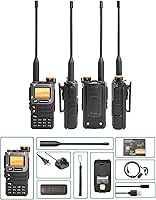
  • In-Box Contents: Package includes the radio unit, Li-ion battery, antenna, belt clip, battery charger, Type-C cable, earphones, and a user manual.

Related Reviews

ANYSECU UV-K5 Air Band Walkie Talkie
82%
88%
Range & Performance
92%
Weather Alert Feature
75%
Ease of Use
83%
Build Quality & Durability
89%
Portability & Size
More
Baofeng UV-32 GPS Ham Two-Way Radio
72%
88%
Value for Money
81%
GPS Accuracy
74%
Bluetooth App & Programming
67%
APRS Functionality
62%
Audio Quality
More
Baofeng UV-21R Dual Band Ham Radio
75%
91%
Value for Money
68%
Build Quality
54%
Transmission Range
83%
Display & Interface
88%
Charging Convenience
More
Rockville DV8K52 Dual 8″ Enclosed Subwoofer System
74%
83%
Bass Output & Punch
76%
Build Quality
88%
Value for Money
91%
Ease of Installation
62%
Amplifier Compatibility
More
BTECH UV-50X2 Second Gen Mobile Radio
73%
88%
Transmission Performance
84%
Audio Clarity
79%
Build Quality
51%
Ease of Setup
47%
User Interface & Menu
More
BaoFeng UV-82HP Dual Band Ham Radio
74%
91%
Value for Money
88%
Signal Output & Range
83%
Audio Clarity
79%
Build Quality & Durability
74%
Battery Life
More
Baofeng BF-F8HP 8-Watt Dual Band Two-Way Radio
72%
88%
Signal Strength & Range
86%
Battery Life
74%
Build Quality & Durability
67%
Audio Clarity
52%
Ease of Programming
More
BTECH UV-PRO Dual Band Two-Way Radio
79%
86%
Build Quality
88%
Waterproofing & Durability
78%
Bluetooth App Integration
81%
APRS & GPS Performance
67%
Range & Signal Clarity
More
Rockville Rock Party 8 Dual 8″ Bluetooth Speaker
83%
87%
Sound Quality
82%
Battery Life
75%
Portability
90%
Ease of Use
80%
Build Quality
More
CT Sounds MESO-8-D4 8-Inch Car Subwoofer
79%
84%
Bass Output & Impact
88%
Build Quality
86%
Voice Coil Durability
91%
Value for Money
77%
Amplifier Compatibility
More

FAQ

Yes, for almost all practical uses. The UV-K5(8) can transmit on VHF and UHF frequencies that fall under FCC Part 97, which requires a valid amateur (ham) radio license. Operating without one on those frequencies is illegal under US federal law. If you have not already passed your Technician class exam, that is the right first step before using this radio for transmitting.

It depends on how you approach it. Manual programming through the keypad is possible but genuinely tedious, especially if you need to load more than a handful of channels. The far better path is using CHIRP, which is free, open-source software that connects the radio to your PC and lets you manage channels in a spreadsheet-style interface. Most users who set aside an evening to learn CHIRP find it straightforward; those who skip it often end up frustrated.

Honestly, it is not the right tool for that. Consumer FRS walkie-talkies are purpose-built for unlicensed, plug-and-play use. This Quansheng handheld radio requires a license for most of its transmit frequencies, has no pre-programmed FRS/GMRS channels out of the box, and needs manual setup before it works. For casual family use, a dedicated FRS radio pair is a simpler and legally cleaner choice.

The 10 km figure cited by the manufacturer assumes ideal, open conditions — flat terrain with no obstructions, which almost never happens in practice. In dense forest, hilly terrain, or urban environments, you can realistically expect somewhere between 1 and 3 km for reliable communication. Range also depends on antenna quality, local RF interference, and whether you are using repeaters. The stock antenna is decent but not exceptional; an aftermarket upgrade can help.

Yes, the UV-K5(8) is supported by CHIRP and has been for some time, though you may need to ensure you have a recent version of the software installed, since early builds did not include support for this model. You will also need a compatible programming cable — the Type-C data cable included in the box works for charging, but a dedicated USB programming cable is typically required for CHIRP connectivity.

Yes, and it works reliably. The Quansheng UV-K5(8) Dual-Band Walkie-Talkie receives NOAA Weather Radio broadcasts, which operate on seven dedicated VHF frequencies between 162.400 and 162.550 MHz. You can tune to your local NOAA station manually or save it as a channel. It is a genuinely useful feature for hiking and camping, especially in areas prone to sudden weather changes.
No, not at all. The UV-K5(8) has no water resistance rating whatsoever — no IP rating, no splash protection, nothing. For an outdoor radio, that is a real limitation worth taking seriously. If you plan to use it in rain, near water, or in humid conditions, you will want to carry it in a waterproof pouch or dry bag as a precaution.

Firmware updates are loaded via a PC connection and the appropriate flashing tool. The Quansheng community has produced several custom firmware builds that add features, fix bugs, and extend functionality beyond the factory defaults — some users consider this one of the best reasons to choose this radio over alternatives. It is worth doing, but approach it carefully: always back up your settings first and follow community-verified instructions to avoid bricking the unit.

The box includes the radio, a lithium-ion battery pack, an antenna, a belt clip, a battery charger, a Type-C charging cable, a pair of earphones, and a user manual. The earphones are basic but functional for monitoring audio in noisy environments. The Type-C cable is a welcome inclusion that feels current compared to older micro-USB setups on rival budget radios. Nothing in the box is exceptional, but it is a complete starter kit with no obvious omissions.

Both sit in a similar budget tier and serve a similar audience, so it is a fair comparison. The UV-K5(8) generally offers broader frequency receive coverage, a more modern Type-C charging port, and an arguably more active firmware development community. The UV-5R has a longer track record and wider name recognition, which means more tutorials and accessories are available. For someone just getting into amateur radio, either can work — but the UV-K5(8) arguably gives you more to grow into if you enjoy tinkering.