Overview

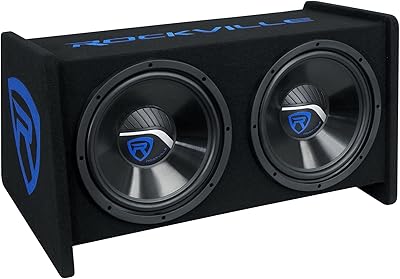
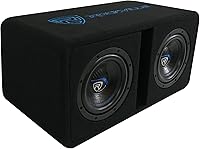
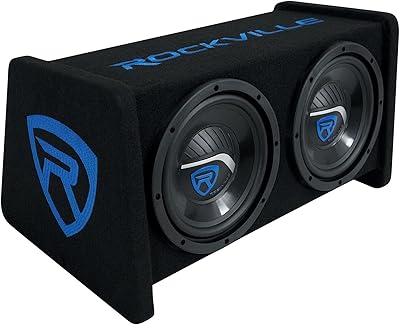
The Rockville DV8K52 Dual 8″ Enclosed Subwoofer System is a ready-to-drop-in bass solution built for drivers who want a real upgrade without the hassle of sourcing drivers, building a box, and tuning ports from scratch. At its price point, it sits in an interesting spot — cheaper than premium branded enclosed systems, but noticeably more finished than most DIY attempts at the same budget. One thing to understand upfront: the advertised 1600W is peak, not continuous. The actual working figure is 400W RMS combined, which is honest for this class. The 2-ohm final load also means your amplifier choice matters — not every amp handles 2 ohms well, so check your specs before buying.
Features & Benefits

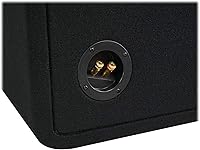
The enclosure itself is the foundation of this system's value. Rockville used 3/4-inch MDF throughout, and the port angle is computer-modeled rather than guessed — that matters for keeping bass tight and avoiding the one-note boominess common in cheap ported boxes. Each of the two 8-inch drivers carries a 30 oz magnet and a 1.5-inch 4-layer voice coil wound with OFC copper wire, which handles heat better than standard copper alternatives during extended listening sessions. The fiber-reinforced paper cones are stiffer than typical non-pressed designs, which tightens transient response. Gold-plated push terminals round things out, making wiring clean and secure without needing specialized connectors.

Best For

This vented sub box is a natural fit for daily commuters who want more bass presence on the road but aren't looking to build a custom install. If your trunk can handle a footprint of roughly 24 by 15 by 12 inches and 42 pounds, you're most of the way there. The most important pairing consideration is your amplifier: you need one that's stable at 2 ohms, ideally rated between 200 and 500W RMS. Push it with an oversized amp and you'll clip before you get clean output. It's not built for SPL competition, but against a single 10-inch sealed setup, the dual-driver configuration generally wins on output and extension.

User Feedback

Buyers generally come away pleased with the bass output for the price, with many noting it hits harder than expected for a pair of 8-inch drivers in a budget box. Installation ease is a recurring highlight — most owners had it wired and in the trunk within an hour. That said, quality control gets flagged occasionally, with isolated reports of rattling enclosures or voice coil issues arriving out of the box. A handful of buyers also ran into amp matching problems, discovering too late that their amplifier wasn't rated for a 2-ohm load. Against comparable dual-sub enclosures in the same price range, the Rockville DV8K52 holds its ground, though long-term durability remains the main open question.

Pros

  • Arrives fully assembled and tuned, saving hours of DIY box-building time.
  • Dual 8-inch drivers in a ported enclosure deliver more output than a single comparably priced sub.
  • 3/4-inch MDF construction feels solid and resists the flex that plagues cheaper enclosures.
  • OFC copper voice coils handle extended listening sessions without overheating as quickly as standard alternatives.
  • Gold-plated push terminals make wiring clean and secure even for first-time installers.
  • At 42 pounds, it is heavy enough to stay planted in a trunk without extra securing hardware in most setups.
  • Computer-modeled port tuning reduces the one-note boom common in budget ported boxes.
  • Compact footprint relative to output makes it practical for smaller vehicles with limited cargo space.
  • The 4.3-star average across over 100 ratings suggests consistent satisfaction at this price tier.

Cons

  • The 2-ohm final load requires a specifically rated amplifier, which adds cost if you do not already own one.
  • Isolated quality control issues, including rattling panels and occasional driver defects, have been reported by buyers.
  • Peak wattage marketing can mislead buyers who do not understand the 400W RMS working limit.
  • Port tuning prioritizes mid-bass punch over deep sub-bass extension, which may disappoint fans of low-frequency rumble.
  • At 42 pounds, repositioning or removing the enclosure solo is awkward and physically demanding.
  • Long-term durability beyond the first year has not been widely confirmed given the product's age and review volume.
  • Rockville's customer support reputation is inconsistent, making warranty claims a potential frustration.
  • The enclosure offers no built-in amplification, so total system cost rises once an amp is factored in.

Ratings

The scores below are generated by AI after analyzing verified buyer reviews for the Rockville DV8K52 Dual 8″ Enclosed Subwoofer System from multiple global sources, with spam, bot activity, and incentivized feedback actively filtered out. Each category reflects the honest consensus of real owners — the strengths that keep buyers satisfied and the friction points that show up repeatedly across independent accounts. Nothing is glossed over.
Bass Output & Punch
83%
For daily listening in a compact sedan or small SUV, the dual-driver setup delivers noticeably more punch than a single sub in the same price range. Buyers running hip-hop, EDM, and pop consistently report that the low-end presence is strong enough to feel, not just hear, during highway driving.
The ported tuning prioritizes mid-bass impact over deep sub-bass extension, so below 35Hz the output drops off more than some buyers expected. Those coming from a single quality 12-inch sealed setup often note the low-end sounds fuller in extension, even if less punchy.
Build Quality
76%
24%
The 3/4-inch MDF panels feel genuinely solid and resist the flex and rattle common in cheaper pressed-board enclosures. The gold-plated terminals and satin nickel hardware add a level of fit and finish that most buyers did not expect at this price point.
A recurring minority of buyers have reported hairline gaps at enclosure seams or minor port rattle after a few months of regular use. Rockville's quality control appears consistent enough to satisfy most buyers, but the occasional unit with a loose baffle or poorly sealed joint does reach customers.
Value for Money
88%
Compared to building a comparable dual 8-inch ported box from scratch — sourcing drivers, MDF, port tubes, and terminals separately — this dual-sub enclosure lands well below the DIY equivalent in total cost and effort. Most buyers feel they received more than what they paid for, especially given the included tuning work.
The value calculation changes if you do not already own a 2-ohm stable amplifier, since adding a compatible amp pushes total system cost considerably higher. Buyers who factor in the full amplifier cost sometimes find similarly priced all-in-one powered enclosures more practical.
Ease of Installation
91%
Because the drivers are pre-installed and internally wired, the enclosure side of the install is as simple as connecting speaker wire to the push terminals — a process most first-timers complete in under 30 minutes. Multiple owners with no prior car audio experience reported a successful install on their first attempt.
The 2-ohm impedance requirement creates confusion for buyers new to car audio, and a handful of owners connected the box to an incompatible amplifier before realizing the issue. The enclosure itself provides no guidance on amplifier compatibility, which would have prevented several frustrated returns.
Amplifier Compatibility
62%
38%
For buyers who already own a 2-ohm stable mono amplifier, the pairing process is straightforward and the system performs cleanly within the 200 to 500 watt RMS range. The push terminals accept a wide range of wire gauges, making connections simple regardless of the amplifier brand.
The 2-ohm final load is the single biggest pain point flagged by dissatisfied buyers — many did not realize their existing amplifier was rated only at 4 ohms and experienced either poor output or amplifier shutdown. This incompatibility issue accounts for a disproportionate share of the negative reviews.
Low-Frequency Extension
67%
33%
The computer-modeled port tuning keeps bass response reasonably controlled and avoids the muddy, undefined low-end that plagues cheap ported designs. For everyday music genres, the extension is adequate and enjoyable during both short city commutes and longer highway drives.
Buyers who specifically want deep sub-bass rumble below 30Hz — the kind felt in movie soundtracks or orchestral recordings — find this vented sub box underwhelming in that range. A sealed enclosure with a quality 12-inch driver consistently outperforms it on raw extension.
Enclosure Fit & Sizing
79%
21%
The 24.25″ x 14.75″ x 12″ footprint fits comfortably in most mid-size car trunks and compact truck beds without eliminating all usable cargo space. Buyers in compact SUVs and sedans frequently note they can still carry groceries or luggage alongside the box.
At 42 pounds, moving the enclosure in and out of the vehicle solo is physically awkward, particularly in smaller trunks with narrow openings. A few buyers in subcompact hatchbacks found the enclosure length tight against the rear seat, leaving very little margin for repositioning.
Sound Clarity at Volume
71%
29%
At moderate listening levels, the fiber-reinforced paper cones track the signal cleanly without the softness or mushiness common in standard non-pressed designs. Daily commuters running the system at 60 to 75 percent gain report clean, distortion-free bass that holds up consistently.
Pushed hard with a high-powered amp or played with the gain set aggressively, distortion becomes audible before the drivers reach their thermal limits. This is expected behavior at this price tier, but buyers accustomed to higher-grade drivers may find the ceiling lower than anticipated.
Long-Term Durability
64%
36%
OFC copper voice coils handle sustained heat better than standard copper alternatives, which matters for buyers who run the system daily for extended periods. The majority of owners who have used this vented sub box for six months or more report no mechanical failures or deterioration in output.
The product has a relatively short track record given its 2020 release date and modest review volume, making long-term durability difficult to assess with full confidence. Some owners have noted enclosure seam separation or surround softening after 12 to 18 months of regular use.
Power Handling Honesty
58%
42%
The 400W RMS combined rating is realistic and aligns with what the drivers can sustain without thermal stress under normal daily use conditions. Buyers who do their research understand the RMS figure and report matching their amplifier accordingly without issues.
The 1600W peak figure prominently marketed on the product creates genuine confusion and leads some buyers to pair the box with amplifiers far exceeding the drivers' actual continuous capacity. Several negative reviews stem directly from buyers who clipped or burned the subs by trusting the peak number over the RMS rating.
Enclosure Resonance Control
74%
26%
The 3/4-inch MDF walls do a good job suppressing panel resonance at typical listening volumes, and the Rockville-branded gaskets provide a tight driver-to-baffle seal that prevents air leaks from contributing to rattles. Most buyers report a clean, rattle-free experience under normal conditions.
At high SPL levels or in vehicles with significant road vibration, minor enclosure rattles have been reported — often traced to loose terminal hardware or slightly misaligned port tubes. These are fixable with basic tools, but they should not be present in a new unit.
Terminal & Wiring Quality
82%
18%
Gold-plated push terminals accept both bare wire and pin connectors cleanly, and first-time installers appreciate how securely the wire locks in without requiring crimped connectors or soldering. The terminal housing feels solid and shows no wobble even when wires are tugged during installation.
A small number of buyers noted the push terminals feel slightly undersized for heavier gauge speaker wire, requiring the wire end to be trimmed and thinned before it seats properly. This is a minor inconvenience rather than a functional flaw, but worth knowing if you plan to run thick wire runs.
Packaging & Arrival Condition
73%
27%
Most buyers report the enclosure arriving well-padded and intact, with drivers pre-installed and undamaged. The packaging is robust enough to handle standard parcel carrier handling without the enclosure shifting internally.
A portion of negative reviews cite damage on arrival — corner dents, cracked MDF edges, or loose drivers — suggesting the outer packaging occasionally fails under rough freight handling. Inspecting the unit immediately upon delivery is strongly recommended to keep return options open.

Suitable for:

The Rockville DV8K52 Dual 8″ Enclosed Subwoofer System is built for the kind of buyer who wants a meaningful bass upgrade on a realistic budget without spending a weekend fabricating a custom enclosure. If you drive a compact sedan, a small SUV, or even a mid-size truck with a manageable trunk, this box fits without consuming your entire cargo area. It makes the most sense paired with an amplifier that is rated stable at 2 ohms and delivers somewhere between 200 and 500 watts RMS — buyers in that setup will get clean, consistent output without pushing either the amp or the drivers beyond their comfort zone. First-time car audio upgraders especially benefit here, since the tuning work is already done and the wiring configuration is straightforward. If your priority is noticeably better bass for everyday listening rather than chasing decibel records, this vented sub box checks the right boxes.
Not suitable for:

The Rockville DV8K52 Dual 8″ Enclosed Subwoofer System is not the right call for serious SPL enthusiasts or anyone building a competition-grade system. The 400W RMS combined ceiling is honest but modest, and buyers expecting the headline 1600W peak figure to translate into real-world performance will be disappointed — that number reflects a momentary maximum, not sustained output. Audiophiles chasing tight, articulate low-end extension below 30Hz will also find the ported design too colored for critical listening. Anyone without a 2-ohm stable amplifier already in hand should factor in that additional cost, since using a mismatched amp risks clipping or hardware damage. Larger vehicles like full-size SUVs or vans may also find the dual 8-inch output underwhelming compared to a single quality 12-inch or 15-inch driver in a proper enclosure.
Specifications

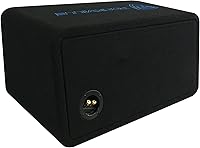
  • Driver Size: Each of the two subwoofer drivers measures 8 inches in diameter.
  • Peak Power: Combined peak power output for both drivers is rated at 1600 watts.
  • RMS Power: Combined continuous (RMS) power handling is 400 watts, which is the figure that matters for real-world amplifier matching.
  • Impedance: The final load is 2 ohms, achieved by wiring the two 4-ohm drivers in parallel inside the enclosure.
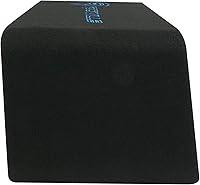
  • Enclosure Type: The box is a vented (ported) design built from 3/4-inch MDF with a computer-modeled port angle for tuned bass alignment.
  • Voice Coil: Each driver uses a 1.5-inch 4-layer aluminum voice coil wound with Japanese oxygen-free copper (OFC) wire for improved heat dissipation.
  • Magnet Weight: Each subwoofer driver is equipped with a 30 oz magnet for strong motor force relative to its size class.
  • Cone Material: Cones are constructed from fiber-reinforced non-pressed paper paired with a thick foam surround to reduce distortion during high-excursion playback.
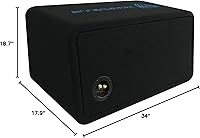
  • Enclosure Size: The enclosure measures 24.25″ long by 14.75″ wide by 12″ tall.
  • Cutout Diameter: Each driver requires a 7.16-inch mounting cutout in the enclosure baffle.
  • Terminals: Wiring connections use gold-plated push terminals with satin nickel hardware for secure, corrosion-resistant contact.
  • Item Weight: The fully assembled enclosure with drivers installed weighs 42.4 pounds.
  • MDF Thickness: All enclosure panels are constructed from 3/4-inch medium-density fiberboard for structural rigidity and reduced resonance.
  • Wiring Config: The two internal 4-ohm drivers are wired in parallel by the manufacturer, presenting a single 2-ohm load to the external amplifier.
  • Brand: Manufactured and sold under the Rockville brand, which specializes in value-oriented car and pro audio equipment.
  • Warranty: The product is covered by a limited manufacturer warranty; buyers should confirm current terms directly with Rockville.
  • Waterproofing: This enclosure is not waterproof and is intended exclusively for dry interior automotive installations.
  • Gasket: A Rockville-branded gasket is included to create a sealed, rattle-free mount between each driver and the enclosure baffle.

Related Reviews
Rockville RV208P Dual 8″ Subwoofer in Vented Enclosure
86%
87%
Bass Performance
90%
Ease of Installation
83%
Sound Clarity at High Volumes
88%
Build Quality
92%
Size and Compactness
More
Rockville RV8.2A Dual 8″ Car Subwoofer Kit
76%
88%
Value for Money
79%
Bass Output & Impact
91%
Ease of Installation
76%
Amplifier Performance
74%
Build Quality
More
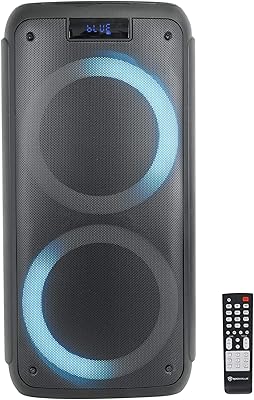
Rockville Rock Party 8 Dual 8″ Bluetooth Speaker
83%
87%
Sound Quality
82%
Battery Life
75%
Portability
90%
Ease of Use
80%
Build Quality
More
CT Sounds TROPO-8-D2 8-Inch Car Subwoofer
77%
91%
Value for Money
83%
Bass Quality
88%
Build Quality
67%
Enclosure Compatibility
71%
Amplifier Pairing
More
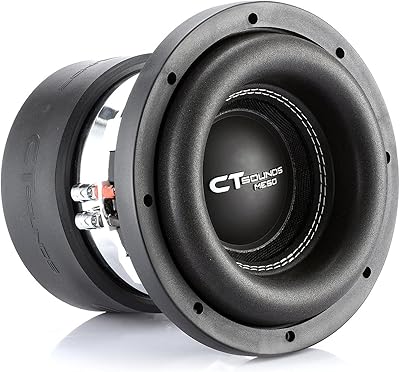
CT Sounds MESO-8-D4 8-Inch Dual 4 Ohm Car Subwoofer
87%
94%
Bass Performance
91%
Build Quality
88%
Sound Clarity at High Volumes
93%
Power Handling
84%
Ease of Integration
More
Rockville RTB80A 8″ Powered Car Subwoofer
69%
88%
Ease of Installation
71%
Bass Output
82%
Value for Money
67%
Build Quality
44%
Power Accuracy
More
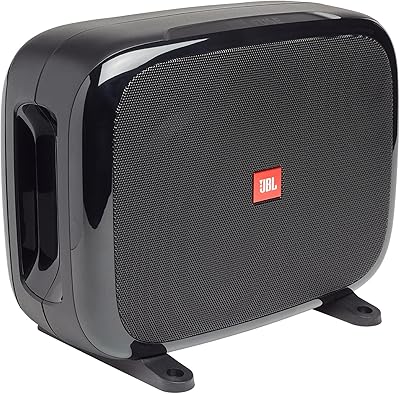
JBL Fuse Dual 8″ Passive Car Subwoofer
72%
78%
Bass Output
71%
Amplifier Compatibility
66%
Build Quality
73%
Value for Money
69%
Ease of Installation
More
Rockville RMW8P 8″ Shallow Car Subwoofer
75%
78%
Bass Output
91%
Space Efficiency
83%
Value for Money
81%
Ease of Installation
62%
Build Quality
More
Rockville Rock Shaker 8″ Powered Subwoofer
75%
83%
Bass Output for Size
88%
Value for Money
91%
Ease of Setup
74%
Build Quality
86%
Connectivity Flexibility
More
Rockville RV1010P Dual 10″ Subwoofer Enclosure
71%
78%
Bass Performance
83%
Ease of Installation
74%
Build Quality
81%
Value for Money
69%
LED Lighting System
More

FAQ

You need an amplifier that is rated stable at 2 ohms, since that is the final impedance the enclosure presents. A mono amplifier delivering between 200 and 500 watts RMS at 2 ohms is the sweet spot — enough to drive the subs cleanly without pushing them past their 400W RMS combined limit. Using an amp that is not 2-ohm stable risks overheating or damage to the amplifier, not just the subs.

It is a peak figure, which represents a brief electrical maximum rather than sustained output. The number that actually matters for day-to-day use is 400W RMS combined across both drivers. When shopping for an amplifier, match to the RMS rating and ignore the peak figure — you will get cleaner, safer performance that way.

It depends on your specific vehicle, but the enclosure dimensions are 24.25″ x 14.75″ x 12″, which is manageable in most mid-size and compact trunks. A hatchback with a fold-down rear seat shelf may be tighter. It is worth measuring your available trunk depth and width before ordering, since at 42 pounds it is not something you want to be returning.

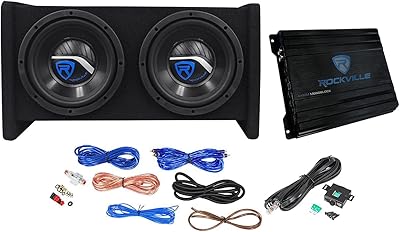
The enclosure arrives with the drivers already installed and internally wired, so the mechanical work is done. What you still need to supply separately is an external amplifier, speaker wire to connect the amp to the enclosure terminals, and all the amplifier wiring (power cable, ground, RCA cables, and remote wire). Think of this box as the speaker half of a two-part system.

Two 8-inch drivers in a ported enclosure generally produce more overall output than a single 10-inch in a sealed box, thanks to the added cone area and the efficiency boost from the ported design. However, a quality sealed 12-inch setup will usually dig deeper into the low frequencies and sound tighter. This vented sub box is the better choice if volume and punch matter more to you than ultra-low extension.

The computer-modeled port tuning keeps it from being the sloppy, one-note bass you get from a poorly designed cheap ported box, but it is not as tight as a sealed enclosure. For hip-hop, EDM, and similar bass-heavy genres it performs well. If you primarily listen to jazz, acoustic, or rock and want precise sub-bass without coloration, a sealed build might suit you better.

A small number of buyers have mentioned isolated issues like slight rattles in the enclosure or driver defects out of the box. These appear to be outliers rather than a systemic problem, given the overall positive rating average. That said, it is worth inspecting the enclosure and testing the drivers as soon as it arrives, while a return or warranty claim is still straightforward to initiate.

No. A head unit does not have nearly enough power output to drive a subwoofer enclosure of this type, and attempting to do so will result in a very weak signal and potentially damage your head unit. A dedicated external amplifier is required for this vented sub box to function as intended.

The subwoofer side of the install is about as straightforward as it gets — you run speaker wire from your amplifier to the gold-plated push terminals on the enclosure and you are done. The more involved part is installing and wiring the amplifier itself, which requires running a power cable from the battery, a ground cable, and RCA signal cables from the head unit. There are plenty of beginner-friendly guides online that walk through exactly that process.

It is possible if the dimensions work out, but at 24.25 inches long and over 40 pounds, under-seat installations are only realistic in full-size trucks with a genuine rear seat cavity. Measure carefully and account for the port on the front face of the enclosure, which needs clearance to breathe properly — blocking the port will noticeably hurt bass output.