Overview

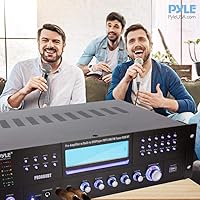
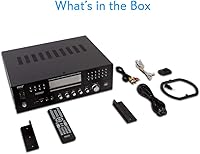
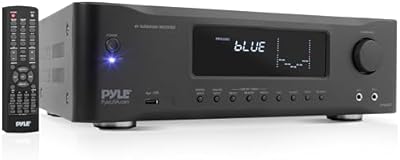
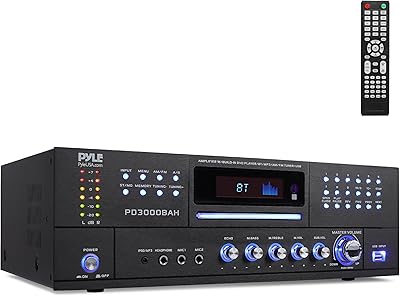
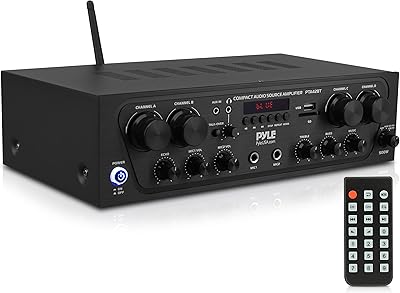
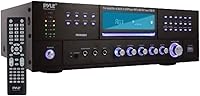
The Pyle PD3000BT.5 4-Channel Bluetooth Stereo Receiver is a budget-friendly, rack-mountable unit built for home entertainers who want one box to handle most of their audio needs. It combines a front-loading CD/DVD player, AM/FM tuner, Bluetooth streaming, and multiple inputs into a single chassis — genuinely useful if you are consolidating gear. One thing worth flagging upfront: the 3000W peak rating is a marketing figure, not a measure of sustained output. Real-world RMS power will be significantly lower, as is standard with value-tier amplifiers. That context matters when sizing speakers. Still, for casual listening rooms and karaoke nights, this Pyle receiver holds its own for the price.
Features & Benefits

What makes this home audio amplifier stand out at this tier is sheer input variety. You get USB, AUX, RCA, optical out, AM/FM, and a front-loading CD/DVD player — all accessible from the front panel or the included remote. The dual microphone inputs with adjustable echo are the clear highlight for karaoke use; plug in two mics and you are ready to host without any extra gear. Physical rotary EQ controls for bass, treble, mic level, and subwoofer let you tune on the fly rather than navigating menus. A dedicated subwoofer RCA pre-out is a welcome touch, and the rack-mount chassis with built-in cooling fan keeps things tidy over extended sessions.

Best For

The PD3000BT.5 is genuinely well-suited to home karaoke setups — that is its strongest use case, and the design choices reflect it. If you are hosting family singing nights or entertaining guests, having two mic inputs and echo built in removes a lot of friction. It also works well for households with existing CD or DVD collections who want Bluetooth capability without replacing their whole system. Small rehearsal rooms or community spaces on a tight budget could find it serviceable as a basic PA solution. That said, this home audio amplifier is not the right fit for audiophiles or large-room installations where accurate, high-output amplification genuinely matters.

User Feedback

Buyers who pick up this Pyle receiver tend to appreciate how quickly it sets up — most report getting it running with speakers within minutes, and the wide input selection earns real praise from users replacing multiple separate devices. Bluetooth pairing is generally described as reliable for everyday use, though range is reportedly average rather than exceptional. Where opinions diverge is on build quality: the plastic chassis feels less substantial than the unit's size suggests, which bothers some buyers more than others. The remote gets mixed marks — functional but inconsistent. A recurring concern is that the advertised wattage creates unrealistic expectations, and buyers should go in knowing actual output is considerably more modest.

Pros

  • Dual mic inputs with adjustable echo make karaoke nights genuinely plug-and-play with no extra gear needed.
  • Covers an unusually wide range of inputs — USB, AUX, RCA, optical, AM/FM, and CD/DVD — in a single unit.
  • Bluetooth pairing is quick and stable for everyday streaming from phones or laptops.
  • Physical rotary knobs for EQ, mic level, and subwoofer make real-time adjustments fast and intuitive.
  • Rack-mountable design with a built-in cooling fan suits semi-permanent entertainment room installations.
  • Setup is straightforward — most users report getting speakers connected and audio playing within minutes.
  • Dedicated subwoofer RCA pre-out lets you add a powered sub without any signal-splitting workarounds.
  • Remote control allows volume and source adjustments from across the room during gatherings.
  • For households still using physical disc media, having a front-loading CD/DVD player built in is a genuine convenience.
  • Represents strong feature density at the price point for buyers consolidating multiple separate audio components.

Cons

  • The 3000W headline figure is a peak rating — real sustained output is considerably lower and should not be used to size speakers.
  • Distortion becomes noticeable when pushed past roughly 60 to 70 percent volume, limiting usefulness in larger spaces.
  • Plastic rear housing feels hollow and inspires little confidence in long-term durability.
  • Remote control has a narrow IR pickup angle, requiring deliberate aim rather than casual pointing from across the room.
  • LCD display washes out in bright lighting and is difficult to read from an angle or from above in rack installations.
  • Bluetooth range degrades noticeably through walls, making it unreliable for open-plan or multi-room use.
  • No HDMI ARC support limits how cleanly this Pyle receiver integrates with modern flat-panel televisions.
  • The onboard EQ adjustment range is narrow — users expecting meaningful tonal reshaping will find the controls subtle at best.
  • Documentation is sparse, leaving users to guess at edge-case configurations like combining optical and speaker outputs simultaneously.
  • Echo effect lacks fine-grained control, producing an artificial quality at higher settings that suits casual fun but not serious vocal use.

Ratings

The Pyle PD3000BT.5 4-Channel Bluetooth Stereo Receiver was evaluated by our AI rating system after analyzing verified buyer reviews from multiple global sources, with spam, bot-submitted, and incentivized feedback actively filtered out. Scores reflect the honest distribution of real user experiences — strengths and frustrations alike — weighted by review depth and purchase verification. This Pyle receiver earns strong marks where it counts for its target audience, but several categories reveal the trade-offs that come with value-tier audio hardware.
Value for Money
78%
22%
For buyers who want a single unit covering Bluetooth, karaoke, CD playback, and multi-speaker amplification, the price-to-feature ratio is hard to argue with at this tier. Most users feel they got more functionality than expected for the spend, particularly when comparing against buying separate components.
If your expectations are shaped by the 3000W headline figure, disappointment is almost guaranteed. The realistic usable output is a fraction of that peak claim, and some buyers feel the marketing sets them up for a letdown before they even plug it in.
Karaoke Performance
83%
This is where the PD3000BT.5 genuinely delivers. The dual mic inputs with adjustable echo make hosting karaoke nights straightforward — plug in two microphones, dial in the echo level, and the room is ready. Users consistently praise how little setup is required to get a fun, functional sing-along experience going.
The echo effect, while appreciated, lacks fine-grained control for users who want a more polished sound. At higher echo settings, some buyers report a slightly artificial or hollow quality that works for casual fun but would not satisfy anyone treating it as a serious vocal performance tool.
Input & Connectivity Variety
87%
Few units at this price offer this breadth of connections. USB, AUX, AM/FM, optical out, RCA, subwoofer pre-out, and a front-loading disc player all in one chassis means most households can consolidate their audio sources without adapters or workarounds. Users replacing aging multi-component setups find this especially practical.
The optical output is a welcome inclusion but lacks the flexibility some users want — there is no HDMI ARC, which limits integration with modern televisions. A handful of buyers also noted that the RCA inputs feel slightly loose over time with repeated cable swapping.
Bluetooth Reliability
71%
29%
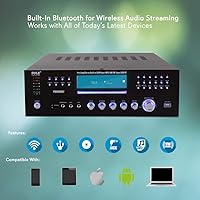
Day-to-day Bluetooth pairing is generally described as quick and stable. Connecting a phone or laptop for background music during gatherings works without much fuss, and most users report the connection holds steady across a typical living room without dropouts.
Range is average at best — walls and interference noticeably degrade the signal beyond about 20 to 25 feet. A small but consistent group of reviewers also mention that after firmware-level resets or device switches, re-pairing can be slower than expected for a modern Bluetooth device.
Build Quality
58%
42%
The rack-mountable metal faceplate gives a reasonably solid first impression, and the overall dimensions feel substantial when the unit is installed in a rack or placed on a shelf. The cooling fan works as advertised, keeping the chassis from running hot during extended use.
Pick it up and the plastic rear housing quickly reveals the cost-cutting. Several buyers describe a hollow, lightweight feel that does not inspire long-term confidence, and the knobs — while functional — have noticeable wobble. For a unit marketed partly on its rack-mount credibility, the construction underwhelms anyone used to mid-range AV hardware.
Audio Output Quality
63%
37%
For background music, party playlists, and karaoke accompaniment, the sound output is more than adequate. Users driving a pair of bookshelf or floor-standing speakers in a medium-sized room report a full, listenable sound with decent bass response when the onboard EQ is dialed in.
Critical listeners will find the audio flat and lacking dynamic range at higher volumes. The amplifier starts to introduce audible distortion when pushed past roughly 60 to 70 percent volume, which is a real constraint in larger rooms or for users hoping to fill a basement or open-plan space.
EQ & Sound Controls
74%
26%
Having physical rotary knobs for bass, treble, mic level, echo, and subwoofer is genuinely more satisfying than menu-based digital controls for casual users. Adjustments are immediate and intuitive, which matters when you are mid-karaoke session and need to quickly pull back the echo or boost the bass.
The EQ range is narrow compared to even modestly priced dedicated equalizers. Users expecting meaningful tonal shaping will find the bass and treble adjustments fairly subtle, and there is no parametric control or preset memory for switching between music and karaoke modes quickly.
CD & DVD Playback
69%
31%
For households with physical disc collections, having a front-loading CD and DVD player integrated into the receiver is a genuine convenience. Playback is smooth for standard audio CDs, and users appreciate not needing a separate player taking up shelf space or adding cable clutter.
DVD video output functionality is limited and largely dependent on your display setup. Several buyers noted compatibility hiccups with certain disc formats or burned discs, and the tray mechanism feels less durable than a standalone player — a concern for units that will see daily use.
Remote Control
55%
45%
Including a remote at this price point is appreciated, and for basic functions like volume adjustment and source switching from across the room, it does the job. Users hosting gatherings find it convenient for quick adjustments without walking to the unit.
Responsiveness is inconsistent — the IR receiver appears to have a relatively narrow pickup angle, meaning off-axis use from across a room produces missed inputs. Several reviewers describe needing to aim with deliberate precision, which undermines the convenience the remote is supposed to provide.
Setup & Ease of Use
82%
18%
Almost universally, buyers comment on how quickly this home audio amplifier gets up and running. The front panel labels are clear, the input selector is straightforward, and connecting a basic 4-speaker setup takes under 15 minutes for most users regardless of their technical background.
The manual is thin and does not cover edge cases well — users trying to configure the optical output alongside the main speaker outputs, for instance, found themselves guessing. For anything beyond a standard hookup, the documentation leaves real gaps.
LCD Display Readability
61%
39%
The LCD panel does its core job of showing the active input and basic playback status clearly enough in normal room lighting. Users who like visual confirmation of their source selection find it handy, especially when the unit is installed in a rack at a distance.
In brighter environments or at an angle, the display washes out noticeably. The font size is also small relative to the faceplate, and several buyers with the unit mounted above eye level found it difficult to read without stepping closer — a practical issue in real rack installations.
AM/FM Tuner
66%
34%
The built-in AM/FM tuner functions reliably in areas with decent signal strength. For users who still listen to radio regularly — sports broadcasts, local talk, or background music — having it integrated removes the need for an external tuner and keeps the setup clean.
Sensitivity is average, and in suburban or semi-rural areas with weaker signals, users report static and difficulty locking onto stations cleanly. There is no RDS display support, so station names do not appear on the LCD — a dated omission even by budget-receiver standards.
Rack Mount Practicality
76%
24%
The rack-mount form factor is a meaningful differentiator for users building out a home entertainment rack or a small venue AV setup. The unit fits standard 19-inch racks properly, and the cooling fan makes extended rack operation more viable than with units lacking active ventilation.
Rack ears are included but the mounting hardware feels lightweight, and the overall chassis depth requires careful measurement before purchasing for tighter rack builds. A few buyers noted minor alignment issues when securing the unit in rack rails.
Subwoofer Integration
72%
28%
Having a dedicated subwoofer RCA pre-out is a real practical benefit — it means users can add a powered subwoofer without any signal splitting or workarounds. The dedicated subwoofer level knob on the front panel makes it easy to balance low-end in the moment.
The subwoofer output level control has limited range, and some users found the crossover point non-adjustable, which creates integration challenges depending on the subwoofer model. Pairing with high-quality powered subs highlights the overall amplifier chain's limitations more than it complements them.

Suitable for:

The Pyle PD3000BT.5 4-Channel Bluetooth Stereo Receiver is a strong fit for households where karaoke is a regular activity — the dual microphone inputs with built-in echo mean you can host a full sing-along without hunting for extra gear or mixing equipment. Families or friend groups who want a single unit covering music streaming, radio, physical disc playback, and multi-speaker audio will find it consolidates a lot of functionality into one manageable box. Budget-conscious buyers upgrading from a basic soundbar to real speaker-driven sound will notice an immediate improvement in room-filling audio without a steep investment. It also suits users who still own CD or DVD collections and want to keep that media accessible alongside modern Bluetooth streaming. Small community spaces, rehearsal rooms, or basement entertainment setups on a tight equipment budget can get genuine utility from this home audio amplifier, especially in rack-based AV installations where the form factor and built-in cooling fan make it a practical semi-permanent fixture.
Not suitable for:

Buyers who care about accurate, high-fidelity sound reproduction should look elsewhere — the Pyle PD3000BT.5 4-Channel Bluetooth Stereo Receiver is a value-tier product, and the audio chain reflects that at higher volumes or with critical listening material. The advertised 3000W peak figure is a marketing number, not a reflection of usable sustained output, so anyone sizing this unit for a large room, outdoor setup, or demanding speaker load will likely find it underpowered for the task. Audiophiles or home theater enthusiasts who have invested in quality speakers will find the amplifier section a bottleneck rather than a complement to their setup. Users expecting robust build quality comparable to mid-range AV receivers will be disappointed by the plastic rear housing and lightweight feel. Anyone needing HDMI ARC integration with a modern television, advanced DSP processing, or reliable performance at the upper range of its volume dial should budget for a more capable unit from an established AV brand.
Specifications

  • Peak Power: The unit is rated at 3000W peak output across 4 channels, though real-world sustained RMS output is significantly lower — typical for value-tier amplifiers in this class.
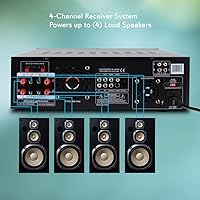
  • Channels: Four-channel amplification supports up to 4 individual speakers simultaneously with 4–8 ohm impedance compatibility.
  • Microphone Inputs: Two front-panel microphone inputs are included, each with an adjustable echo effect for karaoke and live vocal use.
  • Disc Player: A front-loading CD and DVD player is built in, supporting standard audio CDs and video DVDs with MPEG-1, MPEG-2, and MPEG-4 encoding.
  • Connectivity: Input options include USB, AUX, AM/FM tuner, RCA stereo input, and Bluetooth wireless streaming; outputs include RCA subwoofer pre-out and an optical audio output.
  • Bluetooth: Bluetooth wireless connectivity allows cable-free audio streaming from smartphones, tablets, and computers without requiring app installation.
  • EQ Controls: Front-panel rotary knobs provide hands-on control over bass, treble, master volume, microphone level, echo intensity, and subwoofer output level.
  • Display: An LCD front panel displays the active input source and playback status in real time.
  • Remote Control: An infrared remote control is included in the package for source switching and volume adjustment from a distance.
  • Form Factor: The chassis is designed to fit standard 19-inch equipment racks and includes rack-mount hardware for semi-permanent AV installations.
  • Cooling: A built-in cooling fan actively ventilates the chassis during operation to manage heat during extended use.
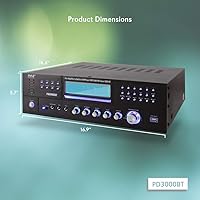
  • Dimensions: The unit measures 21 x 17.5 x 9 inches, making depth measurement important before purchasing for rack or shelf installations.
  • Weight: The receiver weighs 22.6 pounds, reflecting the size of the chassis rather than premium internal component density.
  • Speaker Impedance: Compatible with speakers rated at 4 to 8 ohms impedance — standard for most consumer bookshelf and floor-standing home speakers.
  • Color & Finish: The unit ships in black with a front metal faceplate and a plastic rear housing.
  • Manufacturer: Manufactured by Sound Around, a New York-based consumer electronics brand that markets audio products under the Pyle name.
  • Model Number: The official model designation is PD3000BT.5, used for identifying firmware, support documentation, and replacement parts.
  • Subwoofer Output: A dedicated RCA subwoofer pre-out allows direct connection to any powered or active subwoofer without additional signal-splitting hardware.

Related Reviews

Romicta 4-Channel Bluetooth 5.0 Stereo Amplifier
76%
88%
Value for Money
91%
Ease of Setup
83%
Bluetooth Connectivity
71%
Sound Quality
54%
Power Output Accuracy
More
Pyle PT588AB 5.1 Channel Home Theater Receiver
70%
74%
Value for Money
52%
Build Quality
61%
Audio Performance
83%
Karaoke Functionality
78%
HDMI Connectivity
More
Pyle PT694BT 5.2-Channel Home Theater Receiver
66%
78%
Value for Money
83%
Ease of Setup
63%
Audio Performance
67%
Bluetooth Reliability
54%
Build Quality
More
Romicta 4.1-Channel Bluetooth Mini Amplifier
75%
81%
Value for Money
74%
Audio Quality
67%
Bluetooth Performance
72%
Subwoofer Integration
88%
Ease of Setup
More
Pyle PTA42BT Bluetooth Karaoke Stereo Amplifier
76%
88%
Ease of Setup
84%
Bluetooth Connectivity
79%
Microphone Performance
86%
Talk-Over Function
67%
Power & Volume Output
More
Moukey MAMP1 Stereo Receiver Amplifier
76%
88%
Value for Money
91%
Karaoke Performance
89%
Connectivity & Input Range
83%
Bluetooth Reliability
74%
Sound Quality
More
Pyle PD3000BAH 4-Channel Bluetooth Amplifier
73%
83%
Value for Money
61%
Power & Amplification
88%
Connectivity & Input Range
74%
Bluetooth Performance
77%
CD/DVD Player Functionality
More
Beeitzie B103 Bluetooth 5.4 Transmitter Receiver
86%
89%
Audio Performance
93%
Ease of Setup
91%
Battery Life
85%
Connectivity Range
76%
Dual-Link Functionality
More
Pyle PLSHVC412 4-Channel Stereo Speaker Selector
84%
94%
Ease of Installation
88%
Volume Control Precision
85%
Compatibility with Audio Systems
89%
Build Quality
83%
Power Handling
More
MepvabKY T10 Bluetooth Transmitter Receiver
80%
86%
Build Quality
82%
Bluetooth Connectivity
77%
Audio Latency
89%
Battery Life
84%
Battery Indicator
More

FAQ

Not in the way most buyers expect. That figure represents peak power under ideal laboratory conditions — it is not the sustained RMS output you will experience during normal listening. In practice, expect usable continuous power that is a fraction of that number, which is standard across budget-tier amplifiers. It is enough to drive a medium-sized room with moderate-efficiency speakers, but do not plan on powering a large venue or outdoor event with it.

Yes, that is one of the clearest strengths of this home audio amplifier. Both microphone inputs are active simultaneously, and each has its own echo level adjustment. You can have two singers going at once without any additional mixer or splitter equipment.

Any passive speakers rated between 4 and 8 ohms impedance will work — that covers the vast majority of bookshelf, floor-standing, and surround speakers sold for home use. Just make sure your speakers are passive (not powered or active), since this unit is the amplifier in the chain.

Yes, the Pyle PD3000BT.5 4-Channel Bluetooth Stereo Receiver is designed for standard 19-inch rack mounting and includes the necessary hardware. That said, measure your rack depth carefully before buying — the unit is 17.5 inches deep, which can be tight in shallow racks.
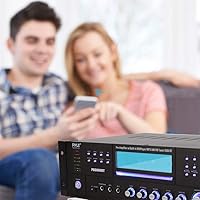
For most living room setups, pairing is quick and the connection holds steady. Where it gets inconsistent is at longer distances or through walls — the signal can drop or weaken beyond around 20 to 25 feet in those conditions. For a standard open room it performs fine for music streaming and background audio during gatherings.

Absolutely. There is a dedicated RCA subwoofer pre-out on the back of the unit, and a front-panel knob lets you adjust the subwoofer level independently. You will need a powered or active subwoofer — this output is a line-level signal, not a speaker-level connection.

It handles standard audio CDs reliably, and many users have success with burned discs as well. Compatibility with home-burned discs can vary depending on the disc format and how it was recorded — CD-R discs tend to work better than CD-RW in most players at this tier.

It works, but you need to point it fairly directly at the front panel IR receiver — it has a narrower pickup angle than most modern remotes. From a typical couch distance in a living room it is functional, but if the unit is installed in a rack off to the side, you may find yourself needing to aim more deliberately than you would expect.

It can connect to a TV via RCA or optical audio output, so you can run TV audio through your speakers. However, there is no HDMI ARC support, which means it will not integrate as cleanly with newer televisions as a dedicated home theater receiver would. For basic TV audio through speakers, it gets the job done with the right cable setup.

In real use, most listeners find the audio quality holds up reasonably well through about 60 to 70 percent of the volume range. Past that point, some distortion and harshness starts to creep in, particularly at the high end. For a medium-sized room at party or background music levels, it stays clean — just do not expect clean headroom all the way to maximum volume.

Where to Buy