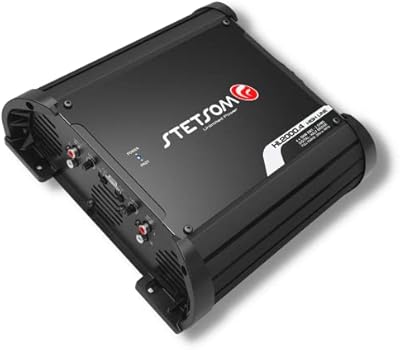
PRV Audio DSP 2.8X 8-Channel Car Audio Processor
Overview
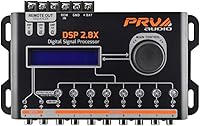
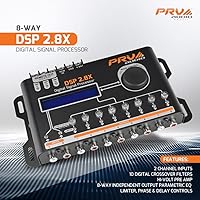
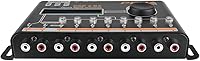
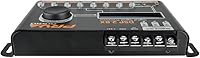
The PRV Audio DSP 2.8X 8-Channel Car Audio Processor sits in an interesting spot — aimed squarely at serious DIY installers who want real tuning control without spending on a professional-grade unit. At its core, the 2-input, 8-output architecture makes it genuinely useful for multi-amplifier builds where independent channel control matters. Unlike many competitors that rely on a laptop or smartphone app, this DSP unit runs entirely through an onboard LCD interface, keeping the setup self-contained. That hardware-only approach is a tradeoff worth knowing upfront. If you're moving up from passive crossovers and want to tune an active system without a huge budget commitment, this is a logical and capable next step.
Features & Benefits
What really stands out about the PRV 2.8X is how much tuning depth it packs into one box. A 15-band graphic equalizer handles everyday tone shaping, while 12 factory presets let you dial in a starting point quickly. For anything more precise, the parametric EQ — available per output channel — lets you target a specific frequency with real accuracy, which matters when correcting a problem driver or a resonant panel. The crossover section supports both Butterworth and Linkwitz-Riley filters at slopes up to 48 dB/octave, giving active builds genuine flexibility. Per-channel time delay handles staging correction up to 275 cm. Measured noise and distortion figures back up the clean signal performance convincingly.
Best For
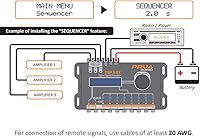
This digital crossover processor is a strong match for builders wiring up a 3-way or 4-way active speaker system who need independent control over each output. Running separate amplifiers for highs, mids, and lows becomes manageable when you can assign crossover points, EQ curves, and delay per channel independently. The sequencer relay output is especially valuable in bass-heavy builds — SPL and SQ setups alike — where staggered amp power-on prevents the loud pop that can damage tweeters over time. It also appeals to first-time active system builders who want real DSP functionality without flagship-unit costs. Budget-minded enthusiasts who already understand audio fundamentals will get the most from it.
User Feedback
With over 500 ratings averaging 4.6 out of 5, this DSP unit has clearly earned its reputation among real-world installers. The most consistent praise centers on the value-to-feature ratio — buyers regularly note they expected less for the price. The sequencer function, in particular, gets called out as solving a genuine frustration that cheaper setups simply cannot address. On the flip side, the menu-driven LCD interface takes adjustment. Several users mention it feels unfamiliar at first, and those used to PC-based DSP software may find the hardware-only approach limiting. A few buyers also note the plastic chassis feels light for a permanent install, though it fits cleanly without fitment issues. Balanced overall.
Pros
- Eight fully independent output channels give serious multi-amp builds the per-channel control they actually need.
- Both Butterworth and Linkwitz-Riley crossover filters are available, with slopes up to 48 dB/octave for precise speaker integration.
- Per-channel time delay up to 275 cm allows genuine soundstage correction in complex speaker layouts.
- The sequencer REM output staggers amp power-on, protecting tweeters and reducing turn-on noise in multi-amp systems.
- A 15-band graphic EQ per channel plus parametric EQ per output covers both broad tone shaping and surgical frequency fixes.
- No laptop or app required — the entire unit is self-contained and functional without any external device.
- Signal-to-noise ratio above 90 dB and THD below 0.01% back up clean, low-coloration signal performance.
- At its price point, the DSP unit delivers a feature set that competes well above its class.
- A security password lock prevents accidental or unauthorized changes once your tune is dialed in.
- Over 500 real-world ratings averaging 4.6 out of 5 reflect consistent buyer satisfaction across varied install types.
Cons
- The menu-driven LCD interface has a genuine learning curve, especially for first-time DSP users.
- No PC or smartphone software support means all tuning adjustments must be made through a small 16x2 character display.
- The plastic chassis feels noticeably lightweight and may not inspire confidence in high-vibration or permanent mount installs.
- Fine-tuning parametric EQ settings via hardware buttons is slow and tedious compared to dragging a curve on a screen.
- Only 2 audio inputs limits flexibility if you're working with a more complex source or preprocessor setup.
- No built-in RTA or measurement tools means you need external equipment to verify your tuning adjustments accurately.
- The 8 ms maximum delay range may be insufficient for very large vehicles or extreme speaker placement scenarios.
- Documentation and setup guides are not always thorough enough for complete beginners building their first active system.
Ratings
The scores below reflect our AI-driven analysis of verified global buyer reviews for the PRV Audio DSP 2.8X 8-Channel Car Audio Processor, with spam, incentivized feedback, and bot-generated reviews actively filtered out before scoring. Each category is weighted against real installation experiences reported by owners across a wide range of car audio builds, from beginner active setups to complex multi-amplifier configurations. Both the standout strengths and the honest frustrations are factored in equally — nothing is softened to protect the score.
Value for Money
Feature Set Depth
Crossover Performance
Sequencer & Protection
Ease of Setup
Signal Transparency
Time Alignment Accuracy
Build Quality
Display & Interface
EQ Usability
Compatibility
Routing Flexibility
Security & Settings Retention
Latency
Suitable for:
The PRV Audio DSP 2.8X 8-Channel Car Audio Processor is built for DIY car audio enthusiasts who are ready to step up from passive crossovers into a proper active system. If you're running multiple amplifiers — separate units for tweeters, midrange, and subwoofer — this DSP unit gives you independent crossover points, per-channel EQ, and time alignment all in one box. It's especially well-suited for 3-way and 4-way builds where staging correction and precise frequency splitting make an audible difference. The sequencer relay output is a practical bonus for anyone tired of amp turn-on pop damaging tweeters over time. Builders who prefer a self-contained hardware setup over a laptop-dependent tuning workflow will find the onboard interface perfectly workable once they spend time learning the menu structure.
Not suitable for:
The PRV Audio DSP 2.8X 8-Channel Car Audio Processor is not the right fit for buyers who expect a modern app-based or PC software tuning experience. If you've used platforms like JL Audio's TuN or similar software DSPs, the hardware-only LCD interface will feel like a step backward in usability, regardless of the underlying feature set. Casual listeners who just want better bass without any configuration effort should look at simpler, plug-and-play solutions instead. The plastic enclosure also makes it less appealing for high-vibration installs or builds where long-term mechanical durability is a priority. And if you're running a simple 2-channel or single-amp setup, the 8-output architecture is more horsepower than you'll ever realistically use.
Specifications
- Input Channels: The unit accepts 2 analog audio inputs, labeled A and B, which can be routed independently or combined per output channel.
- Output Channels: Eight fully independent output channels allow separate amplifier or driver control across a complete multi-way active speaker system.
- Graphic EQ: Each channel includes a 15-band graphic equalizer with 12 factory presets covering common listening profiles such as Flat, Bass Boost, Rock, and Hip Hop.
- Parametric EQ: One parametric equalizer is available on the input stage, plus one dedicated parametric EQ per output channel for precise frequency correction.
- Crossover Types: Both Butterworth and Linkwitz-Riley crossover filter types are supported, giving users flexibility to match filter behavior to their specific speaker setup.
- Crossover Slopes: Selectable slopes of 12, 18, 24, 36, and 48 dB per octave are available for both supported crossover filter types.
- Channel Delay: Per-channel delay is adjustable from 0 to 8 ms, equivalent to up to 275 cm of acoustic distance correction for time alignment.
- Signal-to-Noise: The signal-to-noise ratio exceeds 90 dB, indicating a clean output with minimal background noise under normal operating conditions.
- Distortion (THD): Total harmonic distortion is rated below 0.01%, reflecting low coloration and accurate signal reproduction across the audible frequency range.
- Channel Separation: Channel separation exceeds 80 dB, meaning crosstalk between independent output channels is effectively inaudible in real-world use.
- Latency: System latency is 1.08 ms, which is low enough to avoid perceptible timing artifacts in typical car audio installations.
- Frequency Response: The unit maintains a frequency response within plus or minus 3 dB from 10 Hz to 22.5 kHz, with a tighter minus 1 dB window across the same range.
- Supply Voltage: The processor operates on 10V to 15V DC, making it fully compatible with standard 12V automotive electrical systems.
- Maximum I/O Voltage: Both input and output stages handle a maximum signal level of 5.6 Vpp, equivalent to plus 8.2 dBu.
- Display: An onboard 16x2 character LCD screen provides real-time readout of settings and menu navigation without requiring any external device.
- Sequencer Output: A dedicated REM sequencer output enables staged power-on sequencing of connected amplifiers to prevent turn-on transient noise.
- Security Lock: A password-protected security lock prevents unauthorized or accidental changes to saved tuning settings after installation.
- Dimensions: The unit measures 1.45 x 7.87 x 3.97 inches (H x W x L), suitable for concealed mounting in a standard DIN or custom enclosure space.
- Weight: At 1 pound, the processor is lightweight and easy to position in tight installation spaces without adding meaningful load.
- Frequency Generator: A built-in frequency generator covers 10 Hz to 22 kHz at levels from minus 60 dB to 0 dB, useful for speaker testing and system calibration.
Related Reviews
PRV Audio DSP 2.4X Digital Signal Processor
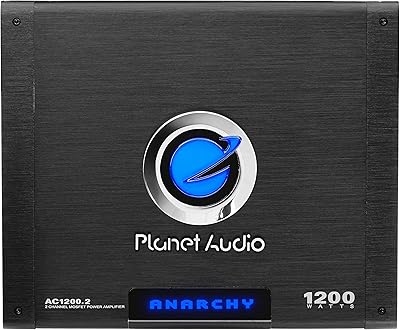
Planet Audio AC1200.2 2-Channel Car Amplifier
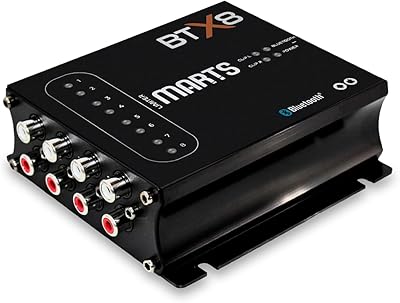
Marts Digital BTX8-DSP 8-Channel Bluetooth DSP Processor
Universal Audio Apollo 8 QUAD Audio Interface
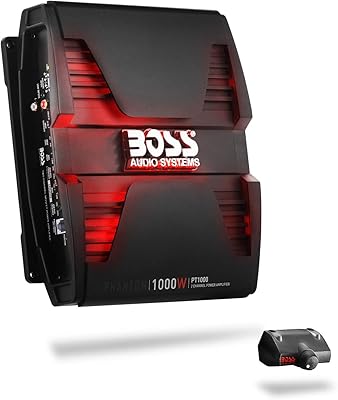
BOSS Audio PT1000 2-Channel Car Amplifier
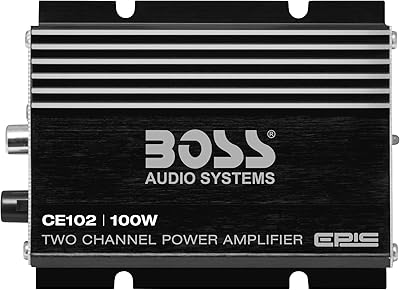
BOSS Audio CE102 2-Channel Car Amplifier
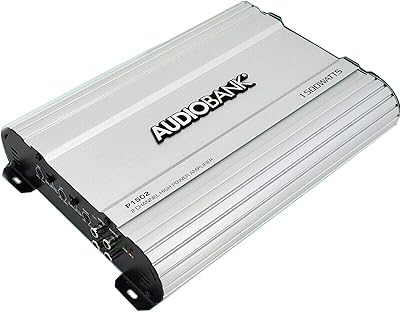
Audiobank P1502 2-Channel Car Amplifier
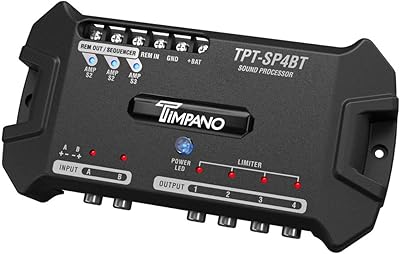
Timpano TPT-SP4BT Bluetooth DSP Car Audio Processor
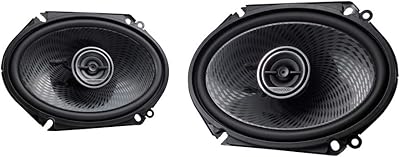
Kenwood KFC-C6896PS 6x8 2-Way Car Speakers