Overview

The Planet Audio BB4.1200 4-Channel Car Amplifier is Planet Audio's answer to the enduring question of how much amplifier you can get without spending serious money. The brand has built its reputation on accessible gear, and this amp fits that mold — it won't compete with Rockford Fosgate or Alpine on raw fidelity, but it holds its own at the price. The Class D design is worth paying attention to: unlike older Class AB amps, Class D runs far more efficiently, generating less heat in that underseat cavity where airflow is limited. At 8.8 x 6.9 x 2.7 inches, it installs without drama. Across 209 customer ratings, it holds a 4.1 out of 5 — respectable, not remarkable.
Features & Benefits

The headline number is 1200 watts, but that's peak — the figure that actually matters day-to-day is the RMS output, which lands at 225 watts per channel at 2 ohms or 113 watts per channel at 4 ohms. Still genuinely useful power for a vehicle cabin. What makes this 4-channel amplifier more versatile than many budget competitors is its bridging capability: collapse the four channels into two and you get 450 watts RMS, enough to drive a subwoofer alongside your door speakers from a single unit. The onboard variable crossovers — both high-pass and low-pass — eliminate the need for external filters, and a variable bass boost handles tuning for bass-heavy listeners without adding hardware.

Best For

This Planet Audio amp is a natural fit for someone tackling their first audio upgrade — replacing tinny factory speakers with something that has real body and volume, without needing a separate signal processor or crossover box. Compact enough to tuck under a seat or mount in a trunk corner, it works well when install space is limited. The bridging option also makes it worth considering for builders assembling a full system: run four speakers cleanly, then bridge a pair of channels when you're ready to add a sub. If you're chasing audiophile-grade sound, look elsewhere — but for a meaningful budget upgrade, it fits the brief well.

User Feedback

Across more than 200 verified ratings, the BB4.1200 earns consistent praise for straightforward installation and a clear improvement over factory audio straight out of the box. Buyers who upgraded from stock head-unit systems routinely describe the jump in volume and presence as immediately noticeable. The concerns are worth knowing, though. A number of owners flag that real-world output doesn't quite match the headline wattage — typical for budget amplifiers where peak figures dominate the marketing. Build quality is described as adequate rather than premium, and a handful of users running the amp hard for extended periods mention heat at high volumes as a factor. Not a dealbreaker, but worth planning for.

Pros

  • Delivers a clearly audible upgrade over factory sound right out of the box, even for casual listeners.
  • Compact enough to fit under a front seat in most mid-size vehicles without modification.
  • Built-in variable crossovers eliminate the need for a separate signal processor in simple installs.
  • Bridging two channels to power a subwoofer is genuinely useful and avoids buying a second amp.
  • Class D efficiency keeps the unit running cooler than older amp designs during moderate use.
  • First-time installers consistently report a smooth, manageable wiring and setup experience.
  • The MOSFET power supply provides more stable output under dynamic loads than older budget designs.
  • RCA pre-amp outputs give you room to expand the system later by adding another amplifier.
  • Variable bass boost lets bass-heavy listeners tune low-end response without extra hardware.
  • For the price tier, the feature set — crossovers, boost, bridging, pre-amp out — is genuinely competitive.

Cons

  • Advertised peak wattage is heavily inflated; real sustained RMS output falls well short of the headline number.
  • Heat buildup at high volumes in confined, low-airflow mounting spots has caused shutoffs for some owners.
  • Build quality feels functional rather than durable — terminal screws and RCA jacks show the cost savings.
  • Crossover and bass boost controls lack frequency markings, making precise tuning a guessing game.
  • A notable minority of buyers report unit failures within the first year, pointing to uneven quality control.
  • Ground loop noise and alternator whine can surface if installation isn't executed carefully — the amp is sensitive to wiring quality.
  • Included documentation is thin and doesn't adequately guide beginners through gain structure or crossover setup.
  • Not 1-ohm stable, which limits compatibility with low-impedance subwoofer configurations.
  • RCA connectors feel slightly loose, and some owners needed tape or cable support to prevent intermittent signal loss.
  • Long-term owners who upgraded to mid-tier brands consistently describe a clear performance gap in dynamic range and headroom.

Ratings

The scores below were generated by our AI review engine after analyzing verified buyer feedback for the Planet Audio BB4.1200 4-Channel Car Amplifier from global sources, with spam, incentivized reviews, and bot activity actively filtered out. Based on real-world installation reports, listening impressions, and long-term ownership experiences, the ratings transparently reflect both where this amp punches above its weight and where budget constraints show up in practice.
Value for Money
83%
For buyers replacing a factory head unit on a limited budget, this 4-channel amplifier delivers a tangible upgrade in volume and clarity at a price that doesn't require financing. Most owners feel they received more amplifier than the price tag suggested, especially given the onboard crossovers and bridging capability.
Buyers who later compared it to mid-tier brands like Rockford Fosgate or JL Audio often acknowledged the gap in real-world performance, which tempers the value story for anyone planning a more serious long-term build.
Power Output Accuracy
61%
39%
Running at 2-ohm loads, the BB4.1200 delivers usable power that noticeably outperforms factory amplification. Listeners who kept volume levels moderate to high — rather than pushing the amp to its ceiling — generally reported satisfying output for daily driving.
The gap between the advertised 1200-watt peak figure and actual RMS delivery is a recurring source of frustration. Real-world measurements and user comparisons suggest the amp doesn't sustain its rated 225W x 4 RMS under demanding, continuous conditions, which matters if you're running power-hungry speakers.
Ease of Installation
88%
This is one of the most consistently praised aspects across the review pool. First-time installers with basic wiring knowledge report getting the amp up and running within an afternoon, with clear terminal labeling and a logical layout that doesn't require guesswork.
A small number of users noted that the included documentation is minimal and doesn't walk through gain-setting or crossover tuning in practical terms, which can leave beginners adjusting by ear rather than by best practice.
Build Quality
67%
33%
The metal chassis feels solid enough for the price tier, and the component layout is tidy. For a surface-mount install in a trunk or under a seat, the physical construction holds up under normal road vibration without obvious rattles or flex.
Compared to amplifiers at twice the price, the fit and finish is noticeably less refined — terminal screws feel slightly soft, and the overall impression is functional rather than robust. A few owners reported cosmetic scuffs on arrival, suggesting the packaging could offer better protection.
Thermal Management
58%
42%
Class D efficiency genuinely helps here — during moderate listening sessions in reasonably ventilated locations, the amp stays warm rather than hot, and thermal shutoff events are rare for casual users.
Push this amplifier hard for extended periods — think long highway drives with the volume cranked — and heat becomes a real concern. A minority of reviewers reported thermal throttling or unexpected shutoffs during sustained high-volume use, particularly in enclosed, poorly ventilated mounting spots.
Onboard Crossover Flexibility
81%
19%
Having both variable high-pass and low-pass crossovers built directly into the amp is a practical advantage that saves money and simplifies wiring. Owners running a mixed speaker and subwoofer setup appreciated being able to filter frequencies without buying a separate line output converter or processor.
The crossover controls lack detents or numeric markings, which makes precise repeatable tuning difficult. Users who want to set exact crossover points by frequency rather than by feel may find the controls imprecise.
Bridging Capability
78%
22%
The ability to bridge down to two channels and output 450W RMS at 4 ohms gives this amplifier real versatility for system builders. Owners who used bridged mode to power an entry-level subwoofer alongside door speakers from a single unit reported the configuration worked cleanly.
Bridged mode demands a 4-ohm minimum load, and users who accidentally ran lower-impedance subs in bridged mode encountered protection shutoffs. The manual's guidance on this limitation is easy to miss, which has caused confusion among less experienced installers.
Signal Quality & Noise Floor
69%
31%
At moderate gain settings, the BB4.1200 produces a reasonably quiet background with no significant hiss or interference for an amplifier in this category. Listeners using it with aftermarket head units and quality RCA cables reported a clean signal in everyday conditions.
Alternator whine and ground loop noise were reported by a notable subset of owners, often traced to gain settings that were run too high or grounding points that weren't properly prepared. The amp is sensitive to installation quality in a way that less forgiving, better-filtered competitors are not.
Bass Boost Control
74%
26%
The variable bass boost is a welcome addition for listeners who want added low-end punch without a separate equalizer. Users who enjoy bass-forward music — hip-hop, EDM, reggaeton — found it useful for dialing in extra warmth on stock or mid-range speakers.
Like the crossover controls, the bass boost lacks precision markings, and it's easy to overdo it. A number of reviewers noted that excessive bass boost introduced audible distortion, particularly on lower-efficiency speakers being pushed near their limits.
Compatibility & Impedance Stability
76%
24%
The 2-to-4-ohm stable design covers the vast majority of aftermarket speaker configurations on the market. Owners running common 4-ohm component sets or 2-ohm coaxials reported stable operation without impedance-related issues under normal listening conditions.
The amp is not 1-ohm stable, which limits pairing options with certain high-performance subwoofers wired for maximum output. Buyers planning a more advanced build with dual voice coil subs in low-impedance configurations will need to plan around this constraint.
Compact Footprint & Mountability
84%
At under 9 inches long and less than 3 inches tall, this is an amp that genuinely fits where others don't. Multiple owners confirmed clean under-seat installs in mid-size sedans and SUVs without needing to modify mounting surfaces.
The mounting hardware included in the box is basic, and the surface-mount feet are minimal. Owners mounting the amp in locations subject to significant vibration — like thin trunk floors — occasionally needed to source their own fasteners for a more secure fit.
RCA Input & Output Quality
71%
29%
Low-level RCA inputs work cleanly with aftermarket head units, and the pre-amp RCA outputs are a thoughtful inclusion that lets system builders add a second amp down the line without rewiring the whole setup.
The RCA jacks feel slightly loose compared to higher-end amplifiers, and a few owners noted that connector fit varied enough to cause intermittent signal issues if the cables weren't secured with tape or a strain relief solution.
Long-Term Reliability
63%
37%
A reasonable number of owners report using this Planet Audio amp for a year or more without incident, particularly those who installed it with clean grounds, proper fusing, and adequate ventilation. For light-to-moderate daily use, longevity seems acceptable for the price.
A visible minority of reviews describe failures within the first six to twelve months — protection mode lockouts, channel dropout, and in a few cases complete unit failure. The pattern suggests quality control consistency is uneven, which is a legitimate risk to weigh against the attractive entry price.
MOSFET Power Supply Stability
77%
23%
The MOSFET-based power supply provides more stable rail voltage under dynamic load compared to older bipolar designs, which translates to less audible compression during loud transients. Owners powering efficient 4-ohm speakers noticed this as a tighter, more controlled sound during peaks.
While the MOSFET supply is a genuine upgrade over older budget amp designs, the benefits become less perceptible when the amp is pushed into higher-output bridged configurations, where voltage sag under load is more likely to affect perceived dynamics.

Suitable for:

The Planet Audio BB4.1200 4-Channel Car Amplifier is a strong fit for first-time car audio enthusiasts who want a meaningful upgrade from factory sound without committing to a high-end budget. If you're running a set of aftermarket coaxials or component speakers in a sedan, hatchback, or SUV and want noticeably more volume, clarity, and low-end presence, this amp delivers exactly that kind of straightforward improvement. The compact dimensions make it a practical choice for installs where space is genuinely limited — under a front seat, tucked into a small trunk corner, or mounted behind a rear panel. Builders who want the option to add a subwoofer later will appreciate the bridging capability, which lets you redirect two channels toward a sub without buying an additional amplifier. Anyone who wants onboard crossover and bass tuning controls — and doesn't want to spend extra on a separate line driver or processor — will find the built-in adjustments a useful convenience that keeps the install clean and simple.

Not suitable for:

The Planet Audio BB4.1200 4-Channel Car Amplifier is not the right tool for listeners who are chasing high-fidelity, reference-level sound or planning a serious competition-grade build. The real-world RMS output, while usable, doesn't match the headline peak wattage that dominates the marketing, so buyers powering demanding, low-sensitivity speakers will likely hit the amp's ceiling sooner than expected. Long listening sessions at high volumes — particularly in poorly ventilated mounting locations — have produced heat-related complaints from a meaningful slice of owners, which is a real concern for drivers who like it loud on extended road trips. If your impedance needs dip below 2 ohms, or you're planning to run a high-performance dual voice coil subwoofer in a low-impedance bridged configuration, this amp simply isn't built for it. Anyone prioritizing long-term reliability above all else should also weigh the quality control inconsistency that surfaces in the review pool — at this price point, the risk of premature failure is higher than with established mid-tier brands.
Specifications

  • Peak Power: Total system peak output is rated at 1200 watts across all four channels combined.
  • RMS Power (2Ω): Each channel delivers 225 watts RMS at a 2-ohm load, representing continuous real-world output under normal operating conditions.
  • RMS Power (4Ω): Each channel delivers 113 watts RMS at a 4-ohm load, the more common impedance for standard aftermarket speakers.
  • Bridged Power: When bridged to two channels, the amplifier outputs 450 watts RMS per channel pair at a 4-ohm load, suitable for powering a subwoofer.
  • Amplifier Class: Class D topology is used throughout, providing high efficiency and reduced heat generation compared to Class AB designs.
  • Power Supply: A MOSFET-based power supply regulates rail voltage for improved stability and lower distortion under dynamic audio loads.
  • Channels: Four independent channels are provided, with the option to bridge down to two channels for higher-power two-channel operation.
  • Impedance Range: The amplifier is stable with speaker loads between 2 and 4 ohms in full 4-channel mode; bridged mode requires a minimum 4-ohm load.
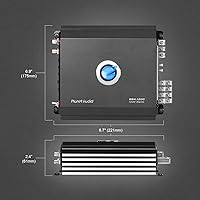
  • Dimensions: The unit measures 8.8″ long by 6.9″ wide by 2.7″ tall, enabling installation in compact spaces including under-seat locations.
  • Weight: The amplifier weighs 4.14 pounds, making it straightforward to handle and position during single-person installs.
  • Operating Voltage: Designed for 12-volt vehicle electrical systems, the amp operates within a supply voltage range of 10 to 14 volts DC.
  • Input Type: Low-level RCA inputs accept preamp-level signals from aftermarket head units without requiring a line output converter in most installations.
  • Output Type: RCA preamp outputs are included, allowing a second downstream amplifier to be connected and driven from the same signal source.
  • Crossover: Both variable high-pass and variable low-pass crossover filters are built in, allowing frequency routing to be adjusted directly on the unit.
  • Bass Boost: A variable bass boost control is integrated onboard, providing adjustable low-frequency emphasis without a separate equalizer.
  • Mounting Type: The amplifier is designed for surface mounting and ships with feet suitable for flat-surface installation in trunks or under seats.
  • Certification: The unit carries FCC certification, confirming it meets US regulatory standards for electromagnetic emissions in consumer electronics.
  • Material: The power supply section uses metal-oxide-semiconductor (MOSFET) components housed within a metal chassis construction.

Related Reviews

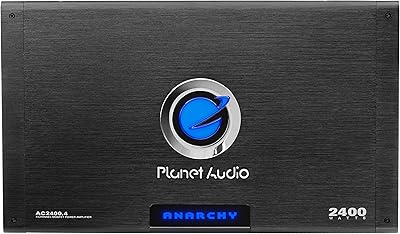
Planet Audio AC2400.4 4-Channel Car Amplifier
84%
95%
Power Output
89%
Sound Clarity
87%
Bass Performance
82%
Ease of Installation
65%
Thermals/Heat Management
More
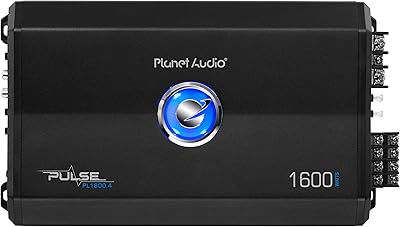
Planet Audio PL1600.4 4-Channel Car Amplifier
72%
88%
Value for Money
84%
Ease of Installation
74%
Sound Quality
58%
Power Output (Real-World)
61%
Build Quality
More
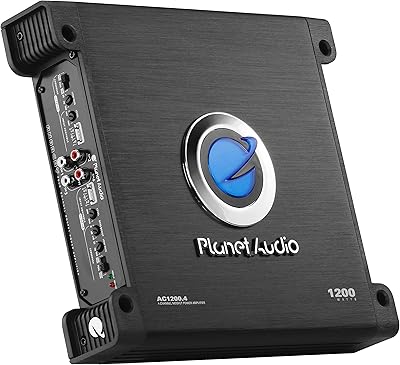
Planet Audio AC1200.4 4-Channel Car Amplifier
73%
88%
Value for Money
67%
Power Output
83%
Installation Ease
74%
Sound Quality
61%
Build Quality
More
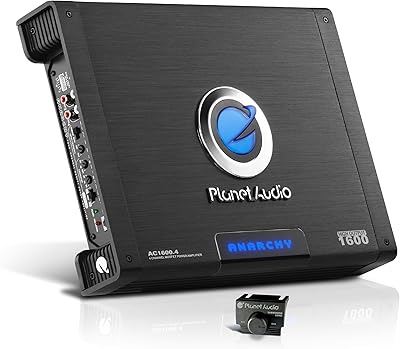
Planet Audio AC1600.4 Anarchy Series 4-Channel Car Amplifier
82%
94%
Power Output
88%
Sound Quality
70%
Ease of Installation
92%
Value for Money
85%
Build Quality
More
Recoil DI800.4 4-Channel Car Audio Amplifier
83%
88%
Sound Quality
92%
Power Output
65%
Thermal Management
84%
Build Quality
91%
Ease of Installation
More
Recoil DI550.4 4-Channel Car Audio Amplifier
74%
91%
Value for Money
78%
Power Output
86%
Ease of Installation
74%
Sound Quality
67%
Build Quality
More
Recoil REA600.4 4-Channel Car Audio Amplifier
84%
89%
Audio Performance
91%
Ease of Installation
85%
Sound Quality at High Volumes
62%
Heat Management
90%
Power Output
More
Soundfy SA 400.4 4-Channel Car Amplifier
71%
78%
Value for Money
72%
Sound Quality
63%
Power Output
58%
Build Quality
81%
Thermal Management
More
BOSS Audio R2504 4-Channel Car Amplifier
70%
82%
Value for Money
86%
Ease of Installation
51%
Power Output (Real-World)
58%
Thermal Management
62%
Build Quality
More
Hifonics BXX800.4 Brutus 800W RMS 4-Channel Car Audio Amplifier
86%
88%
Sound Quality
92%
Power Output
85%
Build Quality
72%
Heat Management
89%
Ease of Installation
More

FAQ

The 1200-watt figure is a peak rating, not a continuous one — and there is a meaningful difference. The Planet Audio BB4.1200 4-Channel Car Amplifier delivers 225 watts RMS per channel at 2 ohms under sustained conditions, which is the number that matters for real listening. Peak figures represent instantaneous spikes, not what the amp holds at volume across an entire drive. It is still genuinely useful power for a vehicle cabin, just manage your expectations relative to the headline number.
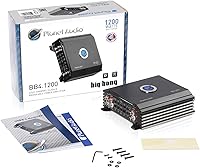
Yes, and this is actually one of the more practical reasons to consider the BB4.1200. You run two channels to your front speakers, two channels to your rear speakers, and when you are ready to add a sub, you bridge a pair of channels together — which gives you 450 watts RMS at 4 ohms for the subwoofer. Just make sure your sub has a 4-ohm impedance in bridged mode, since the amp is not stable below 4 ohms when bridged.

For many mid-size and larger sedans, yes. At 8.8″ long and 2.7″ tall, this 4-channel amplifier fits under the seat of vehicles like a Toyota Camry or Honda Accord without too much trouble. That said, measure your available clearance before buying — some seats sit quite low, and you will want at least a small air gap around the unit for heat dissipation.

This amp uses low-level RCA inputs, which are designed for aftermarket head units with preamp outputs. If you are keeping your factory head unit, you will need a line output converter (LOC) to step the speaker-level signal down to an RCA-compatible level. LOCs are inexpensive and widely available, but it is an extra step and cost that buyers planning a purely stock head unit install should factor in.

Class D amps run cooler than older Class AB designs, so at moderate listening volumes the BB4.1200 stays warm rather than hot. Where heat becomes a concern is when you push the amp hard for extended periods in a poorly ventilated spot — like a sealed under-seat cavity with no airflow. A minority of users have reported thermal shutoff events in those conditions. If your install location is tight and enclosed, leaving a small gap for air circulation is a smart precaution.

Planet Audio recommends a 4-gauge power and ground wire for this amplifier. For fusing, a 40-to-60-amp inline fuse close to the battery is the standard approach for an amp in this power class. If you are unsure, erring toward the higher end of that range is fine — the goal is protecting the wiring, not the amp itself, from a short circuit.

That is almost certainly alternator whine, a ground loop issue that is common in car audio installs. The most frequent cause is a poor ground connection — make sure your ground wire is bolted directly to bare metal on the chassis, not a painted surface or a bolt that goes through the body. Also check that your RCA cables are not running parallel to power cables inside the vehicle, as this can induce noise. Keeping signal and power wiring separated typically resolves the problem.

You can bridge the amplifier into two pairs — channels 1 and 2 bridged together, and channels 3 and 4 bridged together — giving you two bridged outputs rather than four individual ones. You cannot bridge all four into a single mono output. This makes the bridged configuration ideal for a two-way setup: one bridged pair for a subwoofer and one for a set of full-range speakers, for example.

The built-in crossovers are variable, meaning you turn a knob to sweep the filter frequency rather than entering an exact number. For a typical speaker setup without a sub, set the high-pass filter to roll off frequencies below roughly 80Hz — this keeps low bass away from your door speakers and reduces distortion. If you are running a sub on the bridged channels, engage the low-pass filter and tune it to cross over around the same point. Start conservative and adjust by ear from there.

Honestly, there is a noticeable difference in sustained output accuracy, noise floor, and long-term build confidence between this Planet Audio amp and mid-tier brands like Rockford Fosgate or Alpine. This 4-channel amplifier is genuinely competitive for what it costs, and for a first upgrade from factory audio it delivers real improvement. But if you are building a system you expect to grow into over several years, the step up to a more established brand is worth saving for — you will get more consistent power delivery, quieter signal handling, and better reliability over time.

Where to Buy