Overview

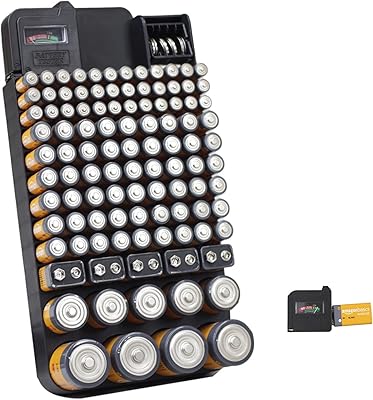
The Ontel Battery Daddy 180-Battery Storage Organizer with Tester tackles one of those quietly annoying household problems — the pile of loose batteries rolling around a junk drawer, half of them dead, none of them sorted. Built around a double-sided design, it houses six different battery types in a single compact case, which is more versatile than most basic storage boxes you'll find. The charcoal plastic shell looks at home on a workshop shelf or tucked in a kitchen cabinet, and the build feels solid without being heavy. What nudges it ahead of simpler alternatives is the included battery tester, a small but genuinely useful addition that makes this a complete solution rather than just a box.
Features & Benefits

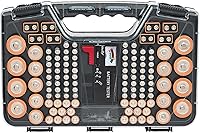
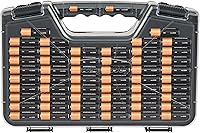
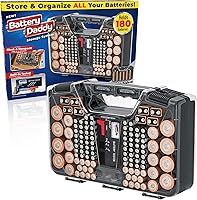
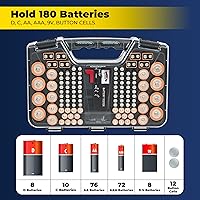
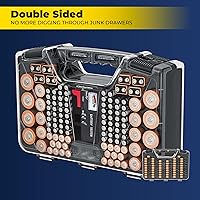
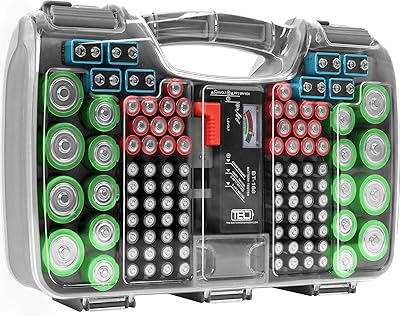
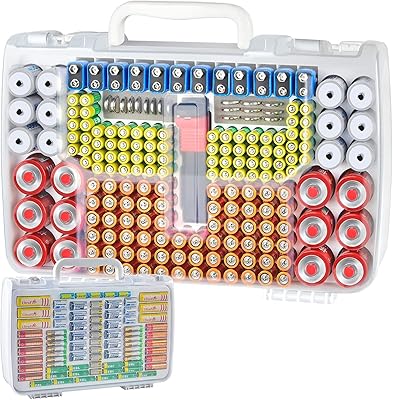
Flip this battery organizer open and the layout immediately makes sense. One side handles the high-volume sizes — 76 AA and 72 AAA slots — while the other covers 9V, C, D, and coin cells. The case runs roughly 13″ long and under 9″ tall, slim enough for a drawer but roomy enough that filling every slot in one go would take serious effort. The clear lid lets you scan your inventory before ever popping the latch, which matters when you're scrambling during a power outage. Keeping batteries separated also prevents the passive drain that occurs when cells touch each other in storage — a detail worth caring about if you're building out an emergency preparedness supply.

Best For

This storage and tester combo earns its place in a few different hands. Parents who've spent ten minutes hunting for a single AA before a kid's toy works on Christmas morning will immediately see the appeal. It's equally useful for DIY enthusiasts and technicians who carry multiple battery types to job sites and need everything accessible in one trip. Households building out emergency kits get real value here too — knowing which batteries still have charge before a storm hits is exactly the kind of small detail that matters most. If you're currently storing batteries in a zip-lock bag or a loose bin, this is a meaningful upgrade that costs less than most people expect.

User Feedback

Buyers tend to land on similar highlights: the latches feel genuinely secure, the sorting system clicks intuitively, and the tester proves its worth almost immediately. That said, the feedback isn't uniformly glowing. People who rely heavily on D batteries or coin cells — think smoke detectors and key fobs — sometimes wish those slot counts were higher. The battery tester also draws a fair caveat: it functions more as a pass/fail indicator than a precise charge meter, so don't expect lab-level accuracy from it. Latch durability after months of daily use gets mixed marks too. Those using the Battery Daddy case primarily for an emergency kit rather than constant access tend to report better long-term satisfaction overall.

Pros

  • Holds up to 180 batteries across six sizes in one organized, double-sided case.
  • The clear lid lets you scan your entire battery inventory without opening or unlatching anything.
  • Separated slots prevent battery-to-battery contact, reducing passive drain during long-term storage.
  • The bundled tester works on both single-use and rechargeable cells, covering most household needs.
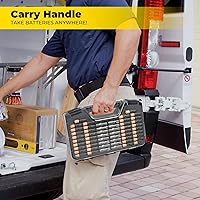
  • Sturdy latches and a solid carrying handle make this battery organizer genuinely portable for job sites or travel.
  • The charcoal plastic build looks intentional and fits naturally on a workshop shelf or kitchen cabinet.
  • Transitioning from loose storage to this system is immediate — no complicated setup, no tools needed.
  • At its price point, bundling a functional tester with a high-capacity organizer represents real combined value.
  • Individual compartment sizing prevents larger batteries from shifting or mixing during transport.

Cons

  • The battery tester only indicates pass or fail — it cannot show remaining charge level or voltage.
  • Eight D-battery slots and twelve coin cell slots feel limiting for households with high demand in those sizes.
  • The clear lid develops visible scuff marks and fingerprints over time, especially on open display shelves.
  • Latch firmness noticeably loosens after several months of frequent daily use.
  • At 2.72 pounds empty, the fully loaded case is heavier than expected for go-bag or compact kit use.
  • No water or moisture resistance makes basement or garage storage in humid conditions a real risk.
  • Shallow kitchen or utility drawers may not close fully with the case stored flat inside.
  • Battery slots can feel slightly snug for off-brand or non-standard rechargeable cells that run thicker than typical dimensions.

Ratings

The scores below for the Ontel Battery Daddy 180-Battery Storage Organizer with Tester were generated by AI after analyzing verified buyer reviews from multiple global markets, with spam, bot-submitted, and incentivized feedback actively filtered out. Ratings reflect the full range of real-world experiences — from households using it as a junk-drawer fix to technicians relying on it in the field — so both the genuine strengths and the recurring frustrations are transparently represented.
Organization & Sorting System
91%
Buyers consistently describe the sorting layout as intuitive from the first use — no guesswork about where each size goes. The dedicated slots for six battery types mean even a quick rummage during a power outage turns into a two-second grab rather than a frantic search.
A small number of users who primarily use oversized D batteries find the eight available slots fill up fast, especially in households with multiple high-drain devices like lanterns or large flashlights. The layout prioritizes AA and AAA heavily, which reflects typical use but can feel unbalanced for others.
Build Quality & Durability
83%
The charcoal plastic shell feels noticeably sturdier than cheaper competitors that flex or crack under modest pressure. Most buyers report the case surviving drops, being tossed in vehicle trunks, and years of shelf life without warping or the lid losing its tight fit.
Some users note that the plastic, while solid initially, shows minor stress marks around the latch points after six or more months of daily opening and closing. It is not a structural failure, but it does raise questions about longevity for people who access the case multiple times per week.
Latch & Closure Reliability
79%
21%
The dual latches hold firmly enough that the case can be carried by the handle upside-down without popping open — something buyers who transport it to job sites specifically called out as reassuring. For emergency kits stored in a closet, the closure gives real confidence that nothing shifts or spills.
Over time, particularly with frequent use, a portion of reviewers report the latches becoming slightly looser, requiring more deliberate pressure to snap shut. It remains functional, but the snug click that new users love does soften with extended wear.
Battery Tester Accuracy
67%
33%
Having any tester bundled at this price point is genuinely appreciated by most buyers, especially for sorting through a mixed pile of rechargeable and single-use cells before a camping trip or holiday toy assembly. It reliably catches fully dead batteries with no false passes.
The tester functions as a basic pass/fail indicator rather than a nuanced charge-level meter, so users expecting percentage readouts or voltage displays will be disappointed. Several reviewers noted borderline batteries sometimes read as good when they only had a partial charge left, which led to frustrating mid-use failures.
Capacity & Size Coverage
88%
Holding up to 180 batteries across AA, AAA, 9V, C, D, and coin cell types in a single case is hard to argue with for most households. Buyers transitioning from multiple loose containers or zip-lock bags repeatedly describe the consolidation as a practical relief.
Coin cell users — particularly those managing multiple key fobs, remotes, and hearing aids — occasionally flag the 12-slot count as insufficient. If your household runs heavy on CR2032s or similar specialty cells, you may find yourself leaving overflow batteries elsewhere, which partially defeats the purpose.
Portability & Carrying Experience
84%
The built-in handle is sturdy and well-positioned, making it easy to carry without the case feeling unwieldy even when fully loaded. Technicians and DIY workers who bring it to job sites describe it as performing more like a proper toolbox accessory than a household organizer.
At 2.72 pounds when empty, the case adds up quickly once fully stocked. A handful of users who hoped to include it in a go-bag or compact emergency kit found it bulkier and heavier than expected for that specific use case.
Clear Lid & Visibility
89%
The transparent locking lid earns consistent praise for letting buyers do a fast visual inventory without unlatching anything. During power outages or pre-trip battery checks, being able to see exactly what you have and where it sits saves real time and frustration.
Over time, the clear lid can develop minor scuff marks from regular handling, slightly reducing visibility. This is a cosmetic issue rather than a functional one, but users who keep the case on open shelves mentioned it affects the overall appearance more than expected.
Ease of Assembly & Setup
93%
There is no assembly required — buyers open the box, load their batteries, and the organizational logic is self-explanatory within seconds. The labeled compartments and slot sizing make it accessible for all ages, including older adults managing medications or hearing aid batteries alongside household cells.
A very small number of users found the slot sizing slightly snug for certain off-brand batteries that run marginally thicker than standard dimensions. This is an edge case, but worth noting for buyers who stock non-standard rechargeable cells.
Value for Money
81%
19%
For a mid-range organizer that bundles a tester, handles six battery sizes, and is built to last more than a single season, most buyers feel the pricing reflects genuine utility rather than brand markup. The cost compares favorably against buying a basic case and a separate tester independently.
Budget-focused buyers who only need storage for one or two battery types may feel the price exceeds what they actually require. If AA and AAA are all you use, simpler and cheaper single-panel organizers exist that deliver 80 percent of the value at a lower entry point.
Slot Security & Battery Retention
76%
24%
Batteries stay put during transport without rattling around, which matters when carrying the case in a vehicle or work bag. The individual slots provide enough friction to hold cells in place even when the case is tilted or inverted briefly.
A few users reported that fully loaded D and C slots occasionally allow slight movement when the case is shaken vigorously — not enough for batteries to escape, but enough to produce audible rattling. For most uses this is irrelevant, but it surfaced consistently enough to note.
Drawer & Shelf Compatibility
86%
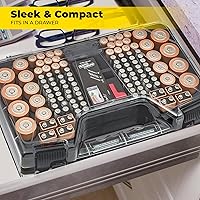
At roughly 13″ long and under 9″ tall, the case fits comfortably in standard kitchen or utility drawers and sits flat on most workshop shelves without dominating the space. Buyers with dedicated utility closets often report it fitting cleanly on a single shelf alongside tools and flashlights.
The 3.23″ depth means shallow junk drawers — particularly in older homes or compact apartments — may not close fully with the case inside. Several buyers had to relocate it to a cabinet or shelf after discovering their drawer was just slightly too shallow.
Emergency Preparedness Suitability
87%
Buyers who built out emergency kits specifically praised the combination of organized storage and the bundled tester as a pairing that makes pre-storm or pre-outage battery checks fast and reliable. Knowing every battery in the case has been verified adds a layer of readiness that loose storage cannot match.
The lack of any water resistance is a real gap for emergency kit use in areas prone to flooding or high humidity. A case stored in a basement kit could be vulnerable to moisture damage during the exact conditions it was meant to serve.
Tester Usability & Design
72%
28%
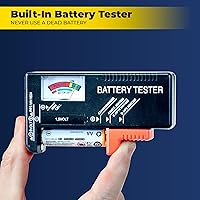
The tester is compact, attaches conveniently to the case, and works without any separate power source or complicated setup. For a bundled accessory, buyers generally found it more useful than expected — particularly for quickly sorting a drawer full of unknown-status batteries.
The indicator display is small and can be difficult to read in low-light conditions, which is ironic given that battery testing most often happens during outages or in dim storage areas. A backlit or higher-contrast display would meaningfully improve the experience.
Aesthetics & Design Finish
78%
22%
The charcoal colorway looks intentional rather than utilitarian, and several buyers mentioned it fits in with modern home organization setups without looking out of place. It reads more like a considered product than a purely functional storage bin.
The plastic surface shows fingerprints and light dust fairly visibly, particularly on the clear lid. Users who keep it on open display shelves found themselves wiping it down more often than expected to maintain a clean appearance.

Suitable for:

The Ontel Battery Daddy 180-Battery Storage Organizer with Tester is a strong fit for households that accumulate batteries faster than they can track them — families with young children, remote-heavy living rooms, and seasonal gadgets scattered across closets will immediately feel the organizational difference. Parents who have spent holiday mornings hunting for the right battery size while a child waits will find the sorted, visible layout a genuine relief. DIY enthusiasts and technicians who carry multiple battery types to job sites benefit from the sturdy handle and secure latches, which make transport practical rather than nerve-wracking. It also earns its place in emergency preparedness kits, where the bundled tester lets you verify battery status before a storm hits rather than discovering dead cells mid-outage. Anyone graduating from zip-lock bags, loose bins, or random kitchen drawers will find this storage and tester combo a meaningful step up that actually changes daily habits.
Not suitable for:

The Ontel Battery Daddy 180-Battery Storage Organizer with Tester is not the right choice for everyone, and it is worth being honest about where it falls short. Buyers who rely heavily on D batteries or coin cells — think households managing multiple smoke detectors, hearing aids, or key fobs — will find the eight D slots and twelve coin cell slots fill up quickly, forcing overflow storage elsewhere. The case is also not water resistant at all, which makes it a risky pick for basement emergency kits or garage shelves in humid climates where moisture could damage stored cells. Minimalists or single-person households that only use one or two battery types regularly will likely find the capacity overkill and the footprint larger than their needs justify — simpler, cheaper single-panel organizers would serve them better. The battery tester, while useful, is a basic pass/fail tool rather than a precision instrument, so buyers expecting charge-level readings or voltage data will be disappointed. Finally, if your primary storage space is a shallow junk drawer, measure carefully before buying, as the case depth can prevent drawers from closing fully.
Specifications

  • Brand & Model: Manufactured by Ontel Products Corp under the model designation BADACH-MC4, sold under the Battery Daddy product line.
  • Dimensions: The case measures 13.27″ long by 3.23″ wide by 8.86″ tall, keeping it slim enough for most standard drawers and shelves.
  • Weight: The empty case weighs 2.72 pounds (1.24 kg), which increases meaningfully once fully loaded with batteries.
  • Material: Constructed from hard plastic throughout, including the body, lid, and latch mechanisms, with no fabric or foam lining.
  • Color: Available in a charcoal colorway that suits both household and workshop environments without appearing overly utilitarian.
  • Total Capacity: Stores up to 180 batteries across six standard sizes when all compartments are filled to maximum.
  • AA Slots: Accommodates up to 76 AA batteries, making it the largest dedicated section in the case by slot count.
  • AAA Slots: Holds up to 72 AAA batteries, the second-largest allocation and well-suited for households with heavy small-device usage.
  • Specialty Slots: Provides 8 slots for 9V batteries, 10 for C batteries, 8 for D batteries, and 12 for coin cell batteries.
  • Compartment Design: Double-sided layout with two main compartments, keeping battery types separated to prevent contact and reduce passive energy drain.
  • Closure Type: Features a clear locking lid secured by dual latches that snap shut firmly to prevent accidental opening during transport.
  • Carrying Handle: Includes a built-in handle integrated into the case body, designed for single-hand carrying even when the case is fully loaded.
  • Tester Included: Ships with one battery tester compatible with both single-use alkaline and rechargeable battery types across all supported sizes.
  • Tester Function: The tester provides a basic pass/fail charge indicator via a visual display window; it does not measure precise voltage or percentage charge.
  • Water Resistance: Rated as not water resistant, meaning the case should not be stored in humid environments or locations prone to moisture exposure.
  • Lid Visibility: The lid is fully transparent, allowing complete visual inventory of stored batteries without opening or unlatching the case.
  • Item Count: Sold as a single unit containing the battery organizer case and one battery tester; batteries are not included.
  • First Available: This product was first listed for sale on January 29, 2025, making it a relatively recent addition to Ontel's product lineup.

Related Reviews
Xuerdon Battery Organizer Storage Case with Tester
86%
93%
Storage Capacity
89%
Battery Tester Effectiveness
85%
Build Quality and Durability
87%
Portability and Ease of Use
91%
Design and Organization
More
The Battery Organizer TBO2699 180-Battery Storage Case
78%
93%
Storage Capacity
78%
Build Quality
91%
Lid Design & Transparency
82%
Wall-Mount Usability
67%
Slot Fit & Battery Compatibility
More
Bee Neat Battery Organizer and Storage Case with Tester
83%
92%
Storage Capacity
88%
Ease of Use
85%
Design and Build Quality
90%
Battery Tester Functionality
76%
Compactness and Space Efficiency
More
RESGKZE XDCH0002 Battery Organizer
80%
93%
Storage Capacity
91%
Organization & Labeling
78%
Included Battery Tester
74%
Build Quality
67%
Lid & Closure Security
More
Dlyfull B4 Battery Tester
87%
88%
Ease of Use
92%
Accuracy
89%
Battery Compatibility
90%
Portability
85%
Build Quality
More
X-cosrack Universal Battery Tester
84%
91%
Ease of Use
88%
Battery Compatibility
92%
Display Clarity
89%
Portability
90%
Accuracy for Small Batteries
More
KKEANIC SL-049 Battery Tester
87%
91%
Ease of Use
94%
Compatibility with Battery Types
90%
Portability and Size
88%
Accuracy of Testing
74%
Display Quality
More
ZTS Mini Multi-Battery Load Tester
87%
94%
Accuracy
91%
Ease of Use
88%
Portability
93%
Test Speed
77%
Battery Compatibility
More
Opus C3400 Battery Charger Tester Analyzer
83%
91%
Charging Performance
88%
Display Quality
85%
Ease of Use
84%
Build Quality
90%
Battery Compatibility
More
Cq Acrylic Clear Makeup Storage Organizer
84%
88%
Storage Capacity
92%
Ease of Organization
75%
Durability
93%
Design Aesthetics
84%
Material Quality
More

FAQ

No batteries are included — the case ships with just the organizer and the battery tester. You load it with whatever batteries you already have or purchase separately.

The tester does not require its own battery to operate. You simply align the positive and negative ends of the battery you want to test against the tester's contacts, and a small indicator window shows whether the cell is still good or effectively dead. It is a pass/fail readout, not a percentage or voltage meter, so keep expectations realistic.

It depends on your drawer depth. The case is 3.23″ deep, which is thicker than many shallow junk drawers in older kitchens or compact apartments. Before buying, measure your drawer depth — if it is under 3.5″, you may need to store the case on a shelf or in a cabinet instead.

You can store any standard-sized rechargeable or lithium batteries alongside alkaline ones, as long as they fit the physical slot dimensions. The battery tester is also compatible with rechargeable cells, which is a handy bonus if you use NiMH or similar rechargeables.

Unfortunately, no. It has no water or moisture resistance rating whatsoever. If you plan to store it in a basement emergency kit or a humid garage, keep that in mind — prolonged moisture exposure could damage both the case and the stored batteries inside.

The latches feel solid when new and hold the lid shut securely enough for transport and storage. That said, heavy daily use does tend to soften the snap over several months — a few users report the latches becoming slightly looser with constant repeated opening. For occasional to moderate use, durability is generally not an issue.

That really depends on your household. Twelve coin cell slots cover most typical homes comfortably, but if you manage multiple key fobs, hearing aids, watches, and remotes, you could fill those slots faster than expected. Heavy coin cell users sometimes end up needing supplemental small storage alongside this case.

Yes, the dual latches hold reliably during transport. Several buyers specifically mentioned being able to carry the case upside down by the handle without it opening. That said, over time with heavy use, the latches do loosen slightly, so it is worth double-checking they are fully engaged before tossing it in a bag.

The slots are sized to physically fit specific battery types, so AA batteries will not accidentally end up in D slots — the dimensions do the organizing for you. There is no printed labeling on the slots themselves, but the size differentiation is intuitive enough that most users find it self-explanatory within the first use.

The practical difference is noticeable. Loose bins and bags allow batteries to touch each other, which can cause slow passive drain over time — especially problematic for batteries stored for emergencies. The separated slots in this case prevent contact, and the clear lid means you can see your inventory at a glance without digging. The bundled tester also adds a utility layer that a bin or bag simply cannot provide.