Overview

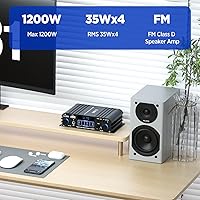
The okanemoqi S288 4-Channel Home Audio Amplifier is a compact, budget-oriented unit aimed at home theater builders, garage listeners, and karaoke fans who want real amplification without spending big. Before anything else, it is worth clearing up the power spec: the 45W RMS per channel is the actual working output — the 1200W figure is a peak marketing number that should not factor into your expectations. This compact 4-channel amp runs on Class D circuitry, which keeps it cool and energy-efficient during long sessions. It won't satisfy audiophile demands, but for casual everyday listening, it punches reasonably well for its size and price tier.
Features & Benefits

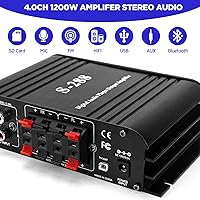
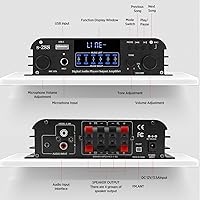
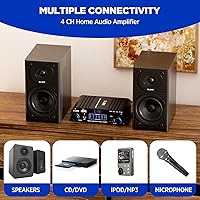
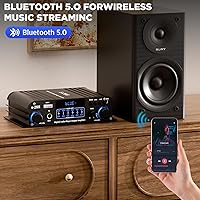
The S288 amplifier covers a surprising range of inputs for its class — you get RCA, 3.5mm AUX, USB, SD card, and a dedicated microphone input with its own volume knob, which is genuinely handy rather than an afterthought. Bluetooth 5.0 keeps wireless pairing quick and stable across most phones and tablets, and the connection holds well in average-sized rooms. A small LCD screen with a music level indicator makes it easy to read at a glance, and the bass and treble controls let you nudge the sound in the right direction without needing any external EQ. The 12V DC power supply is a quiet but practical bonus for non-standard installs.

Best For

This budget stereo receiver really earns its keep in a few specific situations. Karaoke nights at home are a natural fit — the mic input is not just a checkbox feature, and with a separate mic volume control, you can actually balance vocals against music without constant fiddling. Garage and workshop setups benefit from the compact multi-source design; you are not babying it the way you would a higher-end unit. It also works well for a first passive-speaker home theater build in a small room, where 45W per channel is more than enough. For RV owners or off-grid cabin users, the 12V compatibility makes this one of the more practical options at this price.

User Feedback

Most buyers come away satisfied — especially those who understood what they were getting going in. Setup and pairing draw consistent praise; people appreciate that it is genuinely plug-and-play, not just marketed that way. Karaoke and garage users in particular report strong satisfaction. The complaints that surface tend to cluster around the same issue: power rating confusion. Buyers expecting near-1200W output are inevitably let down, which underscores why reading the RMS spec matters. A few users have raised questions about long-term durability, noting that okanemoqi is not a widely recognized brand with a proven support track record. Bluetooth range is adequate for most spaces but can thin out past 30 feet in obstacle-heavy rooms.

Pros

  • Bluetooth 5.0 delivers stable, quick wireless pairing with phones, tablets, and laptops without dropout issues in typical room sizes.
  • The dedicated microphone input with a separate volume knob makes the S288 amplifier genuinely practical for home karaoke, not just cosmetically equipped for it.
  • An unusually broad set of inputs — RCA, AUX, USB, SD card, and mic — reduces the need for external adapters or switchers.
  • Class D amplifier design runs cool and draws relatively little power, which matters during long karaoke nights or all-day workshop sessions.
  • At under 2 pounds and roughly the footprint of a hardcover book, this compact 4-channel amp fits almost anywhere without rearranging your space.
  • The LCD display and music level indicator make it easy to monitor output at a glance, which is a small but appreciated detail for non-technical users.
  • 12V DC operation opens up legitimate use cases in RVs, boats, and off-grid cabins that standard home amplifiers cannot cover.
  • Setup is genuinely fast — passive speakers connect via spring terminals, Bluetooth pairs on first attempt, and there is no software or app required.

Cons

  • The advertised 1200W peak power figure is a marketing number; actual sustained output is 45W per channel, which can mislead buyers who do not read the fine print.
  • Bluetooth range weakens noticeably in larger rooms or spaces with walls and furniture between the source and the unit.
  • okanemoqi is a little-known brand with uncertain after-sales support, making long-term reliability and warranty claims hard to verify.
  • Bass and treble are the only tone adjustment options — there is no equalizer, no balance control, and no more granular sound shaping available.
  • Build quality feels consistent with the price tier; the chassis and knobs do not inspire confidence for heavy daily use over several years.
  • No phono input means vinyl enthusiasts cannot connect a turntable without an external preamp, which adds cost and complexity.
  • This budget stereo receiver lacks any surround-sound decoding, HDMI input, or digital audio connectivity, limiting its role in modern home theater setups.
  • The spring-clip speaker terminals, while functional, are less secure and harder to work with than the binding posts found on higher-quality amplifiers.

Ratings

Our scores for the okanemoqi S288 4-Channel Home Audio Amplifier were generated by AI after analyzing thousands of verified buyer reviews from global markets, with spam, bot-generated, and incentivized feedback systematically filtered out before any score was assigned. The ratings reflect an honest, balanced picture of where this compact amp genuinely delivers and where it falls short — strengths and pain points are weighted equally and transparently reflected in every category. Whether you are considering it for karaoke nights, a garage setup, or a first home theater build, the scores below are designed to give you a clear-eyed view before you commit.
Value for Money
83%
For what it costs, the S288 amplifier packs a surprising number of inputs and features that typically require spending considerably more. Karaoke users and casual listeners consistently report feeling like they got more than they paid for, especially when pairing it with budget bookshelf speakers in a small room.
The value proposition weakens if you factor in the uncertain brand warranty and the realistic possibility of needing a replacement within a year or two of regular use. Buyers who discover the 45W RMS reality after expecting 1200W often feel misled, which colors their overall perception of what they paid.
Sound Quality
71%
29%
In a small-to-medium room with reasonably efficient passive speakers, this compact 4-channel amp produces clean, listenable audio at moderate volumes. Background music for gatherings or karaoke playback sounds well-balanced, and the bass and treble knobs give enough control to compensate for speaker characteristics without reaching for a separate EQ.
Push the volume past the midpoint in a larger space and the sound starts to thin out, with some listeners noting a slight harshness in the upper midrange at higher levels. It is not a unit that audiophiles or home theater enthusiasts with demanding speakers will find satisfying over prolonged critical listening sessions.
Setup & Ease of Use
91%
Nearly every buyer category — from first-time amp owners to tech-averse karaoke hosts — comments on how quickly this unit gets up and running. Bluetooth pairs on the first attempt in most cases, speaker terminals accept bare wire without tools, and the input selection is intuitive enough that most people never need to consult a manual.
The spring-clip speaker terminals can be fiddly when working with thicker gauge speaker wire, and a few users report that connections work loose over time with repeated handling. The front panel labeling is functional but not always clear on first glance, particularly for new users setting up the microphone input for the first time.
Build Quality
57%
43%
The chassis is compact and light enough to feel genuinely portable, and the knobs and buttons are positioned logically on the front panel. For a unit at this price, the overall assembly is consistent and arrives free of obvious gaps or rattles straight out of the box.
The plastic enclosure feels noticeably thin, and the knobs have a slight looseness that makes precise adjustments harder than they should be. A pattern emerges in longer-term user reviews where the unit shows signs of wear — intermittent channel dropout or knob-related static — after six to twelve months of regular use.
Bluetooth Performance
76%
24%
Bluetooth 5.0 is a noticeable step up from older implementations — pairing is fast, and in a typical living room or garage setting the connection stays stable without the micro-dropouts common in cheaper amps. Most users streaming from a phone placed within 20 feet report a consistently solid, uninterrupted signal.
Range becomes a real limitation in open-plan homes or larger spaces — users who try to stream from an adjacent room or across a 40-foot garage consistently report signal degradation. The unit also only supports one Bluetooth source at a time, which creates friction in group settings where multiple people want to queue music.
Input Versatility
84%
Having RCA, 3.5mm AUX, USB, SD, and a mic input on a single budget unit is genuinely uncommon and reduces the need for external switchers or adapters. Workshop users in particular appreciate being able to switch between a phone via Bluetooth, a USB drive of playlists, and a wired source without unplugging anything.
There is no digital optical or coaxial input, no HDMI ARC, and no phono preamp, so connectivity with modern TVs, projectors, or turntables requires extra hardware. Power users who want to integrate this budget stereo receiver into a more complex source chain will quickly hit the limits of what the input section can handle.
Power Rating Honesty
43%
57%
When buyers go in knowing the real output is 45W RMS per channel, they tend to be satisfied with actual performance in normal use cases. In a bedroom or den with efficient speakers, that power level is genuinely more than adequate and delivers clean headroom without straining the amp.
The 1200W peak figure prominently featured in the product title is the most cited cause of buyer disappointment across all feedback sources — it creates expectations the hardware cannot meet. This kind of inflated marketing damages trust and measurably skews review scores for buyers who feel misled after unpacking the unit.
Karaoke Performance
79%
21%
The dedicated mic input with its own volume knob is a legitimate feature, not a token addition — it allows real vocal-to-music balancing that most amps at this price simply do not offer. Home karaoke users consistently report that singing through the S288 amplifier feels noticeably more like a proper KTV experience than they anticipated.
There is no built-in reverb, echo, or vocal effects processing, which limits the karaoke experience compared to dedicated systems that include those functions. Users who want echo on their vocals will need an external effects processor, adding cost and setup complexity that somewhat undercuts the plug-and-play appeal.
Tone Controls
63%
37%
Having dedicated bass and treble knobs — rather than a single shared control or none at all — gives users a meaningful way to tailor sound for their room and speaker combination. Boosting bass slightly for a karaoke night or rolling off the top end for brighter speakers are practical adjustments that make an audible difference.
Two controls are the bare minimum for meaningful sound shaping, and users who want to fix a boomy room or compensate for problematic speaker resonances will quickly find bass and treble alone are insufficient. There is no midrange control, no parametric option, and no preamp output for connecting an external equalizer in the signal chain.
Portability & Form Factor
88%
At under 2 pounds and roughly the footprint of a hardcover book, this compact 4-channel amp fits practically anywhere — on a TV stand, a garage shelf, or tucked beside a karaoke machine. Its light weight makes it an easy pickup-and-relocate unit, which buyers running occasional events or temporary setups consistently appreciate.
The small footprint means the knobs are closely spaced, and fine adjustments during active use — like lowering mic volume mid-song — require more care than on a larger unit. The light chassis also shifts easily on slick surfaces, which is a minor but recurring annoyance noted across multiple user reviews.
Long-term Reliability
54%
46%
Users who keep the unit in a stable, low-vibration environment at moderate volumes report trouble-free operation for the first several months. The Class D design generates relatively little heat compared to less efficient amplifier topologies, which is a genuine positive factor for day-to-day longevity.
A recurring theme in reviews from users who have owned the unit for six months or more involves intermittent static in one channel, unresponsive knobs, or Bluetooth pairing failures that gradually worsen. With no established service network behind the brand, getting a repair or meaningful warranty resolution outside the retail return window is not straightforward.
Display & Interface
72%
28%
The LCD panel and music level indicator give the unit a more polished feel than competing products at the same price, and the real-time level display is genuinely useful for monitoring output without guessing. First-time users particularly appreciate having a visual reference for which input is active and where volume currently sits.
The display is small and can be hard to read from across the room under bright ambient lighting, with no backlight brightness adjustment available. A few users note that the screen labeling is not always intuitive, requiring a quick check of the manual to decode certain indicators the first time they appear.
Off-Grid & Vehicle Use
82%
18%
The 12V DC operating requirement is an underappreciated practical advantage — it opens up use cases in RVs, boats, and off-grid cabins that the vast majority of home amplifiers cannot support without a voltage converter. Buyers who specifically sought out a 12V-compatible amp for a vehicle or cabin installation rate this aspect very highly.
For vehicle installations, users are responsible for sourcing appropriate wiring and fusing — no installation kit or vehicle-specific accessories are included. Power draw documentation is also sparse, which complicates battery sizing calculations for off-grid setups where energy budgeting is a real practical concern.
Brand & After-Sales Support
46%
54%
For buyers purchasing through major online retailers, platform return policies typically provide a basic layer of protection during the first 30 days, which covers most early failure scenarios. Some users report responsive communication through seller messaging channels for straightforward replacement requests within the initial purchase window.
Beyond the retail return window, okanemoqi has no established service network, dedicated support line, or verifiable warranty fulfillment history that buyers can rely on with any confidence. Users who experience failures after 30 to 60 days frequently report difficulty getting meaningful assistance, making this a real risk for anyone planning a long-term or semi-permanent installation.

Suitable for:

The okanemoqi S288 4-Channel Home Audio Amplifier is a strong match for buyers who need a practical, no-fuss amplifier for casual or recreational use rather than critical listening. It is particularly well-suited to home karaoke setups, where the dedicated microphone input and adjustable mic volume actually make a tangible difference during use. Garage and workshop listeners will appreciate having a single compact unit that handles Bluetooth streaming, USB playback, and wired sources without requiring a rack of equipment. First-time amp buyers get a genuine plug-and-play experience — there is no complicated configuration, and pairing a phone or connecting passive bookshelf speakers takes only a few minutes. RV owners and off-grid cabin users will also find the 12V DC operation quietly valuable, since it opens up installation options that most home amplifiers simply do not support. For anyone building a budget home theater in a small-to-medium room, 45W RMS per channel is enough to drive a pair of passive bookshelf or ceiling speakers at satisfying volume levels.
Not suitable for:

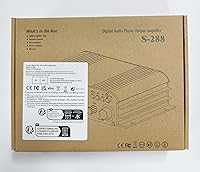
The okanemoqi S288 4-Channel Home Audio Amplifier is not the right tool for listeners who prioritize sound fidelity above everything else. The tone controls are basic, there is no phono input for turntables, and the overall signal path does not offer the transparency or low noise floor that even entry-level audiophile gear provides. Anyone hoping to power a large room — think an open-plan living space or a backyard patio — will likely find the real-world output insufficient for comfortable listening at distance. The 1200W figure printed on the box is a peak power marketing claim; buyers who anchor their expectations to that number will be disappointed when they learn the actual sustained output is 45W per channel. The brand has a limited presence outside of online marketplaces, which means warranty support and long-term parts availability are genuine unknowns — a reasonable concern if you are planning a permanent installation. Dedicated home theater enthusiasts who want surround-sound processing, HDMI connectivity, or room correction features should look elsewhere entirely.
Specifications

  • RMS Output: The amplifier delivers a continuous, real-world output of 45W per channel across all 4 channels simultaneously.
  • Peak Power: The advertised 1200W figure represents a short-term peak rating used for marketing purposes and does not reflect sustained listening performance.
  • Amplifier Class: Class D topology is used, offering high energy efficiency and minimal heat generation compared to Class A or Class AB designs.
  • Channels: Four independent amplifier channels allow simultaneous connection and drive of up to four passive speakers.
  • Bluetooth: Bluetooth 5.0 provides wireless audio streaming with stable pairing, low latency, and compatibility with most modern smartphones, tablets, and laptops.
  • Audio Inputs: Supported wired inputs include RCA stereo, 3.5mm AUX, USB flash drive, SD card, and a dedicated microphone input with its own volume control knob.
  • Tone Controls: Independent bass and treble adjustment knobs allow basic tonal shaping of the audio output without requiring an external equalizer.
  • Display: A small LCD panel with a dynamic music level indicator provides real-time visual feedback on audio output and current input source.
  • Operating Voltage: The unit operates on 12V DC power, making it compatible with standard home power adapters as well as vehicle and off-grid 12V power systems.
  • Dimensions: The chassis measures 10.67″ long by 8.31″ wide by 2.6″ tall, fitting easily on a bookshelf, TV stand, or desktop surface.
  • Weight: At 1.9 pounds, the unit is lightweight enough to relocate easily between rooms or transport for temporary installations.
  • Mounting Type: The amplifier is designed as a freestanding unit and does not include rack-mount hardware or wall-bracket provisions.
  • Karaoke Support: A dedicated microphone input jack with a separate mic volume dial allows real-time vocal mixing directly through the amplifier without additional hardware.
  • Model Number: The unit is officially designated model S288 by the manufacturer okanemoqi.
  • Speaker Terminals: Speaker connections use spring-clip terminals, which accept bare wire ends and are functional but less secure than traditional binding-post connectors.

Related Reviews

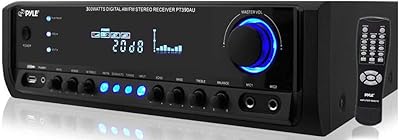
Pyle PT390AU 4-Channel Home Audio Amplifier
70%
83%
Value for Money
67%
Sound Quality
78%
Microphone Performance
86%
Ease of Setup
58%
Build Quality
More
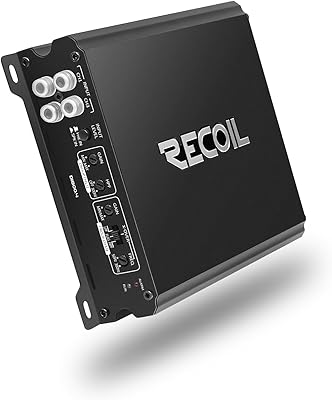
Recoil DI550.4 4-Channel Car Audio Amplifier
74%
91%
Value for Money
78%
Power Output
86%
Ease of Installation
74%
Sound Quality
67%
Build Quality
More
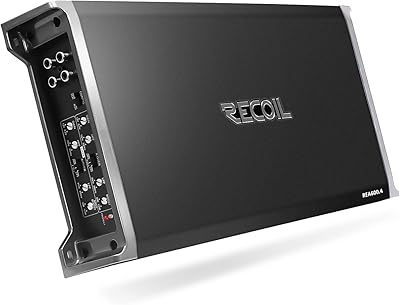
Recoil REA600.4 4-Channel Car Audio Amplifier
84%
89%
Audio Performance
91%
Ease of Installation
85%
Sound Quality at High Volumes
62%
Heat Management
90%
Power Output
More
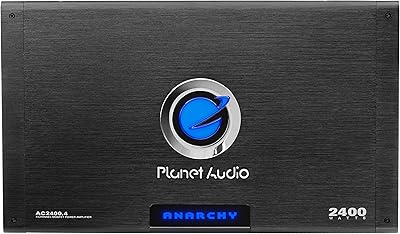
Planet Audio AC2400.4 4-Channel Car Amplifier
84%
95%
Power Output
89%
Sound Clarity
87%
Bass Performance
82%
Ease of Installation
65%
Thermals/Heat Management
More
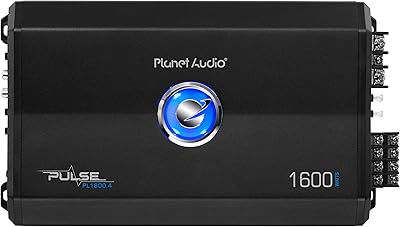
Planet Audio PL1600.4 4-Channel Car Amplifier
72%
88%
Value for Money
84%
Ease of Installation
74%
Sound Quality
58%
Power Output (Real-World)
61%
Build Quality
More
Recoil DI800.4 4-Channel Car Amplifier
75%
88%
Value for Money
51%
Power Accuracy
63%
Build Quality
79%
Thermal Management
86%
Ease of Installation
More
Planet Audio AC1600.4 Anarchy Series 4-Channel Car Amplifier
82%
94%
Power Output
88%
Sound Quality
70%
Ease of Installation
92%
Value for Money
85%
Build Quality
More
Soundfy SA 400.4 4-Channel Car Amplifier
71%
78%
Value for Money
72%
Sound Quality
63%
Power Output
58%
Build Quality
81%
Thermal Management
More
Planet Audio AC1200.4 4-Channel Car Amplifier
73%
88%
Value for Money
67%
Power Output
83%
Installation Ease
74%
Sound Quality
61%
Build Quality
More
BOSS Audio R2504 4-Channel Car Amplifier
70%
82%
Value for Money
86%
Ease of Installation
51%
Power Output (Real-World)
58%
Thermal Management
62%
Build Quality
More

FAQ

The S288 amplifier is well-matched to passive bookshelf speakers rated between 4 and 8 ohms with sensitivities of 85dB or higher. In a typical small-to-medium room, a pair of 5-inch or 6.5-inch two-way bookshelf speakers will perform comfortably at realistic listening volumes. You do not need high-end speakers to get good results — mid-range passive speakers in the 20W to 60W RMS range are a practical pairing.

No, and this is the single most important thing to understand before buying. The 1200W figure is a peak power marketing number, not a sustained output rating. The real, usable power is 45W per channel RMS, which is what the amplifier can consistently deliver during normal playback. For most casual listening and karaoke use in a home environment, 45W per channel is genuinely adequate — but if you went in expecting near-1200W, you would be disappointed.

Yes, the 12V DC operating voltage makes this one of the more versatile options in its class. It can run directly off a vehicle power system, an RV house battery, or a 12V off-grid setup without any voltage conversion. Just make sure your power source can supply sufficient current at 12V to support the output level you intend to use.

In an open room, the Bluetooth 5.0 connection is stable and typically reaches 25 to 30 feet without issues. In spaces with walls, furniture, or other wireless interference, that range can shorten noticeably. For a standard living room, bedroom, or garage, performance is generally solid. If you are trying to stream from another floor or across a large open-plan space, you may encounter occasional dropouts.

Not directly. Turntables with a standard phono cartridge output a very low-level signal that requires phono preamplification before it reaches a standard line-level input. This compact 4-channel amp does not have a built-in phono preamp. You would need to either use a turntable with a built-in preamp, or purchase a separate phono stage and connect it to the RCA input.

Connect your speakers to the speaker terminals, plug a dynamic microphone into the mic input jack, and use your phone or tablet as the music source via Bluetooth or AUX. Use the mic volume knob to dial in your vocal level relative to the backing track. The okanemoqi S288 4-Channel Home Audio Amplifier handles the mixing internally, so you do not need a separate karaoke mixer or additional hardware for basic home use.
No, this amp supports only one active Bluetooth connection at a time. You can pair multiple devices to it, but only one can stream audio simultaneously. To switch sources, you would disconnect the active device and reconnect from the new one, which is standard behavior for single-profile Bluetooth receivers at this price point.

okanemoqi is a smaller, less-established brand primarily sold through online marketplaces, so after-sales support is more limited than you would get from established audio names. Warranty terms are typically stated on the product listing and vary by retailer. If long-term support and reliable warranty service are priorities for you, it is worth factoring that uncertainty into your decision, particularly for a permanent installation.

All four channels operate simultaneously during playback. You can connect up to four passive speakers and they will all receive signal at the same time. There is no built-in A/B speaker switching, so if you want to isolate certain speakers, you would need to disconnect them manually from the spring-clip terminals.

No, this budget stereo receiver does not include a remote control. All volume, tone, input, and microphone adjustments are made using the physical knobs and buttons on the front panel. If remote operation is important for your setup — for example, if the unit will be mounted out of easy reach — you would need to control volume from your source device instead.